11 April 2011

Get Ready For Biometric PAN Cards

New Delhi, Apr 11 : The Indian government has decided to issue biometric PAN cards to taxpayers across the country to weed out the problem of duplicate and fake ones.

The decision was taken recently by the Finance Ministry and it comes in the wake of a Comptroller and Auditor General (CAG) report that asked the Income Tax department to ensure that a single tax payer is not issued multiple cards.

The proposed new biometric Permanent Account Number (PAN) cards would bear the I-T assessee's fingerprints (two from each hand) and the face.

Govt to issue biometric PAN cards

There could be an option to existing PAN card holders to opt for the biometric cards, but it may not be mandatory, a senior official in the I-T department said.

The Finance Ministry and the I-T department had put on hold the biometric PAN card project last year to avoid duplication with the UID numbers to be issued by Nandan Nilekani's Unique Identity Authority of India (UIDAI).

"The bioemetric PAN card project is on again. The step will be very important when it comes to stopping the misuse of this vital identity document," top sources in the Finance Ministry said.

The biometric PAN card was proposed by the then Finance Minister P Chidambaram in 2006 to counter the problem of duplicate PAN cards which were uncovered during I-T searches and raids by police and other enforcement agencies.

The CAG report for 2010-11 on direct taxes, tabled in Parliament recently, has revealed that 958 lakh (95.8 million) PANs were issued up to March 2010 but I-T returns filed in the last fiscal were only 340.9 lakh (34.09 million).

The gap between PAN holders and the number of returns filed was 617.1 lakh (61.7 million), the CAG has said.

Suggesting the Central Board of Direct Taxes (CBDT) to identify the reasons for the gap and use the information to enhance the assessee base, the CAG has said it may be due to issuance of multiple PAN cards and death of some PAN card holders.

"The (I-T) department needs to put in place appropriate controls to weed out the duplicate PANs and also update the position in respect of deceased assessees," the report has said.

The plan has been set rolling for issuance of biometric PAN cards, according to sources. It is expected that the first such cards could be issued by late this year, they said.

While PAN is a 10-digit alphanumeric number allotted by the I-T department to taxpayers, biometrics uses biological method to identify physical features of an individual.

Rebecca Black 'Fake' Article is Itself A Fake

Where will it end? 'Fake' Rebecca Black story a hoax

By Andrew Ramadge

Story Rebecca Black

Rebecca Black's Friday is not a fake. At least, we don't think so. Unless this story is a fake... but it's not. Picture: YouTube

HOW meta can you get?

A news article claiming that Rebecca Black's song Friday is a "fake" is in fact itself fake.

The article, which did the rounds on Twitter today, looked as if it had been published by stuff.co.nz.

It claimed Rebecca Black was actually a fictional character from an upcoming movie called The Music Factory, and was played by an actress named Jessica Jones.

"Teen music sensation Rebecca Black and her internet hit Friday are actually a viral marketing campaign for a new movie," the bogus story read.

"The Music Factory, directed by Home Alone's Chris Columbus, is about a secret facility where cyborgs resembling young teenagers are created and turned into pop stars."

Stuff.co.nz group online editor Sinead Boucher this afternoon confirmed that the story was not published by the Fairfax Digital site.

"No this is not a real Stuff story and it never appeared on the site," she told news.com.au.

Some web-savvy readers began having suspicions earlier in the day.

Even though the article used the same layout and graphics as stuff.co.nz, it was not hosted on the site. Searches of the real stuff.co.nz site also failed to return any results for the story.

"It is a hoax, she hasn't been exposed as a fake," Ms Boucher said.

"So, I guess the bad news is that Rebecca Black is probably for real!"

Source: news.com.au

300 Years On, Puzzle Solved

By Marlowe Hood

Blindfold

Could a blind person recognise familiar objects by sight if their vision was restored? Picture: Getty

  • Philosophical question 300 years old 
  • Neuroscience has finally answered it 

Paris, Apr 11 : RESEARCHERS say they have solved a conundrum about human perception that has stumped philosophers and scientists alike for three centuries.

Irish politician William Molyneux first posed the question in a letter to the great British thinker John Locke written 323 years ago.

Imagine, Molyneux wrote, that a man blind from birth who has learned to identify objects — a sphere and a cube, for example - only through his sense of touch is suddenly able to see.

The puzzle, he continued, is: "Whether he Could, by his Sight, and before he touch them, know which is the Globe and which the Cube?"

For philosophers of the time, answering "Molyneux's question", as it became known, would resolve a fundamental uncertainty about the human mind.

Empiricists believed that we are born blank slates, and become the sum total of our accumulated experience.

So-called "nativists" countered that our minds are, from the outset, pre-stocked with ideas waiting to be activated by sight, sound and touch.

If a blind man who miraculously recovered his sight could instantly distinguish the cube from the globe it would mean the knowledge was somehow innate, they argued.

More recently, this "nurture vs. nature" debate has found its counterpart in modern neuroscience.

"The beauty of Molyneux's question is that it also relates to how representations are formed in the brain," said Pawan Sinha, a professor at MIT in Boston and the main architect of the study.

"Do the different modalities, or senses, build up a common representation, or are these independent representations that one cannot access even though the other modality has built it?" he asked.

Recent studies have suggested that the mental images we accumulate through sight and touch do, in fact, form a common pool of impressions that can be triggered and retrieved by one sense or the other.

But until now, no one has been able to design a definitive experiment.

The problem was finding subjects. They would have to have been blind at birth and then have had their sight restored, but not until they were old enough to reliably participate in tests.

Most forms of curable congenital blindness, however, are detected and cured in infancy, so such individuals are extremely rare.

More precisely, they are rare in rich countries. So in 2003, Prof Sinha set up a program in India in cooperation with the Shroff Charity Eye Hospital in New Delhi.

Among the many patients he treated, he found five — four boys and one girl, aged eight to 17 — who met the criteria for surgery that would almost instantly take them from total blindness to fully seeing.

Once bandages were removed, researchers had to first be sure that the volunteers could see well.

Using objects that looked like Lego building blocks, they tested the ability to discriminate visually between similar shapes. The subjects scored nearly 100 per cent.

They scored nearly as well when it came to telling the difference by touch alone.

For the critical test, however, in which the children first felt an object and then tried to distinguish visually between that same object and a similar one, the results were barely better than if they had guessed.

"They couldn't form the connection," said Yuri Ostrovsky, also a researcher at MIT and a co-author of the study.

"The conclusion is that there does not seem to be any cross-modal" - that is, from one sense to the other - "representation available to perform the task," he said.

The answer to Molyneux's question, then, appears to be "no" - the data blind people gather tactically that allows them to identify a cup and a vase, and to tell them apart, is not accessible through vision.

At least not at first.

"From a neuroscientific point of view, the most interesting finding is the rapidity with which this inability was compensated," said Richard Held, an emeritus professor at MIT and lead author of the study.

"Within about a week, it's done - and that is very fast. We were surprised," he said.

The overall results suggest that the human brain is more "plastic", or malleable, longer into childhood that previously thought, the researchers said.

"This challenges the dogma of 'critical periods', the idea that if a child has been deprived of vision for the first three or four years of life, he or she will be unable to acquire any visual proficiency," Prof Sinha said.

Source: AFP

Jamaican Women Risk Everything To Make Their Skin Whiter

Skin bleaching a growing problem in Jamaica slums

Mikeisha Simpson AP – In this photo taken Jan. 14, 2011, Mikeisha Simpson poses for a portrait in Kingston, Jamaica. Simpson, …

By DAVID McFADDEN

KINGSTON, Jamaica – Mikeisha Simpson covers her body in greasy white cream and bundles up in a track suit to avoid the fierce sun of her native Jamaica, but she's not worried about skin cancer.

The 23-year-old resident of a Kingston ghetto hopes to transform her dark complexion to a cafe-au-lait-color common among Jamaica's elite and favored by many men in her neighborhood. She believes a fairer skin could be her ticket to a better life. So she spends her meager savings on cheap black-market concoctions that promise to lighten her pigment.

Simpson and her friends ultimately shrug off public health campaigns and reggae hits blasting the reckless practice.

"I hear the people that say bleaching is bad, but I'll still do it. I won't stop 'cause I like it and I know how to do it safe," said Simpson, her young daughter bouncing on her hip.

People around the world often try to alter their skin color, using tanning salons or dyes to darken it or other chemicals to lighten it. In the gritty slums of Jamaica, doctors say the skin lightening phenomenon has reached dangerous proportions.

"I know of one woman who started to bleach her baby. She got very annoyed with me when I told her to stop immediately, and she left my office. I often wonder what became of that baby," said Neil Persadsingh, a leading Jamaican dermatologist.

Most Jamaican bleachers use over-the-counter creams, many of them knockoffs imported from West Africa. Long-term use of one of the ingredients, hydroquinone, has long been linked to a disfiguring condition called ochronosis that causes a splotchy darkening of the skin. Doctors say abuse of bleaching lotions has also left a web of stretch marks across some Jamaicans' faces.

In Japan, the European Union, and Australia, hydroquinone has been removed from over-the-counter skin products and substituted with other chemicals due to concerns about health risks. In the U.S., over-the-counter creams containing up to 2 percent hydroquinone are recognized as safe and effective by the U.S. Food and Drug Administration. A proposed ban by the FDA in 2006 fizzled.

Lightening creams are not effectively regulated in Jamaica, where even roadside vendors sell tubes and plastic bags of powders and ointments from cardboard boxes stacked along sidewalks in market districts.

"Many of the tubes are unlabeled as to their actual ingredients," said Dr. Richard Desnoes, president of the Dermatology Association of Jamaica.

Hardcore bleachers use illegal ointments smuggled into the Caribbean country that contain toxins like mercury, a metal that blocks production of melanin, which give skin its color, but can also be toxic.

Some impoverished people resort to homemade mixtures of toothpaste or curry powder, which can stain skin with a yellowish tint.

The Jamaican Ministry of Health does not have data on damage caused by skin-bleaching agents, though dermatologists and other health officials say they have been seeing more cases.

Eva Lewis-Fuller, the ministry's director of health promotion and protection, is redoubling education programs to combat bleaching in this predominantly black island of 2.8 million people, where images of fair-skinned people predominate in commercials for high-end products and in the social pages of newspapers.

"Bleaching has gotten far worse and widespread in recent years," she said. "(Bleachers) want to be accepted within their circle of society. They want to be attractive to the opposite sex. They want career opportunities. But we are saying there are side effects and risks. It can disfigure your face."

Health officials are running warnings on local radio stations, putting up posters in schools, holding talks and handing out literature about the dangers. But a similar anti-bleaching campaign in 2007 called "Don't Kill the Skin" did nothing to slow the craze.

The bleaching trend is sparking a growing public debate. Even dancehall reggae hits celebrate the practice, or condemn it.

The most public proponent of bleaching is singing star Vybz Kartel, whose own complexion has dramatically lightened in recent years. His 'Look Pon Me' contains the lines: "Di girl dem love off mi brown cute face, di girl dem love off mi bleach-out face."

Kartel, whose real name is Adijah Palmer, insists that skin bleaching is simply a personal choice like tattooing.

Christopher A.D. Charles, an assistant professor at Monroe College in New York City who has studied the psychology of bleaching, said many young Jamaicans perceive it "as a modern thing, like Botox, to fashion their own body in a unique way."

Others, however, say it raises awkward questions about identity and race.

"If we really want to control the spread of the skin-bleaching virus, we first have to admit that there's an epidemic of color prejudice in our society," said Carolyn Cooper, a professor of literary and cultural studies at the University of the West Indies, writing in The Jamaica Gleaner newspaper.

Felicia James, a 20-year-old resident of the Matthews Lane slum, said skin bleaching just makes her feel special, like she's walking around in a spotlight. She was taught to bleach by her older sister and her friends.

"It's just the fashionable thing to do. After I bleach, I'm cris," she said, using a Jamaican term for cool. "Plus, a lot of the boys are doing it now, too."

Source: Associated Press

How To Brew Your Own Beer In a WEEK

By Steven Callas
It is said in the Old Testament that the earth was created in seven days.

That’s a pretty awesome thing to accomplish in a week, regardless of whether or not you believe it, right?

It’s not every day that someone wakes up on Monday and says, “man I’m bored, I think I’m going to create me a planet by Sunday.”

Well a company out of New Zealand called
WilliamsWarn is allowing you to accomplish something even more awesome than planetogenesis (made up word, still sounds cool), all in the same amount of time: brewing your own beer.

I can feel your heart racing and I can see that huge grin on your face already.

The WilliamsWarn Personal Brewery is a waist-high device on wheels that can replace your water cooler’s footprint if you so choose.

Which you should, because who wouldn’t want a cold, delicious, frothy brew that will spark conversations that are infinitely more awesome and interesting than those sparked by a paper cup of water?

    The WialliamsWarn Personal Brewery will run you 5,660 New Zealand Dollars (a little over $4,400 USD) from their website and ingredients are priced separately, but at $40 USD for a Blonde Ale pack that will make 23 liters of beer and the fact that your home or office will have its own personal brewery makes it so well worth the price!

    And if that isn’t convincing enough, then check out the video below as it features the three things required to sell you on luxury beer: a suave narrator with a New Zealand accent, a man staring intently at

    The WilliamsWarn Personal Brewery from WilliamsWarn on Vimeo.

    Why More And More Women Are Turning To Internet Porn

    This summary is not available. Please click here to view the post.

    Now THAT is How To Take A Penalty

    Finnish Kid Does Gnarly Backflip After Kicking Penalty Shot

    Besides Landon Donovan's game-winning goal during the World Cup this past summer, I've never creamed my sheets over a soccer clip.

    And, seeing that the next World Cup is three years away, that's not going to change anytime soon.

    However, Finnish U-16 player Joonas Jokinen really knows how to jazz up a penalty kick; check out how he worked some acrobatics into this PK against Swiss club FC Baar.

    Understandably, the crowd goes wild after his back-flip follow-through. Well played, sir.

    Source: brobible.com

    Is Twitter Just Full Of Journalists Following Other Journalists?

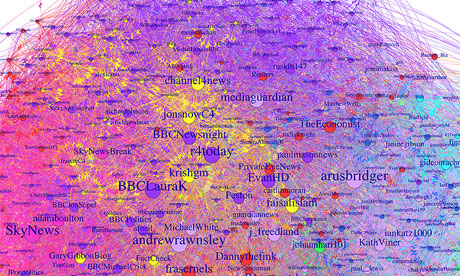
    How much do journalists just follow other journalists on Twitter? This visualisation suggests one answer

    Download the PDF

    By Simon Rogers

    Journalists follow journalists on Twitter 

    Journalists following other journalists on Twitter. Click image to get graphic or Download the PDF

    Last week we looked at how UK media groups and newspapers use Twitter - the subjects they discuss and the amount they Tweet.

    The brilliant Tony Hirst on his blog Ouseful has taken that one step further - using the Tweetminster API to get lists of UK political and current affairs journalists and find out who they follow on Twitter.

    Then he used a really powerful - and free - graphic design software called Gephi to visualise how they link together. What it shows is that journalists follow other journalists, mostly from their own organisation. It shows, says Tony:

    Folk within individual media groups tend to follow each other more intensely than they do people from other groups, but that said, inter-group following is still high. The major players across the media tweeps as a whole seem to be @arusbridger, @r4today, @skynews, @paulwaugh and @BBCLauraK

    You can click on the image above to see it - although this PDF file is easier to read. The colours represent either the media group the reporters are tweeting from or the Tweetminster list they're on.

    What can you do with the data?

    Download the data

    DATAFILE: download the Gephi data (ZIP)