28 August 2015

Top Court Stays High Court Order for CBI Probe Against Arunachal Pradesh Chief Minister

Top Court Stays High Court Order for CBI Probe Against Arunachal Pradesh Chief Minister
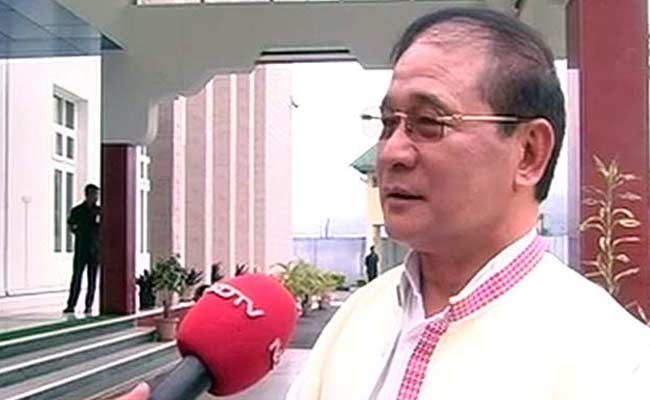
Arunachal Pradesh Chief Minister Nabam Tuki.
New Delhi, Aug 28 :  In a relief to Arunachal Pradesh Chief Minister Nabam Tuki, the Supreme Court today stayed the Gauhati High Court order for a CBI probe into corruption allegations related to his tenure as Public Works Department Minister in 2006.

A three-judge bench headed by Chief Justice H L Dattu also issued notice to the CBI and others on the chief minister's plea against the August 21 order of the high court.

The bench, also comprising justices V Gopala Gowda and Amitava Roy, granted the relief after senior advocate Harish Salve raised the matter.

Mr Tuki is alleged to have influenced the Arunachal Pradesh government to give some contractual works to his relatives as PWD minister in 2006.

"Majority of the said contracts were of Kendriya Vidyalayas of Government of India at Shillong, Kolkata and Rohtak, Haryana and another one was House Keeping in newly constructed Arunachal House in Delhi and two other small contracts in the state capital of Arunachal Pradesh," the petition said while listing out the allegations against Mr Tuki.

The CM has alleged that high court acted in a "hot and haste manner" and got all the PILs transferred from Itanagar bench to principal bench at Guwahati.

"The present SLP raises important questions as to whether the high court without hearing the parties should have passed an order ordering a CBI enquiry into various ten-year-old contracts, which have already been completed," the petition said.

Earlier on August 21, the high court had ordered CBI to register a case in this matter after it found that Mr Tuki had abused his official position as a minister in awarding contracts to his wife, sister-in- law, brother and other relatives without calling tenders years back.

It had directed the probe agency to conduct a probe against Mr Tuki, besides Kendriya Vidyalay Sangathan, New Delhi, and the Director of Sports Council, Arunachal Pradesh, in this regard.

The high court had said that an FIR should be lodged and the final report submitted before the special court at Guwahati.

Naga Hoho Firm On Integration Demand

Kohima, Aug 28 : The Naga Hoho has stood firm on its demand for integration of all Naga inhabited areas."We have told the Centre's interlocutor, RN Ravi, that integration is non-negotiable.

We won't just accept social or cultural integration," said Naga Hoho president P Chuba Ozukum.On Wednesday, a Naga Hoho team met RN Ravi, Centre's interlocutor to the Naga peace talks, at a hotel upon the latter's arrival at Kohima on a three-day visit. He was here to hold consultations with Naga NGOs and state legislators.

The Naga Hoho president maintained that even the Nagaland assembly had passed the resolution on integration five times.Ravi has assured the Hoho team that Centre will not rest with a 'piecemeal solution' but will work towards bringing in a 'comprehensive solution' to the Indo-Naga political issue.It may be mentioned here that on August 3 a framework agreement was signed between NSCN(IM) and the Centre.Ozukum said Ravi had narrated to the Hoho members the salient features of the framework, which had been kept undisclosed to the public. Ravi also told the team that the Centre would not make the same mistake as it did in the past. The interlocutor is learnt to have told the Naga group that the final agreement will address the interests of all groups concerned.

Naga Students' Federation (NSF) president Subenthung Kithan said on Wednesday, meeting with Ravi was encouraging, positive and serious on the Naga issue. He said Ravi had assured the team of working sincerely to usher in solution at the earliest.

Meanwhile, Ravi called on Nagaland governor PB Acharya at Raj Bhavan, Kohima, late on Wednesday. A late night release from Raj Bhavan said Acharya had told Ravi that the state had requested the Centre to hold talks with other Naga political groups with whom the Centre had entered into the peace deal.

Acharya maintained that it was necessary to incorporate the view of the other groups in the framework agreement. He said talks should be inclusive involving all groups. He had spoken to home minister Rajnath Singh even before the peace pact was signed with the NSCN (IM), he added and expressed satisfaction that both the Union home minister and interlocutor had been meeting all groups, including civil societies, NGOs, mothers' association and activists.
27 August 2015

Several Houses Swept Away in Mudslide in the Mizoram Town of Phullen

Consistent rainfall over the past few weeks have caused landslides throughout Mizoram

Aizawl, Aug 27 : At least three houses have been swept away by a mudslide and several others vacated in a north-eastern Mizoram town, an official said Wednesday, the latest in several weather-related incidents that have damaged property and caused hardship in the remote state over the past one week.

Block Development Officer Zorammuana Khiangte said about 50 feet of the town’s main road has also sunk almost a metre and cut off Phullen from the rest of the state following heavy rains over the past two or three days. Fortunately, no casualties have been reported in the town, about 120 kms from state capital Aizawl.

Consistent rainfall over the past few weeks have caused landslides throughout the state, temporarily blocking roads and highways and occassionally leading to mudslides that have buried residences.

A few casualties have been reported, including a driver in his 20s who later died in a hospital after the vehicle he was driving was buried by a landslide near Sailam village, about 75 kms south of Aizawl, this past weekend.

In eastern Mizoram, a Bailey bridge between Khawzawl town and Neihdawn village was damaged by strong currents of the Tuimuk stream on Monday night, cutting off several villages in the vicinity.

Manipur Govt, ILP Activists Ink Agreement

Imphal, Aug 26 : An agreement has been signed between the Government of Manipur and Joint Committee on Inner Line Permit System (JCILPS) which was spearheading a movement demanding implementation of inner line permit system in Manipur, Chief Minister Okram Ibobi Singh said.

The Chief Minister said the agreement with JCILPS came about after four rounds of talks. The government will introduce Bills related to protection of the people of Manipur soon in the state Assembly, as demanded by the JCILPS. He also informed that the state cabinet would soon forward a proposal to convene the Assembly to the Governor.

State Chief Secretary PC Lawmkunga signed the agreement on behalf of the government, while Khomdram Ratan, BK Moirangcha, Arjun Tenheiba, Ksh Somorendro, Haopu Kom, Md Kheiruddin Shah Moijingmayum, Lourembam Nganbi and Oinam Nandababu signed on behalf of the JCILPS.

The Chief Minister told newspersons that the agreement was signed last night and included seven points with a preamble. The agreement said the Government of Manipur and leaders of the JCILPS had agreed on the actions of the government to enact three laws, for which Bills shall be passed in the Manipur Legislative Assembly.

The Bills are Protection of Manipur Peoples Bill, 2015, Manipur Land Revenue and Land Reforms (Seventh Amendment) Bill, 2015 and Manipur Shop and Establishments (Second Amendment) Bill, 2015.

The government also agreed to incorporate all the five-point demands of the JCILPS placed before it, while passing the Bills, Singh said. The government should associate the experts selected by JCILPS while framing the rules of the Protection of Manipur Peoples Bill, 2015, according to the agreement.

The government should also constitute a Manipur State Population Commission to assess the problems and issues of demographic imbalance and other related matters so as to take up measures towards social harmony and peaceful development, it said.

A white paper on population influx should also be brought out by the state government within one year, it added.

China shadow looms over Naga Accord

By G PARTHATHASARATHY

Not just a paper threat China has known to foment insurgencies in the North East NSCN (Khaplang), which is opposed to the deal and operates out of Myanmar, is likely to be encouraged by China

Successful implementation of a Peace Accord would also benefit the neighbouring States of Manipur, Arunachal Pradesh and Nagaland, where there are Naga populations, by ending decades of insurgency and ethnic conflict. In expressing optimism about success of this Framework Accord, reference is often made to the Rajiv Gandhi-Laldenga Accord of June 30, 1986, which has brought about lasting peace, harmony and development in Mizoram. This would, however, be a simplistic assumption.
The Mizoram Accord was inked by the Mizo National Front led by Laldenga, who was the sole and undisputed leader of the Mizo uprising, in a State which is not afflicted with tribal differences and rivalries. Moreover, the Accord was signed when there were no foreign patrons or havens left for the Mizos.
The 8-point Accord clearly spelt out the extent of autonomy the Mizos would enjoy, the process for laying down arms and ammunition and measures for resettlement of underground personnel. This was combined with the conferment of full Statehood and establishment of a separate High Court for Mizoram.
China angle
While the details of the recent Nagaland “framework” have not been made public, it is acknowledged that many complex issues remain to be sorted out. While the demand for a “Greater Nagaland” embracing the territories of Nagaland and Naga dominated areas in Manipur, Assam and Arunachal Pradesh appears to have been given up by the NSCN (IM), the issue of Regional Councils or other such institutions for Nagas in the three neighbouring States will remain contentious, especially given the none-too-happy experiences following the establishment of a Bodoland Council in Assam.
Moreover, Naga society is afflicted by tribal rivalries and by the presence of large number of armed groups, each with its own sense of self-importance. Finally, the most powerful insurgent group after the NSCN (IM), the NSCN (Khaplang), which broke along standing cease fire agreement with New Delhi on March 7 and killed 18 Indian soldiers on July 4,remains implacably opposed to the August 3 Accord.
The NSCN (K) is predominantly Myanmar based and its cadres are trained and operate from areas in the neighbouring Sagaing Division and the Kachin State. These areas are along the borders with China, where the Myanmar Government has scant control and China now freely consorts with Indian separatist outfits.
New Delhi has to bear in mind and react imaginatively to the reality that Myanmar now faces serious problems on its borders with China’s Yunnan Province in the Shan and Kachin States. The Chinese have a cosy relationship with the Kachin Independence Army, which exercises full control of areas in Kachin State bordering China.
Ever since they were ousted by Sheikh Hasina from Bangladesh scores of members of north eastern separatist groups including the NSCN (K), ULFA, the Peoples’ Liberation of Army of Manipur and the National Democratic Front of Bodoland have taken refuge along the Myanmar-China border, in Kachin State.
These groups have now come under the umbrella of an NSCN (K) led and quite evidently Chinese backed grouping, calling itself the “United National Front of West Southeast Asia”.
As its name suggests, the grouping is exclusively India centric. We are evidently seeing a return to Chinese policies of the Maoist era, when China backed and armed separatist groups along our borders with Burma and the then East Pakistan.
Importance of Myanmar
Given the policy of NSCN (K) to seek a peace accord for its people and desist from violence within Myanmar, it is unlikely that Myanmar will be in a position to respond positively to any request for the extradition of the NSCN (K) leadership. What can at best be achieved is obtaining Myanmar pressure on the Khaplang leadership to get the NSCN (K) to join the Nagaland peace process and desist from violence. The Home Ministry and needs a word of caution on this score. They should curb the propensity to seek media publicity and conduct all moves involving Myanmar, maintaining strict secrecy.
Apart from the inability of the Myanmar Government to exercise control over areas of Kachin State bordering China, where Indian insurgent groups are based and are strengthening links with China, Myanmar itself seems headed for political uncertainty, as the country heads toward elections for a new Parliament and President on November 8. The two main Parties are the National League for Democracy led by Aung San Suu Kyi (who is still ineligible to be elected as President by the Legislature) and the army backed Union Solidarity and Development Party (USDP), led by the Parliament Speaker and former Armed Forces Chief General (Thura) Shwe Mann.
The army establishment, in which former military ruler Senior General Than Shwe wields considerable influence, is still averse to Aung San Suu Kyi, or her Party assuming, or influencing the Presidency.
In these circumstances, both Shwe Mann, who realistically realised that his Party the military backed USDP would receive a drubbing in the elections and Suu Kyi who needed Army support to become eligible for office, appeared to be moving towards a deal, in which Su Kyi’s NLD would back a Shwe Mann bid for President, after the elections. Sensing this, President Thein Sein, with the backing of the current armed forces Chief Senior General Min Aung Hlaing and quite evidently the former Junta Leader Senior General Than Shwe, acted decisively to marginalise Shwe Mann. While positioning himself for re-election, President Thein Sein removed Shwe Mann for the post of the Party Chief of the USDP and himself took charge of the Party. Troops of Myanmar Army positioned themselves around the offices of the USDP and the residence of Shwe Mann. The die was cast and the message sent that while Suu Kyi would enjoy respect as an elected leader, the army would resist her access to effective executive power. It remains to be seen how developments play out in Myanmar.
It is evident that in dealing with implementation of the August 3 MoU with the NSCN (IM), New Delhi will have to tread carefully internally and externally, in its relations with Myanmar.
The writer is a diplomat and former Indian High Commissioner in Pakistan
25 August 2015

Northeast TV calls girls in shorts monkeys, sparks controversy

A news clip aired by an Assamese news channel, which went viral on social media, has equated young girls wearing shorts to monkeys, giving rise to a heated debate in civil society in the northeastern state with some saying "nowadays we are more scared of the media than the police".

Assam boasts of traditionally empowering women, but the video aired by Pratidin Time opened with a shot of a monkey dressed in pants with a voice in the background saying in Assamese: "Monkeys have also started wearing clothes and know how to wash clothes, but girls in Guwahati now prefer wearing shorts for comfort. Maybe for them fashion means exposing, resulting in their attire which is shorter than needed."

The video has a number of clips of girls walking around the city in short dresses or wearing t-shirts and shorts.

Civil society members have protested against the channel and a peaceful march was organised in Guwahati on Sunday. But the inexplicably police arrested several of the protestors, booking them for "violating curfew" when no announcement of curfew was made.

"Privacy is being violated. Nowadays, we are more scared of the media than the police because you never know when and where mediapersons will catch us and shame us, in the name of news, Minakshi Bujarbaruah, researcher and gender rights activist, said over the phone from Guwahati, where she was also arrested earlier for taking part in the protest march. The channel's editor-in-chief, Nitumoni Saikia, posted an apology on its Facebook page for "unintentionally hurting people's sentiments." "We are responsible for what was aired, but the packaging and some of the content (referring to the part about monkeys) were wrong. Warning has been given to the reporter regarding the matter not to repeat anything similar in future," Saikia said.

However, he indirectly appeared to justify the objection to short dresses. "Will you go to a wedding to "naamghar" (traditional Assamese prayer hall) wearing a pair of shorts? No. Some things will never be a part of or be welcomed into Assamese society," Saikia asserted. He said Assamese society still needed to open up to a lot of things, especially when it came to issues like the length or shortness of clothes.

Saikia said that what the reporter "wanted to convey was not intended to hurt anyone. It was to only show people what is going on in the city these days." The channel also carried the views of a man who said: "The culture of Assam is not the same any more. After wearing such things, they (women) have the audacity to shout at men who letch." But is wearing shorts or showing a bit of skin a problem in Assam? According to Abhinav Borbora, Guwahati president of the NGO College Students Welfare, what is worrisome is not the short dress but the fear that Western influences can lead to an "untimely death of culture and traditions."

Borbora, who is also organising an event on the issue in Guwahati, said that according to some people, Western clothes means exposure and Indian attire means tradition. "My point here is that a woman can expose a lot more wearing a saree and a blouse rather than a pair of shorts and a t-shirt," he added. Bujarbaruah says it was "very unfortunate that the media whom we call the pillars of democracy is hell bent on moral policing." She said they were planning on a mass protest next week to sensitise people towards women. "It will help create a movement of like-minded people on a larger scale," she added.

According to observors, the kind of TV report carried by the channel brands people into stereotypes -- one a girl who a man feels proud to introduce to his parents, or another who goes to discos, wears short clothes, drinks and smokes and is therefore labelled as "devoid of Assamese culture". "Gender equality is something that the media should work on more. The media should really break women-centric stereotypes and there should be a sincere effort for gender balancing.

Responsible journalists should take this as an opportunity to educate people," said senior journalist and TV talk show host Wasbir Hussain over the phone.

Bijoy Hrankhawl Wants To Act As 'Interlocutor' in Peace Talks

Agartala, Aug 25 : A former insurgent turned politician, Bijoy Hrankhawl, on Monday offered to be an "interlocutor" in the ongoing tripartite peace talks between the outlawed National Liberation Front of Tripura (NLFT), the state government and the Centre.

"We should always give peace a chance. I am ready to be an interlocutor to persuade the NLFT or any banned outfit to have a meaningful dialogue with the governments for restoring peace in the state," Hrankhawl told PTI over phone.

However, the former insurgent leader said he did not receive any communication from the Centre or the state government, but knew from media reports that the NLFT offered the Centre to appoint him, Mizo National Front (MNF) leader and former Mizoram chief minister Joramthanga to be the interlocutors.

Two rounds of tripartite talks were completed in Delhi and Shillong in the past six months.

Hrankhawl criticised Chief Minister Manik Sarkar for his comments that he had links with the NLFT.

"From the day I have come over ground, I have always remained a backer of peace and tranquillity. Obviously I know NLFT leaders; otherwise how will I act as an interlocutor? I do not know why the Chief Minister is annoyed at the proposal of the NLFT to appoint me as an interlocutor," he said.

Sarkar had said he was informed that Hrankhawl had links with the banned NLFT and that was proved when the NLFT named him to be the interlocutor.

Northeast 'safest' For Women, Kids

Activists question NCRB report

New Delhi, Aug 25 :
Militant guns routinely draw blood here. Ceasefires have been called and aborted. But the troubled Northeast is still the safest for two vulnerable sections - women and children.
So says the National Crime Records Bureau in its report for the year 2014.
Women, according to the report, are far more safe here than they are in, say, Bengal or Uttar Pradesh.

Except Assam, which contributed to more than five per cent of cases of violence against women nationally, the other states in the region - Arunachal Pradesh, Manipur, Mizoram, Meghalaya, Tripura, Sikkim and Nagaland - accounted for around 0.9 per cent of the total number of crimes against women last year, the NCRB report says.
Table-toppers Bengal and Uttar Pradesh each accounted for 11 per cent of such cases, in other words together contributing over a fifth of such cases across the country.
According to the report, the region is also the safest for children, accounting for 2.7 per cent of the total number of cases of crimes against them in the country. There have also been no reported cases of child marriage or infanticide from the region.
Not that the Northeast presents a perfect picture. Despite the encouraging figures, the eight states have collectively shown an increase in reported crimes against women and children. While those against women have gone up by 1,935 cases, the number of cases of crimes against children has increased by 1,403.
Still, the insurgency-torn region, where ambushed security forces have bled in attacks by militant groups, have reported a negligible crime rate compared with the rest of the country - contributing around 4.2 per cent of the total number of crimes committed in the country last year.
Not everyone is convinced. At least one activist said the NCRB figures might not reflect the true picture, as many women routinely refuse to report cases of sexual violence.
"I do not agree with this NCRB data that is floating around. Most women in this region do not report violence. Also, one must understand that most of the crimes against women are committed either in the form of domestic violence or, particularly in this region, by armed personnel. No one reports these crimes," said Rosemary Dzuvichu of the Naga Mothers Association, a civil society group based in Nagaland.
"Also, incidents in this region are not highlighted as is done with cases in other parts of the country."
According to the NCRB figures, Nagaland is the most peaceful state in the region, recording just 1,157 cases registered under the Indian Penal Code, while Assam has topped the list with 94,337 cases.
Women and children too seem to be the safest in Nagaland, with just 110 reported cases of crimes against women and 93 against children.
In Assam, on the other hand, cases of crimes against women jumped to 19,139 in 2014 from 17,449 in 2013. In Tripura, the number of cases dropped marginally to 1,615 in 2014 from 1,628 in 2013.
In Meghalaya, cases of violence against women increased to 388 in 2014, up from 343 in 2013. In Arunachal, it remained stable at 288, while in Sikkim the number has increased, from 93 to 110. Manipur and Mizoram, which recorded a decrease in the number of cases of crimes against women in the last two years, saw a marginal increase in such cases.
The NCRB data also revealed that Manipur, which accounts for around 0.2 per cent of the country's population, registered nearly 65 per cent of cases under the Unlawful Activities Prevention Act, a law mainly aimed at curbing attacks on India's integrity and sovereignty.