21 July 2015

ZoRO President Thangmawia Passes Away

Geneva/Aizawl, Jul 21 : President of Zo Reunification Organisation (ZoRO), R Thangmawia passed away in Geneva on Monday at around 12.45 (IST).

Thangmawia left Aizawl on July 15 to attend the "8th Session of the Expert Mechanism on the Rights of Indigenous Peoples" in Palais des Nations, Geneva, Switzerland slated to be held from July 20 to 24, 2015.

He was found dead inside the toilet of the hotel he is staying.

The cause of his dead is yet to be ascertained. He was 79.

Thangmawia is well-known for his zeal in unifying all the Zo people— Chin-Kuki-Mizo-Zomi — who are divided by three international boundaries - India, Myanmar and Bangladesh- under one administrative unit.

F Lalruatliana, coordinator of ZoRO Northern Zone said Thangmawia was the first-elected treasurer of ZoRO in 1988. He was elected as its president on July 17, 1991 and held this post till date.

Mawia was appointed as the Senator in the Provisional Govt of Mizoram and also became the first Chairman of Foreign Affairs, under Provisional Government of Mizoram.

Mawia is said to have shared close rapport with Isak Chishi Swu, the chairman of National Socialist Council of Nagalim (Isak-Muivah/ NSCN-IM) during their college days in the late fifties. In those days, Mawia was pursuing a degree in Commerce (BCom) in Shillong and held the post of presidentship of Mizo Zirlai Pawl (Mizo Students Assn), and later became a scholar in Economics.

"We are deeply saddened by his demise. We lost our great leader," said F Lalruatliana.

"It will be hard to find a true leader like Thangmawia," Lalruatliana said.

In his hey days, Mawia visited China, South Korea, Thailand and German to promote the movement of ZoRO. He marched on foot from Jiribam (Manipur) to Makokchung, Nagaland which is a distance of about 600 kms, and from Makokchung to Moreh, a border town in India-Myanmar, about 400 kms during the Mizo Movement, in 1967. Thangmawia has never contested any MDC, MLA or MP elections during his life. Thangmawia was born in Maite village in 1936. He was survived by his wife, two daughters and a son. He lived in Aizawl Electric Veng.
20 July 2015

Mizoram Told To Implement FSA

Aizawl, Jul 20 : The Centre has given September 30 deadline to the Mizoram Government for implementing the Food Security Act, an official of the State Food, Civil Supplies and Consumer Affairs department said here.

John Tanpuia, Deputy Director of Food, Civil Supplies and Consumer Affairs, however, said that there has been no replies from the Centre on many queries and explanations sought by the State Government including profit margin for the retailers, cost of transportation and other modalities in implementing the scheme, reports PTI.

The Centre had given several deadlines for implementation of the Food Security Act by the States, but this would be the last deadline, according to the instruction from the Government of India.

Earlier, State Food, Civil Supplies and Consumer Affairs Minister John Rotluangliana informed the State Assembly that implementation of the Food Security Scheme would lift the burden of the State Government to provide rice for all the people of the State.

The heavy burden of subsidy to the State exchequer would also be lifted while many people in the State would suffer due to the implementation of FSS in the State, Rotluangliana said.

Newmai News adds: Rotluangliana said that FSA will cover only 6,06,000 families and there will be no more BPL families but only AAY families, who are entitled to get 35 kg of rice per month.

The Minister said this while interacting with the new village council members of Rawpuichhip, Dapchhuah, Dampui, Mamit and Lengpui villages at a MZP Mamit felicitation programme on Thursday.

About half of the Mizoram population shall not be covered by the FSA, the Minister said, adding, however, that the State Government is taking steps so that even the families not covered by the Act may get ration as before.

The Minister called on the village leaders to form a selection committee for the implementation of FSA in their respective villages and asked for selection of people who are really in need of the government provision, not along party lines.

In Supreme Court Intervention, Hope for Families of Manipur Encounter Victims


In Supreme Court Intervention, Hope for Families of Manipur Encounter Victims

Imphal, Jul 20 : 
In a nearly 7-year-long wait for justice, the past one week has given the maximum hope to the mother of Sanjit Meitei, an unarmed man shot dead by security forces in a busy market in Imphal on July 23 in 2009.

The incident is one of Manipur's most infamous alleged fake encounters that led to over six months of violence and protests on the streets of Imphal. Last Monday, the Supreme Court asked the Centre, Manipur government and the National Human Rights Commission to prepare a comprehensive report on 62 alleged fake encounter cases in the state.

The petition was filed by the Extra Judicial Execution Victims' Families Association, seeking enquiry into 1,528 cases of alleged fake encounters.

Sanjit's mother, Inatombi said, "As of now no action has been taken in my case. I want the people responsible for my son's killing to be punished."

Renu Takhellambam's husband was shot dead right next to her house on the outskirts of Imphal in 2007. A magisterial enquiry was conducted in the case, the result has never made public. Ms Renu said, "We don't want any further delay as justice delayed is justice denied."

Activists say the Court's intervention has come as a boost for these families.

A member of the group Human Rights Alert, Babloo Loitongbam said, "Supreme Court intervention is helping in a big way. In 2009, we documented no less than 500 cases of fake encounters where security forces just picked up people off the streets and killed them saying they were terrorists. In 2013, we documented just 3."

Despite the allegations of fake encounters, government officials and security forces have maintained that most of them were legitimate, and that the government's version will be given to the Supreme Court.

As for the families of alleged fake encounter victims, justice may be a lengthy process, but they say they are willing to go through it for the sake of closure.

Manipur’s Latest Sigh And The Idea of India

By Garga Chatterjee

While sections of the ILP movement points to ‘non-Indian’ outsiders as its primary concern, that’s a narrative of tactical convenience, given Manipur’s present political status vis-a-vis the Indian Union.

Manipur’s Imphal valley, is witnessing an extraordinary mass movement around the Inner Line permit (ILP) issue, in the face of relentless curfews and Khaki violence. Protesters have been killed and wounded. We remain blissfully unconcerned because no senile ‘Gandhian’ or NCR candle-holding or tricolour self-righteousness is involved. The ILP is an Indian Union government issued travel document that outsider Indian citizens need to enter Arunachal Pradesh, Mizoram and Nagaland (except Dimapur).

The non-partisan civic-political coalition called JCILP wants the ILP system to be promulgated in Manipur too. The ILP system was introduced during the late 19th century when the British were making new territorial acquisitions in the present day Northeast by force and adding these newly acquired areas to what  they called India. The ILP was partially developed to secure British commercial interests by maintaining peace without spending resources. British acquisitions that were beyond the inner-line enjoyed considerably more internal autonomy than their Indian counterparts.

Such ‘Swaraj’ lapsed with New-Delhi raj. In 1949, the unelected King of Manipur was virtually detained in Shillong and allegedly forced to sign a merger document with the Indian Union.  At that time Manipur had a democratically-elected representative sovereign government in place, led by the Praja Shanti Party, which was of course dismissed by democratic India. New Delhi sponsored democracy has been unstoppable in Manipur ever since.

Manipur has no ILP system because it was never part of British India. When the British were busy expanding their India into these areas, the sovereign rulers of Manipur managed to largely preserve Manipur’s centuries’ old distinctiveness, politically, demographically and otherwise. After the 1949 merger, it had no method of regulating the entry of outsiders.

The ILP demand is about preserving the communities whose homelands are in Manipur. The ILP demand stems from the reasonable anxiety of being destroyed by superior numbers. The population of Uttar Pradesh is 75 times that of Manipur. But aren’t we all Indians, from Kashmir to Kanyakumari? 

Whether we are one people or not, depends on who you ask but what’s certain is that we are co-citizens. The youth of Imphal do not enjoy the freedoms available to the youth of Delhi. Probing those differences may uncover unpalatable truths. Hence, Indian Union’s ‘national’ media showers more concern on the treatment of Manipuri students in Delhi than the condition of actual Manipur.

While sections of the ILP movement points to  ‘non-Indian’ outsiders as its primary concern, that’s a narrative of tactical convenience, given Manipur’s present political status vis-a-vis the Indian Union.

For communities who once enjoyed autonomy to suddenly become ‘small’ or even minority in their homeland is extremely destablising. While the Constitution shows no concern for demographic anxieties within subsets of its population, the anxieties are real, especially in the backdrop of widely varying poverty levels, employment opportunities and total fertility rates from Kashmir to Kanyakumari. Phizo, the Naga statesman, stated in 1951 that “we can easily be submerged and get lost: our culture, our civilisation, our institutions, our nation and all that we had struggled and build up as we are today will be perished without the least benefit to mankind” (emphasis by the present author). No one wants to become a pariah in their homeland. It’s this humane plural vision of the future, to live and let live, that has to be remembered.

Can Tamils imagine becoming minority in Tamil Nadu? Can that ever be a good thing? If such a scenario threatens to emerge, can we even imagine the kinds of forces that will be unleashed as a reaction? No people should be pushed to such a corner. ILP for Manipur is an idea whose time has come.

The author comments on politics and culture

MHA Declines to Share Information on AFSPA in Arunachal Pradesh

New Delhi, Jul 20 :  The Home Ministry has declined to share, under the RTI Act, the viewpoints of stakeholders on the declaration of districts in Arunachal Pradesh as disturbed area under the Armed Forces Special Powers Act (AFSPA), saying the information was classified which may effect sovereignty and integrity of the country.

"The viewpoints of the stakeholders on the declaration of all the districts in the state of Arunachal Pradesh, including Tirap, Changlang and Longding districts bordering the state of Assam, as 'disturbed area' under AFSPA are classified, and therefore, cannot be disclosed under Section 8(1)(a) of the RTI Act, 2005," it said in reply to an RTI query filed by Venkatesh Nayak of NGO Commonwealth Human Rights Initiative (CHRI).

The Section bars "information, disclosure of which would prejudicially affect the sovereignty and integrity of India, the security, strategic, scientific or economic interests of the state, relation with foreign state or lead to incitement of an offence".

The Home Ministry also denied to give details of inputs and file notings pertaining to the decision to supersede a notification issued by it to impose AFSPA in the state citing the same clause.

The Ministry, however, said that it has not received any representation, petitions or submissions from anybody on opposing or supporting the notification.

It also declined to give details of documents or records submitted by the state governments of Arunachal Pradesh, Assam, Manipur, Meghalaya, Mizoram, Nagaland, Sikkim and Tripura during 2014 to February 1, 2015, for seeking reimbursement of amount under the Security Related Expenditure (SRE) scheme.

"This is to inform that there is a scheme of SRE which covers all north east states except Mizoram and Sikkim. The SRE is reimbursed against the expenditure incurred for supporting security apparatus in the insurgency or militancy affected states.

"Since the details of SRE are sensitive in nature, the same is exempt under Para 8(a) of the RTI Act," the Ministry said.

The details of SRE reimbursement cannot be uploaded in the Ministry's official website. However, year-wise and state-wise expenditure released under SRE over the years is uploaded on MHA website, the reply said.

Assam Tops Northeast in Accidents

By Andrew W. Lyngdoh


Shillong, Jul 20 : Assam recorded the highest number of deaths in accidents among the northeastern states in 2014 while Meghalaya had the maximum increase of reported traffic accidents in the country, according to a report.

The Accidental Deaths and Suicides in India 2014 report provided by the National Crime Records Bureau (NCRB) has revealed that there were 4,51,757 accidental deaths reported in the country, an increase of 12.8 per cent compared to 2013.

In 2013, there were 4,00,517 accidental deaths recorded in the country.


The data revealed there were 52 accidental deaths every hour in 2014. While every hour nearly two persons died in "natural calamities", the data revealed that nearly 36 people were killed in "unnatural accidents" every hour in 2014.

"Out of 4,51,757 accidental deaths, 3,16,828 and 1,14,728 deaths were due to unnatural causes (70.1 per cent) and other causes (25.4 per cent), respectively, and the remaining 4.5 per cent deaths were due to causes attributable to forces of nature," the report said. (See chart)

Accidental deaths attributable to nature include deaths owing to floods, earthquake, landslides, lightning and epidemic, among others.

Deaths owing to unnatural causes included traffic accidents, air crash, drowning, collapse of structure, stampede, and others, while deaths owing to other causes include those caused by consumption of spurious liquor, suffocation and deaths of women during pregnancy, among others.

The notheastern states, including Sikkim, recorded a total of 8,875 accidental deaths, and out of these, 6,623 were deaths owing to "unnatural causes" while 530 and 1,722 deaths were owing to "natural" and "other causes".

Assam recorded the highest number of accidental deaths while there were no accidental deaths owing to "natural causes" in Manipur.

On an all-India basis, the data revealed that the incidence of accidental deaths increased by 12.8 per cent during 2014 compared to 2013.

The data revealed the quantum of accidental deaths by causes attributable to forces of nature has declined by 11.2 per cent and that of deaths by unnatural causes (including other causes) has increased by 14.2 per cent during 2014 over 2013.

The highest rate of accidental deaths was reported from Puducherry (96.3) followed by Chhattisgarh (84.6), Gujarat (59.2), Haryana (58.5), Madhya Pradesh (57.6) and Maharashtra (57.0) against the national average rate of 36.3, the data said.

Gender-wise analysis revealed that 21.5 per cent and 78.5 per cent of the total victims were females and males respectively.

"The age group of most of the victims was between 18 and 45 years. This group of people accounted for 58.6 per cent of all persons killed in accidents in the country during 2014. A total of 41,744 senior citizens were also killed in various accidents during 2014," the data revealed.

Traffic accidents: The data revealed that traffic accidents in the country have marginally increased by 1.3 per cent during 2014 compared to 2013. The maximum increase (55.2 per cent) was reported in Meghalaya (from 194 cases in 2013 to 301 cases in 2014), the data stated.

"Traffic accidents comprising road accidents, railway accidents and railway crossing accidents were the major contributors to accidental deaths by unnatural causes," the data stated.

A total of 4,81,805 traffic accidents comprising 4,50,898 road accidents, 28,360 railway accidents and 2,547 railway crossing accidents were reported, and these accidents caused 1,41,526, 25,006 and 2,575 deaths respectively in 2014, the data revealed.

In 2014, the northeastern states recorded 9,885 traffic accident cases. Out of these, 7,825 cases were in Assam alone.

Meghalaya recorded 301 cases, Tripura (716), Mizoram (95), Manipur (735), Nagaland (39), Arunachal Pradesh (112) and Sikkim (62 cases).

The data revealed that the 9,885 traffic accidents had caused 4,037 deaths, the maximum being in Assam with 3,212.
19 July 2015

Mizoram’s Missing Pangolin Scales – A Tale Of Maybes And Whodunits

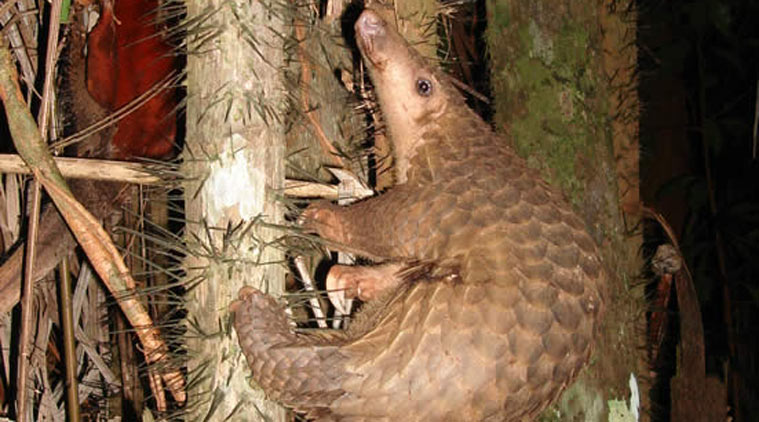
Pangolins are protected under national and international law, but their scales are apparently highly-valued in some Asian countries, for decorative as well as alleged medicinal properties.

A Pangolin. (Source: Wikipedia)

A Pangolin. (Source: Wikipedia) It is a tale of maybe’s and whodunit’s, how more than a third of all pangolin scales seized in Mizoram have disappeared and possibly re-appeared (only for some portion to perhaps disappear again) in another seizure more than 350 kms away.

It began in the end of May this year when it was discovered that 292 kgs of seized pangolin scales locked up in a forest department godown in Kolasib, a western town, had been replaced by fakes.
The consignment made up more than a third of the 848 kgs of pangolin scales various law enforcement agencies had caught from smugglers since 2012.

Pangolins are protected under national and international law, but their scales are apparently highly-valued in some Asian countries, for decorative as well as alleged medicinal properties.

Consignments have been seized in some North-Eastern states, all supposedly headed towards South-East Asia through Myanmar.

A case was registered soon after the end-May incident at Kolasib, but initial investigations apparently went nowhere.

Then, two-and-a-half weeks later on June 11, a joint operation by police and the Assam Rifles seized six bags from a bus at Farkawn, a village close to the international border with Myanmar, at six in the evening. The bags contained 216 kgs of pangolin scales, the police and AR told the forest department when they handed it over the following day at two in the afternoon.

The official account from the forest department says the AR troops had opened the bags and took pictures with the seized pangolin scales and then re-packed them for submission to the forest officials.
But when the forest department officials received and weighed the bags, they found it was 32.5 kgs lighter.
As of now, they remain clueless how this could have been — either some amount went missing during the 20 hours between the seizure and the handing over of the consignment to the forest department, or the police and AR had incorrectly weighed the goods.

What has added more mystery to the siezure was that the bus driver testified the cargo was loaded onto the bus by one Hmangaihthangi of Kawlkulh village, more than 164 kms north-west of Farkawn.

Hmangaihthangi went to Farkawn after being told that the cargo had been seized because it contained unlawful materials, but when she was interrogated, she said she had indeed loaded it onto the bus but that it was someone else’s.

The owner, she said, was a Myanmarese trader she knew only as Paliana, which could either be a name or the person’s build because Palian in Mizo translates to Big Man.

She knew Paliana from before and she met him unexpectedly in Aizawl about nine days before the seizure while she was there for a medical check-up, she said.

She said he gave her Rs 1,000 to help her with her bills, and asked that she do a simple favour in return; some of his wares were coming by Sumo Service from Shillong to Aizawl on June 9, he said, and asked if she could load them unto the Farkawn bus for him.

She obliged, she said, and left for Kawlkulh the following day. The day after that, the cargo was seized at Farkawn.

Officials are not ruling out the possibility that the 216 kgs (or 183.5 kgs, as it turned out later) of pangolin scales seized at Farkawn are part of the 292 kgs that was replaced with fakes at the forest department godown at Kolasib less than three weeks earlier.

Forest Minister Lalrinmawia Ralte, who gave a brief report about the missing scales at Congress Bhavan on Friday, said, “We are investigating the cases and we cannot say they were or they were not, but it is difficult to say anything definite as long as Paliana is not found and arrested first.”

Kidnapping in Mizoram Drops to Zero in 2015

Officials from the state Home Department confirmed that there had not been a single kidnapping incident so far this year.

The ebbing of militancy in Tripura has had a positive effect in the neighbouring state of Mizoram. As Tripura exited AFSPA with the number of extremist-related incidents, civilian deaths, security personnel deaths, kidnappings and encounters falling to zero this year, Mirzoram, too, saw the number of kidnappings by Tripura-linked militants drop to zero.

Officials from the state Home Department confirmed that there had not been a single kidnapping incident so far this year. They attribute the success to the current tripartite talks between the NLFT, Tripura and the Centre, the second round of which was concluded earlier this month.

Over the past half-decade, at least 31 people were kidnapped — 29 at gunpoint — within Mizoram in nine separate incidents.

Except for two kidnappings near the state’s north-western border with southern Assam, all others incident took place in the border area with Tripura and Bangladesh, according to data furnished to the Tripura Assembly last November by state Home Minister R Lalzirliana.

The latter’s hilly, forested border area has been a hotbed of militant groups that, investigators said, relied on ransom-kidnappings as their main revenue source. The major operators in the area have been the National Liberation Front of Tripura (NLFT) and lesser-known gangs of Bru tribals that aid the NLFT.

Tripura CM Manik Sarkar recently said the NLFT cadres remain in 16 camps in Bangladesh, three of them close to the Indian border. The Mizoram Home Minister added that 10 kidnappers had been arrested by Mizoram Police, among them seven cadres of the Bru Democratic Front of Mizoram and two cadres of the NLFT.

Seven of these arrested kidnappers were from North Tripura’s Naisingpara relief camp for internally displaced Bru tribals.