12 June 2015

Mizoram: Lifting of prohibition spells bad news for wineries

Following the lifting of prohibition, the vineyard growers’ societies of Mizoram, who also own the twin wineries at Champhai and Hnahlan, have suffered a huge hit.

For the majority of consumers, too, any form of alcohol would do; choosing between spirits and wine was a luxury only for wetter places.


By Adam Halliday

Champhai, Jun 12  : It was an overcast July afternoon last year when Mizoram’s legislative assembly decided to replace an 18-year-old prohibition law. The lifting of prohibition unleashed a cocktail of sentiments. Many in the state opposed it, but just as many were happy and excited to drink legally after a generation had been deprived of this, save through the bootlegs and moonshine route.
Besides, there were some who did not really protest at the start. In Mizoram’s eastern corner bordering Myanmar, home to North-east India’s only vineyards, the effects of lifting prohibition began to manifest themselves gradually in the form of declining wine sales. “By the end of the last financial year, our sales had fallen to roughly half of what it used to be in previous years (when prohibition was in place),” says C Zohmingliana, assistant secretary of the Champhai Grape Grower’s Society, consisting of 279 families who plant the native American Vitis labrusca grape variety used in making wine.
Following the lifting of prohibition, the vineyard growers’ societies of Mizoram, who also own the twin wineries at Champhai and Hnahlan, have suffered a huge hit. Port wine was the only alcohol exempted from the state’s now-defunct prohibition law. For the majority of consumers, too, any form of alcohol would do; choosing between spirits and wine was a luxury only for wetter places.

Almost immediately after the new law was passed — actual legal sales of alcohol began only eight months later — bootlegged spirit volumes registered a jump and prices dropped. This had to partially do with community organisations opposed to public drunkenness curtailing street patrolling and also government agencies previously tasked with upholding the ban on liquor sales finding themselves in a new role — facilitating its plentiful presence.

The potential market for wine in a dry state was realised quite early even after the enactment of the prohibition law. The Mizo National Front government, in 2007, braved Church opposition to make an amendment to the 1997 Act allowing manufacture, sale and consumption of local port wine. As realisation dawned that wine production could mean a source of livelihood for thousands, even those opposing chose to remain silent.

The government further gave both the Champhai and Hnahlan societies seed funds of Rs 80 lakh each — which they topped up with individual loans of Rs 160 lakh from the Mizoram Rural Bank — to build wineries. Apart from these, they received two 10,000-litre capacity fermentation tanks each two years ago from the state horticulture department. State support, both financial as well the amended prohibition policy, helped in boosting sales of the two wineries. Hnahlan alone recorded annual sales of between 1.5 lakh and 1.8 lakh bottles from 2010 (when actual production began) and the financial year ending March 2014. That translated into an annual turnover of around Rs 2.3 crore for this smaller of the two wineries.

But the lifting of prohibition has changed things drastically. During 2014-15, production rose to over 2 lakh bottles, but more than 80,000 remained unsold. The farmers’ collectives are now struggling to stay afloat. Champhai’s Zohmingliana notes that roughly two-thirds of all the grapes produced by the society’s members are bought by the winery.

The Champhai winery has now started supplying concentrated grape juice to a regional manufacturer for use in its line of liquor brands. In January, the society entered into an agreement with Radiant Manufacturing to supply 3.6 lakh litres per year to the company, which owns the Vinho Porto brand of port wines sold across North-East India and Bhutan. Last month, the first two truckloads of 16,000 litres of concentrated juice were flagged off from the society’s facility. Radiant’s CEO, Bheeshma Chand, informs that his company has been using grape juice concentrate sourced from Goa, Maharashtra and Karnataka for its wine manufacturing. Mizoram’s grapes are not only better, but the proximity to Radiant’s facilities makes this an economical raw material sourcing arrangement, he adds.

The Hnahlan growers’ society’s winery, which is 60 km away, has meanwhile sought to experiment with launch of new brands, while also making small batches of grape brandy. The collective, with 156 grower-members, has even hired a new Goa-trained winery manager, PB Lalrinfela, for making aged wine and applying for licences to market them under new brands in the liquor shops that have opened up following lifting of prohibition.

“We can start selling the aged wine in a few months. The grape brandy batches that we have made have all disappeared as sample drinks to visiting officials. We’ve been dry so long, you know,” he laughs.

If fear stays, may leave Manipur: Mary Kom

Mary Kom, manipur ambush, manipur army men, world champion Mary Kom, 18 Army personnel killed, manipur militants, Manipur, Mary Kom boxing, Mary Kom, Rio Olympics qualifiers, Manipur voilence, manipur army ambush, manipur insurgents, manipur attack, manipur news, india news

Being constantly on the move, the 33-year-old mother said she spends a lot of time worrying about the situation at home.

Last Thursday, five-time world champion Mary Kom was exercising here when she heard that 18 Army personnel had been killed by militants in her home state. The news left her troubled, as it brought back memories of past violence. Worried about insurgency in Manipur and the safety of her three children, the boxer has, of late, been thinking of moving out of the state.

“It’s very difficult to decide whether to stay there or shift to some other state. I have my family there and also my academy. But we cannot continue to live in constant fear. If the problem persists, then let’s see, I may leave the state,” Mary told The Indian Express in Bangalore, where she is training for next year’s world championships which will also serve as Rio Olympics qualifiers.
Being constantly on the move, the 33-year-old mother said she spends a lot of time worrying about the situation at home. “We are all scared. Killings, blasts… nobody likes it. I have children now, but there is always stress and tension. When I was a child, I saw how difficult it is to live in such a situation. Let’s stop killing each other,” said Mary.

“Over the last couple of decades, we have suffered. The constant violence disrupts your life completely. It had reduced significantly for a few years, but is now back again,” she said.

Asian Games bronze medallist Sarita Devi, who is also from Manipur, said the news was “disturbing”. “Such news is disturbing, especially since there was no such thing happening for a long time. This was sudden. We are all peace-loving people (in Manipur), we don’t like these things. We lose sleep. We grew up at a time when our movements were restricted because of this (violence). We hope our children don’t face the same problem,” she said.
10 June 2015

Indian Army in hot pursuit of terrorists behind Manipur ambush, enters Myanmar, kills 20 Northeast insurgents

New Delhi, Jun 10 : In a tough, well coordinated and surgically executed operation a few kilometers inside Myanmar, the Indian Army killed at least 20 terrorists belonging to Northeast insurgent groups who had ambushed a convoy of 6 Dogra Regiment in Chandel district of Manipur on June 4.

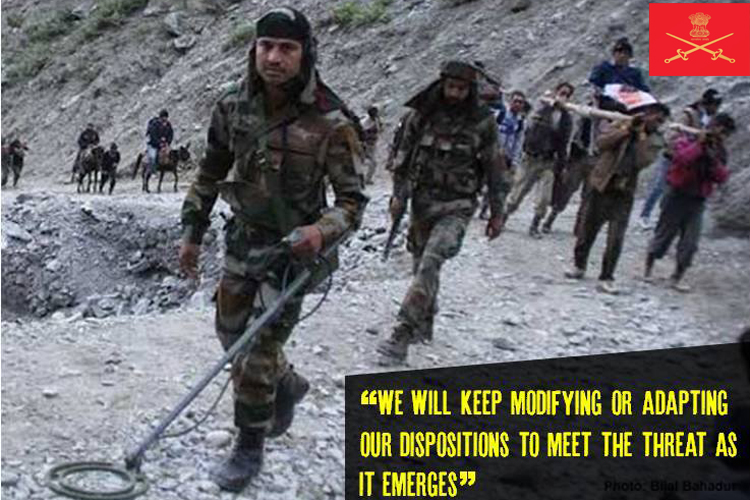
Sending out the strong message that Army will not hesitate to hot pursuit terrorists who challenge the Indian authority, Special Forces in coordination with the Indian Air Force launched a daring operation to neutralise insurgents near the Indo-Myanmar border. The operation began on Tuesday morning when troops engaged two separate groups of insurgents, one of which was along the international border while the other was based along the Nagaland-Manipur border.
While 20 terrorists have been killed and two camps of Northeast insurgent groups destroyed, the Indian side suffered no casualties.
The operations are still continuing inside the Myanmar border where Army commandos are hunting down other Northeast terror groups. While 20 terrorists have been killed and two camps of Northeast insurgent groups destroyed, the Indian side suffered no casualties.

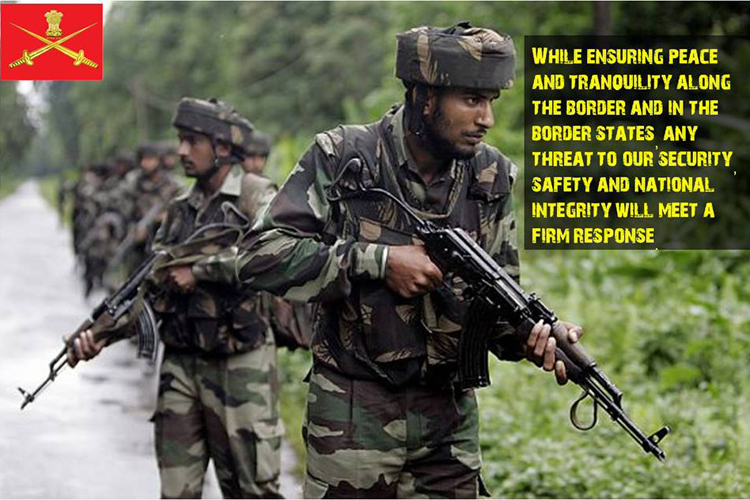
In a rare press conference by a senior official, Additional Director General of Military Operations (A) Major General Randhir Singh assured the country that "any threat to our security, safety and national integrity will meet a firm response".

Major General Singh said that Army units got intelligence reports that more attacks were going to be carried out in the region and launched an operation to neutralise the threat.
army2
"Following the attack on our security personnel on 4 June, 2015 in Chandel, Manipur, Indian Army has been on a high alert. In the course of the last few days, credible and specific intelligence was received about further attacks that were being planned within our territory. These attacks were to be carried out by some of the groups involved in earlier attacks on our security personnel and their allies," said the Major General.

"In view of the imminent threat, an immediate response based on intelligence, operations were conducted to counter these planned assaults. Early this (Tuesday) morning, the Indian Army engaged two separate groups of insurgents along the Indo-Myanmar border at two locations, along the Nagaland and Manipur borders. Significant casualties have been inflicted on them. As a consequence, threats to our civilian population and security forces were averted," he said.

army3
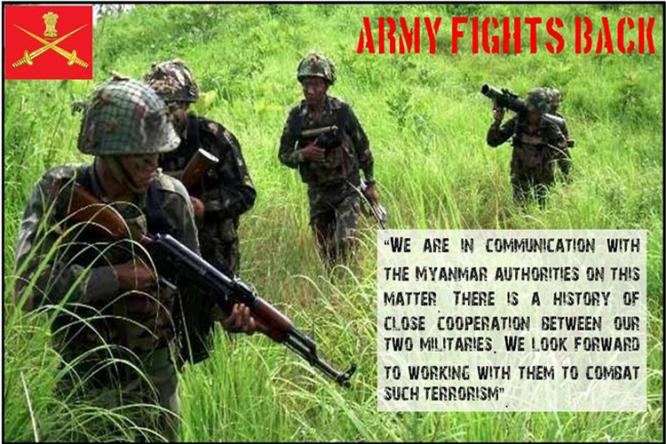
"Indian Army is in communication with the Myanmar authorities on this matter. There is a history of close cooperation between our two militaries. We look forward to working with them to combat such terrorism. While ensuring peace and tranquility along the border and in the border states, any threat to our security, safety and national integrity will meet a firm response," the officer added.

The ambush on the 6 Dogra Regiment convoy, which was being deinducted from the area, was carried out by terror groups active on the Tengnoupal-New Samtal road between Paralong and Charong villages at about 9 AM, about 80 km from Manipur capital Imphal.

The army truck carrying soldiers and fuel was first hit by a powerful Improvised Explosive Device (IED) following which the terrorists used rocket propelled grenades and automatic assault rifles to pin down the soldiers resulting in the heaviest casualty suffered by the force in over three decades. Eleven other soldiers were injured in the ambush.

Naga insurgent outfit Nationalist Socialist Council of Nagaland-A (NSCN) along with Manipuri outfit Kangleipak Communist Party (KCP) and Kanglei Yawol Kanna Lup (KYKL) claimed responsibility for the attack on the convoy.

Several Northeast terrors group have their camps in Myanmar and they routinely cross the porous border to enter Indian, and target security forces and civilians. After carrying out an attack, the terrorists slip back into Myanmar.

China and Pakistan have been using and arming the Northeast terror groups to foment trouble in the region.
09 June 2015

Repatriation of Brus Cancelled

A camp for identifying bona fide residents of Mizoram was held in North Tripura.- PHOTO: RITU RAJ KONWAR
Aizawl, Jun 9 : The proposed commencement of repatriation of Brus lodged at Kaskau relief camp in North Tripura district was cancelled on Monday as Brus had not turned up for identification at the camp last week.
Additional Secretary for Home Lalbiakzama told PTI that identification of bona fide residents of Mizoram was conducted between June 2 and 4, but not a single Bru approached the officials camping at the Kaskau camp.
Mr. Lalbiakzama, however, said that the repatriation process identification of bona fide residents of Mizoram at Khakchangpara relief camp would be conducted as scheduled from June 15 to June 18. Those who turn up and are identified would be repatriated between June 22 and 26.
“We would undertake the repatriation process as per the time-table set in the Road Map IV for repatriation prepared by the State government and approved by the Supreme Court,” he said.
The Apex Court had last month instructed the Centre and the governments of Mizoram and Tripura to complete the repatriation process of Brus within six months.
Following the court order, the Mizoram government prepared a roadmap for repatriation of around 3,500 Bru families between June to September 2015.
They did not turn up for identification at the camp last week

Mizoram Govt Employee Allege Assault By Policemen in Mumbai

Mumbai, Jun 9 : A 28-year-old youth, employed with the Government of Mizoram, has alleged that he was assaulted by four plainclothes police officers outside a cafe near the Gateway of India here.

According to the youth, he and his two friends were sitting outside the cafe at around 12.50 am when four plainclothes policemen approached and ordered them to go home.

"When we replied that we are leaving in a while, one of them asked me to show my identification card. So I asked them to show their identification cards first since they were in plainclothes," the victim alleged.

"All of them were furious and one of them began beating me up with a baton, even though I told him that I am a government servant. One of my female friends got frightened and she repeatedly requested them to leave me alone, but they turned a deaf ear and continued roughing me up," he said.

"After we began leaving the place, one plainclothes policeman dragged me into a police jeep, took me to the Colaba police station and inspected my identification card," he said.

"Even after assuring them that I am a government servant serving in the Government of Mizoram's guest house in Parel, they detained me in the police station upto 1.40 am," he said.

The victim reported the incident to Mizoram's Resident Commissioner in Maharashtra who is contemplating to lodge a formal complaint.

"Yes, the victim has narrated the incident which is extremely unfortunate. We are contemplating about filing a case against the police atrocity," Resident Commissioner of Mizoram in Maharashtra V Zaithanmawia said.

NIA names leaders of wrong Naga faction in Manipur ambush case


Militants armed with advanced weapons ambushed a military convoy in Manipur’s Chandel district bordering Myanmar, killing at least 18 soldiers.

Guwahati, Jun 9 : The case registered by the National Investigation Agency on Saturday against several Naga rebel leaders in the June 4 ambush in Manipur that killed 18 soldiers has mistakenly identified two leaders of the National Socialist Council of Nagaland (Khole Kitovi) as members of ‘NSCN (Khaplang) and its affiliates’.

The NSCN (KK) reacted late Monday night, questioning the NIA’s ‘high-class investigative agency’ tag and wondering how it targeted the wrong group.

NSCN (KK) was formed in 2011 after two senior leaders Khole Konyak and Kitovi Zhimomi fell out with SS Khaplang, chairman of NSCN (K) that abrogated a 14-year ceasefire with New Delhi on March 27. The ministry of home affairs did not lose time in recognising NSCN (KK) and inking a ceasefire pact with it.

A government official in Delhi said the Manipur police, which had initially registered the FIR, had made the mistake: “Since a central investigating agency is required to re-register the original FIR when it takes over a case, the error continues to be reflected in the NIA’s FIR also.”

“The government should have known that the NSCN and NSCN (K) are two separate parties. In spite of NSCN (K) claiming responsibility outright for the Chandel incident, NIA is wasting time implicating the wrong people,” a NSCN (KK) statement said.
08 June 2015

YMA U-Turn on Census of Chakmas

Aizawl, Jun 8 : Mizoram's most powerful organization, the central committee of the Young Mizo Association (YMA), abandoned its proposed census of Chakmas scheduled to commence from the first week of June.

The YMA's U-turn came after it inked a joint resolution with the central Young Chakma Association (YCA) on Wednesday in southern Mizoram's Chawngte town in Lawngtlai district in the presence of the additional secretary for the state home department Lalbiakzama.

Both the community-based civil societies agreed to cooperate with the government, especially the task force on illegal immigrants constituted by the state government following instructions from the ministry of home affairs to detect and deport illegal immigrants from Bangladesh.

YMA leaders said they would watch the activities of the task force and review its decision if they were not satisfied. YMA leaders and student organizations in Mizoram have been raising their voices for years on the issue of illegal immigrants, especially Chakmas, entering Mizoram through the porous 319-km international border with Bangladesh.

Former Mizo Zirlai Pawl (MZP) leader Lalhming Liana said the illegal influx was aggravated by the creation of a separate Chakma Autonomous District Council in the early 1970s.

"When Mizoram, then one of the districts of Assam, was elevated to the union territory statues in 1972, the Centre converted the erstwhile Pawi-Lakher Region into three autonomous district councils without consulting the people and the then government of Mizoram," Liana said.

The separate autonomy for the Chakmas encouraged more Chakmas to enter and settle illegally in the state, he said.

Civil society and student leaders alleged that the decadal growth of the population of Chakmas was abnormal and much higher than the overall population growth in the state.

"We have no reason to doubt that the high rate of growth of the Chakma population has been due to illegal immigration," said Vanlalruata, general secretary of the central committee of the YMA.

After the ambush: What needs to be done for peace in Manipur


Manipur police commandos detain and question locals after a rally against the Manipur state government in Mao. (AP file Photo)

Thursday's ambush of an Indian army convoy by militants in Manipur's Chandel district, about 15 km from the Myanmar border, in which 18 army personnel lost their lives has been described by the Prime Minister as a senseless act.

While the perpetrators are yet to be identified, all available evidence indicates the ambush was authorised by a new umbrella militant outfit called the United Liberation Front of Western South East Asia (UNLFW in short) formed a couple of months ago under the leadership of Khaplang, chairman of NSCN(K), a Naga insurgent group active in eastern Nagaland and having camps in the adjoining areas of Myanmar.

UNLFW is said to be a conglomerate of NSCN(K), United Liberation Front of Assam - Independent (ULFA-I), National Democratic Front of Boroland - Songbijit (NDFB-S), and Kamatapur Liberation Organisation (KLO). This is not the first ambush inspired by UNLFW. There were two other ambushes on the Assam Rifles in the past few months, resulting in a loss of lives.

NSCN is a Naga insurgent group formed in 1975, having Naga sovereignty as its objective. In 1988, the group split into two factions, NSCN (IM) and NSCN (K). The Government of India and NSCN (IM), the larger group, entered into a ceasefire agreement in 1997 and peace talks soon after. The ceasefire still holds -- incidentally, it is one of the longest ongoing ceasefires in the world -- and the negotiations continue.

NSCN(K) also desired a ceasefire and in 2001 the government entered into such an agreement. Owing to strong differences between the two factions of NSCN, and also the fact that Khaplang himself lives mostly in Myanmar, direct formal peace talks with him could not commence.

Meanwhile, the Naga civil society tried its utmost and with persistence, to bring peace between the rival factions and to end factional killings. NSCN(K) keeps on splitting. In 2010, it split, leading to a new faction called NSCN-KK. In March 2015, Khaplang expelled two NSCN(K) leaders and unilaterally abrogated the ceasefire with the government on the ground that the ceasefire did not lead to any political solution.

The expelled leaders formed a new outfit called NSCN (Reformation) and in April 2015 signed a ceasefire agreement with the government for a period of one year. The government expressed its dissatisfaction with the Khaplang faction as its cadres continued to commit ceasefire violations and extortions.

NDFB(S) and ULFA(I) are also anti-talks factions, and have split from the parent organisations when the latter settled for negotiations with the government.

Reports that many other Meitei insurgent groups such as KYKL and KCP were closely involved with Khaplang in planning the creation of UNLFW, as a coordinating body to achieve the common objective of fighting against the government, are worrying. This tie-up could lead to various Northeast insurgent groups finding safe havens in NSCN(K) camps in Myanmar, easier procurement of illegal arms, better training for militant cadres, etc.

Manipur is largely comprised of hills (80% of the area) dominated by the Naga and Kuki tribes and the valley area (the remaining 20%) is almost exclusively inhabited by the Meiteis (read Manipuris).

There has been a large number of Meitei militant groups operating in the valley for several years. Their principal grievance is that the merger of Manipur state was done under pressure and that the Government of India gives more attention to Naga issues and not to issues related to the Meiteis.
Irrespective of the merits of these arguments, the fact remains that neither the government nor the Meitei insurgent groups ever seriously attempted to get to the negotiating table. The Meitei insurgency is being treated essentially as a law and order problem. It is important that a serious political dialogue is started with the Meitei groups to look at their social, developmental and political issues.

Even as regards the negotiations with Naga groups, with whom negotiations are going on or are to be commenced, the groups must feel convinced that the government is serious about finding a mutually acceptable solution. It is easier said than done. A lot depends on the reputation and credibility of the government’s interlocutors.

Simultaneously, the government should seek necessary cooperation from the Myanmar authorities to deny safe havens for militant groups active in India. The international border has to be managed in an effective manner to stop crossing over of militants.

Taking into account the cross movement of insurgent groups in the Northeast, the responsibility of sealing the India-Myanmar border should be the sole responsibility of the Army. A proper assessment of the performance of the Assam Rifles should be done and a decision taken about their deployment in the Northeast or elsewhere.

The state police forces should be strengthened substantially. They can be supported by central police organisations, which have been substantially strengthened in the last decade. If conditions in the Northeast improve, the government should review the use of the Armed Forces Special Powers Act in specific areas.

The author is former home secretary and interlocutor for talks with the Naga group NSCN-IM. The views expressed are personal.