02 July 2014

Not Confrontation But Transformation

By Sanjoy Hazarika

In his home on a high, windy hill above the broken road that passes for a national highway in Nagaland, Niketu Iralu told us of his work and how he and his wife, Christine, have created a welcoming environment that embraces dialogue among differing groups in the North-Eastern region.

Listening to their stories, a friend from Delhi said, “I really find it hard to believe that people like you exist in this world.”

The Iralu home in Zupsha, near Kohima, is always filled with music, the cooking of many meals and talk. Friends, associates and well-wishers contribute — villagers come with sacks of grain, others bring meat, some send fresh vegetables.

Young Nagas come to share problems, political leaders drop in as do powerful bureaucrats, grizzled village elders and church figures. Bodo activists from Assam tell of concerns, so do Assamese scholars and writers.

For many years, Niketu and Christine have worked tirelessly to build a fabric of reconciliation among communities, binding the wounds of conflict in a place that is breathing peacefully after half a century of bloodshed.

This is not an isolated trend: Across the North-East the Iralus and others are part of a growing band of quiet foot soldiers who are marching to the tune of a different drummer, working for peace, discussions and the restoration of rights.

A group with which I am closely associated organises boat clinics for the unreached on the islands of the Brahmaputra, partnering the National Rural Health Mission, in an innovative effort that has reached over 1.3 million people with healthcare.

A former army doctor and his wife have set up a network of Bodo women weavers, which spreads the message of productive peace. An inventor wins prizes for new simple creations that peel vegetables and fruits.

These are not noisy activist groups seeking change through confrontation but transformation through dialogue. Of course, there are also outspoken organisations such as the Naga Mothers Association, which battles human rights violations as well as the new enemies of drugs and alcohol, and Manipur’s Irom Sharmila in her unending hunger strike against the AFSPA.

One sturdy group in Nagaland that has refused to bow to the formidable might of militants is the Action Committee Against Unabated Taxation (ACAUT).

Started a few years ago by a team that includes Kekhiye Sema, a former IAS officer, the ACAUT has taken the armed factions head-on, accusing them of extorting the Nagas dry and enabling New Delhi to exploit differences among the major Naga armed factions.

Last November, it organised a public meeting of people fed up with the daily extortion – ranging from tea-shop owners and professionals to government officials and business persons. The most powerful group, the NSCN (I-M), ‘banned’ the meeting but over 25,000 defied the diktat.

The ACAUT’s efforts go beyond criticising the ‘underground’ groups. A majority of the cadre here with ULFA and other factions live in ‘designated camps’ while unending dialogues continue. Smaller breakaway groups buck dialogue by hitting vulnerable groups and officials.

Under its banner of ‘One tax, One government’ (Nagas and most hill tribe groups in the NER are not covered by income tax), the ACAUT wants all the armed and political factions to unite and take the discussions with New Delhi forward.

This represents the missing factor in talks that have eluded settlement and which the Government of India could tap into: Consulting civil society, which has mobilised for a common cause.

(Sanjoy Hazarika is director of the Centre for North East Studies and Policy Research, Jamia Millia Islamia, New Delhi. The views expressed by the author are personal.)
- See more at: http://www.hindustantimes.com/comment/analysis/not-confrontation-but-transformation/article1-1235717.aspx#sthash.EztFDMDg.dpuf

Northeast To Have Air Ambulances Soon

Guwahati, Jul 2 : Patients from difficult-to-access locations in the landlocked northeastern states can heave a sigh of relief, as a Guwahati-based hospital is planning to launch air ambulance services to ferry patients from across the region.

The Guwahati Neurological Research Centre (GNRC) Tuesday unveiled a plan to launch air ambulance and medical outreach programme using helicopters to remote areas of all the eight northeastern state - Assam, Arunachal Pradesh, Meghalaya, Manipur, Mizoram, Nagaland, Tripura and Sikkim.

"Doctors from GNRC will be ferried to difficult-to-access locations across the region and provide doorstep medical support to the people," said neurologist Nomal Chandra Borah of GNRC Hospitals Ltd.

Once started, the air ambulance service will be the first of its kind in the region.

GNRC was founded by Borah in 1985. It was the first super specialty healthcare centre in northeast India and presently operates three hospitals offering over 500 beds.

The hospital serves people of Assam, the other northeastern states as well as the neighboring southeast Asian countries of Nepal, Bhutan, Bangladesh and Myanmar.

Borah said GNRC was recently chosen by the World Bank to receive a grant of $150,000.

"We intend to set up 10 more hospitals in the region and beyond, within the next five years," he said.

Japan Finally Apologizes to Its Women

Say it like you mean it.                                                                                           Source: The Asahi Shimbun via Getty Images
Say it like you mean it.                                                                                          

Source: The Asahi Shimbun via Getty Images
On June 23, a middle-aged male Japanese politician, dressed in the traditional dark suit and '80s-retro haircut, walked in front of a waiting line of news cameras, to where a younger female politician waited. As the cameras flashed, he apologized to the woman, and bowed deeply; she looked on gravely.

To a naïve Western observer, this scene might look like just another day in the byzantine, hidebound world of Japanese politics. But I’ve been watching Japanese politics and civil society for more than a decade now, and when I saw Akihiro Suzuki bow to Ayaka Shiomura, I caught my breath. I knew what I was seeing was big. Epochal, even.

The background: On June 18, Assemblywoman Shiomura, who belongs to a small minority party, was speaking to the Tokyo city assembly about the need for programs to support working women -- a point that has been a main theme of Prime Minister Shinzo Abe’s administration. While she was speaking, someone from Abe's dominant Liberal Democratic Party (LDP) yelled: “You should get married!” and “Can’t you even bear a child?” Shiomura, visibly disturbed, finished her speech, after which she returned to her seat and began to cry. After the incident, Shiomura and other opposition politicians requested that the LDP find and punish the heckler, but party officials responded that they didn’t know the identity of the heckler, and hence could do nothing.

In the Japan of the 1990s or early 2000s, that probably would have been the end of the issue. But not this time. Soon, the story was all over the Japanese news, and complaints began pouring in. Petitions appeared and circulated, demanding that the offenders be found and forced to apologize (about 100,000 people signed). A network of feminist groups, using the petition-gathering platform Change.org, made the issue a rallying point. A few days later, the LDP caved, identifying Akihiro Suzuki as the man responsible for (at least some of) the heckling. The historic apology followed soon after. But that didn’t stop an angry man from egging Suzuki’s house!

This incident is only a symbol, but it points to a larger underlying trend -- the metamorphosis of Japanese women from a subservient caste, valued only for their delicate beauty and homemaking skills, to full-fledged equal members of society. Prime Minister Abe, of course, is making a name as the chief booster of women’s economic equality, but it turns out that he’s jumping on a trend that’s been building for a while. Working-age women’s employment has been climbing steadily since the early 2000s, and is now higher than in the U.S. Slowly, Japanese companies are hiring more female managers and executives, and Japanese voters are electing more female politicians.

Meanwhile, social change is happening as well. Popular TV shows now depict women as tough, smart lawyers. Child pornography -- which exploits large numbers of teenage girls -- was finally banned this month. The man who egged the sexist politician’s house is an example of a growing trend of “white knighting” (men standing up for women who are being bullied in public) in a country more traditionally known for train groping.

Of course, all change is generational; some older, conservative Japanese men still view women as inferiors, to be bullied and humiliated at will (much like in the U. S.). Just a couple of weeks after the Shiomura incident, a female politician in Osaka was heckled in a similar incident. And Japan still lags far behind most other rich nations in gender equality.

But there are two forces driving social change in Japan. The first is the changing of the guard. As Devin Stewart of the Carnegie Council has noted, the 76er generation – Japan’s equivalent of America’s Generation X – is far more liberal in its outlook than the older baby boomers. Feminists such as Mariko Bando, Chizuko Ueno, and Akie Abe (yes, the prime minister’s wife!) have gained national celebrity, and a new generation, such as writer Renge Jibu and activists Asako Osaki and Emmy Suzuki Harris, are gaining in prominence as well. Meanwhile, younger male executives, politicians and academics are also talking much more openly about the need for women’s equality.

The second force is economic, and here Abe becomes the central figure. Abe’s reforms include moves toward shareholder capitalism, free trade, lower corporate taxes, and deregulation -- a sort of delayed Reagan-Thatcher revolution. Those measures, even if partly successful, will put pressure on Japanese companies to hire women (who offer more productivity per dollar than men), to reform the rigid labor systems that are biased against working mothers, and to ditch the expensive drinking sessions that preserve the “boys’ club” mentality.

Many Westerners and Japanese people alike tend to view Japan as an ancient, unchanging samurai culture, bound eternally in traditional feudal values. But Japan is turning out to be much more like Europe and America -- a place capable of social as well as economic progress, a place capable of reinventing itself through both evolution and revolution.
30 June 2014

Resume Peace Talks With KNO: Mizoram CM to Rajnath Singh


Aizawl, Jun 30
: Mizoram Chief Minister Lal Thanhawla has appealed to Union Home Minister Rajnath Singh to resume peace talks with Manipur's Kuki National Organisation (KNO) leadership soon, an official statement today said.

The statement said Lal Thanhawla met Singh in Delhi yesterday and informed the latter that the KNO was not fighting for secession from the Indian Union but struggled for rights of the Kukis.

The Chief Minister said the KNO had signed a Suspension of Operation (SoO) with the Union Home Ministry and that resumption of talks to find a permanent solution to the Kuki problem would be welcomed.

He also apprised Singh about the repatriation of Bru tribals from the relief camps in Tripura saying 6,511 Brus belonging to 1,237 families have been repatriated till date despite opposition and obstruction from the Mizoram Bru Displaced People's Forum (MBDPF), the statement added.

Award For Mizoram Rural Bank

By Pankaj Sarma

Guwahati, Jun 30 : The Mizoram Rural Bank has received recognition for successfully financing wineries run by self-help groups in Mizoram. The rural bank was presented with the Gold Award in the livelihood promotion category for SKOCH Financial Inclusion and Deepening Awards 2014 at the 36th SKOCH Summit held in New Delhi recently, a bank spokesman said.

The award was given to the bank for financing and supporting the Champhai and Hnahlan Wineries managed and run by various self-help groups under the Champhai Grape Growers Society and Hnahlan Grape Growers Society respectively.

The SKOCH Financial Inclusion and Deepening Awards is given by SKOCH Consultancy Services Private Ltd to identify and felicitate individuals, projects and institutions that have made significant contributions to the cause of financial inclusion, financial deepening, customer service and value addition.

The SKOCH Consultancy Services Private Ltd, founded in 1997, is a strategy and management consulting firm that runs the SKOCH Development Foundation, an autonomous, non-profit policy think tank.

The bank spokesman said currently, Champhai Grape Growers Society has 110 self-help groups affiliated to it and over 1,650 members. Likewise, Hnahlan Grape Growers Society was formed in 2008 with 32 self-help groups, which has grown to 51 with over 800 members today. “The two societies have also contributed more than Rs 75 lakh to the state exchequer as revenue, which is a success story,” a source said.

India To Have World’s Tallest Girder Rail Bridge in Northeast

By Samudra Gupta Kashyap

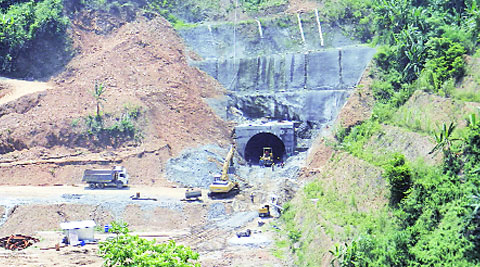
Tunnel No. 14 on Jiribam-Imphal route.

Summary

At present, the Malarijeka via-duct in Montenegro, Europe, with a height of 139 metre is the highest such rail bridge, the official said.

M_Id_396914_Manmohan_Singh
The much-delayed railway link to Manipur’s capital Imphal is set to get the world’s tallest girder rail bridge on the 125-km-long Jiribam-Tupul-Imphal route.

First included in the 2003-2004 central budget, the Jiribam-Tupul-Imphal project has seen many delays and construction is not even one-third the way through, but the Railways says it has so far completed seven of the 46 tunnels on the project, with the NF Railways saying it will complete five more in the current year.

“Last week we completed Tunnel No 14 that passes under the Silchar-Imphal National Highway-37, with which we have so far completed 19.5 km of the 39.4 km of total tunnel-length that the Jiribam-Imphal track will have,” a senior NF Railay official said on Sunday. The longest tunnel on this route will be 10.7 km in length, he said.

But the biggest feat the Railways has been working on is Bridge No 164, which will have a proposed pier height of 141 metre and would make it the tallest girder rail bridge in the world.

At present, the Malarijeka via-duct in Montenegro, Europe, with a height of 139 metre is the highest such rail bridge, the official said.

Declared as a National Project in 2012, the Jiribam-Tupul-Imphal project has already missed two deadlines, with the revised target for completion now fixed at 2022.

“We however want to complete the Jiribam-Tupul 84-km section by March 2016 in the first phase.

This portion will require 1,310 hectares of land out of which work is in progress in 1,263 hectares.

There will be 112 minor bridges and six major bridges, out of which 52 minor bridges have been already completed,” the NF Railway official said.

Arunachal CM urges Centre to reopen road linking India to China and Burma

By Manoj Anand

Stilwell Road (Photo Courtesy: gokumming.com) Stilwell Road (Photo Courtesy: gokumming.com)

Guwahati, Jul 30 :
In what may change the face of landlocked border states of India’s Northeast, most of the region’s Chief Ministers have urged the Centre to reopen the historic Stilwell Road, linking India to China and Burma by land.

The historic road was built in 1942 by the Allied forces for swift passage of British and American armies during World War II. While there have been several attempts to reopen the road, the home ministry has always rejected it on the grounds of security. The bureaucracy fears revival of the road link may help rebel groups operating from Burma.

The long-pending demand was revived once again this weekend by Arunachal Pradesh CM Nabam Tuki, who urged Prime Minister Narendra Modi to revive the Stilwell Road, and open Indo-Bhutan trade through Tawang. Direct trade with Bhutan will help Arunachal Pradesh to tide over its perennial hardships due to blockades and agitations in Assam. The other northeastern states are forced to depend almost wholly on Assam for all links to the rest of India.

Mr Tuki told the PM that building a road from Lumla in Tawang to Tashigang in Bhutan will not only provide an alternate route for the people of Tawang to reach Guwahati and other parts of India, it will also facilitate tourism and other activities between the two countries.

Mr Tuki also urged opening of the Pangsau Pass to boost Indo-Burma trade. The 1,700-km-long Stilwell Road links three countries: about 1,000 km falls in Burma, 630 km in China and only 62 km in India.
It was named after American Gen. Joseph Warren Stilwell, who played a stellar role in the China-Burma-India region, on the suggestion of China’s President Chiang Kaishek.

It established communication between Chinese forces and US-British forces when the Japanese Imperial Navy was blocking all marine supply chains. Despite opposition from Winston Churchill and others over its heavt cost, General Stilwell persuaded the government to release funds. The road begins at Ledo in Upper Assam?s Tinsukia district. Most of the existing stretch is serviceable and only 160 km in Mynamar needs to be renovated.

Work on Agartala-Akhaura Railway Link To Begin Next Year

Agartala, Jun 30 : The proposed 15-km long railway link from Agartala to Akhaura will bring economic prosperity and strengthen people to people contact between India and Bangladesh.

An eight-member delegation from Bangladesh recently met their Indian counterparts during the third meeting of the Agartala-Akhaurah railway Link Project Steering Committee in Agartala.

They did a field inspection and visited Agartala railway station and Nischintapur, the bordering village from where the proposed rail line will enter Bangladesh.

India will build 15-km railway tracks, coasting Rs. 252 crores, to link Tripura's capital Agartala with Bangladesh's southeastern city of Akhaurah, an important railway junction connected to Chittagong port, resource-rich Sylhet and Dhaka.

Joint Secretary in Bangladesh Railways, Sunil Chandra Pal, said, "We discussed the decisions taken in the earlier meetings. Both sides are satisfied with the progress. We will finalize the project documents and get approval from the appropriate authority and then start the work, may be by the end of this year or the 1st half of next year."

An agreement to implement the railway project was signed in 2010 between the Prime Ministers of India and Bangladesh.

With the new rail link, Northeast India would be connected to Chittagong international sea port in Bangladesh.

This will help in reducing the time consumed for transporting food grains and other essential commodities.

Joint Secretary in Ministry of External Affairs, Alok K.Sinha, said, "Cooperation in the railway sector between India and Bangladesh is an important component of our bilateral co-operation programme. Several projects have been undertaken. This project in particular when implemented will be greatly beneficial to the people in our two countries."

Surface connectivity is an important factor as India's northeastern states which are surrounded by Bangladesh, Myanmar, Bhutan and China.

The only land route to these states from within India is through Assam and West Bengal. But it passes through over 70 per cent hilly terrain with steep roads and multiple bends.

India has for long been seeking land, sea and rail access through Bangladesh for ferrying good and heavy machinery to its northeast from abroad and other parts of the country.