Katy Perry – photoshoot for Rolling Stone Magazine Photoshoot (July 2011) – not HQ 


Katy Perry – photoshoot for Rolling Stone Magazine Photoshoot (July 2011) – not HQ
Alison Haislip in her underwear – photoshoot for Esquire (Me in My Place) 


Indian in LA: Freida Pinto, the Slumdog Millionaire girl, will soon be back on the big screen in yet another Hollywood film.


By Smita Gupta
Improving connectivity only way to ensure real integration: Union Minister for North-East

– PHOTOS: KAMAL NARANG / RITU RAJ KONWAR 
CONNECTING INDIA: Union Minister for Development of North-East Region Bijoy Krishna Handique reflecting on new policy options. At right, the fruits of connectivity: tourists on an outing inside Assam's Pobitora Wildlife Sanctuary, 50 km from Guwahati.
New Delhi, Jun 25 : Smaller airports, smaller aircraft, intra-regional air connectivity and more frequent flights in and out of this geographically difficult region — apart from improving safety standards — could be the answer to ending the physical exclusion of the North-East, according to Union Minister for Development of the North-East Region (DoNER) Bijoy Krishna Handique.
“Our outlook is limited by geography,” said Mr. Handique in an exclusive interview. “We need to break the shell of isolation within which the people of the North-East live, separating them from mainland India. We need to connect important towns in the interior with each other, and the major towns with the rest of the country. Improving connectivity is the only way to promote real integration.”
It is to this end that the Union DoNER Ministry has produced a new policy document on civil aviation titled “Multi-utility aviation in the North-Eastern Region — An alternative innovative model for hastening development”, which Mr. Handique discussed with Prime Minister Manmohan Singh recently. “Dr. Singh said the Prime Minister's Office would examine the document,” said the Minister.
Making a pitch for his new policy, Mr. Handique stressed: “We need a well-defined North-Eastern perspective in the civil aviation policy to put air connectivity on the fast track. It is our lifeline.”
Indeed, in the wake of the tragic helicopter crash last month in which Arunachal Pradesh Chief Minister Dorjee Khandu was killed, Mr. Handique also met Union Civil Aviation Minister Vayalar Ravi to discuss his ministry's proposal for a different approach to civil aviation for the North-East. In the wake of that discussion, the Civil Aviation Ministry agreed in principle to develop the Guwahati, Agartala, Imphal and Dibrugarh airports as regional hubs (Level 1).
Mr. Handique said Mr. Ravi, who had been very “sympathetic”, has agreed to travel to the North-East next month to lay the foundation in Guwahati for the first of the four regional hubs. Developing Guwahati as a regional hub has been a three-decade-old demand, he added.
If the DoNER Ministry's plan is accepted, then the regional hubs, which would connect the North-East to the rest of the country, would in turn be linked to 20 “spokes” (Level 2) across all seven North-Eastern sister-States and Sikkim. Currently there are 20 such airfields in addition to the four regional hubs; sadly, only seven are operational, while the remaining 13 have fallen into disuse, but could be easily upgraded.
Once the “spokes” are activated, the DoNER Ministry would like 59 of the 86 districts not serviced by Level 1 and 2 services or three proposed greenfield airports to have permanent helipads.
Indeed, Mr. Handique, referring to the suspension of Pawan Hans services following the death of Mr. Khandu, said: “Given the difficult terrain in the North-East, helicopter services must be restored. I don't mind even Pawan Hans, provided the safety auditing is done. But connectivity is a must.”
Indeed, his policy document points out that the “chicken neck” that connects the North-East with mainland India only connects two States, Assam and Sikkim, and that this narrow strip of land is choked not just by a high-density population but by roads, rail lines, cables, oil pipelines and power transmission lines. “Therefore, inclusiveness of the North-Eastern region with the rest of India is physically possible only through air services.”
Thanks to the Open Sky policy of the 1990s, the commercial aspect of air services to the North-East gained ground: this meant private airlines did not see air services to the region as financially viable; Air India did provide four twin-engine turbo prop ATRs (subsidised by DoNER) to the North-East, but even this was “not satisfactory,” points out Mr. Handique.
The North-Eastern States, hampered by difficult terrain, economic backwardness and poor connectivity, rarely impinge on the national consciousness unless separatism raises its head. According to the Minister, it's time this less than splendid isolation ends.
In Arunachal Pradesh, a remote region of India that time forgot, brave amateur naturalists can join a scientific expedition to collect snake venom
By Kevin Rushby
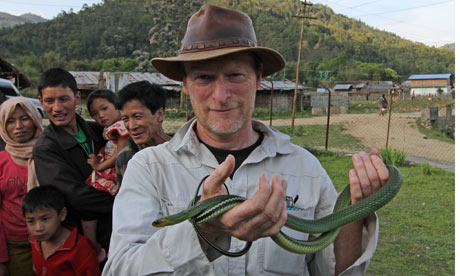
In safe hands … Kevin Rushby holds a (non-venomous) rat snake in Arunachal Pradesh, India. Photographs by Kevin Rushby
The first thing that happened was that an old man wearing a cap crowned with a peacock's claw, a hornbill's beak, a bearskin and a pair of knitting needles strolled up to the veranda of the government resthouse. "You want snakes?" he asked in broken Hindi, "Come with me now."
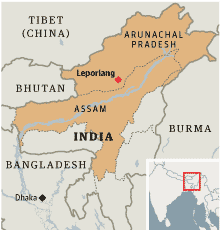
It was late afternoon. We had only just arrived from Assam, driving north for the last 100 miles up through increasingly thick jungle on a deteriorating dirt road, watching the last vestiges of modern India drop away. The garish advertising went first, the traffic next, then the plastic litter and jerry-built, stained concrete buildings. In their place came deep jungle and mountain rivers, interspersed with bamboo longhouses and people who stared. "Are you ghosts?" one man shouted. By the time we reached Leporiang village at the end of the track, we had slipped out of the 21st century and landed, hopeful and smiling, in something very different to the rest of the howling, honking mayhem that is modern India.
The north-east of India has never made much of a contribution to the country's tourism phenomenon. There have been, for a start, plenty of political problems. Culturally more akin to Burma or China than Delhi or Mumbai, the region has been a minefield of independence movements and ethnic rivalries. And of these, Arunachal Pradesh is one of the most remote and inaccessible. It covers those jungled mountains that extend 350 miles eastwards from the Bhutanese border all the way to Burma. Claimed by China and largely ignored by Delhi, its steep-sided hills and rampaging rivers have barely been touched by the modern world. Our hosts, the Nyishi tribe, are a people whose knowledge of the lands beyond their jungles was, until half a century ago, largely based on slaving forays among the lowland Assamese. I had arrived as part of a scientific expedition, one that amateur naturalists can accompany, with the aim of collecting snake venom for anti-venom serum.
This is not a frivolous or obscure project, as expedition leader Gerry Martin pointed out. "There are about one million snake bites in India every year – 50,000 of them fatal. Thousands of other people are incapacitated."
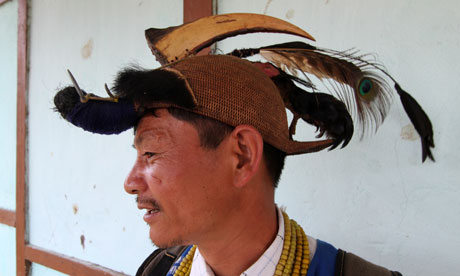 A member of the Nyishi tribe in traditional headgear
The problem is that Indian snakes are not well studied. Scientists are just beginning to realise that venom is often location-specific and also that certain species may in fact be several distinct species. Our other expert, Rom Whitaker, American-born but brought up in India, is one of the greatest authorities on Indian snakes; he was quick to point out the limitations of current knowledge.
"Take some of the snakes we are looking for here: Medo's pit viper – we know almost nothing. It's probably a group of species. And Kaulback's pit viper – discovered in 1940 in south-west China and here in India only three years ago. It's a six-foot-long, highly venomous pit viper – that's about all we know." Rom's particular object of study is king cobras. "They'll be here for sure."
I'm no snake expert. In Africa once I was chased by a black mamba and the experience frightened the life out of me. I have very mixed feelings about this trip. But I am not going to have time to dwell on that. No sooner has the old man in the curious tribal hat mentioned his knowledge than we are on the march, heading out past the rice fields, following him down towards the river at the bottom of the valley.
We cross the torrent on logs laid across boulders, then climb up to a large flat rock in a bracken-covered clearing. "They live under there," says our informant. Immediately Gerry and his assistant Soham Mukherjee are on their knees shining torches into the cracks. "Cobras," whispers Gerry, "Big ones."
A crowd of excited villagers is gathering. For them it is clearly a thrilling novelty that someone might want to catch a snake and not kill it. Rom is showing them identification photographs and they all pick out the monocled cobra as the species we are tackling. They are more interested, however, in another picture: Kaulback's pit viper. "Oh, very bad!" says one young man in English – a language as rare as anti-venom in these parts. "We call him barta [meaning the deadliest of all snakes] and he is very bad. If you see one, you must kill it immediately or it will follow you home and kill someone in your longhouse."
"Where do you find them?" asks Rom.
"In the jungle – mountain tops."
Rom looks doubtful. "People always think snakes are far away, but in my experience they are close, like this one."
Gerry is calling him over to the boulder. He's placed a coat over one side of the crack, creating a dark, inviting escape hole. Now he's gently poking with a stick and waving the torch. "He's coming. You ready, Rom?"
Rom jumps up next to the boulder, a long, hooked snake stick in hand. Some of the local children start running away, a few adults too. The snake, smooth, powerful and grey, shoots out of the hole over Rom's waiting snake hook. Rom grabs it by the tail and lifts it up with the hook. The cobra, furious, whips its body around hissing, but Rom skilfully controls it. Gerry has a canvas bag ready and the six-foot reptile is dropped inside. It immediately settles down, comforted by the darkness. "They go into a kind of torpor," says Gerry. "We'll keep him a week, then take venom before we release him."
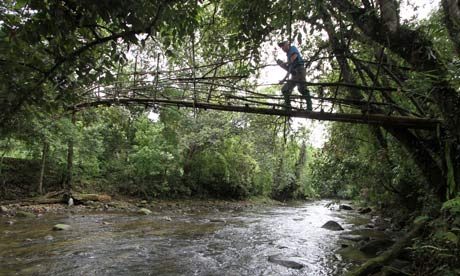 Snake expert Rom Whitaker crosses a bamboo bridge
Walking back to the resthouse, it's getting dark and I'm close behind Rom at a tricky climb over a bamboo fence. Suddenly he stoops down and seizes a snake in the undergrowth and bags it. "Himalayan keelback," he grins. The manouevre is completed so quickly I haven't even seen the creature.
Later, this incident prompts me to ask if an untutored outsider can actually help much on an expedition like this.
"Honestly?" he asks. "Well, the money from paying guests helps a lot. This kind of expedition would not go ahead without it. And extra pairs of eyes and hands are genuinely useful."
There is another benefit that I start to appreciate over the following days. Simply by showing an interest in wildlife, the visitor can help transform local attitudes. In Nyishi territory, the birds, for example, are hunted along with other creatures: the deer, the squirrels, the clouded leopard and bear. Tigers and elephants have all but disappeared, though a few old men tell us that they still exist in the most remote areas. Our interest triggers a response. Climbing up a steep hillside cleared for rice, one farmer is keen to show me a nest in his rain shelter, then points out the brilliant colours of a golden-throated barbet on a nearby tree and a pair of woodpeckers. The Nyishi here are hunters and they have an intimate and detailed knowledge of every living creature around them. It just never occurred to them that these might have any use other than food.
That evening more people stop by the resthouse – as we are apparently the first Europeans ever to visit Leporiang, we are treated to a constant stream of curious visitors. They leaf through our books, stare at Gerry's laptop, ask questions: "Why do you white people all look the same?"
One youth grins at our female expedition members, Janike and Hema, and announces, "In my grandfather's time we would keep your women and thrash the men." We all laugh. I'm pretty sure that "thrash" is a euphemism for "kill".
Almost every middle-aged man carries a sword, and some have bows and poison-tipped arrows in bearskin quivers. The youths scorn such things, preferring hair gel and sneakers. Women are less adorned and appear to do all the work: hoeing the impossibly steep hillsides, carrying vast loads of firewood and cooking our meals in the government resthouse – Leporiang's only accommodation for visitors. On Sunday they head for the church on the hill and throw themselves, babies on their backs, into frenetic bouts of mass hysteria and swooning. This is a culture that's diving headlong into its own unfathomable future.
Among our visitors is one old man who saunters up the veranda and from a basket produces a dead snake – a gorgeous black, yellow and blue creature about five foot long. The effect on our experts is electric. Janike does a scale count – a diagnostic test in snakes – and declares the creature to be a Kaulback's. The old-timer has different ideas.
"It's not barta," he says, using the local name. "It's taji. They are different."
This is inexplicable, but our scientists do not discount it: knowledge of these snakes is so scarce that every morsel of local information is noted down.
The next day we trek for miles, deep into the jungled mountains, to find where this snake lived. The trees are shaggy with orchids and ferns – entire ecosystems in themselves. The rivers are heaving with fish and tadpoles the size of my thumb. And the vegetation is laden with leeches – harmless, if unpleasant. We flick them away with increasing regularity. Inside a narrow valley, we locate the precise spot where the Kaulback's pit viper was killed, then we fan out and start searching. Three hours later we have not found any snakes and decide to return. Almost immediately, Soham spots movement in the undergrowth and pounces, triumphantly lifting up a small lizard. It's a long-legged creature with a gorgeous green and orange throat.
"Almost certainly a new species," declares Gerry. "We found one last year in the next valley and no one has yet identified it." It seems a pretty good consolation for not finding the viper, but our guides are not satisfied. That night another old man in a Nyishi cap arrives to look at us. News of the strange foreigners who are interested in snakes has reached his longhouse some miles away. "Search the river at night," he tells us. "The overhanging trees are full of snakes."
Naturally, a torch-lit search for venomous reptiles while waist-deep in a fast-flowing Himalayan river is a snake-hunter's idea of a good night out. After dinner we head off, myself rather reluctantly at the rear. We clamber down to the river below the village, Gerry and Rom leading the way. Not everyone, it has to be said, would enjoy such abnormal behaviour, but I am about to experience one of the highs that such determination can bring.
The river is fast-flowing and 30 metres across. Soon the group is spread out, torches flaring off the trees and water. I find myself wading after Soham – he found the lizard, I reason, so maybe good luck is with him. We get separated from the others and come across two local men hunting fish with their hands. It's one of them who shouts the warning. "Look up!"
On a branch 10 feet above the raging torrent is a coiled emerald-green serpent, its head the shape of a blunt arrowhead. We inch closer. The boulders are desperately slippery and I go down once, grateful I've packed my camera in a dry bag. The fisherman, eager to help, grabs the branch and shakes. The viper falls in the river among us. Soham coolly dives forward and grabs its tail, then gets it on his snake stick. We all shuffle and stumble towards a sandbank to get a closer look at this phenomenally beautiful creature, so perfect in every precisely defined scale and feature.
Back at base camp we get further treats: Leporiang has only recently got electricity and there are a few bulbs in town, some of them on our veranda. The light has brought visitors: a huge pale moth, pressed to the door like a fallen moon, then another, as broad as my outstretched hand, with huge brown eyes on its furry wings.
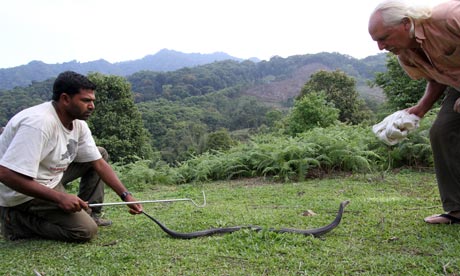 Gerry Martin, left, and Rom Whitaker with a cobra
The days roll by and the end of the week arrives. It's time to inspect all our snakes – nine of them – to identify and photograph them. Unfortunately, I am going to miss the venom extraction as the necessary ice has not arrived from Assam, but we go through the identification. First is a green rat snake – non-venomous, so I have a go at handling it. Then come keelbacks – Himalayan and St John's – and two Medo's pit vipers, one a baby with its umbilical cord mark still visible (most vipers give birth rather than laying eggs). Next is a false cobra and a strange burrowing snake, more like a worm, really. Finally we come to the two cobras. Gerry prepares carefully. This is a big, fast animal and extremely venomous. As it drops out of the bag it's clearly angry, hissing loudly. Held by the tail, however, the snake rears up and spreads its hood.
"Monocled cobra," someone shouts confidently. But Rom is frowning. "I'm not so sure. Let's do the scale counts."
They place the snake's head in a clear plastic tube to prevent any mishaps and start the counts. Janike immediately announces that nothing fits the expected figures for a monocled cobra – a well-known Indian species. "Check the tail-to-body ratio," she says.
When the result is shouted out, Rom shakes his head. "That's incredible. I mean, what is this thing?"
Further results only increase his consternation. The snake, meanwhile, is getting tired. They pop it back in the bag to rest. It feels like no one dares say it, so I do. "New species of cobra?"
Gerry and Rom share a glance. "Could be."
"It's a long process," explains Gerry. "And the truth is we are probably looking at a local variation within the monocled species."
That night, my last in Leporiang, I wander out among the paddy fields, treading carefully on the narrow earthen bunds that separate the fields. Thousands of frogs are celebrating the arrival of the monsoons, and no doubt, so too are the vipers, the cobras and the keelbacks. On either side of me, I can sense, rather than see, the jungle: a dark shadow that rises up. I had never expected that such a place could exist in modern India, a place so unknown and untouched. In this province the local government is planning dozens of new hydroelectric dams, and yet the contents of that astonishingly diverse jungle remain largely unknown and undiscovered. If paying guests can help scientific expeditions like ours to take place, then the tourist dollar, I reckon, will be well spent.
Getting there
Planet Wildlife (0845 519 4948, planetwildlife.com) is running a 12-day trip to the Gujarat highlands in October led by Gerry Martin to see snakes, birds and Asiatic lions for £1,648pp, excluding flights. Planet Wildlife can also arrange flights from London to Ahmedabad – ask for details. Emirates (emirates.com) has return flights via Dubai from £500 for travel in October. Kevin travelled from York to London with East Coast Trains (eastcoast.co.uk). Returns from £20
Further information
For details of other Gerry Martin expeditions, see gerrymartin.in. To see king cobras in the UK, visit the King Cobra Sanctuary (07508 797010, kingcobrasanctuary.com) in Eastwood, near Nottingham. To get involved with reptile and amphibian conservation in the UK, contact Amphibian and Reptile Groups of the UK, arguk.org
via the Guardian

KMSS General Secretary Akhil Gogoi being taken into custody by the Guwahati police on Friday in connection with the violent agitation at Dispur on Wednesday. Photo: PTI
Guwahati, Jun 25 : The Krishak Mukti Sangram Samiti has called a 12-hour Assam bandh on Saturday to protest against the arrest of its secretary Akhil Gogoi for allegedly leading the violent protest in which three persons were killed.
The shutdown will begin at 5 am on Saturday, a release issued by KMSS said.
Meanwhile, as news of Mr. Gogoi’s arrest spread, KMSS activists blocked roads in different parts of the State.
In Guwahati, slogan shouting KMSS supporters gathered near Pan Bazaar police station where Mr. Gogoi was taken after his arrest from the Guwahati Press Club.
Supporters also gathered in Garchuk and Narengi-VIP Road area to protest against the arrest.
The activists blocked National Highway 37 along Kaziranga National Park under Bokakhat police station and also in some areas of Sonari, Chabua and Teok in Upper Assam.
Security has been intensified throughout the State in view of the recent developments, officials said.
Several organisations, including the All Assam Students Union (AASU), have condemned the arrest. The anti-talk ULFA, led by Paresh Barua, has also condemned the arrest stating that this proves that there is no place for ’democratic protest’ in Assam.
AGP president Chandra Mohan Patowary has also criticised the State government for arresting Mr. Gogoi.

By Sanjeev Devasia
Mumbai, Jun 24 : Is it India, Bharat or Hindustan? Even the Home Ministry doesn't seem to know, reveals RTI query.
Is our country officially called India, Bharat or Hindustan? If you're a little unsure, take heart, for the Home Ministry doesn't know either.
RTI activist Manoranjan Roy realised this when he filed a query with the Union Home Ministry seeking to clear his doubts on the subject and was told that they had 'no information on the subject'. 
"In English, the country is called India; it is referred to as Bharat in Hindi and in Urdu as Hindustan.
If our country is called by so many different names, what is its original one? I filed the RTI query to find out exactly that," said Roy.
The reply (copy with MiD DAY), however, shocked Roy and he now plans to move court. "If a commoner changes his name, he has to go through a legal process.
However, here the government doesn't even know the official name of the country. I plan to file a PIL to find out if our country has an official name and a national language," he said.
Language too
In the same query, Roy also sought to know the national language of the country, to which the information officer replied that there was no mention of national languages in the Constitution. 
RTI activist Manoranjan Roy
Roy was told that, according to Article 343 of the Indian Constitution, Hindi is the official language of the country.
"According to most experts, 14 languages have been categorised as official languages in the Constitution. Later, one more language was added to the list, taking the number to 15.
The officials, however, seem to be unaware of this," said Roy.