09 June 2010

ANSAM Stands its Ground in the Face of Wanted Tag

Imphal, Jun 9 : Reacting to the State Government's declaration of ANSAM and UNC presidents as wanted men, the All Naga Students' Association, Manipur (ANSAM) has stated that the Naga people would be compelled to respond to any attempt to arrest and harass the executives of ANSAM and UNC in a befitting manner.

A statement issued by ANSAM categorically stated that the economic blockade was not targeting any particular community and the Nagas were equally affected by it.

When the Manipur Government out rightly rejected the genuine demands of the Nagas, the people had no other option but to resort most unwillingly to this form of agitation.
Even then, the Government went ahead and imposed the election, it asserted.
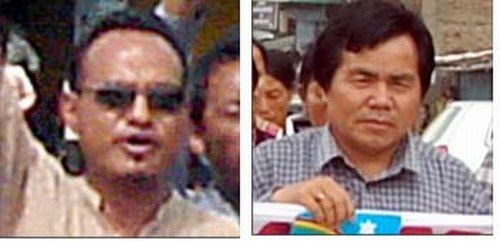

Samson Remmei and David Chorro

Now that the imposed elections for the ADC have been mock staged on May 26 and June 2 with "nil" votes being cast in most of the Naga areas and Congress candidates finding themselves uncontested in 36 constituencies, the State Government is congratulating itself for the successful conduct of the election, ANSAM derided.

Chief Minister O Ibobi, as reported in the media, extended an invitation through a letter from the Chief Secretary to the ANSAM for talks on the ADC issue and the economic blockade on May 26 at 2.30 pm, the day of the first phase of ADC polls, it said.

As the first phase of polling had already started, the invitation had no relevance except the intention to project the ANSAM as opposing any initiative to resolve the issue, charged the student body.

This was followed by issuance of arrest warrants against ANSAM and UNC executives.
The cheap gimmick of inviting for talks when elections were already imposed and then following it up with arrest warrants will definitely convince the Naga people of the sincerity of the State Government, it asserted.

"We therefore appeal to the general public of Manipur, once again to understand the game played by the Ibobi Singh Government to suppress the rights of the tribal people and also why we must continue to agitate till our grievances are addressed", ANSAM asserted.

Saying that the hill people have consistently demanded for the extension of 6th Schedule since 1990, ANSAM iterated that the tribals would have the benefit of decentralization, self governance and development in their land, if their demands have been been granted.

After 20 years of agreeing to extend 6th Schedule to the tribal areas of Manipur, with dithering on "local adjustment" the valley centric Manipur State Government came out with the Manipur (Hill Areas) District Councils (3rd Amendment) Act 2008, carefully doctored and stripped off of all the provisions that go into self governance and the rights of the hill people over their land and resources and removing the primacy of the traditional institutions of the tribals.

Thus after a series of consultative meetings conducted under the aegis of the UNC, Manipur and Naga frontal organizations, the Naga people unanimously decided to reject the Manipur (Hill Areas) District Council Act 1971 and the Manipur (Hill Areas) District Councils (3rd Amendment) Act 2008 in its present form and content.

Decrying the position of the State Government that the ADC elections must be held as scheduled and necessary amendments to the ADC Act can be taken up later, ANSAM rued that had the elections been deferred and the empowering amendments enacted, the election would have been a successful democratic exercise.

The intending candidates for ADC who all wanted to withdraw from the election on realizing the profound wishes of their people and return to their villages in the Naga hills were kept in Imphal under high security, it alleged.

Allowing the extension of 6th Schedule to the tribals would mean allowing the tribals to decide their own future which would understandably be different from that of the Meiteis.

So the only way left for the Ibobi Government was to impose an election under the Manipur (Hill Areas) District Councils (3rd Amendment) form of agitation.

Even then, the Government went ahead with the imposition of the election, it asserted.
Now that the imposed elections for the ADC have been mock staged on May 26 and June 2 with "nil" votes being cast in most of the Naga areas and Congress candidates finding themselves uncontested in 36 constituencies, the State Government is congratulating itself for the successful conduct of the election.

Chief Minister Ibobi, as reported in the media, extended an invitation through a letter from the Chief Secretary to the ANSAM for talks on the ADC issue and the economic Blockade on May 26 at 2.30 pm, the day of the first phase of ADC polls.

As the first phase of polling had already started, the invitation has no relevance except the intention to project the ANSAM as being opposed to any initiative to solve the issue.

This was followed by issuance of arrest warrants against ANSAM and UNC executives.

The cheap gimmick of inviting for talks when elections were already imposed and then following it up with arrest warrants will definitely convince the Naga people of the sincerity of the State government, it asserted.

"We therefore appeal to the general public of Manipur, once again to understand the game played by the Ibobi's Government to suppress the rights of the tribal people and also why we must continue to agitate till our grievances are addressed", ANSAM conveyed.

Saying that the hill people have consistently demanded for the extension of 6th Schedule since 1990, ANSAM iterated that the tribals would have the benefit of decentralization, self governance and development in their land, if their demands have been been granted.

After 20 years of agreeing to extend 6th Schedule to the tribal areas of Manipur, with dithering on "local adjustment" the valley centric Manipur State Government came out with the Manipur (Hill Areas) District Councils (3rd Amendment) Act 2008, carefully doctored and stripped off of all the provisions that go into self governance and the rights of the hill people over their land and resources and removing the primacy of the traditional institutions of the tribals.

Thus after a series of consultative meetings conducted under the aegis of the UNC, Manipur and Naga frontal organizations, the Naga people unanimously decided to reject the Manipur (Hill Areas) District Council Act 1971 and the Manipur (Hill Areas) District Councils (3rd Amendment) Act 2008 in its present form and content.

Decrying the position of the State Government that the ADC elections must be held as scheduled and necessary amendments to the ADC Act can be taken up later, ANSAM rued that had the elections been deferred and the empowering amendments enacted, the election would have been a successful democratic exercise.

The intending candidates for ADC who all wanted to withdraw from the election on realizing the profound wishes of their people and return to their villages in the Naga hills were kept in Imphal under high security, it alleged.

Allowing the extension of 6th Schedule to the tribals would mean allowing the tribals to decide their own future which would understandably be different from that of the Meiteis.

So the only way left for the Ibobi Government was to impose an election under the Manipur (Hill Areas) District Councils (3rd Amendment) 2008, which does not provide for any sort of autonomy and leaves the District Councils at the mercy and control of the State Government.
Through deceit and calculated schemes, all through these years, the rights of the tribals have been undermined and attempted to be curtailed with legislations by taking advantage of the majority of 40 MLAs in a total house of 60 .

The sensible Imphal valley people must seriously think how they are being misled by the State Government and the organizations colluding with it, who are allegedly still on the outdated mission of forced decimation of hill people, ANSAM called out.

[ via The Sangai Express ]

Sacraments Bar on Gays In Mizoram

Homosexuals will be allowed to pray, says Mizoram Church


homosexuals-are-gay Aizawl, Jun 9 : A major church congregation in Mizoram has said homosexuals would be allowed into the church for regular prayers but would not be allowed to take part in the community ritual of the Sacraments.

Rev. Zosangliana, the moderator of the Mizoram Presbyterian Synod, the largest church assembly in the state, today told The Telegraph over telephone that his church would not include the sexually deviant individuals, both male and female, in the practice of the Sacraments inside the church.

The Sacraments is a religious ceremony during which baptism and penance are bestowed on practicing Christians.

The reverend also denied a national agency report quoting the Synod saying homosexuals in Mizoram would either be excommunicated or suspended if they were found to be “gross deviant” in nature.

The Synod is a revered body among the Christians in the state, with nearly 3.5 lakh members, over half the total population of Mizoram. It has over 1,000 churches spread over the state.

Rev. Zosangliana said the Synod recently conducted a survey in Aizawl and found that among the church members, at least 13 pairs were homosexuals.

He said the reports from the state’s other towns and rural areas on the number of the homosexuals in Mizoram were yet to be collected as Presbyterian churches were either in the process of either compiling data of corroborating the cases of these individuals through confessions.

The reverend said in December last year, the Synod was accused of being “too lenient on the cabal of homosexuals”.

At that time it had even toyed with a proposal of excommunicating two homosexual men and two lesbians living together like man and wife, thus “vitiating the general air of decency in society”.

However, Rev. Zosangliana said such a harsh measure did not find favor with the Synod Executive Committee, the highest decision-making body of the Presbyterian congregation in Mizoram.

2 Women Held For Uranium Smuggling in Meghalaya

uranium smuggling Shillong, Jun 9 : Two women have been arrested in Meghalaya on suspicion of uranium smuggling, police said Tuesday.

The duo -- Jobila Marak and Evalila Sangma -- were arrested in Jengjal area in West Garo Hills district Monday, police said.

They were arrested by Meghalaya Police on the basis of information given by two people arrested earlier last week in Assam's Mankachar town with a packet suspected to contain uranium.

Booked under the Arms Act and the Explosives Act, the two women will be handed over to Assam Police for questioning, police said.

Last week, Mankachar police in Assam's Dhubri district arrested two men - Sanjeev Marak and Trolik Marak - with a packet bearing a seal of the Department of Atomic Energy. A pistol was also recovered from them.

The packet has been sent to the forensic science laboratory for analysis, Dhubri Superintendent of Police Deepak Choudhury said.

'We cannot say for sure now what it contains, but we apprehend that it contains some kind of explosives,' Choudhury told IANS over phone.

The Mankachar-West Garo Hills district is a sensitive sector due to its proximity to Bangladesh. This corridor is used by militants to infiltrate into India and also enter Bangladesh.

Dhubri district's border with Bangladesh is manned by the police together with the help of the Border Security Force, barring the riverine border, the police official said.

Meghalaya to Have Winter Capital

tura-peak-meghalaya Shillong, Jun 9 : Meghalaya is likely to have a winter capital in Tura, Chief Minister Mukul Sangma announced Tuesday.

Tura, district headquarters of West Garo Hills, is about 340 km from from Shillong.

Garo Hills is name after the tribe that inhabited the area while Shillong, the Meghalaya capital, is dominated by the tribal Khasi.

'Construction of the annexe Raj Bhavan in Tura will begin this fiscal,' Sangma told the assembly.

08 June 2010

India Will Develop National Highway Linking Bangladesh

Bangladesh-Map New Delhi, Jun 8 : After deciding to construct a bridge over the Feni river in south Tripura to get access to the Chittagong port in Bangladesh, India has decided to convert the connecting two-lane national highway into four-lane one, officials said Tuesday.

'The National Highway Authority of India (NHAI) would convert the Agartala-Sabroom portion (133 km) of the Assam-Agartala national highway (NH 44) from the existing double lane to four-lane at a cost of Rs 2,000 crore by 2013,' Tripura public works department (PWD) chief engineer Sunil Bhowmik told reporters here.

Bhowmik said Scot Wilson India Ltd, a NHAI approved consultancy agency, had been asked to prepare a detailed project report (DPR) for the conversion project.

The 133-km long highway from Tripura capital Agartala to the border town of Sabroom would be reduced to 127 km as the existing alignment of the highway would be changed in 119 locations. It would avoid passage through Agartala city and the Sipahijala wild life sanctuary and national park in western Tripura.

A high-level NHAI team, led by its Chief General Manager S.S. Nahar, visited the northeastern state Sunday and held a meeting with the state government officials and planned the strategies to start the works.

The 630-km long NH 44, considered the life line of Tripura, Mizoram, southern Assam and eastern Manipur, also connects Meghalaya capital Shillong with Sabroom. Of the 630 km length, 184 km is in Meghalaya, 111 km is in southern Assam and 335 km is in Tripura.

Works is now in progress to convert the NH 44 from southern Assam to Agartala into four lanes.

India has decided to construct a bridge over the Feni river to get access to the Chittagong port for carrying goods and heavy machineries for the land-locked northeastern region.

The Bangladesh government has earlier this year agreed to allow India to use the Chittagong port, about 75 km from Sabroom.

Tripura Commerce and Industry Minister Jitendra Choudhury said

the centre would provide required funds from the assistance to states for developing export infrastructure and allied activities (ASIDE) scheme to construct the bridge.

'The proposed bridge would connect Sabroom town with Ramgarh town of southeastern Bangladesh. Besides construction of the bridge, various other tourism-related amenities and infrastructure would also be constructed in and around the area,' he added.

Indian Govt Turns Down Meghalaya's Proposal For Music University

Keyboards Shillong, June 8 : The Centre has turned down Meghalaya&aposs proposal for setting up a world class university of music in the state.

State Education Minister Ampareen Lyngdoh told the assembly today that the proposal for the Rs 100 crore project, made by her predecessor Manas Chaudhuri, was turned down by the then Union HRD Minister Arjun Singh.

The Centre had argued that Meghalaya already had North Eastern Hill University, a central institution.Recalling that during his tenure as Education minister Chaudhuri himself had written to the then Union Minister of DoNER, Mani Shankar Aiyar for setting up a world class central university of music, Lyngdoh informed the House that the ministry took up the matter with HRD ministry.

In his reply to the state education department, Singh had, however, acknowledged that the people of state did have"exceptional aptitude"in a myriad genre of music.

Contending that such a music university should be set up in any other state of the Northeast region, which does not have a central university, Singh had even proposed Assam’s name for the proposed project.

Pointing out that there was"music talent"in the state, Chaudhuri urged the education minister to examine the idea of introducing music in the school board curriculum.

The education minister maintained that the state government was still "trying to put pressure"on the Centre for clearing the proposal.

Assam Truckers Hesitant to Ply Through Nagaland

assam trucks Guwahati, June 8 : Private truck associations in Assam have expressed reservations in running their vehicles on National Highway 39 leading through Nagaland to Manipur, crippled by a blockade by Naga students.

"Although we sincerely want to carry essentials to the Manipur, safety concerns for out staff on trucks prevent us from plying vehicles through Nagaland," a spokesman of the association said here.

"The association has decided to refrain from plying vehicles on National Highway 39 due to the blockade by the Naga Students Federation (NSF) due to safety concerns," he said.

Meanwhile, the influential All Assam Students Union (AASU) today appealed to NSF to lift the blockade on 'humanitarian grounds' in the interest of the common people.

"We have appealed to NSF which is a part of the North East Students Organisation (NESO) to lift the blockade," AASU advisor and NESO chairman Samujjal Bhattacharya said.

Rights Group Exposes Children Mining Scandal in Meghalaya

8mining1 Kazuko Ito (left) with Hasina Kharbhih at the press conference in New Delhi

New Delhi, Jun 8 : At least 70,000 children, mainly from Bangladesh and Nepal, are working in hazardous and inhumane conditions in mines in the Jaintia Hills area of Meghalaya in northeastern India.

An international human rights group and an Indian NGO have urged national and international bodies to investigate.

India has many mechanisms to address child labor but they are ineffective in the Jaintia Hills of Meghalaya, Kazuko Ito, secretary general of Human Rights Now (HRN), a Tokyo-based international human rights group.

Meghalaya comprises three hills districts - Garo, Jaintia and Khasi.

An HRN team collaborated with the Impulse NGO Network, a Meghalaya-based NGO, to study the child labor situation in the Jaintia Hills from May 31-June 2. The team visited three coal mines and interviewed 45 people, including child workers.

Ito said they found most children below 14. A 12-year-old boy told them he has worked there since he was eight.

The children also work in extreme danger with few safety measures. They cut coal in deep underground holes with little air supply.

Ito said her team felt suffocated and made a hasty retreat after going some 1000 meters into a coalmine hole.

The team quoted some elders as saying middlemen duped the children promising easy money for simple tasks.

Hasina Kharbhih of the Impulse NGO Network alleged that the mine owners are also guilty of extrajudicial killings as they lock up children in closed mines as punishment and many die.

She said her group has worked in the Hills for the past five years and had reported the matter to the federal Social Welfare Department and National Human Rights Commission, but so far no action has been taken.

The NGOs want international monitoring bodies such as Commission of Inquiry of ILO and UN Special Rapportuers to look into child trafficking and extrajudicial killings in the Jaintia Hills.

They also want the Indian government to sign a bilateral agreement with Nepal and Bangladesh to prevent child trafficking and prosecute offenders.

The groups also want international business communities to stop buying coal from Meghalaya until the mine owners stop using child labor.

[ via ucanews ]