20 May 2010

What Will it Take to The Change The Indian Police?

By Paranjoy Guha Thakurta and Ayaskant Das

As far as the states are concerned, the acceptance of the seven directives of the Supreme Court to reform policing has been uneven at best or, at worst, ignored completely, say Paranjoy Guha Thakurta and Ayaskant Das.

The image of the policeman in popular Indian cinema has hardly changed over the decades. He is either a bungling buffoon. Or he is corrupt to the core. The honest cop who is also efficient is hard to find -- and even he is certain to be in a woefully small minority in a battalion where jokers and crooks proliferate.

Compared to many countries the number of police personnel per person in India is quite low: Roughly 130 for every 100,000 residents, against around 350 in the United States, Australia, Thailand and Malaysia, over 550 in Italy, 280 in South Africa and 180 in Japan. The norm suggested by the United Nations is 220 per 100,000.

The issue is not merely the number but the quality of people who become part of the police force, the facilities provided to them and, perhaps most importantly, the laws that govern policing -- laws that are, at least in India, frequently subverted and manipulated by politicians and bureaucrats holding positions of power and authority.

It is common knowledge that the Indian Police Act, 1860, was formulated by the colonial rulers of the country to check mass uprisings that started with the revolt of 1857, which the British described as the 'Sepoy Mutiny' and nationalist historians called the 'First War of Independence'.

After 1947, there was widespread consensus across different sections of Indian society that the colonial act would have to be amended and comprehensive reforms ushered in to improve the system of policing in a democracy. Unfortunately, despite the recommendations of many commissions and expert bodies appointed by the central and state governments over the years, very little has been achieved in reforming the policing system.

Policing is a subject listed under the state list in the Seventh Schedule of the Constitution of India and hence, it is largely the prerogative of state governments to bring about policing reforms. As for Union territories, there has been a persistent demand from civil society organisations that the Union government take the lead in enacting a new police law or a Model Police Act (MPA) for all Union territories based on directions that were laid down by the Supreme Court.

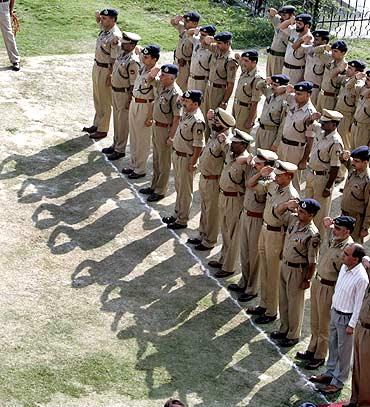
Image: Senior Indian police officers at a wreath-laying ceremony for fallen colleagues in Srinagar, September 13, 2009.
Photographs: Danish Ismail/Reuters

The Supreme Court directives to reform policing have been ignored
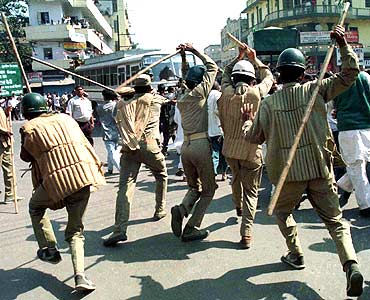
On September 22, 2006, the Supreme Court of India delivered a historic judgment in the Prakash Singh vs Union of India case (on the basis of a petition that had been moved a decade earlier) instructing the central and state governments to comply with a set of seven directives to reform policing in the country. One of these directives concerned the Union government, namely, to establish a National Security Commission.

The court sought to achieve two broad sets of objectives: First, to ensure functional autonomy for the police through security of tenure, streamlined appointments and transfer processes and the creation of a 'buffer body' between the police and the government and to enhance accountability of the police at an organisational level and also to curb individual misconduct.

The Supreme Court required all governments, at the Centre and in the states, to comply with the seven directives by the end of 2006 and to file affidavits of compliance by January 3, 2007. Whereas a few state governments complied with the directives on time through executive orders, there were many that were vehemently opposed to the directives and perceived these to be measures that would erode the autonomy of state governments.

The short point: As far as states are concerned, the acceptance of the seven directives of the Supreme Court has been uneven at best or, at worst, ignored completely.

Prakash Singh, former director general of the Border Security Force and the Uttar Pradesh police, told rediff.com that the states that have been the "most defiant" in accepting the directives of the Supreme Court are Tamil Nadu and Andhra Pradesh. The Bihar government has enacted a "perverse law that makes a mockery of the Supreme Court directives" while Uttar Pradesh has "perhaps been the worst in implementing the directives while making contrary claims."

Mr Singh added that certain states in north-east India such as Nagaland, Manipur and Mizoram had promptly accepted the directives of the court but were tardy in implementation. "Rajasthan has passed the best law but this has not yet been implemented," he said.

The Union government formed a Police Act Drafting Committee (PADC) in 2005 under the chairmanship of Soli Sorabjee, the eminent jurist and former attorney general of India. The PADC submitted a proposition for a Model Police Act, MPA, in October 2006, the broad scheme of which was endorsed by the Second Administrative Reforms Commission, ARC, set up by the central government under the chairmanship of Veerappa Moily (who is now the Union law minister).

In its review of the system of policing and criminal justice, the ARC had suggested a few additional provisions in the proposed MPA, notably a penalty for illegal orders that were tantamount to interference in investigation by the police and obstruction of justice.

Three civil society organisations have jointly drafted an alternate bill
In September 2009, Union Home Secretary G K Pillai requested Delhi Lieutenant Governor Tejendra Khanna to send a legislative proposal for amendments to the Delhi Police Act, 1978, in conformity with the directions of the Supreme Court and the provisions of the MPA. In February 23 this year, the lieutenant governor forwarded a draft Delhi Police (Amendment) Bill, 2010, to the home ministry. This bill was also placed in the public domain for comments and objections.

Three civil society organisations keenly interested in police reforms -- Common Cause, the Commonwealth Human Rights Initiative, CHRI, and the Foundation for Restoration of National Values, FRNV -- did an independent study of the bill. They arrived at the conclusion that it is practically impossible to overcome the inherent limitations of the Delhi Police Act, 1978 through the amendment route.

These organisations have argued that the proposed amendments cannot give the Delhi Police Act 1978, adequate teeth to meet the contemporary needs of policing in the context of a hostile security environment, mounting social tensions and rapid urban expansion. Several eminent citizens echoed similar views at a workshop organised by the Bureau of Police Research & Development on April 10 in New Delhi.

The three civil society organisations have jointly drafted an alternate bill that has, among other provisions, provided for well-defined structures that would ensure operational autonomy of the police force along with institutional arrangements to assess performance and enforce accountability. The alternate bill seeks to clearly define the role, functions, duties and responsibilities of police personnel vis-a-vis other civilian authorities.

The alternate bill seeks to enhance levels of professionalism and leadership qualities in the police force through regular training and also by improving the infrastructure and facilities made available -- transport, computerised databases, communication networks, modern weapons, better police stations and so on.

The alternate bill emphasises core police functions and duties and argues for the need to phase out non-core functions to state and local institutions in accordance with the intent and provisions of the Constitution of India. It also argues for transparent procedures for recruitment, promotion and redressal of grievances and suggests various welfare measures for the lower ranks of police personnel.

The alternate bill was given on May 3 to Home Secretary Pillai who is known to be in favour of many of these suggestions for reforming the country's police system. Whether legislators would be responsive is another story altogether.

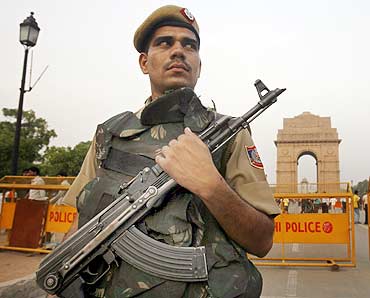
Image: A policeman stands guard at India Gate in New Delhi.
Photographs: B Mathur/ Reuters

[ via rediff ]

CPI-M Seeks More Power For Northeast Autonomous Councils

Communist_Party_of_India_Marxist Agartala, May 20 :  The Communist Party of India-Marxist (CPI-M) Wednesday urged the central government to give more powers to the northeast autonomous councils for all round development of the tribals, who constitute 27 percent of the region’s total population of around 40 million.

“We have been urging the centre to give more powers to the tribal autonomous district councils in northeast to eradicate poverty and diverse backwardness of the indigenous tribals,” CPI-M central committee member Khagen Das told reporters.

He was speaking ahead of the Left Front controlled sixth council’s assumption of office in the Tripura Tribal Areas Autonomous District Council (TTAADC).

The CPI-M also demanded infrastructural development in the existing 16 autonomous district councils (ADC) in northeast India facilitating the socio-economic development of tribals.

Of the 16 ADCs, six are in Manipur, three each in Assam, Meghalaya and Mizoram and one in Tripura.

“The Tripura government has given huge power to the TTAADC. The state assembly had passed a resolution long back urging the centre to give more powers to the TTAADC,” Das added.

An eight-member executive council led by chief executive member Ranjit Debbarma Wednesday assumed office at the TTAADC headquarters at Khumulwng, 25 km north of state capital Agartala.

The ruling CPI-M-led Left Front has stormed back to power in the TTAADC earlier this month for the second consecutive term.

The Left parties won handsomely in all the 27 seats with the dominant CPI-M securing 25 seats while its ally Communist Party of India (CPI) and Forward Bloc bagged one seat each.

The Congress and the other opposition parties failed to secure a single seat in the politically important autonomous council.

The council, election for which was held May 3, has 30 members, two of whom are nominated by the governor. Polling for one seat was postponed after a Bharatiya Janata Party (BJP) candidate died after being bitten by a dog.

With this victory, the Left Front has captured the TTAADC four times (1985, 1995, 2005 and 2010) after the autonomous council was formed under the Sixth Schedule of the Indian constitution in 1985.

Socio-Political Bodies to Start Movement Against Tipaimukh Dam

By Ehsanul Haque Jasim

save tipaimukh Dhaka, May 20 : Different political parties and social organizations are preparing to launch movement against India's move to start the construction of Tipaimukh dam in the Manipur state of India, apprehending that it would affect adversely the country's rivers and environment as well.

People of the Indian states of Manipur, Assam and Mizoram are also taking similar movement programme against the dam as its construction would have an adverse impacts on their states too.

Environmentalists fear that the north-eastern region of Bangladesh, including the greater Sylhet, might be turned into a desert area due the adverse impacts of the dam. Its implementation could also inundate a number of villages of Manipur, Assam and Mizoram states.

The Tipaimukh Dam issue was reportedly raised by Bangladeshi Prime Minister Sheikh Hasina when she met her Indian counterpart Manmohan Singh during her recent visit to India.

In that time, the India Premier had assured Sheikh Hasina that India would not do anything which would be harmful for Bangladesh.

Meanwhile, a memorandum of understanding (MoU) was signed on April 28 last among the NHPC Limited, Government of Manipur and SJVN Limited, a joint venture of the government of India and the government of Himachal Pradesh, for formation of a Joint Venture Company to start the construction of Tipaimukh dam.

After knowing this decision of the Indian government, different political parties and social organizations in the country have expressed their grave concern and sternly protested the decision. Bangaldesher Samajtantrik Dal (BSD) has already protested on the Indian move for construction of the4 dam, saying it would announce a number of movement schedules soon. BSD central leader Mahin Uddin Chowdhury Litan told this reporter that his party would launch movement programs from its central meeting to be held on May 25.

Sources said that the main opposition BNP is thinking to launch programme against the construction of the dam soon. BNP chairperson Begum Khaleda Zia has already launched hartal programme on June 27 against what the party said for the misdeeds and misrule of the government.

The party may launch a long march programme towards Tipaimukh Dam after the hartal programme, added the sources.

Aggression Protirod Jatiya Committee, the organization which is critical against the Indian water aggression, has already expressed its concern over the decision to start construction of the dam. It threatened the government that if it failed to take any initiative to stop the dam construction, the committee would launch tough movement along with the country's people.

In the meantime, Sylhet Division Development Action Council (SDDAC), a Dhaka-based organization of the people of Sylhet, would initiate various programs like demonstration, human chain and procession to make the people aware against the4 adverse impact of the Tipaimukh Dam.

SDDAC president Advocate Abed Raja told The New Nation that India is constructing the dam cheating with the people of Bangladesh as it assured that it would not do anything which would be harmful for Bangladesh. So there is no alternative to movement on the issue, he said.

On the other hand, the Sylhet Division Development Students' Action Council would organize different programs on the Dhaka University campus and in the capital protesting the construction of the dam.

Manipur: No Exit At The End Of The Road

By M. S. Prabhakara

Security men fire teargas shells to disperse protesters who were demonstrating against their deployment to check the entry of NSCN (I-M) Secretary General Thuingaleng Muivah into Manipur, at Mao Gate on May 6, 2010. Blockades at Mao Gate imposed by one or the other organisation in Nagaland have become a fact of life.

Security men fire teargas shells to disperse protesters who were demonstrating against their deployment to check the entry of NSCN (I-M) Secretary General Thuingaleng Muivah into Manipur, at Mao Gate on May 6, 2010. Blockades at Mao Gate imposed by one or the other organisation in Nagaland have become a fact of life.

The Mao Gate confrontation is just one instance of the bind which absolutist ideologies can lock themselves into.

Pradip Phanjoubam, Editor of the English Daily Imphal Free Press, bicycles to his office and everywhere else in Imphal. Sananami Yambem, who recently took voluntary retirement from NABARD, walks. So do many others in Imphal and other places in Manipur who for long had used motorised transport.

These choices have been forced on them. NH-39 is the principal highway from the rest of India into the State. NH-53 (the New Cachar Road) linking Cachar in Assam to Imphal is another lifeline, though it is longer and less preferred. There is yet another point of entry, going all the way into Mizoram and entering Churachandpur district.

The uniqueness of the political geography of the State is that Manipur is at the end of a receiving chain of roads, and on the edge of the periphery of the Indian state. Most essential goods come into Manipur; few goods considered essential by the rest of the country leave it. Blockade of highways leading into and out of Manipur, which has become a routine phenomenon, only hurts the State, not the rest of the country. This is not the case, for instance, with Assam, a well known candidate for such coercive blockades. When there is a blockade in Assam, Delhi has to resolve the real or imagined grievance that led to the blockade. Blockades of Manipur do not inspire such a sense of urgency.

Following the intensification of the ongoing blockade of NH-39 since early April (on an entirely different issue) at Mao Gate on Manipur's northern border with Nagaland by Naga organisations protesting against the Manipur government's resolve to bar the entry of Thuingaleng Muivah, the general secretary of the National Socialist Council of Nagaland (I-M), into the State, and the violence that accompanied it, supplies of essential goods from the rest of India have virtually stopped. Petrol now sells in the so-called black market for about Rs. 200 a litre. So, bicycles that were once the normal mode of transport and indeed defined the State are returning to the roads, though they are sure to disappear when the blockade is lifted.

The blockade is not unique. For the people of Manipur as well as those from outside the State doing business in Manipur, blockades at Mao Gate imposed by one or the other organisation in Nagaland have become a fact of life. Road transporters moving goods into or out of the State have always paid tolls at various points to one or other militant group, self-proclaimed or real. These impediments by their nature were temporary and one could buy relief on the spot.

Things are rather complicated when larger political issues are involved. In the present instance, the NSCN(I-M) general secretary planned to travel to Somdal, his ancestral village in Ukhrul district, whose overwhelmingly Tangkhul Naga population supports the call by the NSCN(I-M) for the “integration of Naga inhabited areas outside Nagaland into a single political unit,” in other words, Nagalim, or greater Nagaland.

Inherent in this demand for an enlarged Naga Land — this form is used to differentiate the putative ‘Nagalim' from the present State of Nagaland — is the disintegration and effacement of the present State of Manipur. In the Naga nationalist imagination whose political programme has not always followed a rigid trajectory, such a formal acknowledgement of the territoriality of Naga nationalist imagination is the first step in the attainment of its final objective, a sovereign and independent Naga Land, Nagalim.

This fundamentally undermines the Manipuri nationalist imagination as articulated by the majority of the people in the Valley. In its more extreme form, this at least in theory requires an acknowledgement of the skulduggery that was inherent in the “manipulated merger” of Manipur in India in October 1949, though such an acknowledgement would not necessarily entail “the restoration of the sovereign and independent status of Manipur.” But this certainly militates against the Naga nationalist imagination whose very ‘reason for existence' is the disintegration of the present political and geographical State of Manipur. A rock and a hard place can well be the metaphor for such contending, and equally fervid, nationalist imaginations that, curiously, are united in their rejection of the broader, and (in their perspective) oppressively inclusive, Indian nationalist imagination.

June 18, the day in 2001 when many parts of Imphal went up in flames and virtually all the “people of Manipur” (a fraught expression that needs to be qualified and defined, which is not always possible given space constraints) rose in revolt against the Government of India's decision to make the annual periodic extension of ceasefire against the NSCN(I-M) applicable “without territorial limits to all Naga-inhabited areas” perhaps saw the first organised expression of the united resolve of the people of the Valley to resist with violence, if necessary, moves to diminish the political and territorial entity of Manipur.

The coming into being of the United Committee of Manipur (UCM) now means no initiative can be taken to resolve the Naga issue without the fullest consultations, not merely with the State government but also ‘civil society' organisations. The emergence of the UCM also challenged the generally accepted view (outside the State and the region) that while the Meitei people inhabited the Imphal Valley, four of the outlying districts (Senapati, Ukhrul, Chandel, and Tamenglong) were Naga inhabited while the fifth, Churachandpur, was Kuki inhabited.

The reality is, however, more complex. Whatever may have been the population profile of these districts in historic times or in the wake of the colonial conquest or even at the time of Independence, now it is decidedly a mix of non-Naga ethnic groups, tribal and non-tribal, with the predominant Naga stream itself divided and sub-divided in terms of clans and others. People from one part of the State have moved to settle in other parts of the State, with the result that the once near-absolute correlation between a district and the people who inhabit the district no more obtains.

Even Ukhrul district, viewed as overwhelmingly inhabited by one Naga tribe, the Tangkhul, now has a significant presence of other people, in particular the Kuki. In Senapati district, supposedly inhabited overwhelmingly by the Mao Naga, Kuki people dominate the Sadar sub-division. They also have many political demands for ‘recognition', assertion of territoriality and demarcation of an exclusive political space. Much the same points may be made in respect of Tamenglong and Chandel districts. A further complexity of switching of tribal identities is a marked feature of the identity politics, which is especially marked in Chandel district.

So, Mr. Muivah, for years accustomed to having his way with the government of India, is unlikely to make his way, to Manipur, technically his home State. It was Mr. Muivah, above all, who made territoriality central to the nationalist imagination of the Naga people as sovereignty. Though ever since the beginning of the Naga struggle for freedom these two have been seen as two sides of the same coin, and without the one the other is not complete, it was the NSCN under Mr. Muivah that invested territoriality with its intensity and urgency. This has also made any compromise difficult.

The intensity of the blockade and confrontation at Mao Gate, which even the State government is not taking any initiative to resolve, is just one instance of the bind which absolutist ideologies with an all or nothing mindset can lock themselves into. There is a lesson in this for exclusivist nationalisms of every hue in the region. There is a lesson for exclusivist Manipuri nationalists, too, though by definition they cannot undertake any programme of blockade, which of its nature will be against the well-being of the very people whose cause they espouse.

[ via the Hindu ]

19 May 2010

Young Tripura Entrepreneur Leads by Example

By Pinaki Das

recycling-paper A young female entrepreneur in Tripura is not only generating employment for people, but is doing her bit for the environment by converting waste to wealth. Alma Chowdhry is a housewife-turned-entrepreneur from Golchakkar village near the Indo- Bangladesh border in Tripura.

In 2007, she along with a team of 25-members formed Samrat Papers, an outfit to recycle waste paper, discarded paperboard and cartons with a small government loan.

"I had noticed that Indian wastepaper made its way illegally to Bangladesh so, I wanted to set up something here, which would create employment for our people," Chowdhry said.

"We set up the factory where we collect waste paper, recycle it and export the product to Bangladesh and other states. Many people today have got employment in our factory," she added.

A majority of over 70 workers at Samrat Papers are housewives, who now earn extra income that helps them in looking after their families.

"We work as part-time labour and earn an additional income of Rs. 1300 per month. This is a great opportunity to earn for our family," said Rupa Das, a worker.

"Earlier we were just housewives but after being employed here we are now earning members as well. This extra income helps in educating our children and also running our families smoothly," said Asma Begum, another worker.

The final products are sold in Tripura and other states.

Cardboard is exported to Bangladesh and helps earn foreign exchange.

Indeed! Salma Chowdhry's initiative has changed many lives in the non-descript village.ore significantly, her contribution to saving trees by recycling waste paper is noteworthy.

Dio's Two-Finger Gesture - What Does it Really Mean?

Hand sign by Ronnie James Dio

WHO, WHAT, WHY?

American rock singer Ronnie James Dio, who died on Sunday, popularised a hand gesture commonly used by heavy metal fans. But what does it mean?

THE ANSWER

It has different meanings, depending on context and position of fingers:

For Dio, it was a superstitious way to ward off evil

At heavy metal gigs, fans use it to show their appreciation

For Texans like George W Bush, it is a show of support for the state university

In American sign language it means 'I love you'

Bill Clinton and Barack Obama have used it in this way

President Obama also does a Hawaiian 'aloha' greeting

It's a gesture commonly seen at rock concerts.

The index finger and the little finger are upright and the thumb is clasped against the two middle fingers.

Ronnie James Dio, who sang with Black Sabbath and Rainbow before forming his own band, was partly responsible for it becoming a common symbol among metal fans.

But it has other uses too, depending on the position of the thumb, and the context. Here is a round-up of some of the common meanings.

'WE ARE LOVING THIS GIG'

"Ronnie started throwing the horns shortly after replacing Ozzy Osbourne as Black Sabbath's vocalist in 1979," says Simon Young, news editor of heavy metal magazine Kerrang!.

"Many metal fans began to reciprocate the gesture and along with headbanging, it became synonymous with metal."

Kiss fans at Donington Park in 2008

Less energetic than headbanging

Dio wasn't the first, says Young. In the 1960s, there had been Coven frontman Jinx Dawson, and the cartoon version of John Lennon on the cover of The Beatles' Yellow Submarine was seen using it too. But it really took off from Dio.

It has been misinterpreted as a sign of allegiance to the devil, because the shape of the fingers have been associated with 666, the number of the beast, says Young.

But Dio, says Young, explained that he was taught the so-called corna sign by his Italian grandmother, as a way to scare off the "evil eye", a look which is said to cause bad luck. It's like knocking on wood for superstitious purposes (more on this below).

Fans copied Dio because they thought it looked cool, and it became a sign of appreciation at gigs. But it has more recently crossed over into mainstream youth culture, says Young.

"Rihanna, Britney Spears and Avril Lavigne have all done it - perhaps they're all secret metal fans - but it has led to several internet groups forming in protest over the 'egregious overuse and inappropriate use' of throwing the horns. Quite right. Leave it to the metal fans."

WARDING OFF THE EVIL EYE

When Dio's Italian grandmother taught him the corna sign, she was drawing on a much older superstition.

WHO, WHAT, WHY?

Question mark floor plan of BBC Television Centre

A regular part of the BBC News Magazine, Who, What, Why? aims to answer some of the questions behind the headlines

Bram Stoker mentioned it in his novel Dracula, published in 1897. In the first chapter, protagonist Jonathan Harker notes the following in his journal while in Eastern Europe's Carpathian Mountains:

"When we started, the crowd round the inn door, which had by this time swelled to a considerable size, all made the sign of the cross and pointed two fingers towards me. With some difficulty I got a fellow-passenger to tell me what they meant; he would not answer at first, but on learning that I was English, he explained that it was a charm or guard against the evil eye."

This superstitious belief is especially common in Italy, but it is also shared in other countries.

In southern Italy, it can also be directed at a man whose wife is thought to be unfaithful, so it should be exercised with great care.

'GO, THE TEXAN LONGHORNS'

George W Bush in Texas in 2000

Go, Texas!

The slogan of the University of Texas is "Hook 'em, horns" and the hand sign that illustrates this motto is the same as the one used by heavy metal fans.

It is intended to symbolise the head and horns of the university mascot, the longhorn, and has been used since the 1950s.

Fans use it as a greeting or just to emphasise their Texan identity, a demonstration most famously seen in recent years by George W Bush.

His wife Laura and daughters were also fans.

'I LOVE YOU'

With the thumb sticking out, it has a different meaning entirely.

"It is the American sign for 'I love you'," says Sarah Murray of the British Deaf Association.

Barack Obama

Obama used it on the campaign trail

"It would probably be recognised by people here [in the UK] but you wouldn't see it often used."

American politicians like Barack Obama, Bill Clinton and Dick Cheney have been photographed using it in the same way, although some believe that Jimmy Carter was its first exponent when running for president in the 1970s.

When the Obamas use it with their thumb sticking out, it is different from the specifically Texan use by George Bush, says Trevor McCrisken, a professor in US politics at the University of Warwick.

"They want to show that they care about people that need to use sign language," he says. "If you're at a political event in the US, there will be a couple of people down the front signing to the audience, so they're more careful [than in the UK] to ensure that everyone with special needs is catered for."

'HANG LOOSE'

Ronaldinho

It's Ronaldinho's trademark celebration

At his presidential inauguration, President Obama was seen doing what is known as the "shaka" greeting, which has the thumb and little finger extended.

It is also exercised by Brazilian footballer Ronaldhinho as part of his goal scoring celebrations.

In Hawaii, where the president was born, the sign conveys affection or "aloha".

It has been adopted by the wider surfing community as a greeting meaning "hi", "cool" or "hang loose".

Hotmail Gets a Makeover

Screenshot of Windows Live Hotmail, Microsoft
The refresh will mean some content is viewable on the e-mail inbox window

Microsoft is refreshing its free e-mail service Hotmail in an attempt to give it an edge over rival offerings from Yahoo and Google.

The update will mean documents sent via Hotmail can be viewed and edited via web versions of its Office software.

Other changes are designed to improve security by filtering spam and spotting phishing attacks.

Hotmail is the world's biggest e-mail provider but faces increased competition, particularly in the US.

Figures from research firm Comscore show that Yahoo mail still dominates the free e-mail market in the US, with Microsoft in second place. Google's Gmail service is quickly adding to its market share.

Video window

Walt Harp, one of the directors at Windows Live, said many of the changes were designed to help people get to grips with the huge amount of information flowing through inboxes.

"That's where you manage your personal life, through your e-mail accounts," he said.

Updates from social networks, videos and snaps from friends, shipping details for goods ordered via the web all pass through e-mail inboxes, he said.

For instance, he said, one-click filters will let people see messages from one source such as Facebook or web retailer Amazon. Microsoft is also introducing the ability to sort e-mails by conversation rather than individual messages.

The feature is already available in Gmail.

The refresh includes tools to quickly get to work on the extras, such as web links, pictures and videos, included in messages.

The Active View system will preview pictures at the top of a browser window rather than send users to a separate page or service. Microsoft said Flickr, YouTube and the US Postal Service wil be among its partners using this feature.

Most of the elements of the refresh will be available after the summer update. However, said Mr Harp, the tighter connection to its latest version of Office - launched last week - will not happen until the autumn of 2010.

The launch of Office 2010 was seen by many analysts as a direct response to Google, which offers its own suite of Office software - known as Docs - for free online.

Windows Live Hotmail is currently the world's biggest e-mail provider. It claims to have more than 360 million members and it handles more than eight billion messages per day.

Lohan Has a New Lesbian Lover: Indrani

Lindsay_Indrani Indrani, a stunning photographer and a reality show star is Lindsay Lohan’s new cougar lesbian lover, according to a report published in the nypost. It says that Lindsay Lohan has been secretly seeing Indrani after they had worked together on a photo shoot last fall. Twenty three year old Lindsay Lohan is reported to have been on a series of dates in Los Angeles with thirty six year old Indrani and they have recently spent a night at Lohan’s hotel.

Indrani is also known as Julia I. Pal-Chowdhury. She is the half of the respected lens duo Markus Klinko and Indrani.

    We have been spending a lot of time together. I have never had a relationship with a woman before, but Lindsay is just somebody who I find fascinating, gorgeous and extremely smart, as well as super-hot.

Indrani told The New York Post,

    Lindsay gets a lot of bad press, but she’s a really strong, creative woman and is trying really hard to get her life in a good, positive place.

The other person of the lens duo, Klinko said,

    I’ve seen them on dates, I have seen them making out . . . Indrani is a good influence on Lindsay. She is the opposite of a party girl — a Princeton graduate, she’s into art and is a philanthropist — not what you’d expect the typical girl for Lindsay to go out with.

Lohan previously dated deejay Samantha Ronson. Indrani is not the first person Lohan is being linked to after her split from Ronson two years ago. She has been linked with many celebrities which includes Gerard Butler, “Entourage” star Kevin Connolly, Jason Segel, and French star Aurelien Wiik.


[ via nypost ]