18 April 2010

Fishing Festival in Manipur

manipur fishing with nets Willong, Apr 18 : The annual fishing festival in Manipur has attracted hundreds of people from the Maram tribe.

The festival commenced on Friday at the origin of the Barak river in Willong area of State's Senapati district.

Ngauning Gabriel, chairman of Willong, explained the rituals of the festival, known as 'Karjoi'.

"As part of our tradition, after the fish have been caught, people start drinking and bring out the Yai (type of fish) and declare that the fish have been caught. After catching the fish, we go back to our homes and offer the fish to the elderly and people who are ill and were unable to come to the festival. The majority of the fish is dried and stored until the next fishing festival takes place," said Gabriel.

The fishing festival takes place in either the month of March or April.

The Maram tribe is known for their age-old fishing techniques and believes failure to hold the festival brings misfortune to their community.

Hmar Rebels Asks Mizoram to Rethink Policy on Tipaimukh Dam

tipaimukh-dam-map Sakawrdai, Apr 18 : The Hmar Peoples Convention-Democratic (HPC-D) in its press statement today urged the Mizoram government to reconsider its policy on the construction of the controversial Tipaimukh Dam project to be built near the Mizoram and Manipur border.

The armed HPC-D group is an offshoot of the Hmar People’s Convention (HPC), which came into existence in 1986, spearheading a movement for self-government in the north and northeast of Mizoram.

H. Zosangbera, General Secretary of the HPC-D, stated that it is the duty of the Mizoram government to provide protection to the people in the demand areas of the HPC-D. Last year, the HPC-D demanded the creation of Hmar Territorial Council (HTC) in the State of Mizoram within the scope of the Sixth Schedule of the Constitution of India.

The HPC-D stated that it is firmly committed not to seek separation from Mizoram but to strengthen it against outside actors who are planning to steal and grasp the rich natural resources and land of the people of Mizoram.

It also added that if the Tipaimukh Dam is forcibly built without first considering the destructive impacts it will have on Mizoram and its people, and without taking the consent of the Hmar people, it will create more conflict and bloodshed.

The press statement also said that if the Mizoram government allows the dam to be built, then it will be fighting against its own people. It asked the Mizoram government in protecting the interests of its people and land.

The armed group destroyed the foundation stone of Tipaimukh Dam and some drilling machinery used by NEEPCO in 2008 at the remote Tipaimukh Dam site.

The Tipaimukh Dam is a 1500MW hydroelectric project proposed to be built 500 meters downstream of the confluence of the Tuivai river (Mizoram) and Tuiruong (Barak) rivers in Manipur.

Last year, the Government of India asked the NHPC Ltd, Satluj Jal Vidyut Nigam Ltd (SJVN) and the Government of Manipur to form a joint venture (JV) for developing the project. NHPC would hold a majority 69 per cent stake in the project, while SJVN would take up another 26 per cent stake. The remaining 5 per cent would go in favor of the Manipur government.

The project was initially awarded to the state-owned utility North Eastern Electric Power Corporation Ltd (NEEPCO). The company had, however, expressed its inability to take up the project citing lack of budgetary support. The Mizoram government had 1-2 percent stake then.
Different national and international organizations have long been resisting the construction of the Tipaimukh Dam.

Iceland's Volcano

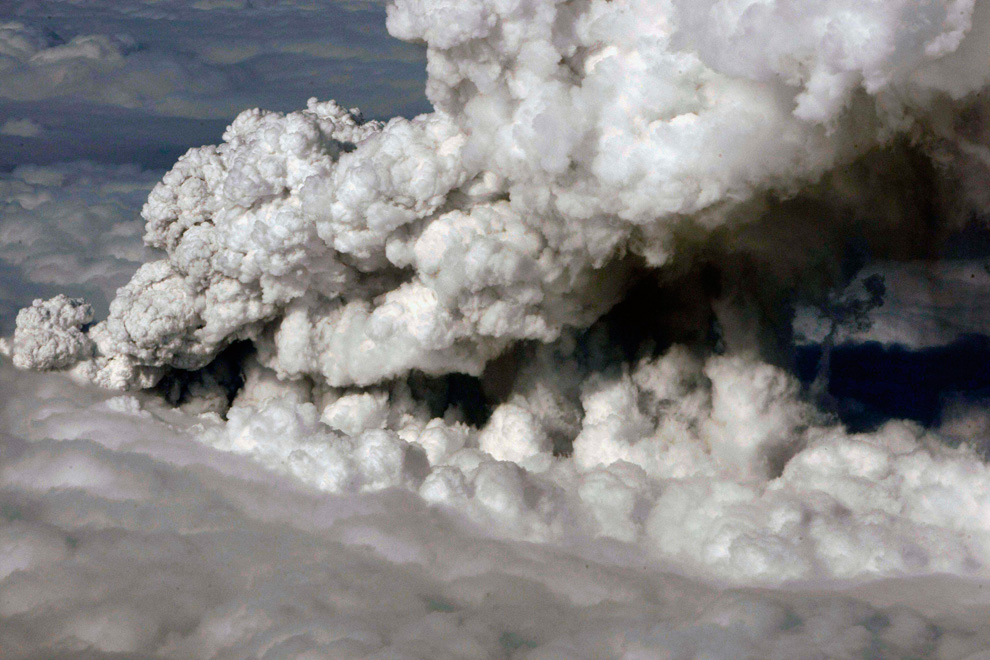
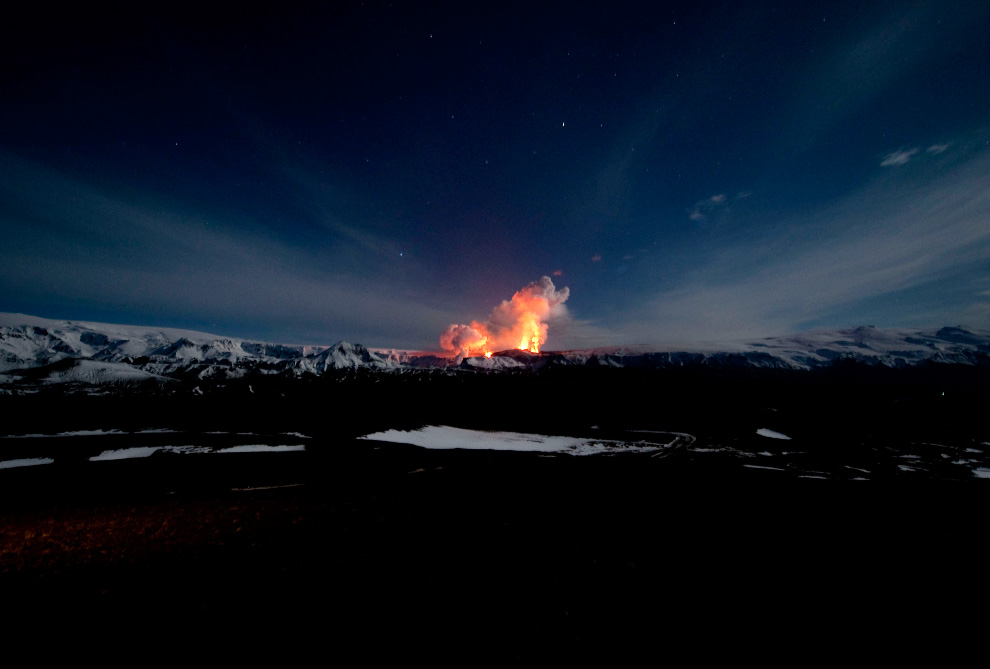
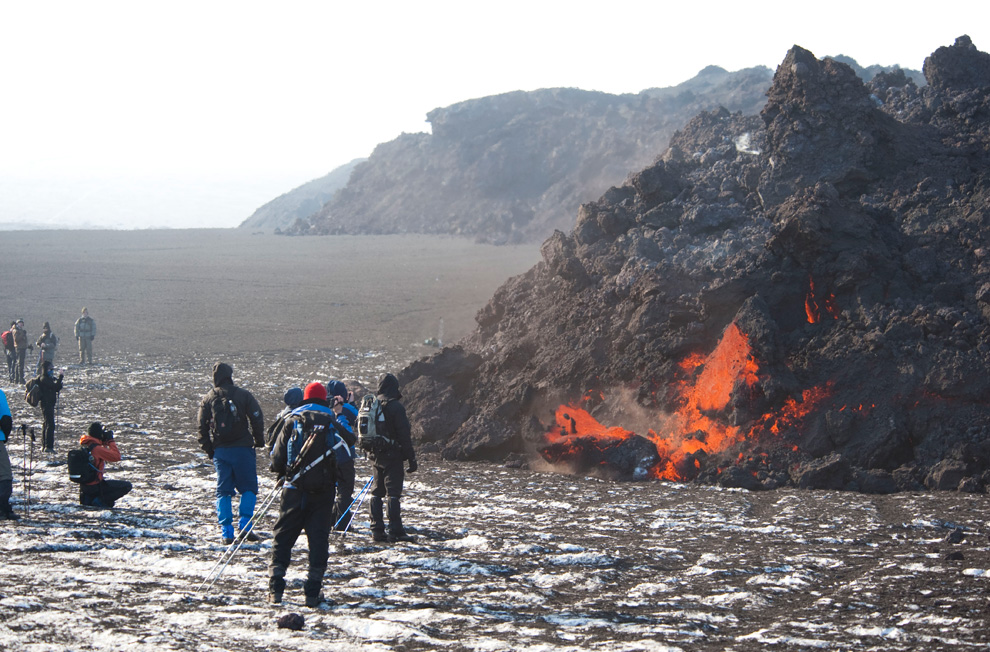
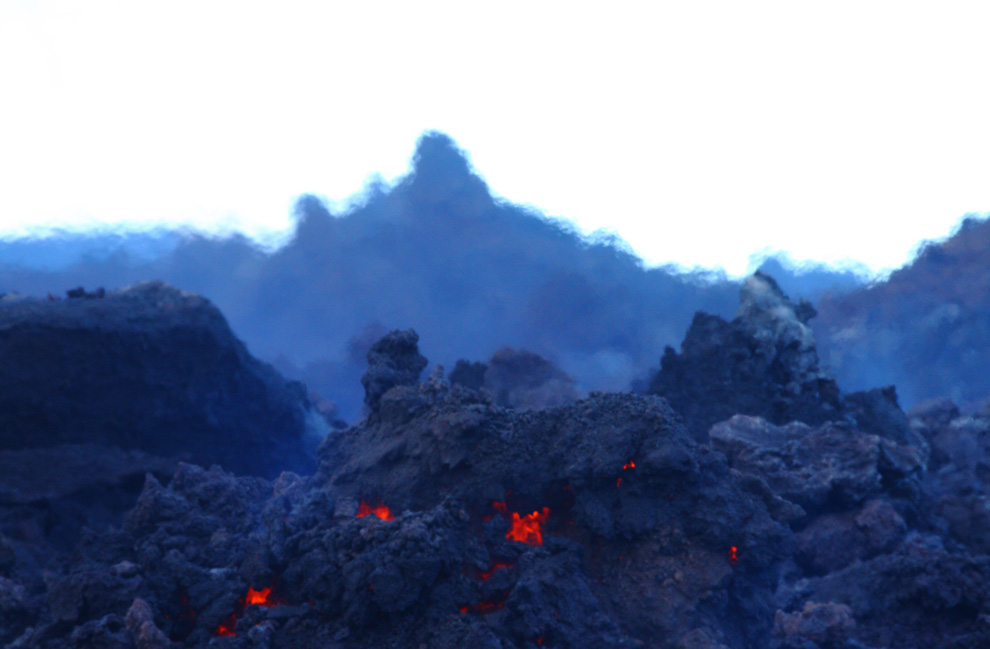
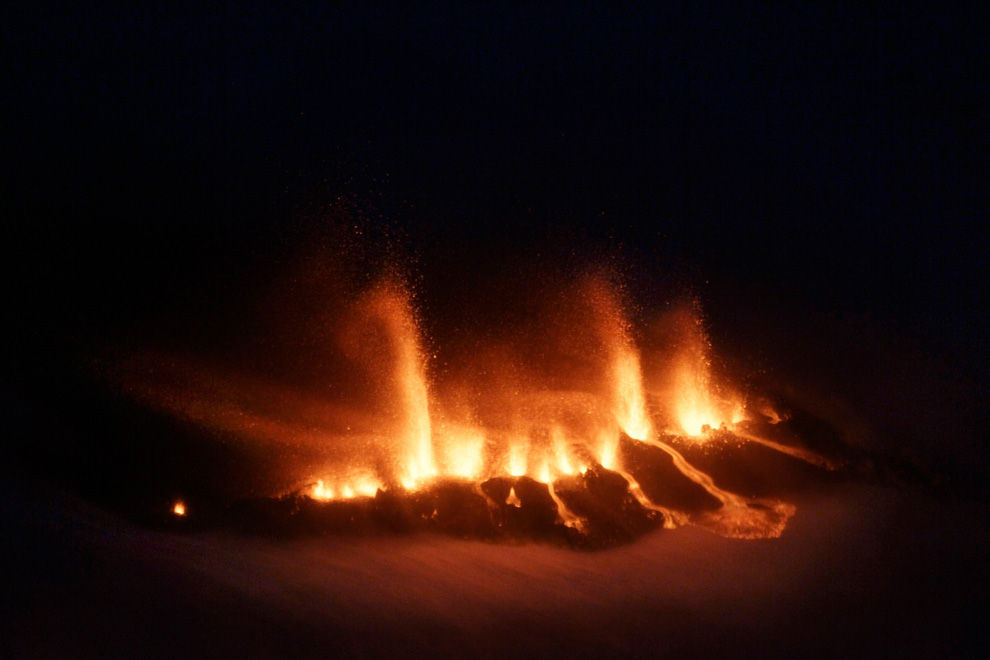
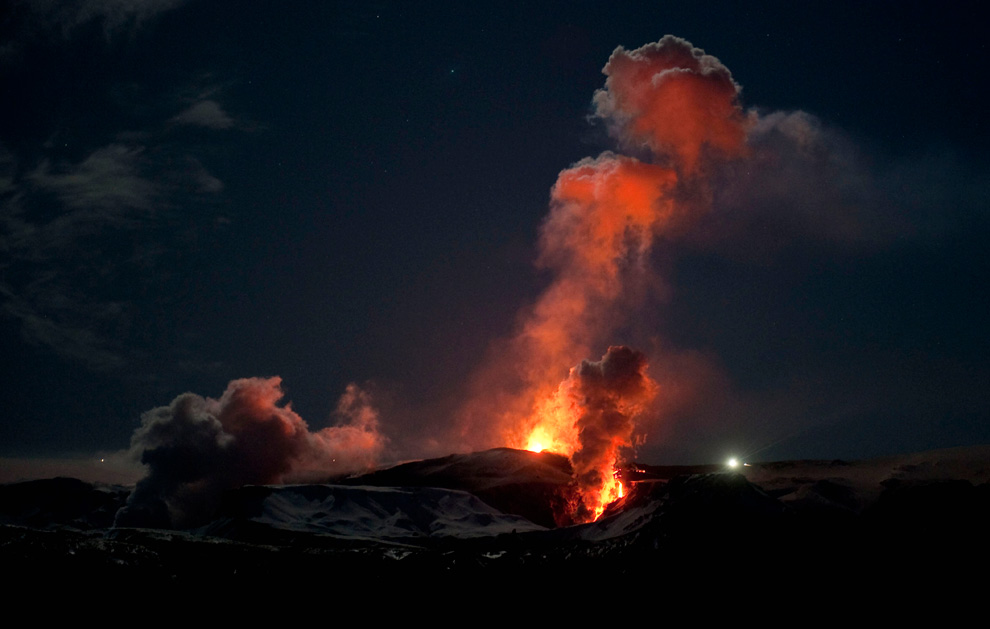
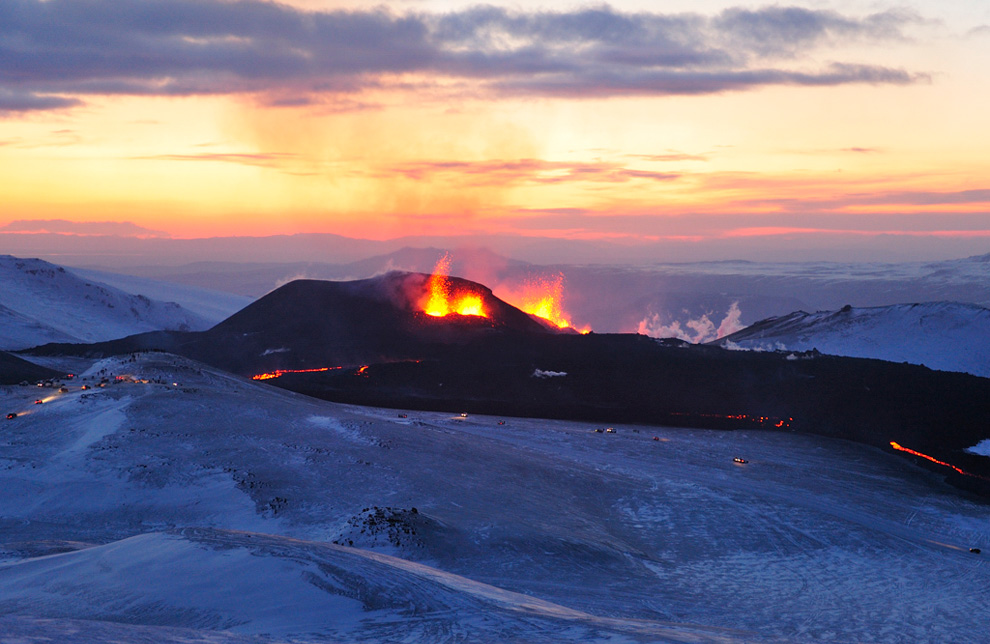
Today, British civil aviation authorities ordered the country's airspace closed as of noon, due to a cloud of ash drifting from the erupting Eyjafjallajökull volcano in Iceland. The volcano has erupted for the second time in less than a month, melting ice, shooting smoke and steam into the air and forcing hundreds of people to flee rising floodwaters. The volcanic ash has forced the cancellation of many flights and disrupted air traffic across northern Europe, stranding thousands of passengers. Collected here are photos of the most recent eruption, and of last month's eruptions, which were from the same volcano, just several miles further east.

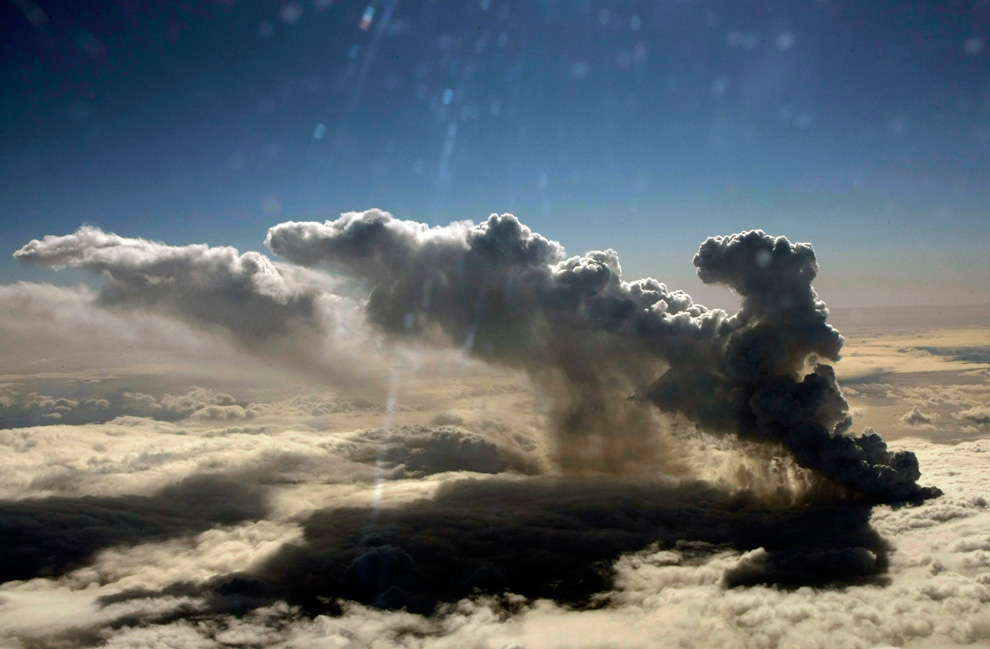
Smoke billows from an erupting volcano which seems to be close to the top of the Eyjafjalla glacier on April 14, 2010 near Reykjavik. All London flights, including those from Heathrow, will be suspended from noon (1100 GMT) today due to volcanic ash from Iceland that has already caused almost 300 cancellations here, officials said. (AFP/Getty Images)

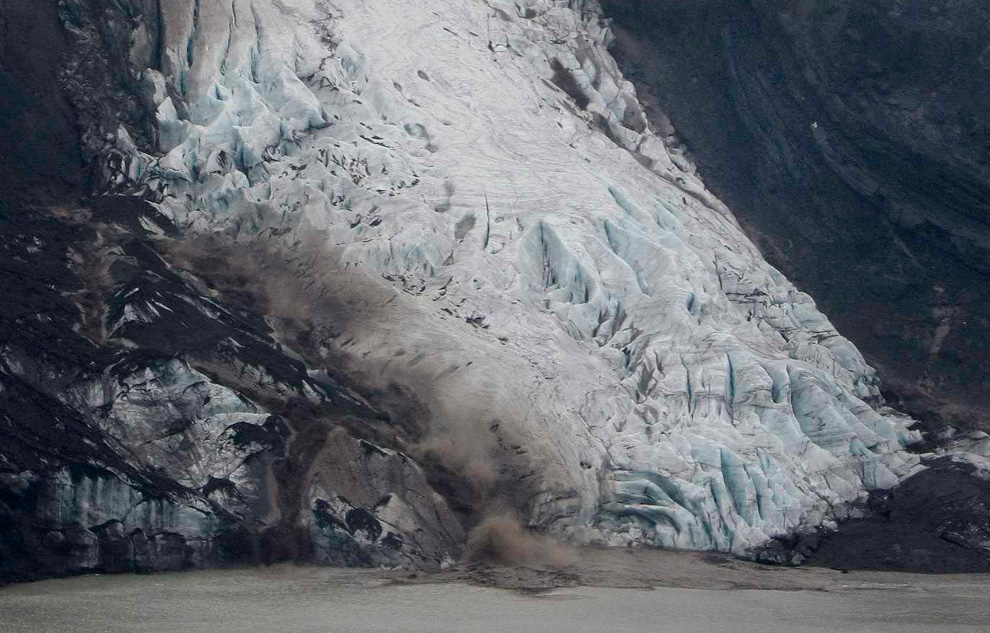
An aerial handout photo from the Icelandic Coast Guard shows flood caused by a volcanic eruption at Eyjafjalla Glacier in southern Iceland April 14, 2010. The volcanic eruption on Wednesday partially melted a glacier, setting off a major flood that threatened to damage roads and bridges and forcing hundreds to evacuate from a thinly populated area. Picture taken April 14, 2010. (REUTERS/Icelandic Coast Guard/Arni Saeberg)

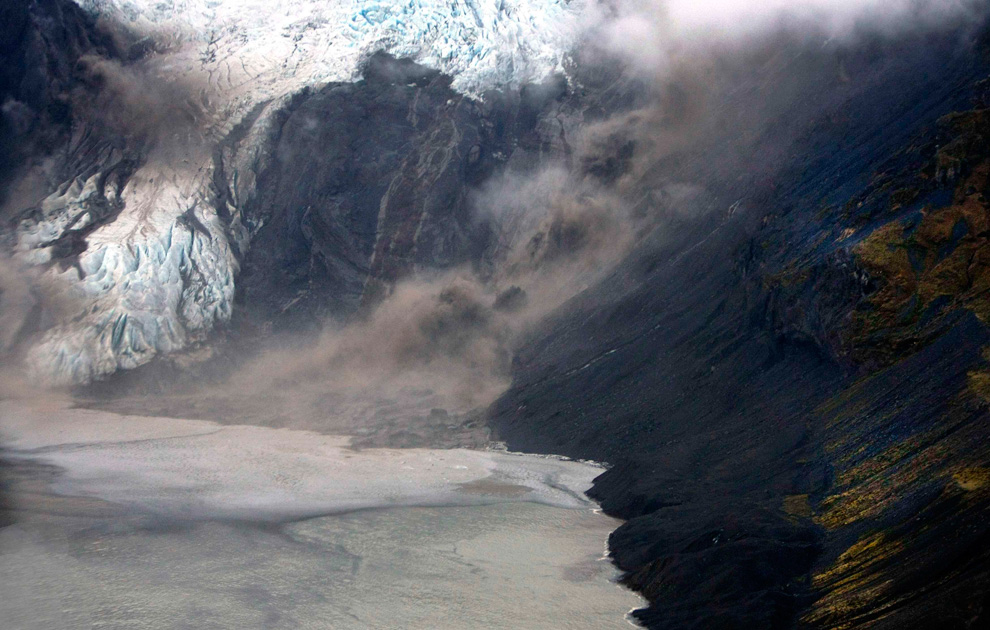
Melting ice caused by a volcanic eruption at Eyjafjalla Glacier in southern Iceland April 14, 2010. (REUTERS/Icelandic Coast Guard/Arni Saeberg)

Photo taken on April 14, 2010 the Markarfljot glacial river, west of the Eyjafjalla glacier. Iceland's second volcano eruption in less than a month melted part of a glacier and caused heavy flooding on April 14, forcing up to 800 people to evacuate and grounding some flights over Norway. (HALLDOR KOLBEINS/AFP/Getty Images)

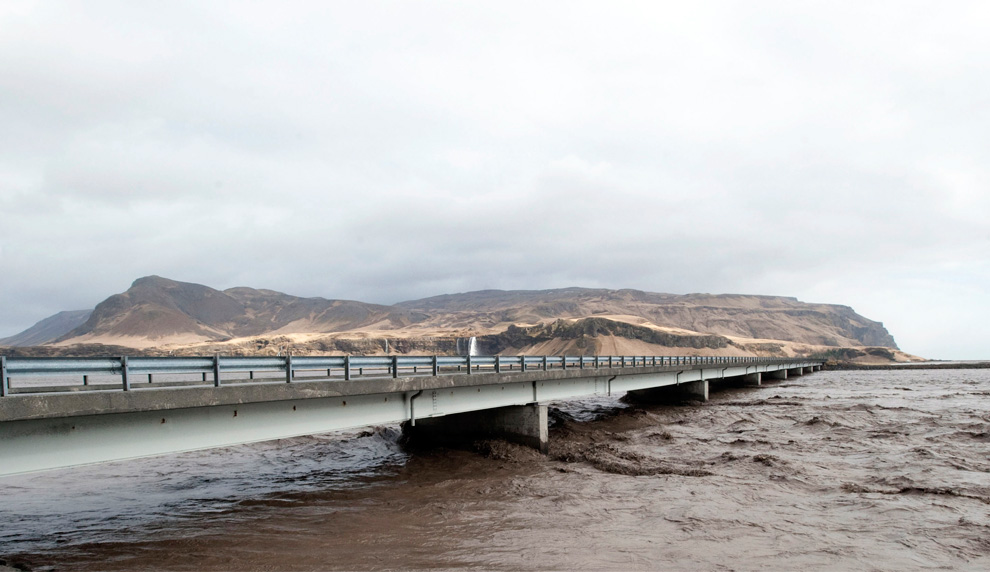
Flooding caused by a volcanic eruption at Eyjafjalla Glacier in southern Iceland April 14, 2010. (REUTERS/Icelandic Coast Guard/Arni Saeberg) #

A man takes a picture of a road that has been washed away by flood water following the melting of the Eyjafjalla glacier due to the eruption of a volcano on April 14, 2010 near Reykjavik. (HALLDOR KOLBEINS/AFP/Getty Images)

In this Wednesday April 14, 2010 photograph, smoke and steam are seen rising from the volcano under the Eyjafjalla glacier in Iceland, which erupted for the second time in less than a month, melting ice, shooting smoke and steam into the air and forcing hundreds of people to flee rising floodwaters. (AP Photo/Icelandic Coastguard) #

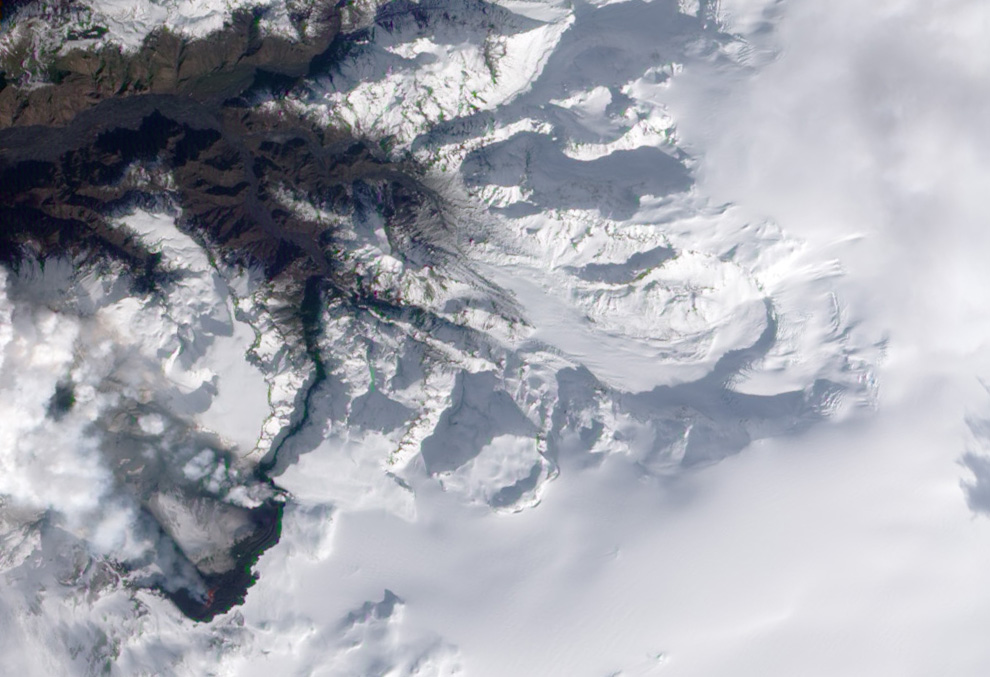
A natural-color satellite image shows lava fountains, lava flows, a volcanic plume, and steam from vaporized snow. The image was acquired on March 24, 2010, by the Advanced Land Imager (ALI) aboard NASA's Earth Observing-1 (EO-1) satellite. The lava fountains are orange-red, barely visible at the 10-meter (33-foot) resolution of the satellite. The scoria cones surrounding the fissure are black, as is the lava flow extending to the northeast. White volcanic gases escape from the vent and erupting lava, while a steam plume rises where the hot lava meets snow. (The bright green color along the edge of the lava flow is an artifact of the sensor.) (NASA's Earth Observatory/Robert Simmon)

This picture taken on March 27, 2010 shows lava spurting out of the site of a volcanic eruption at the Eyjafjallajökull volcano some 125 km east of Reykjavik. With lava still gushing, a small Icelandic volcano that initially sent hundreds fleeing from their homes is turning into a boon for the island nation's tourism industry, as visitors flock to catch a glimpse of the eruption. (HALLDOR KOLBEINS/AFP/Getty Images)

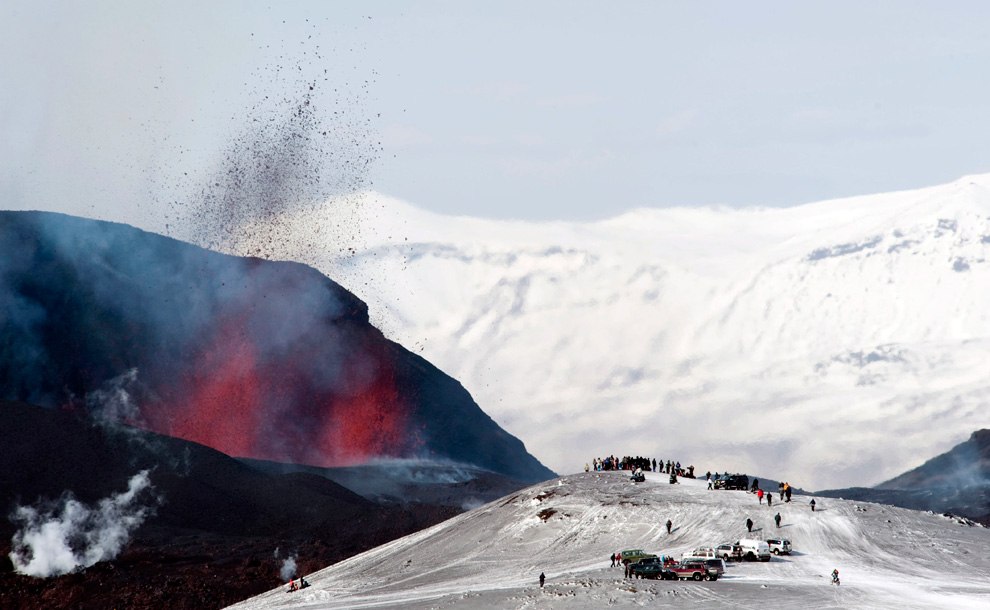
Tourists gather to watch lava spurt out of the site of a volcanic eruption at the Eyjafjallajökull volcano on March 27, 2010. Up to 800 people were evacuated in Iceland early on April 14, 2010 due to a volcano eruption under the Eyjafjallajokull glacier in the south of the island, police and geophysicists said. (HALLDOR KOLBEINS/AFP/Getty Images)

People gather to watch lava flow at the site of a volcanic eruption at the Eyjafjallajökull volcano near the Eyjafjalla glacier on March 27, 2010. (HALLDOR KOLBEINS/AFP/Getty Images) #

Heat shimmers above lava flowing from the Eyjafjallajökull volcano in Iceland on March 28th, 2010. Original here. (Bruce McAdam / CC BY-SA)

Lava spews out of a mountain on March 21, 2010 in the region of the Eyjafjalla glacier in Iceland. (RAGNAR AXELSSON/AFP/Getty Images)

Lava spurts out of the site of a volcanic eruption at the Eyjafjallajökull volcano near the Eyjafjalla glacier in Iceland on March 27, 2010. (HALLDOR KOLBEINS/AFP/Getty Images)

Smoke and steam hang over the volcano under the Eyjafjalla glacier in Iceland, early Thursday April 15, 2010. (AP Photo/Brynjar Gaudi)

Lava spews out of a mountain on March 21, 2010 in Hvolsvöllur in the region of the Eyjafjalla glacier in Iceland. (Fior Kjartansson/AFP/Getty Images)

Steam and hot gases rise above lava flowing from the Eyjafjallajökull volcano on April 3rd, 2010. Original here. (Ulrich Latzenhofer)

This image made available by NEODASS/University of Dundee shows the volcanic ash plume from Iceland, top left, to the north of Britain at received by NASA's Terra Satellite at 11.39 GMT Thursday April 15, 2010. (AP Photo/NEODAAS/University of Dundee)

[ via Big Picture @ Boston Herald ]

Norway’s Stranded PM Uses iPad to Govern Country From U.S

What has technology done for us? Norway PM command & control is now the Ipad…20 years down the line, we could be electing someone in US to rule somewhere in Africa, its a possibility we cannot ignore.

Power does flow from the Ipad.


An enormous volcanic ash cloud has shut down air travel in Europe, canceling flights and stranding Europe-bound passengers around the world.

But thanks to the iPad, stranded Norwegian Prime Minister Jens Stoltenberg hasn't had any trouble.

Stoltenberg, who traveled from Oslo to the U.S. to participate in President Obama's nuclear summit, is now stuck in New York City. Stoltenberg's press secretary told CNN that the prime minister has been running his government from Apple's tablet.

A photo of Stoltenberg on the Norwegian Government's official Flickr account shows the prime minister and his iPad under the (translated) title "The prime minister is working at the airport."

(Flickr headline translated using Google Translate)

[ via Huffington Post ]

How to Master The Art of Persuasion

Persuasion is a difficult art to master. Be too forward and you’ll hinder your success rate. Be too subtle and you’ll never reach your goal. Luckily, The Skinny On has created a handy web comic which outlines one simple thing to remember when trying to lead a friend, customer, whoever, in a particular direction.

Get the goods at The Skinny On.

17 April 2010

Mizoram Wants To Cash in on Cricket

BCCI-India-cricket Aizawl, Apr 17 : Cricket achieved a major milestone in Mizoram as Chief Minister Lal Thanhawla today laid the foundation stone of Suaka Memorial Cricket Stadium, the first-of-its-kind in the state.

The chief minister, also the new president of Cricket Association of Mizoram, lauded the efforts of the association in promoting cricket in Mizoram. ''Thanks to the association for the initiatives it had undertaken so far. Work for the stadium is in the halfway,'' he said.

Lal Thanhawla believed that cricket is the right game for Mizo boys who were good at throwing stone and catching. ''I strongly believe that Mizo boys can play cricket as well as football. This game should be popularized in Mizoram since it is also the game that makes the biggest money in our country,'' Lal Thanhawla said, and thanked the CAM for popularizing the game among the young boys.

A large plot of land at Sihhmui near here was donated by Rotluanga, a prominent citizen of Vaivakawn locality in Aizawl, for the cricket stadium in memory of his late father Suaka.

The CAM began its work on June 23, 2005 and has now transformed it into a large flat ground. The association received Rs 11.20 crore from DoNER ministry for construction of the stadium.

The CAM has been giving cricket coaching to about 70 kids below 14 years of age at Durtlang since 2008, before the sports minister launched his Catch Them Young policy.

The young boys are getting coaching classes from 0600 hours onwards in the morning session and from 1600 hours onwards in the afternoon session.

The CAM was formed by some cricket enthusiasts in Mizoram a few years back. The association is yet to be affiliated to the Board of Control for Cricket in India (BCCI). It had been striving hard to get the BCCI’s affiliation but to no avail till date, it was learnt. With the chief minister heading the association, it hopes to get the much sought-after affiliation soon.

''The BCCIs affiliation will go a long way in promoting and developing the game in Mizoram where a majority of young boys are crazy after football,'' a source in the association said.

Kim Kardashian NUDE & Unretouched: Naked In Harper's Bazaar

Kim Kardashian takes all her clothes off in a Photoshop-free shoot for the May issue of Harper's Bazaar. She is not the first this week to get naked or forgo airbrushing. Here are some excerpts from the interview.

On her butt:
"I don't get why everyone is always going on about my butt," Kim tells the magazine. "I'm Armenian. It's normal. My butt is probably not as big as you might think, because I have small legs and a small waist, which makes it appear bigger."

On her boobs:
"I was wearing a C cup by the time I was 11," the star recalls. "I would go to bed and pray, 'Please, Lord, don't let my boobs grow any bigger.' I hated what was happening."

On her curves:
"The message [of this shoot] is embrace your curves and who you are. I feel proud if young girls look up to me and say, 'I'm curvy, and I'm proud of it now.'"

On Friday Kim tweeted about her empowerment.

KIM-KARDASHIAN-NUDE-NAKED-PIC-PHOTO

Crying Out to Humanity! India's Flagrant Human Rights Violation

human rights Human Rights violation is a growing concern in our society. While Maoists (or Naxalites) remain the worst human rights violators in the country the state is not far behind. The number of custodial deaths is on the rise.

By Nava Thakuria

The Asian Centre for Human Rights, a New Delhi based rights group in its report titled 'Torture in India 2010' released on April 13, argues that impunity is the root cause of increasing custodial torture in India. While the government fails to establish accountability for acts of torture perpetrated by the armed groups like the Maoists, both the Central government and the state governments also refuse to provide sanction for prosecution under section 197 of the Criminal Procedure Code, it asserted.

"Taking 2000-2001 as the base year, custodial deaths have increased by 41.66% persons under the UPA government between 2004-2005 and 2007-2008. This includes 70.72% increase of deaths in prison custody and 12.60% increase of deaths in police custody," informed Suhas Chakma, director of Asian Centre for Human Rights.

He also added that it is only the common people who are facing the torture and other inhuman and degrading treatment. However, the UPA government has failed to address the violations of the rights of, mainly, the ‘aam aadmi’, Chakma added.

The ACHR welcomes the fact that the UPA government has taken a number of measures to address the economic rights of the 'aam aadmi' and problems of the vulnerable groups through enactment of various legislations such as the National Rural Employment Guarantee Act, the 'Unorganised Workers' Social Security Act 2008, the Right to Education Act, the Domestic Violence Act, the Commission for Protection of Child Rights Act, 2005, the Forest Rights Act and legislation for 50% reservation for women in local bodies the panchayats and the current commitment on the Women's Reservation Bill and the Food Security Bill.

The UPA government has failed to show the same alacrity to legislate against torture. Though the Cabinet approved the decision to introduce the Prevention of Torture Bill, 2010 before the parliament and ratify the UN Convention Against Torture, the Bill is being treated as 'state secret'.

"If the Union government of India can hold public discussion on the Food Security Bill, why is it treating the Prevention of Torture Bill, 2010 as a secret document? It shows that the government has more to hide as its earlier draft, Prevention of Torture bill, 2008, contained only three operative paragraphs relating to definition of torture, punishment for torture, and limitations for cognizance of offences," Chakma stated further.

The ACHR lamented the responses of the Indian Home Ministry before the parliament that puts the responsibility only on the State governments on custodial deaths. The MHA repeatedly states, "Police and 'Public Order' are state subjects under the Constitution of India. It is for the state governments to take appropriate action in every crime."

The report mentions about the Union Territories which is governed by the Central government directly, where too, New Delhi has failed to take action against custodial deaths.

"In the decade 1999-2009, the Congress-Nationalist Congress Party ruled Maharashtra had the highest number of deaths (246 cases) in police custody followed by Uttar Pradesh (165 cases), Gujarat (139 cases), West Bengal (112 cases), Andhra Pradesh (99 cases), Tamil Nadu (93 cases), Assam (91 cases), Punjab (71 cases), Karnataka (69 cases), Madhya Pradesh (66 cases), Haryana (45 cases), Bihar (43 cases), Delhi (42 cases), Kerala (41 cases), Rajasthan (38 cases), Jharkhand (31 cases), Orissa (27 cases), Chhattisgarh (23 cases), Meghalaya (17 cases), Uttarakhand (16 cases), Arunachal Pradesh (15 cases), Tripura (9 cases), Goa (5 cases), Himachal Pradesh, Jammu & Kashmir and Chandigarh (4 cases each), Pondicherry (3 cases) and Mizoram, Sikkim, Dadra & Nagar Haveli, and Andaman & Nicober islands (1 each)," the report said.

The Central government also refused to implement the Law Commission of India's recommendations in its 152nd Report on 'Custodial Crimes' to amend the Indian Evidence Act, 1872 (insertion of section 114b) to provide that in cases of custodial death, the burden of proof must lie with the police.

Among the armed opposition groups, the Naxalites or Maoists are the worst human rights violators and regularly resort to 'violence to life and person, in particular murder of all kinds, mutilation, cruel treatment and torture' in blatant violation of the International Humanitarian Law.

"On 11 March 2009, the Maoists dragged Kedar Singh Bhotka (45 years) and his brother Ganesh Singh Bhotka from their house at Gurudih village under Katkamsandi police station in Hazaribagh district in Jharkhand. They were allegedly tied to a tree and tortured by the Maoists. Thereafter, while Ganesh was released, his brother Kedar, who was a government school teacher, was killed for being an alleged 'police informer'," Chakma claimed.

At the same time, Chakma further questioned, "Are we to presume that the Central government has no responsibility for the failures that led to the massacre of 76 Central Police Force Personnel in Chhattisgarh?

If that is the case why did Home Minister P Chidambaram offered to resign?" In December 2009, the Bombay High Court asked the Maharashtra government to explain why it had rejected the state Criminal investigation Department's plea to prosecute 10 officers of Mumbai Police in the Khwaja Yunus murder case. The Maharashtra government had sanctioned the prosecution of four minor officers but let off 10 senior officials despite the CID establishing their roles in the custodial death of Yunus in January 2003.

While the decision to introduce the Prevention of Torture Bill, 2010 is welcome, the ACHR director asserted that unless Government of India takes lessons learnt from the failure of the Supreme Court judgement (DK Basu judgement) and amendment of the Criminal Procedure Code and addresses these shortcomings, torture and custodial death will continue to rise.

The ACHR recommends New Delhi to hold public discussion on the Prevention of Torture bill, 2010 with all stakeholders including the civil society groups and enact the same in 2010 itself; implement the recommendations of the Law Commission of India to make consequential amendments to the Indian Evidence Act, 1872 (insertion of section 114b) to provide that in case of custodial death the onus of proving of innocence is fixed on the police; and repeal section 197 of the Criminal Procedure Code to uphold the supremacy of the judiciary.