17 August 2015

Demands to Ground Northeast's 'Flying Coffins' Get Louder

By Prasanta Mazumdar

A crashed Pawan Hans helicopter being airlifted

Guwahati, Aug 17 :Three crashes in five years, which claimed 27 lives including that of former Arunachal Pradesh Chief Minister Dorjee Khandu, have made the All Arunachal Pradesh Students’ Union (AAPSU) put the heat on the Congress government in the state to ground the ‘flying coffins’ of Pawan Hans Helicopter Ltd (PHHL).

The influential students’ body in the Northeast state has urged the Arunachal Pradesh Chief Minister Nabam Tuki government to immediately terminate the MoU it had signed with PHHL. “The Pawan Hans Helicopter Ltd has become synonymous with flying coffin in our state,” the AAPSU said in a representation to the Chief Minister.

“In the past there have been quite a few mishaps and that should have been enough to awaken the government from deep slumber. But to our utter surprise, the so-called flying coffins are still flying,” it said.

The AAPSU said that the latest crash, which occurred in the state’s Tirap district on August 4, has once again exposed the inefficiency of the helicopter service operator. “The incident indicates the choppers used in our state are not fit to fly in the hilly terrains,” it said.

The crash had claimed the lives of Tirap district Deputy Commissioner, Kamlesh Joshi, and pilots M S Brar and Rajeev Hoskote. The Dauphin VT-PHK helicopter had crashed inside a deep gorge between two steep mountains within minutes after take-off from Khonsa. The bodies were found by the commandos eight days after the incident. On that day, Joshi, who had joined as Tirap district Deputy Commissioner in June, 2013, was to attend a meeting of the Ministry of Home Affairs (MHA) in New Delhi. He was born in 1983 and belonged to the 2010 IAS batch.

Officials of Arunachal Pradesh government and PHHL said the Tirap crash was being investigated. “The next course of action will depend on the ongoing enquiry and guarantee of air safety,” a senior government official told The Sunday Standard.

The fears have been growing among people in Meghalaya too. Asked if the state government has any plans to suspend the PHHL services, official sources said that it was too early to take a call. “At the moment, we are trying to get the details of the chopper crash in Tirap. We cannot comment anything more.”

Meghalaya had in 2011 suspended PHHL services. In due course, it came to light that travel requirements made the government allow the public sector undertaking (PSU) to operate in the state despite expiry of license. Back in 2004, a chopper crash near the state’s capital, Shillong, had claimed the lives of ten people, including a cabinet minister and two MLAs.

Apart from Arunachal and Meghalaya, the PHHL operates in Nagaland, Tripura, Mizoram and Sikkim. The license is renewed annually.

In the Northeast, communication is a major bottleneck. So, the people prefer to travel by helicopters as it is affordable. The PHHL operates here on 75 per cent subsidy of the MHA. This does not include recovery from passengers. The state government provides for the remaining 25 per cent.

The private airlines are not so lucky though, for they are not considered eligible for subsidy. The high operational cost left two private operators to shut shop after a brief stint in Arunachal Pradesh.

In 2011, the PHHL had drawn flak from the public due to safety issues after two choppers crashed within a span of just ten days. In one of the incidents, five people, including Khandu, were killed. Another crash claimed the lives of 19 people. The operations were suspended then, but services resumed in 2013. The latest crash has brought to the fore the safety issues, again.

DEADLY RIDE

September 22, 2004: Meghalaya Community and Rural Development Minister Cyprian R Sangma, two MLAs and a former Deputy Speaker were killed in a Pawan Hans helicopter crash, near Shillong.

August 6, 2010: A Pawan Hans crew died by falling from 10,000 feet at Namsai in Arunachal Pradesh, while trying to close a door that had flung open mid-air.

April 19, 2011: A Pawan Hans Mi-17 helicopter, en route to Tawang from Guwahati, crashed while trying to land at Tawang. Of the 23 people on board, 17 were killed on the spot. Two others succumbed later.

April 29, 2011: A Pawan Hans helicopter carrying former Chief Minister Dorjee Khandu and four others, crashed. All them died.

August 4, 2015: A Pawan Hans chopper carrying Tirap Deputy Commissioner Kamlesh Joshi and two pilots on board crashed, killing all the passengers.
14 August 2015

FIFA Official On Talent Scout Mission in Mizoram

Aizawl, Aug 14 : FIFA's Regional Development Officer for South and Central Asia Shaji Prabhakaran on Thursday said that Mizoram was among the seven states in India where the governing body would launch the 'State Football Association Development Project'.

Prabhakaran told reporters here that the world football governing body would give logistical and financial support to the Mizoram Football Association (MFA) to formulate and undertake plans to develop football in this north eastern state.

"Mizoram should have sound strategic plan to develop football so that the FIFA would be able to support development of the game among the Mizos," he said.

The state's achievement in the field of football during the past few years was commendable, the FIFA official said, adding that Mizoram has the potential to turn the Football powerhouse of the country.

Prabhakaran, FIFA Technical Director for South East Asia Region Vincent Subramaniam, All India Football Federation (AIFF) I-League CEO Sunando Dhar and AIFF Course Instructor and Development Officer Savio Medeira were in Mizoram for three days in a fact finding mission on the project.

Married in Meghalaya: Feminist dream or the iron fist of matriarchy?

By Simantik Dowerah

Nobody in the wife's house cares about her husband. He feels like an outsider. He can't return to his parental house because his sister won't care for him. He feels lost. So many Khasi men feel like an outcasts. They become desperate," Keith Pariat told Firstpost, from Cherrapunji.

Pariat is a building contractor by profession and the president of Syngkhong Rympei Thymmai ('a new hearth'). SRT aims to overthrow Meghalaya's matrilineal system. The organisation, which was founded in April 1990, in Shillong has taken upon itself to "liberate" men from female "dominance".

The iron fist of matriliny?

An exception in a predominantly patrilineal world, Khasi tradition dictates that property owned by a couple must be inherited by their youngest daughter so that she can take care of her brothers and parents. As per the norm, the youngest daughter's husband has to stay at her residence.

"As per the matrilineal system, the younger daughter as the custodian of the property has to get her maternal uncle's permission to do anything with the property. This keeps the brothers and husband out," said Pariat.

The maternal uncle in the Khasi system wields immense influence since the youngest daughter in a family, who is the custodian of property, has to consult with him on all issues. "But nowadays the maternal uncle stays with his own wife and is busy with his family. So the daughter keeps the property for herself without caring for her husband or brother," said Pariat. "Be it as a brother or as a husband, the position of men in the Khasi community is not at par with women."

Not everyone believes that the old ways are in need of change. Esther Syiem, who heads the department of English at the North-Eastern Hill University in Shillong, says that Pariat's SRT is relevant since it highlights loopholes in the present system. But she warns against taking it too seriously.

"But what is the strength of the SRT?" she asked. "Less than 2,000-odd urbanites against over a million plus. In the rural areas where the laws of marriage are strictly matrilineal, there is hardly anyone who would opt for a radical change to patriarchy. Change is inevitable but it cannot be drastic."

Syiem points out the role that men have traditionally occupied in these societies and the cultural implications of those choices. "Changes will have to be take place but not at the cost of culture," she said. "The feeling of insecurity is definitely there among some men. But you have to understand that historically, men have always been the ones who were the decision makers of society. In that respect, they have never been or ever wanted to be associated with material wealth."

Syiem says the culture evolved from the fact that women were considered the custodians of material wealth and keepers of ritual and religion. "In this day and age however, material wealth has taken precedence over everything else and the claims speak louder than the responsibilities. And so the complaints continue," she said. She also pointed to the fact that women aren't always the sole inheritors of property. "Among the War (a Khasi sub-tribe), property is being distributed among all the children, boys and girls,” she says.

Not all men are opposed to the system either.

"I believe in equality in the family as both parents play an important role in healthy development of their children. There is no question of anyone trying to subjugate the other," said Teilang J Marwein, who is Khasi but lives and works in Mumbai. Marwein believes that the patrilineal society is favourable only if a man is setting up a business, since establishing one in a matrilineal society is "next to impossible". But that's the only drawback that he sees.

"The insecurity that some Khasi men have is more to do with their financial status and dependency on the wife or in-laws. Any financially independent person who can support and raise his family should not have an inferiority complex at all," he said.

A Khasi couple pose in traditional wedding costume after their marriage ceremony in the Shillong. The Khasi tribe is one of the world's few remaining matrilineal societies, who trace their descent through their mothers and take their maternal ancestors' surnames. Reuters

No escape from marital woes


The Khasi community can take pride in the fact that no dowry system exists in its practices and it's also a community where women are comparatively freer than their counterparts in the rest of India. But though women have the right to property, it doesn't necessarily mean they are better off. Traditional burdens like child rearing are still there and ills of a patriarchal society like domestic violence remain prevalent despite matriliny. Domestic violence numbers are among the highest here, according to Syiem. Marriages are brittle in Meghalaya, and divorce and separation rates are very high. The 2011 census data revealed the state is second only to Mizoram in terms of its divorce rate.

However, that has little to do with matriliny.

"Our marriages break easily because we do not believe in the concept of doli (palanquin) to asthi (ashes). If there is any wrong against us, we are not afraid of walking out of the marriage...Our families always stand by us when we have to walk out of the marriage," said Jasmine Mawthoh (name changed), who hails from Shillong and works in Mumbai.

Even if a couple that is separating has children, families are usually supportive. "Separation is accepted in Khasi society," said Syiem. "In the past, in the villages, the couple would announce their separation and the husband and wife went back to their parents. If the woman has children, her parents help her in raising the children."

She says there are many single mothers and fathers in the community who faced no trouble while raising kids. "My own uncle brought up his children single-handedly. An extended family is one of the strengths of this society," Syiem said.

The threat from outsiders
Pariat believes that the old system is now being exploited by many non-Khasi men.

"They [non-Khasi men] target the youngest daughter of a Khasi family to get the property indirectly," claimed the SRT head. "They even open businesses in their wives' names as we tribals don't have to pay income tax. They exploit the privileges given to us by the government. Many unassuming Khasi girls are falling into this trap."

Marriage between Khasis and non-Khasis is nothing new. "Earlier when Khasi men married non-Khasi girls from the plains and came back to the hills, the girls were given a new surname involving the word 'khar'," said Mawthoh. "Surnames like Kharkongor, Kharumnuid, Kharbamon indicate that. It is primarily a Niam Trai, or the indigenous Khasi tradition. This has been there for ages." Mawthoh herself is married to a non-Khasi and while she admits these inter-community marriages may be used for outsiders, it didn't mean a girl should be banished from the community as some organisations like the Khasi Students' Union demand.

Syiem sees nothing wrong in cross-cultural marriages. She points out that it's not just the Khasi women, but the men too are doing so. "There are many women who have married men from the rest of the country and the world. I personally know many such couples who've actually settled here and vice-versa. Increasingly there are many men now marrying from other communities and bringing their wives here," said Syiem.

The effect of being surrounded by patrilineal societies

Given almost every other community outside Meghalaya is a patrilineal one, its effects are being felt upon the Khasis' age-old tradition.

"Once you stay outside Meghalaya, you are bound to be influenced by your surroundings,"says Faddey Nongkynrih (name changed), who teaches in Shillong and has been married for 15 years. "Following ways that are similar to patrilineal society is quite normal. For example, if the husband is earning and feeding his family in Mumbai, it is natural that he will have more say." While this doesn't usually affect the transfer of property within the state, it is making an impact upon the next generation. Nongkynrih says his own equations are good with his in-laws though he doesn't stay with them.

The Khasi community is now at a point where it is trying its best to adapt to the practices of a patrilineal society without doing away with the matrilineal ones. "We are at a stage where there is a tug-of-war going on within society," said Pariat. "Even at my house, there is a tug-of-war between my wife and me. She wants the old system to continue, but I am against it. And this has been going in many families."

He claims matriliny is a system whose time has ended. "We would prefer Khasis losing their uniqueness as matrilineal society than to go extinct. We want to join the mainstream of the world as a patrilineal community," he said. Others believe that the cost of such radical change will be far too high. "If our roots and culture collapse, I don't think we can survive for more than two or three generations at most and our identity would be lost forever," warned Marwein.

But most believe that change, while inevitable, does not need to be either radical or destructive.

"I find that people look upon the matrilineal society as a 'museum piece'," said Syiem. "The Khasis are being seen as following some ancient tradition that no longer fits into the modern world. But in a country like India, cultural hybridity is nothing new. We survive very happily, imbibing changes and making them part of our system. So changes at ground level happen, at their own pace."

No Breakthrough in Talks Between JCLIPS and Manipur

Okram Ibobi Singh Okram Ibobi Singh No breakthrough was reached between the Manipur government and the Joint Committee on Inner Line Permit System (JCILPS), a committee leader has said.

Manipur government could not provide copy of the drafted bill submitted to the Chief Minister Okram Ibobi Singh by the Bill Drafting committee on August 4 last to 20 representatives of JCILPS, Kh. Ratan, Convenor of the JCILPS, told mediapersons last night after coming out from the talks table. This showed the drafted bill was yet to be finalised and there was trust deficiency on the government's part for the talks, the Convenor alleged.

A government spokesman, however, maintained they were hopeful of resolving the issue by continuing dialogues with the committee. However, Ratan further said JCILPS insisted to include five points already submitted to the government while drafting the bill but the state side could not give any update about the inclusion of the points in the bill. The JCILPS convenor called for passing the Bill on implementation inner line permit system on or before August 15 next "to save the indigenous people of the state", Kh Ratan added.

Regarding the claimant of the body of Sapam Robinhood who died in alleged police action on July 8 last during JCILPS movement, the convenor said representatives of the state government could not say anything about the matter. He demanded the issue of claiming the body should be decided by the Joint Action Committee (JAC) formed after the killing of Sapam Robinhood and parents of the deceased with the JCILPS.

Muivah reaches out to wary neighbours ahead of Naga I-day

NSCN(IM) general Secretary Muivah arrived at Dimapur on his first ever visit after signing the framework agreement with the Centre on August 3. CAISII MAO Dimapur, Aug 14 : National Socialist Council of Nagaland (Isak-Muivah) General Secretary Thuingaleng Muivah, who signed the August 3 Naga peace accord with the centre, arrived here on Wednesday ahead of the Naga Independence Day to be observed on Friday.

This visit of Muivah, who is the Ato Kilonser (prime minister) of the Government of People’s Republic of Nagaland (GPRN), the parallel regime of the NSCN(IM), has generated much interest in the state capital for people are keen to hear what he says on the NSCN(IM)’s core demand of Greater Nagalim and the pact in general in his address to Nagas on Friday.

The pact has created much uncertainty in the concerned areas of the northwest after none of the parties decided to divulge the details so far. Muivah, however, has been thumping his chest over the fact that the agreement looks at the concept of ‘shared sovereignty’ where both the Nagas and GoI are ‘equal’ entities.

Senior NSCN(IM) leaders said that Muivah would give an outline of the agreement at an event at Camp Hebron, the outfit’s headquarters located about 35 kilometres from here, on Friday.

Muivah, however, has already started addressing his own people. After reaching Dimapur where he was given a ‘low-key’ public reception, the leader made an effort to reach out, not only to the people of Nagaland but the rest of the northeast, in a brief speech.

“That is going to be the new policy of our leadership. This deal is outcome of 18 years of negotiations, we understand and so does New Delhi that it is important to address to the concerns of those aggrieved and concerned,” said a senior secretary in the GPRN cabinet.
13 August 2015

How the Naga Accord Will Affect Politics in the Rest of the North-East

The accord, whatever its substance, has further burnished the perception that the BJP-led NDA government is a government that gets things done, particularly in the northeast

Prime Minister Narendra Modi witnessing the exchange of the peace accord text by the Government of India interlocutor RN Ravi and  NSCN(I-M) leader Th. Muivah in New Delhi on August 3, 2015. Credit: PTI Photo
Prime Minister Narendra Modi witnessing the exchange of the peace accord text by the Government of India interlocutor RN Ravi and NSCN(I-M) leader Th. Muivah in New Delhi on August 3, 2015. Credit: PTI Photo

These are exciting, if anxious, times for anyone interested in the history and politics of India’s northeast region.

Last week, the Government of India and the National Socialist Council of Nagaland (Isak-Muivah) announced they had come to an ‘historic’ agreement on the Naga issue. We were even treated to a televised accord signing ceremony.

But what exactly have the two sides agreed to? More than a week has passed and we are none the wiser. What we know now, through selected leaks, is that the most contentious and crucial demand of the NSCN (I-M), i.e. political integration of Naga-dominated areas in the northeast, is not a part of the accord. The sovereignty issue was discarded a long time ago. As for what’s in the accord, we may have to wait till the agreement is placed before Parliament, as the government has promised to do. However, the fact that the NSCN(I-M) has agreed to formally end its armed insurgency and come to a compromise agreement with the government is itself very significant.

Advantage BJP
The accord, whatever its substance, has further burnished the perception that the BJP-led NDA government is a government that gets things done: while the BJP is a party of action, the Indian National Congress (INC) is a party of the status quo, at least in matters concerning the northeast.
This perception is not without basis. On matters concerning the northeast – which is usually seen through the prism of ‘national security’ – the INC has always seemed undecided, always second-guessing every option. Take the case of the Armed Forces (Special Powers)Act. The BJP’s position in support of AFSPA is well known, and nobody expected it to do anything about the Act. However, the ambivalence of the Congress-led UPA government on the issue is telling. It was convinced that AFSPA needed to be either repealed or amended. Toward this end, the Justice Jeevan Reddy Committee was set up. The committee recommended the Act be repealed but the government didn’t have the stomach for this. P. Chidambaram, who was home minister in the UPA government, has since confirmed that while he was in favour of repeal and pushed for it, the government ultimately dared not overrule the objections of the army.

For some people, this is yet another sign of the centralising nature of Modi. May be it is. But it is also marks the welcome reassertion of the civilian executive vis-a-vis the national security establishment in matters of the northeast.
On the Naga issue, it was, indeed, the Congress-led government under PV Narasimha Rao that first decided to search for a political solution through talks. There soon emerged a consensus amongst all the major parties on this. But, it was the BJP-led Vajpayee government that was willing to recognised, in a written declaration, the ‘uniqueness’ of Naga history and situation.  Of course, it was also this government that took the decision – which proved untenable and politically costly in the wider region – to extend the ceasefire ‘without territorial limits’. Throughout UPA-I and UPA-II, NSCN(I-M) leaders fretted and fumed about the lack of leadership in the government, and how they wished a ‘statesman’ like Vajpayee come back to power. Now the Modi government, in a little more than a year, has produced an accord. Even if it is just a ‘framework’, with a lot of details still to be filled in, the BJP certainly has some bragging rights.

The dramatic manner in which the accord came about is also telling. News reports say that only four people – the Prime Minister, the National Security Advisor, the official interlocutor R.N. Ravi, and the Home Minister – had advance knowledge of the accord. The home ministry bureaucrats and the army were apparently kept in the dark. Modi himself said that his office directly oversaw the final stretch of the talks process. For some people, this is yet another sign of the centralising nature of Modi. May be it is. But it is also marks the welcome reassertion of the civilian executive vis-a-vis the national security establishment in matters of the northeast. In any case, the issues and the compromises necessary have long been well known, so it is disingenuous to say that more consultations are necessary.

Electoral picture
Will the Naga accord  help the BJP in terms of electoral politics? It is important to note that the BJP has been seen as a Hindu party in the hill states of the northeast, some of which are predominantly Christian. In the 2014 general elections, while the Modi-led BJP wave swept through mainland India, the northeast remained an outlier to this national trend. Out of the eight northeastern states, including Sikkim, the BJP managed to make its presence felt only in Assam and Arunachal Pradesh. In Assam, which has 14 Lok Sabha seats, the BJP won seven seats while the INC got only three. In 2009, it was the INC that won seven and the BJP four. In Arunachal Pradesh, the BJP wrested one seat (out of two) from the INC, which had won both seats in 2009. In Nagaland, the Naga Peoples Front (NPF), which has an alliance with the BJP, retained the only seat. The party failed to make its mark in the other five states.

There are many reasons for this. The BJP’s Hindu character is certainly one. To the tribal Christians of northeast India, the BJP’s pet themes like ban on cow slaughter, its emphasis on Hindi, uniform civil code, etc. are anathema. The recent attacks on minority religious institutions and the general ascendancy of Hindu right groups make them worry about religious freedom. Also, the BJP has never had committed cadres and grassroot organisations in the region to match that of the Congress. The northeast has never been the BJP’s priority.

In places like Manipur valley, the Indo-Naga talks have cast a dark shadow. It is significant that in the summer of 2001, when Manipur valley was in turmoil over the Central government’s ill-fated decision to extend its ceasefire agreement with the NSCN(I-M) without territorial limits, the BJP had 26 MLAs in a 60-seat assembly. In the assembly election held the next year, 2002, the BJP’s tally came down to four seats and in the last two assembly elections, in 2007 and 2012, the party drew a blank even as the Congress further consolidated its gains, both in the valley and hills.

The latest Naga accord will further cement the Manipur valley’s hostility towards the BJP. But in the hill areas, things may change. The hill-valley divide is deep. While the valley is consumed by fear of the nameless outsider which presently expresses itself through the agitation for the Inner Line Permit system, the hills are in fear of being overwhelmed by the valley Meiteis. As the INC-led government in the state and the party itself come to be seen as representing Meitei interests, the hill tribals are on the lookout for a party sympathetic to their concerns.

Sixth Schedule as way forward
While the politics of the Naga dominated districts is generally aligned with the greater Naga movement, politics in the Zomi-Kuki areas is controlled by two underground groupings, i.e. the United Peoples Front (UPF) and Kuki National Organization (KNO), both of which have had a Suspension of Operations  arrangement with the Indian army since around 2005. They are demanding an ‘Autonomous Hill State’ and a full-fledged Kuki state respectively and anxiously waiting for political talks with the Indian government. With no talks on the horizon, they have become increasingly frustrated with the state government and the INC generally. Their anxiety is heightened by the present accord which will likely contain something about the Naga areas in Manipur. What will become of the Zomi-Kuki areas, they ask.

Under the circumstances, the longstanding demand for the provisions of the Constitution’s Sixth Schedule be implemented in the tribal areas of Manipur is expected to escalate in the coming days. The Sixth Schedule is titled ‘Provisions as to the Administration of Tribal Areas in the States of Assam, Meghalaya, Tripura and Mizoram’ and envisions the creations of districts and regions within these states that can enjoy a measure of administrative autonomy on certain subjects.

Between the Meitei stand against dilution of Manipur’s territorial unity and the hill tribals’ insecurity, the Sixth Schedule seems to offer the best compromise for both sides. The demand for the Sixth Schedule for Manipur Hills has a long history. As recently as September 2014, members of the six Autonomous District Councils (ADCs) in the Manipur Hills held demonstrations in Delhi’s Jantar Mantar demanding upgradation of the existing ADCs to Sixth Schedule areas. Indeed, it was on this issue that a crack opened up between the state government and the ADCs, both of which are controlled by the Congress, during the ADC elections in May-June this year.

In 2010, when ADC elections in the hills were held after a gap of 21 years, it was dominated entirely by the INC. In the last election held in June, the picture became fragmented. In Churachandpur district, which is the biggest district in Manipur dominated by the Zomi-Kuki group, most of the incumbent candidates, who were already awarded INC tickets, spurned the Congress party and contested as independents. 18 independent candidates were elected (out of a total of 24 elected seats) and 17 of them later formed the Hill Peoples Alliance (HPA). The INC managed to win only five seats while the BJP opened its account by winning one seat. In fact, while the INC was in power in all the six ADCs during the last term, the party managed to retain a majority only in the Sadar Hills ADC this time round. While HPA leader Langkhanpau Guite, who was re-elected Chairman of the Churachandpur ADC, says he endorses the demand for an Autonomous Hill State for Manipur Hills, he also recognises that the Sixth Schedule remains the most feasible way forward under the present circumstances.

Thangkhanlal Ngaihte is an independent researcher based in New Delhi

Army officer transferred following Mizoram Guv intervention

Aizawl, Aug 13 : An army officer posted at the Counter Insurgency and Jungle Warfare School (CIJW) at Vairengte has been transferred following the intervention of the Mizoram governor for allegedly misbehaving with the local people.

An official statement here said that the transfer order came after Mizoram Governor Lt. Gen. (retd) Nirbhay Sharma spoke to CIJW School Commanding officer Maj. Gen. Vivek Sehgal regarding complaints from the people of Vairengte, which lies on the Mizoram-Assam border.

The army officer, Col R Singh, was transferred to Guwahati yesterday, it said.

The Young Mizo Association (YMA) of Vairengte town had submitted a memorandum to Sharma seeking his intervention for the immediate transfer of the said officer.

In the memorandum, IMA alleged that Col Singh often organised football matches near the Vairengte local church during church services.

"The colonel, carrying pistol and other weapons like sword or knife, used to terrorise people in the streets of Vairengte and even abused women," YMA had alleged, adding that "in an inebriated state, (he) also used to drive his motorcycle noisily and dangerously".

Local community leaders in Vairengte had submitted an FIR against Col Singh on July 4 and again on August 5 while criminal cases have been registered against the officer at Vairengte police station.

The governor, meanwhile, expressed hope that the people of Vairengte and staff and personnel at the CIJW School would continue to live in harmony as they have done all these years.

Why the Naga peace accord is keeping Manipur on its Toes

naga-peace-accord759

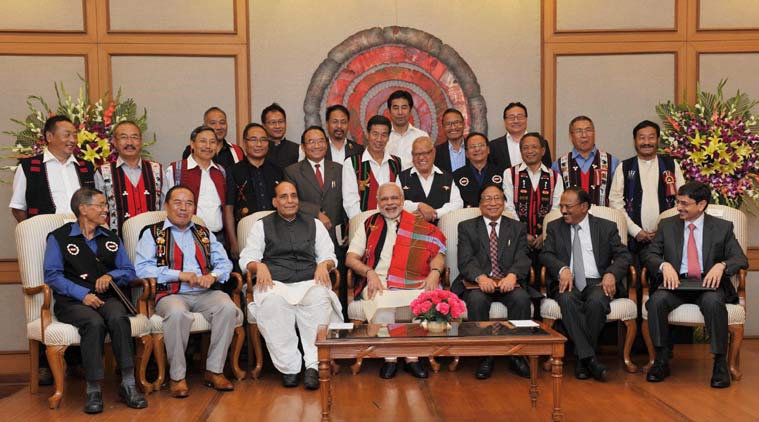
Prime Minister Narendra Modi, Home Minister Rajnath Singh with leaders of the NSCN(IM) in New Delhi (PTI photo)
Despite repeated assurances from the Union government that the territorial integrity of Manipur, Arunachal Pradesh and Assam will be maintained and the peace accord recently signed between the Centre and the NSCN (IM) will not affect these states, tension has been palpable in Manipur since August 3.

Both Chief Minister Okram Ibobi Singh and Deputy Chief Minister and Home Minister of the state G Gaikhangam (himself a Naga) have maintained that they had been kept in the dark and had not been consulted before the signing.


Any other month in any other year, the secrecy of the peace accord would have been enough to spark violent protests among the non-Nagas in the state – the dominant Meitei community who inhabit the four districts that constitute the Imphal valley, and Manipur’s third largest community the Kuki tribe.

But despite headlines in Manipur’s local dailies and Manipuri sentiment being dominated by the present Inner Line Permit agitation and demand, underneath lies a slowly simmering anger about the peace accord.

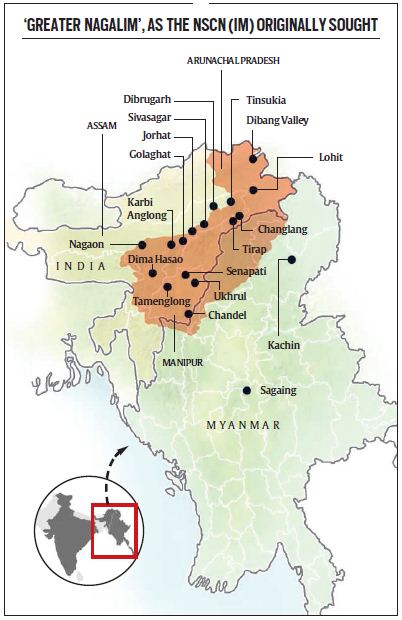
In 2001, the Centre had to quickly clarify the terms and conditions of the ceasefire signed with the NSCN (IM) as Imphal valley erupted in violent communal riots in protest against the ceasefire. The ceasefire was to be valid for all Naga area without territorial limits. Manipur reacted to it as an implicit threat on its territorial integrity – an acceptance on the part of the Indian Government that all Naga areas were considered one.

The Chief Minister’s residence was attacked as was the Secretariat, government buildings were set afire and mobs ran amok. To this day the violence of the June 18, 2001 protests are marked as yearly anniversaries across the Imphal valley.

There are four Naga districts in Manipur – Senapati, Ukhrul (where NSCN (IM) General Secretary Th Muivah hails from), Tamenglong and Chandel which cover vast expanses of Manipur’s land. The fear in 2001, as is today, is that the land will be handed over to Nagaland reducing Manipur to a shadow of a state.

greater
Even as Manipur waits and watches, Naga families who have been living in Imphal for decades have already begun considering moving out of the valley and relocating to their original districts and making contingency plans and “escape routes” in case communal riots break out in the near future.

The Kuki Inpi – Manipur umbrella Kuki body – has meanwhile issued an open memorandum to the Prime Minister demanding that the peace accord be explained.

The Kuki Inpi has said that the “criminal actions” of the NSCN (IM) needed to be addressed before the signing of the accord – a reference to the Naga-Kuki riots which had taken place in the early 90s in which 906 kukis were killed and 3,000 Kuki villages and 100,000 Kukis displaced by the Nagas.