13 January 2015

No talks with militant outfits indulging in violence, says Rajnath Singh

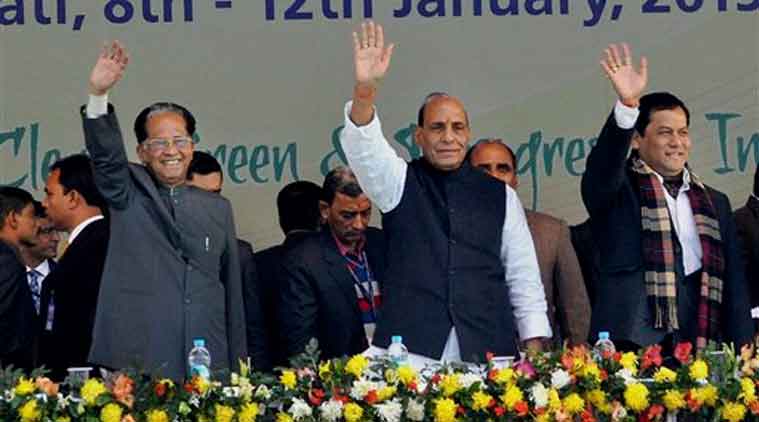
Home Minister Rajnath Singh, Assam Chief Minister Tarun Gogoi and Union Sports Minister Sarbananda Sonowal wave at the crowd during the closing ceremony of the 19th National Youth Festival in Guwahati on Monday.  ( PTI  Photo) Home Minister Rajnath Singh, Assam Chief Minister Tarun Gogoi and Union Sports Minister Sarbananda Sonowal wave at the crowd during the closing ceremony of the 19th National Youth Festival in Guwahati on Monday.

Guwahati, Jan 13 : Union Home Minister Rajnath Singh said Monday that there will be no talk with any group involved in violence. Expressing concern over the growing insurgency, Singh said that the nation was passing through a critical phase and sought cooperation of the youth in tackling the issue.

Apparently refering to the recent acts of violence in Kokrajhar and Sonitpur districts of Assam that left over 80 people dead, Singh said: “I must make it clear that there is no place for violence in a democracy. Doors for negotiated settlements are open only for the groups that do not indulge in violence. The government cannot remain a silent spectator to any acts of violence.”

Singh asked the people of the northeast, particularly the youth, not to allow any form of violence and insurgency to take place in the region. Saying that there is no disconnect between the northeast and the rest of the country, the minister said, “If Kashmir is India’s crown, the northeast is its strong arm.

If any foreign force makes any attempt to cause harm to the nation, this strong arm will give a befitting reply,” he said.

Terming unemployment as a major problem, Singh said the Centre has sought cooperation of the state government. The Centre’s ‘Make in India’ initiative was one such initiative that would help create huge job opportunities for the youth and wean them away from digressions, he said.

Complimenting the participants of the National Youth Festival, the minister also asked them to follow the teachings of Swami Vivekananda, who he said had taught that the whole world was a family. The country’s youth were capable of transforming India into a global superpower, he said.
12 January 2015

Manipur Encounters: Burying the Truth

By Sreenivasan Jain


Manipur Encounters: Burying the Truth
In 2013, a Supreme Court-appointed commission of inquiry found six encounters to be fake

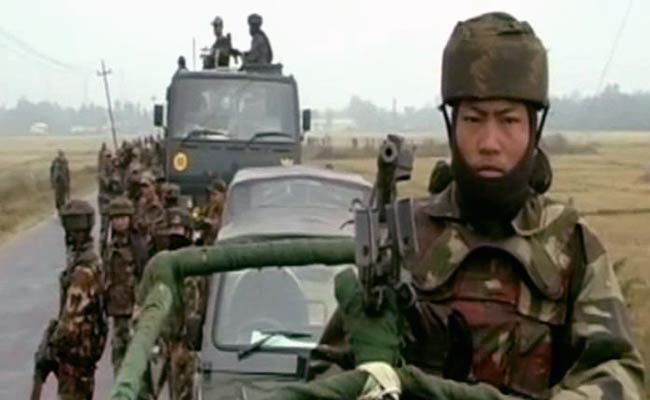
Imphal:  In an overgrown field outside Manipur's capital, Basanta Nameirakpam points to the spot where his son, Nobo, lies buried. The 27-year-old was killed in an encounter by a joint team of Manipur police commandos and Assam Rifles in April, 2009. His cousin, Gobind, was also shot dead that evening. Ordinarily the two men would have been cremated, but they have been buried should the need arise to exhume their bodies, as proof against their killers.

In March 2013, a Supreme Court-appointed commission of inquiry found six encounters, including Gobind and Nobo's, to be fake. Its report, authored by Justice Santosh Hegde, noted that the incidents were "egregious examples of AFSPA's (Armed Forces Special Powers Act) gross abuse" in the state. The Court was acting on a petition filed in 2012 by the families of encounter victims and a Manipur-based human rights group.

During the inquiry, it was found that the security forces had acted on unreliable intelligence, if any, and the weapons seized appeared to be planted. There was no proof that Gobind and Nobo had ever been militants. Claims about retaliatory firing were also debunked. The two men were fired at 89 times, 16 of which hit Gobind alone, in breach of the court's guidelines on the use of force by the Indian Army.

"All the six encounters were actually out and out murder," Hegde told NDTV. "This was only a facade to show that it was an encounter."

In Manipur's bloody history, such unequivocal indictments of the armed forces have been rare. But, even attempts to probe the army's excesses have been denied. The Hegde commission could only learn that of the 66 complaints of human rights violations against the army since 2007, only 3 had been disposed of. The status of those cases wasn't revealed. Manipur Home Secretary, Suresh Babu, couldn't remember a single instance when the state had sought the union government's sanction to prosecute army jawans, as prescribed under AFSPA.

These circumstances, some say, have only perpetuated a culture of impunity, giving rise to fresh violence. "If you want to deal with the militancy, ensure that democratic institutions function," said Babloo Loitongbam, director of Human Rights Alert. "That is the core of people's anger."

In December 2014, two important court judgements further acknowledged that encounter killings were a reality in the state. The first was in the case of the Malom massacre in November 2000, which saw 10 people killed by soldiers from the 8th Assam Rifles. After an explosive was set off near their convoy, the Riflemen had gunned down bystanders at a bus stop outside Imphal town.  Massive unrest followed, giving birth to Manipur's best known voice against AFSPA, Irom Sharmila. A recent judgement by the Manipur High Court disproved the army's claims that they'd been fired upon and ordered compensation of Rs. 5 lakhs to each of the victim's families.

The second was the Supreme Court's order of compensation to the family of Thangjam Manorama. On a night in July 2004, Manorama had been dragged out of her home in Imphal East district and killed by a team from the 17th Assam Rifles. Upendra Singh, who led an inquiry immediately after the incident, accused the soldiers of brutally killing her in a fake encounter.

The probe itself, Singh told us, had been repeatedly stonewalled by the armed forces and the state. The Assam Rifles didn't reveal the names of the officers who conducted the operation. His summons, too, got no reply at first. "They appeared only after I issued warrant for arrest," Singh told NDTV. His report, submitted a few months later, was only made public last November, a decade after the killing.

Repeated attempts to get the Assam Rifles to comment were unsuccessful. A source in the unit told us that they have internal processes to ensure action against such violations. But, he did not specify if there was any in these cases, or what that action could entail.

The court verdicts have been met with both relief and bitterness in Manipur. Victims's families are disappointed that neither judgements speak of prosecuting the guilty army personnel.

Our source in the Assam Rifles also claimed that extrajudicial killings are an exception, but this remains contested in the absence of credible data. Activists allege over 1500 such killings since the 1970s, but the Supreme Court could only investigate 6 and the Manipur government has rejected the longer list.

Last year, insurgency related deaths in the state had reduced to 48, from 485 in 2008. This has been attributed to the courts' pronouncements on Malom and Manorama. Suresh Babu, the Home Secretary, said that the verdicts have also created an environment for insurgents to come back. After six decades of violent conflict, which has killed thousands, this relative peace could easily be shattered and the pleas for justice, if unaddressed, are potentially explosive.

Zoramthanga For Peace Talk with Myanmar Ultras

Aizawl, Jan 12 : Mizo National Front president Zoramthanga left for Myanmar on Sunday for peace talks with the Myanmar government and ethnic rebel groups.

A statement by Mizo National Front said Zoramthanga will facilitate peace negotiations between Yangon and 17 ethnic rebel groups operating in the neighbouring country.

After leaving the state capital on Sunday, he will leave for Myanmar capital Naypyidaw from Kolkata on Monday.

As per schedule, Zoramthanga will hold talks with Myanmar Minister In-Charge of peace talks with ethnic groups, U Aung Min, during January 13-17. Then he will fly to Bangkok, where he is schedule to meet leaders of different ethnic rebel groups, including Karen National Liberation Army, Kachin Independence Army and Arakan Liberation Army.

Zoramthanga will give report to the Indian Home Ministry in the national apital on the 22nd of this month.

This is a follow-up to a discussion held earlier in October 2014 at New Delhi between Mr Zoramthanga and Dessislava Roussanova, one of the team members of former British Prime Minister Tony Blair on brokering peace in the neighbouring Myanmar.

The statement said that Mr Roussanova felt that a former insurgent leader himself, Zoramthanga would be the best person to take up peace initiatives in Myanmar and that time-tested Mizo Accord was eloquent of the importance of the former chief minister.

Zoramthanga and Blair’s representatives agreed to work together to bring long-lasting peace in the trouble-torn Myanmar, the statement said.

It further claimed that Myanmar underground groups had long been insisting on having Zoramthanga as a facilitator of peace between them and the Myanmar government.

But it could not be fulfilled as the Congress-led UPA was in power in India at that time.

“Now, with the NDA taking over, the long-dreamt peace talks are about to be fulfilled with Mr Zoramthanga as mediator,” it said.

Zoramthanga is being accompanied by Mizo National Front General Headquarters Secretary Rosangzuala and an official from Delhi, it added.
09 January 2015

Mizoram’s 18-year-old alcohol prohibition law to be relaxed from January 15

Aizawl, Jan 9 : Mizoram’s 18-year-old alcohol prohibition law will be relaxed from January 15 after the government on Thursday issued a notification that will put into force the rules of a new liquor legislation.

The notification issued on Thursday states that the rules framed for the Mizoram Liquor (Prohibition and Control) Act 2014 will be implemented from next week.

Under the new law, whoever is above the age of 21 years and who has been issued a permit to buy and consume alcohol will be able to buy a limited amount of alcohol from wine shops — six bottles of hard liquor and ten bottles each of beer or wine per month.

The partial lifting of prohibition has pitched the Congress government against the powerful church and mass-based voluntary organizations, who are against the move.

About a dozen Aizawl neighborhood authorities, known as Local Councils, have also pledged to disallow the sale of alcohol in their jurisdictions although most are ruled by opposition parties.

The government has insisted meanwhile that the new law does not lift prohibition but merely regulates the sale of alcohol in the state and based it’s argument on the legislation’s title which includes “prohibition and control”.

The government’s argument is that the new law will not only reduce the risk of continued deaths from consumption of illicit alcohol, but also bring in much needed revenue into the state coffers.
- See more at: http://indianexpress.com/article/india/india-others/mizorams-18-year-old-alcohol-prohibition-law-to-be-relaxed-from-january-15/#sthash.ZAXMdH08.dpuf
08 January 2015

Mizo Advocate sworn-in as Gauhati High Court judge

Aizawl, Jan 8 : Senior advocate Michael Zothankhuma was today sworn-in as judge of the Gauhati High Court in Guwahati.

Son of former Mizoram chief secretary P. Rohmingthanga, Zothankhuma was the second Mizo to become a High Court Judge and the first Mizo from Mizoram to be appointed as a High Court Judge.

He was inducted as judge of the Gauhati High Court along with four others.
26 November 2014

Mizo Govt Pays Over Rs 1 Crore Penal Interest

Aizawl, Nov 26 : The Mizoram government paid more than Rs 1.07 crore penal interests under Urban Local Body (ULB) to the implementing agencies due to late release of fund by the state finance department during 2010-11 to 2014-15 as documents from the Centre for the purpose reached late, Finance Minister Lalsawta told the Assembly today.

Lalsawta, replying to a question from Lalruatkima of the opposition Mizo National Front (MNF), said that General Basic Grant and General Performance Grant under the ULB fund were to be transferred to the accounts of the implementing agencies within ten days as per the guidelines of the 13th Finance Commission's Awarded Grants.

"It was almost impossible for the finance department to transfer the ULB fund to the implementing agencies like the AMC during the time-frame as a plethora of problems were there in clearing the files," he said.

He said that the finance department received the documents of release of grants after ten days of dispatch from the Centre.

He said the Treasuries also sometimes withheld the release of fund due to the fear that there would be overdraft as the financial position of the state had been precarious.
25 November 2014

Mizoram's Literacy Rate 91.33 Per Cent

https://encrypted-tbn2.gstatic.com/images?q=tbn:ANd9GcRD2oYfU8L-vHxTmwsc_RA-niBN0PRZJ5DhQjekowHei3SJeYksAizawl, Nov 25 : The literacy rate of Mizoram stood at 91.33 per cent making it the third most literate state in the country after Kerala and Lakshadweep, a state minister said.

The highest literacy rate was achieved by the central Mizoram's Serchhip district at 97.91 per cent followed by Aizawl district at 97.89 per cent, state School Education Minister H Rohluna told the state Assembly here.

The lowest literacy rate was at southernmost Lawngtlai district at 65.88 per cent followed by Mamit district on the Mizoram-Bangladesh-Tripura border and south Mizoram's Lunglei district at 84.93 per cent and 88.86 per cent respectively, he said.

He added that concerted efforts were made to increase the literacy rate of the state, especially in the districts of Lawngtlai, Mamit and Lunglei districts by appointing animators and coordinating with NGOs and evangelist teachers working under different churches in the remote areas.

Hindi teachers without salaries for 7 months in Mizoram

Hindi teachers without salaries for seven months in Mizoram Mizoram school education minister H Rohluna.

Aizawl, Nov 25 : Hindi teachers under Centrally Sponsored Scheme (CSS) numbering 1,305 have not received their salaries for seven months, Mizoram school education minister H Rohluna said on Tuesday.

In a written reply to Vanlalzawma of the Mizo National Front (MNF) in the state assembly, Rohluna said that the Hindi teachers did not receive salaries since April till October this year and the salaries were being paid in November.

He said that the salaries could not be paid as the Union Ministry of Human Resources Development could not give sanction on time.

He said that workers under the state mission of the Sarva Shiksha Abhiyan (SSA) could not get their salaries since August this year.

He added that there were 4,245 workers including 3,007 teachers working under the state mission of the SSA.