For Naga ethnic groups inhabiting the Naga Hills in the Indo-Myanmar
trans-borders, the road to peace and prosperity lies in forging a
common political Naga identity. There are several models the world over,
both old and new, that could serve as examples on a comparable scale
for political solidarity amongst geographically neighbouring people with
similar but subtly varied cultures. Most of these cultures also are in
disadvantageous juxtaposition due to external impositions of State
administrations and territorial demarcations, with serious implications
for the traditional homeland setup of these ethnic groups. In the past
the formation of the Six Nations in North America, more recently the
multinational struggle of the Kurds in the Middle East, nearer to home
the evolution of the modern nation of Bhutan and currently the campaign
for autonomy of Kachin neighbours of the Nagas are good instances of
affiliated ethnic groups and tribal clans seeking common ground for
collective political goals. The Kachin Independence Organisation (KIO)
of the Kachins has a civilian-run extra-legal bureaucracy providing
public services in Kachin State. Bhutan has several ethnic groups with
one dominant group-controlled absolute monarchy. The country has
recently made a successful transition from monarchy to a constitutional
democracy. The Kurds of Kurdistan are currently a nation in the making
in a trans-border conflict zone contiguous with Armenia, Iran, Iraq,
Syria and Turkey. In early American history, the Six Nations, also
called the
Iroquois, was a confederacy of different Native
American ethnic groups. Today, this powerful super group has unified
independent governance, and lives both in the United States and Canada.
As a historical illustration, in contrast to the success of the
Iroquois
was the Great Sioux Nation made up of several ethnic groups whose
traditional homeland once spanned across thousands of square kilometres
in the Great Plains of the U.S. and Canada. The Sioux being formidable
warriors, but divided along group loyalties, lost a major chunk of their
territories to the invading U.S. military, including the Black Hills,
which are sacred grounds since ancient times for the Sioux and remains
lost to them even today. The once proud peoples have been reduced to
living in scattered reservations in the land of their ancestors. In
2007, a group of Sioux travelled to Washington DC to reassert their
independence and sovereignty.
Naga Identity: Ideal versus Reality
The Naga Hoho, while being the apex civil society body of the Nagas
striving for a unified Naga identity, has been fighting a losing battle
bringing reconciliation to the several factions of Naga militias divided
along tribal lines or factional loyalties, which override ethnicity.
Naga tribes in their ancestral homeland face the divisive international
boundary between India and Myanmar as well as national administrative
boundaries in both countries. However, much more than man-made lines on
maps, the major challenge towards building a cohesive political unit is a
fragmented identity engaged in internecine strife with bloodied
consequences, which is in opposition to the larger Naga identity. As an
illustration, the Zeliangrong United Front (ZUF) is an armed ethnic
militia of the Zeliangrong Naga group consisting of the smaller Zeme,
Liangmei and the Rongmei ethnic groups. Zeliangrong groups are spread
over contiguous territories in Nagaland, Assam and Manipur States of
India. The Zeliangrong territory is also the domain of other Naga
faction rivals of the ZUF fighting for the Naga cause. There have been
several incidents of encounters between these competing Naga militias
vying to dominate the same geographical space inhabited by the
Zeliangrong people, especially between the ZUF and National Socialist
Council of Nagaland-Isak- Muivah faction [NSCN (I-M)].
Figure 1 - Major Naga Ethnic Groups' Areas
 ©
© Namrata Goswami
(Click here for a higher resolution image)
On the other end of the Naga identity spectrum is the National Socialist Council of Nagaland-
Khaplang faction NSCN (K) headed by S. S. Khaplang, who is a
Heimi Naga. The
Heimi
ethnic group belongs to the larger Tangsang Naga group including the
Pangmi, Khaklak and Tangan ethnic groups spread over contiguous
territories in Sagaing and Kachin States of Myanmar. In India, the
Tangsang group consists of the Tangsa, Muklom and Tutsa in Arunachal
Pradesh. The NSCN (K), with its headquarters in Myanmar, signed a
ceasefire agreement with the Myanmar government in 2012. This faction
holds sway over Nanyun and Lahe Townships in the Naga Self-Administered
Zone, with a liaison office at Khampti town in Sagaing Region of
Myanmar.
The Indian Government too has a ceasefire agreement
with the NSCN (K) since 2001, which has expanded its presence in Naga
inhabited areas of India. Traditionally the NSCN (K) has been challenged
in Naga inhabited areas of India by the NSCN (I-M). There have been
numerous deadly clashes between these two NSCN factions in a fierce feud
to dominate maximum Naga inhabited territory. As a few illustrations, a
significant development starting in the early 2000s was the advent of
NSCN (I-M) cadres into Arunachal Pradesh, originally the NSCN (K)’s
backyard, turning the peaceful districts of Changlang, Tirap and the
newly formed Longding into a battlefield. Both factions were fighting
for dominance in Naga inhabited areas of the State, when in 2009 the
NSCN (K) brought in their traditional ally, Myanmar’s heavily armed and
battle hardened Kachin Independence Army (KIA) to take on the NSCN
(I-M). The NSCN (K) also combined forces against the NSCN (I-M) with
non-Naga militants like the United Liberation Front of Asom (ULFA) and
the United National Liberation Front (UNLF) of Manipur, both of whom
have camps in NSCN (K) active areas in Arunachal Pradesh and bordering
the Naga Self-Administered Zone, Myanmar. In 2006, the internecine feud
between the NSCN factions took an unprecedented turn when the NSCN (K)
issued ‘quit notices’ to all Tangkhuls in Nagaland, accusing that ethnic
group of ‘masterminding terrorism against the NSCN (meaning the
Khaplang faction) and innocent Nagas’.
1
Members of
the Tangkhul ethnic group from Manipur are exclusive cadres of NSCN
(I-M) and with this move the NSCN (K) was attempting to deny Naga
affiliation of the Tangkhuls.
Figure 2 - Areas of the operations of the NSCN factions
 ©
© Namrata Goswami
(Click here for a higher resolution image)
The biggest blow to the NSCN (K)’s pan Naga influence in India came
with the formation of the NSCN-Khole Kitovi (NSCN-KK) faction on June 7,
2011. The faction was formed by a dissenting group of cadres and their
leaders, Khole Konyak and Kitovi Zhimoni, from the NSCN (K). Khole
Konyak is from the Konyak ethnic group, the largest amongst the Nagas of
Nagaland State. An interesting fact is that the Konyaks are the
dominant group in contiguous Lahe Township, headquarters of the Naga
Self-Administered Zone in Myanmar and also inhabit Khampti Township of
Sagaing Division in Myanmar (See Figure I). Kitovi Zhimoni is a Sumi
Naga who are numerous in Nagaland. Since both the NSCN (K) and NSCN (KK)
occupy the same ethnic territories, there are bitter and deadly
shooting incidents/encounters between the two splinter factions for
military dominance. However, presently, the NSCN (KK) are focused on the
current boundaries of Nagaland with the goal of pushing out and
limiting the NSCN (K) to being a diminished Myanmar based outfit.
Figure 3 - NSCN (I-M)'s claimed Nagalim
 ©
© Namrata Goswami
(Click here for a higher resolution image)
NSCN (I-M)’s
Nagalim
i.e. the lofty goal of an independent ‘Greater Nagaland’ encompasses
large swathes of contiguous territory inhabited by both Naga and
non-Naga ethnic groups in India and Myanmar. In Myanmar, major chunks of
claimed areas have mixed Naga and other ethnic groups populations.
Tanai Township in Kachin State have several Naga villages along with the
Kachins. Even Khampti Township, which was earlier headquarters of the
‘Burma Naga Hills District,’ have a sizeable minority of Nagas living
with Bamar, Shans, Chinese and Indians. Other ‘Naga towns’ like
Homalin,
inhabited by fewer Nagas, are dominated by Bamar, Shans, Chin, Chinese
and Indians. The NSCN (I-M) has not been active in Myanmar to press
their claims of
Nagalim after a declared ‘unilateral ceasefire’ with the Myanmar government.
The
Nagalim
territorial claims in India include large strips of territory
peripheral to Naga inhabited areas, which have minuscule Naga
populations as in Assam’s Cachar, Nagaon, Golaghat, Jorhat, Dibrugarh
and Dhemaji districts. In Dima Hasao (formerly North Cachar Hills)
district, Nagas are a sizeable minority and a small minority in Karbi
Anglong district of Assam. Arunachal Pradesh’s Lohit, Anjaw, Dibang
Valley, Lower Dibang Valley and Upper Siang districts are inhabited by
ethnic groups such as the Adi, Mishmi, Zekhring, Khampti, Deori, Monpa,
Memba, Tai Ahom, Singpho, Chakma and Tibetans, with distinctive
identities bearing no affiliation to Naga ethnicity. The NSCN (I-M)
however, has been actively engaged in endeavours to expand its influence
to all Naga inhabited areas of India as well as mentoring other
non-Naga insurgencies of northeast India in a sort of titular ‘mother of
all insurgencies’ role.
The leaders of the NSCN (I-M) are
Thuingaleng Muivah who is a Tangkhul Naga and Isak Chishi Swu who is a
Sumi Naga, both from two of the larger Naga ethnic groups (see Figure
1). The Tangkhul Nagas form a large ethnic group in Manipur and
adjoining areas of Sagaing, Myanmar where they are called Somra Nagas.
Tangkhuls are the mainstay of the NSCN (I-M) and have taken the
faction’s fight to faraway operational zones like Arunachal Pradesh.
However certain major incidents illustrate the complex nature of the
ethnocentric support for the NSCN (I-M). In December 2013, the Sumi
Nagas of Nagaland threatened to evict the NSCN (I-M) from their lands.
The incident was triggered by the attempted rape and molestation of two
Sumi women and the grievous injuring of two Sumi men who were all
travelling to Zunheboto town. Their vehicle was allegedly waylaid by
four armed cadres of the NSCN (I-M) who perpetrated these actions. The
Sumis were further incensed by the failure of the NSCN (I-M) to later
hand over the culprits hiding inside the guarded designated camp,
instead attempting to compromise with the Sumi Hoho and even ‘pay off’
the victims to silence them.
In 2010 the NSCN (I-M)’s General
Secretary Th. Muivah made abortive attempts to visit his native village
in Manipur. These visits were stiffly opposed by the Manipur State
government as earlier ones had triggered violence in Naga inhabited
areas of the State. The NSCN (I-M)’s inclusion of Naga inhabited areas
of Manipur into
Nagalim evokes a deeply resentful response from the Meiteis for whom the issue is very sensitive.
The complexity of ethnic boundaries, as has been illustrated above,
forced divisions of ethnic communities inhabiting the border areas of
India and Myanmar by the imposition of an arbitrary international
boundary with little regard to local realities, and the framework of
policy-making that views ethnic groups as somehow pre-modern and in need
of development are the major existential and ideational challenges.
Inherent in this framework is a notion that somehow, the so called
mainstream culture and institutions are themselves not ethnically
slanted but universal.
2 In this scenario, policy making is
propelled by the ‘command culture of legitimacy’ that the public
administrators espouse, especially in dealing with minority communities,
which can backfire. Consequently, what is required, and which has not
been developed yet, is a deep seated understanding of the culture of
identity recognition and preservation. Most importantly, since
negotiations with armed groups in the Northeast are conducted in a
scenario of threat, it is important to understand this framework so that
there are no false expectations.
3
The challenge for
armed groups like the NSCN (I-M), NSCN (K), and NSCN (KK) is to meet
the claim of representation of a common Naga identity and community,
already run asunder by the territorial divisions brought about by a
modern state mechanism as well as by the internecine clan/tribe-based
fights that threaten the notion of common ethnic identity. Only time
will tell whether, like the Great
Iroquois, the Nagas can form a
common supra-national/transnational structure that provides a common
platform to their way of life and traditions.
Disclaimer: The views expressed in this article are solely those of the author.
References:
1For more, see “NSCN-K Quit Notice”, The Telegraph, January 30, 2007, at
http://www.telegraphindia.com/1070130/asp/frontpage/story_7324330.asp (Last accessed on June 14, 2014).
2For more on this, please see Wsevolod W. Isajiw, “Approaches to Ethnic Conflict Resolution: Paradigms and Principles”,
International Journal of Intercultural Relations, 24 (2000), pp. 105-124.
3Ibid


 By Rahul Karmakar
 Sanamahhi
Motors proprietor W Kumar; Sales and Service Eastern Region manager for
Royal Enfield, RK Sachdeva; All Manipur Working Journalists’ Union
president Wangkhemcha Shyamjai, M Chitaranjan, G Prafullo and otheres
were in attendance.
Sanamahhi
Motors proprietor W Kumar; Sales and Service Eastern Region manager for
Royal Enfield, RK Sachdeva; All Manipur Working Journalists’ Union
president Wangkhemcha Shyamjai, M Chitaranjan, G Prafullo and otheres
were in attendance.  Past
few years has seen the number of Royal Enfield riders in the state
grow. Royal Enfield has 307 dealerships pan India and is focusing on
North East, especially Manipur and Assam. Royal Riders Manipur has been
instrumental in getting riders together and organising activities here.
6th edition of North East Riders’ Meet (NERM) is scheduled for
5-7-Nov-2014 at South Loushing near Chingnungkhok, Lamlai, Imphal.
Past
few years has seen the number of Royal Enfield riders in the state
grow. Royal Enfield has 307 dealerships pan India and is focusing on
North East, especially Manipur and Assam. Royal Riders Manipur has been
instrumental in getting riders together and organising activities here.
6th edition of North East Riders’ Meet (NERM) is scheduled for
5-7-Nov-2014 at South Loushing near Chingnungkhok, Lamlai, Imphal. After
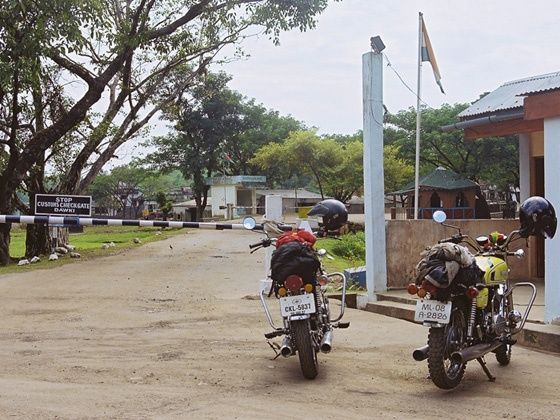
a long detour around Bangladesh, the riders reached Nagaland and
Manipur having first crossed Patna. The North eastern regions that feel
very different to the rest of India entailed a border crossing at
Nagaland guarded by heavy military presence, and foreigners have only
recently started entering these areas. The 10 armed women guards at the
border welcomed the riders.
After
a long detour around Bangladesh, the riders reached Nagaland and
Manipur having first crossed Patna. The North eastern regions that feel
very different to the rest of India entailed a border crossing at
Nagaland guarded by heavy military presence, and foreigners have only
recently started entering these areas. The 10 armed women guards at the
border welcomed the riders. With
breakdowns to be dealt with and no Enfield dealer in Imphal at the
time, the Aussies planned to contact Eddie, a member of the Royal
Enfield club, Royal Riders, but with no mobile network coverage, that
wasn’t to be. This is when Eddie pulled up on his Royal Enfield having
been riding around 2 states looking for them so he could ride with them.
The group left from Imphal after meeting more ‘Royal Riders’ before
heading to the Myanmar border.
With
breakdowns to be dealt with and no Enfield dealer in Imphal at the
time, the Aussies planned to contact Eddie, a member of the Royal
Enfield club, Royal Riders, but with no mobile network coverage, that
wasn’t to be. This is when Eddie pulled up on his Royal Enfield having
been riding around 2 states looking for them so he could ride with them.
The group left from Imphal after meeting more ‘Royal Riders’ before
heading to the Myanmar border.