28 March 2014

Can't promise on Naga settlement: Rahul Gandhi

By Xavier Rutsa

KOHIMA: Speaking on the Indo-Naga peace process at a rally in Kohima on Thursday, Congress vice-president Rahul Gandhi said, unlike Nagaland chief minister Neiphiu Rio, he did not want to promise something that he could not fulfill.

"I am not like your chief minister. I do not like to make promises in the air," he added.

Rahul came to Kohima to campaign for K V Pusa, Congress's candidate for Nagaland's lone Lok Sabha seat.

Taking a potshot at Rio for having claimed that he would bring about a solution to the Naga political problem within three months during the 2003 assembly election in the state, Rahul said, "Unlike your CM, I cannot promise to bring about a political settlement within three months after returning to power."

He added, "The UPA government has taken a bold decision by inviting NSCN for talks."

However, Rahul also added, "I promise that I will do all that I can to bring about an early resolution of this problem. I will help the state of Nagaland, but I cannot promise to solve the problem in exactly three months."

"I am trying to bring peace and harmony to the state," Rahul said to a roaring crowd who clapped energetically after every statement he made.

Addressing the problem of communication in the region, Rahul said connectivity was one of the biggest problems the state faced time and again. If the Congress-led UPA returned to power, the government at the Centre would focus on improving roads and infrastructure development for better rail and air connectivity, he said.

The party was committed to creating 100 million jobs in the country in the next five years, Rahul added.

He said Nagaland was one of the few states in India that was actually moving backwards.

"Normally, a car has four gears - first, second, third and fourth gear. But the Nagaland government has put the state into reverse gear. This is definitely not good for the people of Nagaland," he added.

Instead of making empty promises, the CM should ensure that Nagaland progressed at top speed, he said, adding that the growth rate of Nagaland had slumped from 8.3 per cent to 3.5 per cent.

Rahul told the gathering that in the last 17 months, the Centre had paid Rs 300 crore for building roads in Nagaland, but not a single road had been constructed in the state till date.

"Now the DAN government wants to revise the estimated rate by two-and-half times, thereby not only driving the car in the reverse gear but also failing to build a road in the first place," he pointed out.

On his first visit to the state, Rahul said he was happy to have come to Nagaland and seen its beautiful people. The attire they wear signified the glorious aspects of Naga history, he said, adding that he respected the culture and tradition of the Nagas.

"To make our country really great, we first need to respect each other's culture and I believe in your history and culture," Rahul added.

He mentioned that some Naga students, who had met him in Delhi, had told him that 70,000 youths were unemployed in Nagaland.

He then said Nido Tania was killed by a small group of people who did not understand and respect the culture of the northeast and stated that the ideology of Congress was to spread love, peace and brotherhood. He added that people from the northeast had the right to feel safe and comfortable whenever they went. Nagas and other northeasterners should not feel alienated and should be able to live fearlessly in any part of the country, Rahul added.

He also announced that he would be the "special representative" of the region's people in Delhi and asked them to contact him anytime as his door would always be kept open for them.
27 March 2014

Field of Menhirs Promises To Shed New Light on History of Mizos

By Adam Halliday

Aizawl, Mar 27 : Mizoram has made an entry into India’s archaeological map. In a first, the Ministry of Culture has declared a 9,000 sq m area dotted with several caves, and more than a hundred menhirs embossed with figures of humans, animals and weapons as an ancient site of national importance.

Some 170 menhirs, each at least as tall as a man, stand at the site at Champhai district’s Vangchhia village, which lies on the bank of the Tiau river that separates India and Myanmar.

Villagers call the site “Kawtchhuah Ropui” (The Great Gateway) and have protected these monuments for years in spite of not being sure what they represent or how they came to be there.

The Mizoram chapter of the Indian National Trust for Art and Cultural Heritage (INTACH) along with the state’s Art & Culture Separtment has been studying the menhirs, seeking help from the Archaelogical Survey of India (ASI) in interpreting the embossing.

There has been no significant breakthrough yet, either in reading the carvings or in understanding why the menhirs are there.

The ministry’s notification declares the menhirs, as well as the ground on which they stand, the surrounding caves and forest as protected.

INTACH is hopeful that studies on the menhirs and the figures on them will shed more light on the history of the Mizos, much of which was never documented. The community followed an unwritten, oral tradition until a script was developed a little over a century ago.

Menhirs with similar images have also been found in parts of eastern Mizoram including at Chawngtlai village near Khawzawl town and, according to Mizo historian B Lalthangliana, in the Chin Hills of Myanmar.

NE couple thrashed for defying Munirka curfew

By Jayashree Nandi

New Delhi, Mar 27
: A couple was beaten up allegedly by their landlord's son and some goons in Munirka on Tuesday for trying to step out of their rented house at 9.30pm. The landlord, who likes to lock the main gate of the house early, was reportedly angry with the couple from Manipur when they asked for the keys. He allegedly called in youths from the neighbourhood to intimidate the victims.

Mercy, who was carrying her 10-day-old baby, alleged that a woman hit her with a broom and some goons pushed her. Her husband, Thangminlian, a jawan posted in J&K, claimed to have been hit with rods, prompting a fight-back.

Thangminlian was taken to hospital by youths from the northeast. He has injuries on the hands and back. Mercy had come to Delhi for her delivery. Her mother, Heneng, has a small garment business in Munirka. Thangminlian had also taken leave for a month to tend his wife. Mercy was with her baby girl and a four-year-old son on Tuesday, when they decided to visit a relative who also lives in Munirka. "When we asked for the keys, the landlord and a stranger asked us why we didn't go out during the day. It's been less than a month since we moved in, but they have always looked down on us," said Mercy who belongs to Churachandpur, Manipur.

Thangminlian, who was discharged on Wednesday, has been recuperating at a relative's house. "Being in the Army, I interact with soldiers from different communities all the time. I think we are not welcome here," said the enfeebled Thangminlian.

Rosemary, at whose house the couple was recuperating, said discrimination and racist comments were common.

When the youths attacked Thangminlian, his son, Siamboi, ran to his grandmother's house. She tried to shield her son-in-law. The couple is planning to leave Delhi soon. When TOI visited the couple's one-room house in Munirka, there were bloodstains on the wall, floor and bed. "We have arrested seven people, including the landlord and his son," said a senior cop of the south district. He added that a case of assault and sections of the SC/ST Act have been slapped on them.
26 March 2014

UDF's Royte richest candidate in Mizoram

AIZAWL: With assets worth Rs 31.53 crore, Robert Romawia Royte, United Democratic Front (UDF)'s nominee for the Mizoram's lone Lok Sabha seat is the richest among the three candidates in the fray. The state will go to polls on April 9.

Royte and his wife, according to an affidavit submitted to the returning officer and deputy commission of Aizawl district, Juhi Mukherjee, have Rs 5 lakh and Rs 4 lakh cash in hand respectively. While Royte has Rs 19.27 crore worth of moveable assets and Rs 12.27 crore worth of immovable property, his wife has Rs 45.63 lakh and Rs 2.5 crore in movable and immovable assets. The total worth of his assets including his wife's, is Rs 34.49 crore.

A government employee who voluntarily resigned from service while working in the school education department, Royte is the proprietor and chief managing director of North East Consultancy Services (NECS). He is also the chairman of the TT Royte Group.

He has been fielded as an independent candidate by the 8-party alliance known as UDF which comprises the state's opposition parties—Mizo National Front, Mizoram People's Conference, Zoram Nationalist Party, BJP, NCP, Mara Democratic Front, Paite Tribes Council and Hmar People's Convention.

The second wealthiest candidate in Mizoram is Aam Aadmi Party (AAP)'s nominee M Lalmanzuala, who has Rs 10,000 in hand, while his wife has Rs 5,000 cash in hand. The retired IAS officer claimed to have Rs 2.11 crore and Rs 4.05 crore in moveable and immoveable assets respectively, while his wife's moveable assets are valued at Rs 22 lakh.

C L Ruala, sitting MP and Congress's nominee is the 'poorest' among candidates, with Rs 5 lakh in hand. He has Rs 41,53,421.83 and Rs 2,15,80,000 in moveable and immoveable assets respectively.

Independent candidate Vanlalngaia withdrew his nomination on Monday leaving only three candidates in the fray.

India's Brahmaputra river: 'The flood waters are eating away at our land'

Flooding on the Brahmaputra has brought death, displacement and disease to what has become one of India's poorest regions
Kieran Cooke in Laupani, India

MDG : Brahmaputra river and environment change in Assam India
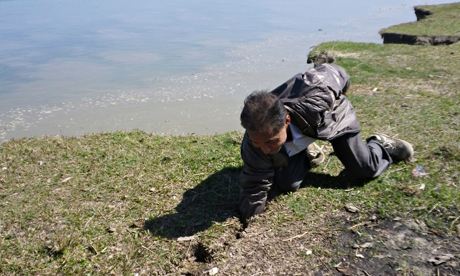
Flood of misery … the overflowing waters of the Brahmaputra river have encroached on the land of locals, heaping sand on their paddy fields. Photograph: Kieran Cooke
Man Maya Bhujel stands on the banks of the Brahmaputra river. The small village of Laupani is nearby. In the distance, a pink evening light shines on the snowy ridges of the eastern Himalayas.
"When I came to the village to marry, 42 years ago, it took an hour to walk to the river," says Bhujel.

"Now the river's waters are here, eating away at our land, heaping sand on our paddy fields."

The Brahmaputra is one of the world's mightiest rivers, 10km wide in places. Its waters rise more than 5,000 metres up the Tibetan Plateau and flow for about 3,000km through China, India and Bangladesh before joining the Ganges and emptying into the Bay of Bengal.

The river is a lifeline to millions, delivering vital nutrients to the plains of Assam and other areas, but its fast flowing waters also cause widespread misery. In 2012, more than 1.5 million people in Assam were displaced by floods, with many lives lost and whole villages washed away.

Bhujel is 70. Her calloused hands and lined face are testament to a lifetime of hard work on the land. She is dressed in a widow's white sari: her husband died last year.

"We once had three bighas of land [one bigha is about a third of an acre], but most of it has been eaten away by the river. The last thing my husband did before he died was sell our cattle."

In part the flooding and land erosion is a natural phenomenon. The Brahmaputra carries a vast volume of water, an amount only exceeded by the Amazon and Congo rivers.

As the Brahmaputra's waters cascade down from the mountains on to the soft alluvial soils of Assam, they eat away at the river's banks and deposit tons of sand on nearby lands, turning once verdant areas into what looks like an enormous beach.

North-eastern India is a highly seismic zone. An earthquake in 1950 was one of the most violent recorded, altering the geology of the entire Brahmaputra river basin and raising the river level by eight to 10 metres in places.

But rampant deforestation, particularly in areas further upstream, is another factor driving land loss.
"Over time different rivers in the Brahmaputra basin have merged, braiding over a very wide area, and thousands of square kilometres of paddy fields have been lost," says Professor Jogendra Nath Sarma, a local geologist who has been studying the Brahmaputra for years.

"Population growth and immigration from Bangladesh and other areas has put a big strain on Assam's land resources. In the past people would migrate to higher ground during the monsoon and flooding season, but now there is nowhere for them to go.".

Laupani is almost entirely populated by Nepalis, whose ancestors migrated from their mountain homes to the plains of Assam in search of a better life more than a century ago.

Subhakar Subedi, the village chief, says farmers are experimenting with more flood resistant rice strains. Others are turning what land they have left into small tea gardens or vegetable plots.
There are pools of stagnant water, left behind by last year's floods. They provide ideal breeding grounds for mosquitoes; malaria, says Subedi, is on the rise.

The government has erected flood defences in some areas. Aaranyak, a locally based NGO, has joined forces with the Kathmandu-based International Centre for Integrated Mountain Development – the only transboundary organisation looking at development issues across the Hindu Kush-Himalayan region – to install a number of flood early warning devices along the Brahmaputra's banks.
Subedi says the government in New Delhi should be doing more.

"Our ancestors were poor but we are poorer. The politicians come – especially now, at election time – and say they will help us. But little happens – it's all wada, wada [promises, promises]."

India's north-east is a tribal area. With its tea plantations and plentiful natural resources, including oil and coal, it was once one of the country's richest regions. Now it is one of the poorest.

Many people in the area feel cut off from the rest of India and neglected by central government.

There have been frequent violent clashes between indigenous groups and central government authorities.

There are few young men in Laupani. With little land left to farm, many have migrated in search of work, mainly to cities such as Chennai and Bangalore in southern India.

People in Laupani and elsewhere along the Brahmaputra face other challenges. Many glaciers in the eastern Himalayas and on the Tibetan Plateau that feed into the Brahmaputra are melting due to higher temperatures.

Accumulations of soot-like black carbon pollutants on the snowy peaks cause more heat to be absorbed, hastening glacial melt. In the short term this could lead to larger and more volatile river water flows.

Both India and China, its northerly neighbour, are involved in a large-scale dam building programme on upstream areas of the Brahmaputra and its tributaries. The consequences for downstream communities are uncertain.

Bhujel is concerned with the day to day. One of her grandsons is using bamboo poles to build a new, temporary dwelling for the extended family.

"With every monsoon season, we fear we will have to move again. The river is always hungry for more land," she says.
23 March 2014

All women’s bank to open three branches in northeast India

Agartala, Mar 23 : The Bharatiya Mahila Bank (BMB) — India’s first all-women bank — will open three more branches in three capital cities of the northeastern states this week, officials said here Sunday.

“Three branches of the BMB will be set up in Agartala (Tripura), Shillong (Meghalaya) and Itanagar (Arunachal Pradesh) in this week,” a senior official of the Reserve Bank of India told IANS.

The government-owned bank that was launched Nov 19 last year has set up its northeast India’s first branch in Assam’s main city Guwahati last year.

The official said BMB chairman and managing director Usha Ananthasubramanian would set up the region’s second branch in Agartala Monday.

The Shillong and Itanagar branches of the women’s bank will be set up within this week.

“By March 31 or before the end of the current fiscal (2013-14), 23 branches are expected to be opened across the country,” the official added.

Besides the three northeastern capital towns, the cities where new branches will be set up during the 2013-14 fiscal include Hyderabad, Chandigarh, Shimla, Bhubaneswar, Jaipur, Dehradun, Patna, Naya Raipur, Panaji, Srinagar, Thiruvananthapuram and Ranchi.

Aiming to economically empower women, Prime Minister Manmohan Singh and United Progressive Alliance chairperson Sonia Gandhi inaugurated the BMB Nov 19 simultaneously opening seven branches of the bank.

The bank’s nine branches, one each in Delhi, Mumbai, Kolkata, Chennai, Ahmedabad, Indore, Bangalore, Guwahati and Lucknow, are all operational.

Online retailing on the rise in Northeast India

India's North East is quietly becoming one of the fastest-growing markets for online retailers with an increasing number of youngsters from the region logging on to buy mobiles, accessories and much more.

Portals such as Myntra, Jabong and Snapdeal are finding good traction for orders from the region as the number of customers looking to buy the best brands at affordable prices is on the rise.

"Youngsters today are extremely fashion conscious and tech savvy and online shopping gives them a platform to access the best brands at affordable prices with the convenience of shopping from anywhere. North Eastern markets behave similarly," Myntra co-founder Ashutosh Lawania told PTI.

"From a geographic reach and availability perspective, perhaps more so - we are seeing a steady increase in business from this region," he added.

The North Eastern states -- Arunachal Pradesh, Assam, Manipur, Meghalaya, Mizoram, Nagaland and Tripura -- generate about 8 per cent of traffic and business for Myntra and the company expects further growth in the coming quarters, Lawania said, without disclosing absolute numbers.

"North East is doing really well in terms of acceptance (of online retail) and the market potential is also very big. The taste for fashion is very refined there and customers are trendy, experimental and are ready to try out fresh arrivals," Jabong co-founder Praveen Sinha said.

Snapdeal Vice-President Operations Saurabh Goyal said the percentage of contribution from the region to the New Delhi-based company's overall business is in double digits.

"The region is one of the fastest-growing markets in the country for us. We are growing in double digits month on month," he added.

Even eyewear online shopping portal Lenskart has seen good traction for its products from the region.

"About 20 per cent of our overall business comes from the North East plus West Bengal. Fashionable eyecare products are much in demand," Lenskart CEO Piyush Bansal said.

For Myntra, Guwahati, the most populous city in the region, and Aizawl in Mizoram are the two key markets, while there has been a steady increase in the number of online shoppers from Dibrugarh, Jorhat, Sibsagar and Tinsukia -- all in Assam -- in the past few months, Lawania added.

Lawania said men in the North East region shop for smart casuals and footwear while women opt for western and ethnic wear online.

"Brands like Puma, Nike, Adidas, CAT, Wildcraft, Duke, Lee, Levis, Clarks, Shree and Myntra.Com's in-house brands Roadster, DressBerry and Anouk are preferred by shoppers in these region," he said.
21 March 2014

Myanmar Weavers To Train inmates of Mizoram Home

Aizawl, Mar 21 : A number of orphans and drug addicts, all inmates of a home run by Thutak Nunpuitu Team (TNT) at Zuangtui near Aizawl, will be trained at the Handloom Weaving Centre by two Myanmarese weavers.

The Handloom Weaving Centre, jointly established by TNT and the Amway Opportunity Foundation (AOF), was inaugurated on Tuesday by G Malsawmdawngliana, joint director of industries (handloom and handicraft).

The weaving centre is equipped with 8 Myanmarese looms and three Indian-made looms installed at a cost of Rs 3 lakh funded by the AOF under its corporate social responsibility programme.

Amway executive Bikramjit Paul said the weaving centre will serve as a skill-development centre and will be self-sustaining for the inmates of the home so that they find employment after leaving the home.

The AOF has also helped the students of the home by providing them school uniform, textbooks, drinking water and sanitation inside the home's premises.

At present, the TNT home has 68 workers, 250 mentally challenged people and drug addicts, 420 orphans and 303 students. The home depends solely on donation from NGOs, individuals and churches.