05 December 2012

Meghalaya Panel Favours Inner Line Permit

Shillong, Dec 5 : The Meghalaya government-constituted panel on influx Tuesday unanimously resolved to recommend immediate implementation the Inner Line Permit (ILP) system to check the influx of illegal Bangladeshi immigrants in this mountainous state.

The committee, headed by Deputy Chief Minister Bindo M. Lanong, would submit its recommendation to the Mukul Sangma government in a day or two.

"Although alternative proposals were made such as implementation of three-tier card system, a consensus decision emerged on the need to introduce Inner Line Permit system in the state," Lanong told journalists.

The mandate of the Lanong committee is to review the situation of influx in the state and to suggest a multi-pronged strategy and a practical approach to tackle the problem.

The ILP is issued under the Bengal Eastern Frontier Regulation, 1873, by the state governments to Indian citizens entering Arunachal Pradesh, Nagaland and Mizoram. The then British government had introduced the Act in the northeastern states to "protect the tribals from exploitation by restricting entry of outsiders".

In Meghalaya, ILP was repealed from Garo Hills in 1897. The issue of Garo Hills being outside the purview of the ILP was discussed threadbare and the committee decided that the government must ensure (if needed through legislation) that ILP covers the entire state and should not be implemented partially.

"The provisions of the Act cannot be implemented partially. We cannot have two sets of law for the state, so we have to tread carefully, although there is a general consensus that ILP should be introduced in the state to check influx," said Lanong.

Earlier, the committee thought of presenting two options - the ILP or the three-tier identification system, whichever is conducive.

In the latter, permanent residents of the state would be presented a green identification card, while "semi-permanent" residents like central government employees, businessmen and contractors would be presented with a blue colour card.

A temporary red colour identification card would be issued to "tourists, labourers etc".

This card would be issued at the inter-state entry points and Meghalaya Houses. The permanent card would be issued after identification by the Dorbar (traditional bodies) and confirmation from the deputy commissioners.

Chief Minister Sangma, who had earlier admitted that the entry of illegal immigrants into the state was alarming, said the state would have a "more stringent institutionalised mechanism" than the ILP.

Shillong Bypass To Open Year Ahead Of Schedule

By Deepak Kumar Jha

Shillong, Dec 5
: The over two-decade wait for better and fast road connectivity to the North Eastern States of Meghalaya, Mizoram, Manipur and Tripura via Shillong bypass is likely to be over in a few days’ time. Though almost 20 years late, the NHAI’s ambitious 48 km Shillong Bypass project has been completed a year ahead of its December 2013 schedule.

The Meghalaya Chief Minister’s office has expressed desire to the Ministry of Road Transport and Highways (MoRTH) and other functionaries of the UPA-II for commissioning of the Rs. 220 crore project. The much awaited Bypass would help ease traffic congestion in the city and would be beneficial not only to landlocked Meghalaya but also for other States in the region like Mizoram, Tripura and parts of Manipur.

The social economy of the entire region is expected to get a major boost as the project is likely to save more than Rs. 5,000 crore annually in the region. Trucks and other heavy vehicles moving to Jaintia Hills, Barak Valley and further would take this route. Also, the bypass will come as a big relief to the air-travellers as there will be a cut of almost one-and-a-half-hour drive from the city to the airport. Often there were complaints about people missing flights as they got stuck up in traffic.

Meghalaya Chief Minister Mukul Sangma told The Pioneer that the Shillong Bypass would be inaugurated before Christmas. “We are planning to inaugurate the project sometime in the second or third week of December. This would be the first project in the region which is being completed one year ahead of the deadline,” Sangma said.

The project was delayed due to several problems, including that of alignment in different parts of East Khasi Hills and Ri-Bhoi districts. The Bypass starts at Umiam in Ri-Bhoi district and ends at NH 44 near Mawryngkneng in East Khasi Hills district and includes a major and eight minor bridges in this hilly area also adding to the scenic value in the region.

Shillong Bypass is one of the two most ambitious NHAI’s projects in North East with the other being the 61.80-km four-laning of Guwahati-Shillong NH-40 which is still under development. “This is one of the rare feats of the country’s road making agency which has completed a difficult project almost a year ahead of its schedule. The Meghalaya Government wants to commission the project for national interest,” said a MoRTH official.

On the other hand, the widening of Rs. 530 crore NH-40 began which began early this year. This too is on track after facing a roadblock recently at Umsning in Ri-Bhoi district due to land compensation and realignment problems. The Centre-approved project is also likely to ease traffic snarls on NH-40, which connects Shillong to Barak Valley in Assam and Mizoram through NH-44.
04 December 2012

Pope Gets On Twitter


You can follow the pontiff on twitter

https://twitter.com/Pontifex

HPC Plea To implement Accord

Aizawl, Dec 4 : Overground Hmar politicians of the Hmar People’s Convention (HPC) will step up their demand to implement the 1994 peace accord signed by the Mizoram government with the outfit.

They slammed the state government for failing to hold elections for the Sinlung Hills Development Council for the past 18 years, though the guidelines for the council had been notified on September 10, 2008, in the Mizoram Gazette.

The development comes after the state government’s decision to start negotiations with the armed HPC-Democratic (HPC-D) on December 13. Its chairman, Zosangbera, is in an Aizawl jail since July.

The chairman of the HPC Memorandum of Settlement (MoS) Implementation Demand Committee, S. Khuma, told The Telegraph today that the panel was set up last July to push for implementation of the accord. However, 18 years have passed without the memorandum being implemented, except for the setting up of the Sinlung Hills Development Council office.

“People have nothing to do with the present council, as the chairman is appointed by the state government and no elections have ever been held.”

“We want the area to be declared under the Sixth Schedule according to paragraph 6.1 of the MoS, and the area demarcated,” said Khuma, adding that the committee was scheduled to visit New Delhi to take up the issue directly with the Centre.

He said they had written memorandums to the chief minister, home minister and the governor of the state but no reply had been received. The attempts to meet the political leaders of the state have failed so far, he said.

“The government simply appoints their own man as chairman, and this is why we demand elections for the council,” James Hrangchal, secretary of the committee, told The Telegraph.

He said the party in power had lured the HPC leaders, by offering them the chairmanship of the council.

The committee has also called a meeting of the factional leaders —Rosiama and Thanglianchhunga — to iron out disagreements.

The adviser to the committee, J. Laldinliana, a founder of the HPC, said they had taken this step as, “neither the HPC nor the SHDC seemed interested in getting things done”.

On the armed HPC (D), which is also fighting for the same cause, Hrangchal said, “It is true that we all want the same thing, but our difference is that when we signed the MoS we gave up violence and opted for the peaceful democratic way of getting our rights.”

They also plan to meet the “Scheduled Tribes of the southern autonomous councils to chalk out a joint future strategy,” they said.

The HPC is registered political party. The HPC (D) split from the HPC in 1986 over slow implementation of the accord.

'Being Assamese, I Was Asked For My Passport'

By Devidas Deshpande


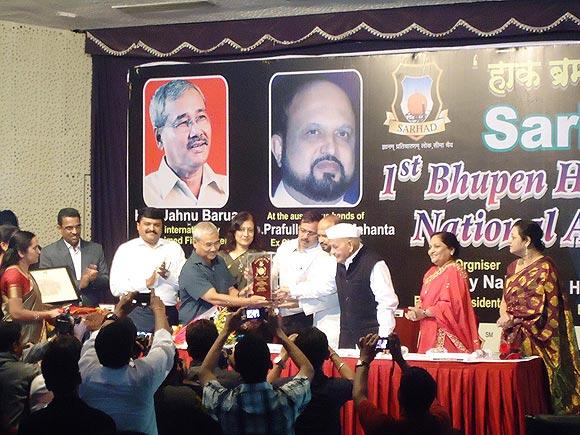
Director Jahnu Barua -- who made the award-winning 2005 film Maine Gandhi Ko Nahin Maara -- gets candid during an award ceremony in Pune. Devidas Deshpande reports.


Pune, Dec 4 : Even as he received an award in the name of his "Dronacharya-like guru" in Pune, acclaimed Assamese filmmaker Jahnu Barua revealed how he was once asked for his passport in Rajasthan.

"I have been through many such instances. People mistake us (Indians from the north-east) as foreigners and they can't be blamed totally. We also have to blame ourselves," he said, citing an incident in Udaipur, Rajasthan, when he was asked to present his passport at a five-star hotel.

"When I checked in, the receptionist asked me to present my passport. When I told her I was from Assam, she bluntly replied, 'I understand Sir, but we have a policy of asking passports from foreigners.'"

"The issue was not resolved even when I advised her to see the map of India. Later, it was resolved with the intervention of her boss," he said.

Barua received the first-ever award instituted by the Pune-based non-governmental organisation, Sarhad, on Sunday.

The award ceremony was held against the background of the brief exodus of Assamese and other north-easterners from Pune just three months ago.

"During the late 1970s," Barua said, "I did all the work for my production company. The owner of the studio -- where I gave my movie reels to develop -- thought I was a Nepalese working in my company. I did not try and remove his impression and built a good relationship with him since he was a good-hearted fellow."

"He got to know my real identity five years later through a newsreel playing in a movie theatre when I received the National Award. Had I reprimanded him for thinking me a foreigner, we could not have built a relationship," he recalled.

Recounting his meetings with the late maestro Bhupen Hazarika, Barua said even though he met Hazarika just 10, 12 times, he had a close relationship with the composer and was a 'guru' in a way for him.

"He (Hazarika) told me that 'If you are scared, you are not a creative person'," Barua said.
Describing Maharashtra as his second home, the Mumbai-based Barua recounted some humourous anecdotes from his early days at the Film and Television Institute of India in Pune.

"I spent three years in Pune -- they were the best years of my life," he said, narrating how he spent three nights in a garden in the city. Many years later, he showed the bench where he had slept during those nights to his wife.

Photograph: Jahnu Barua receives the award from former Assam chief minister Prafulla Kumar Mahanta (partly seen).

Study Underway on Climate Change in Northeast

Agartala, Dec 4 : The Indian Council of Forestry Research and Education (ICFRE), an autonomous body under the union ministry of environment and forests, has undertaken a study to assess the impact of climate change in the northeastern region, a top official said here Monday.

"Like other parts of the world, there must be a climate change affect in the mountainous northeastern region. Rising population, developmental works and illegitimate activities are putting pressure on environment and forests," ICFRE director general V.K. Bahuguna told reporters.

The crucial climate change study, which began recently, will help the authority to take apt action to protect the forest and environment of the northeast, the official said.

He said: "Besides the climate change study, the ICFRE has also taken a series of steps to sustain the livelihood of forest dwellers, focusing on forest-based income generation, promotion of non-timber forestry products, and development of cultivation techniques and value addition for forest produce."

The ICFRE, an apex body in the national forestry research system, has been undertaking holistic development of forestry research through need-based planning, and coordinated research and education.

The council has eight regional research institutes and four research centres in different bio-geographical regions of the country to cater to forestry research needs of the country.

The ICFRE's northeast regional office in Assam's Jorhat district looks after the entire region; there are also two other centres recently set up in Tripura capital Agartala and Mizoram capital Aizawl.

Bahuguna, also the Chancellor of the Dehradun-based Forest Research Institute University, said that to quantify the socio-economic impact and living standards of those beneficiaries who received land under the Scheduled Tribes and Other Traditional Forest Dwellers (Recognition of Forest Rights) Act, 2006, there was need to conduct impact assessment exercises and disseminate success stories in other parts of the country.

ICFRE is also planning to restore bamboo resources in Tripura, promoting the most preferred bamboo species of the state.

"The centre is committed to extending technical support to bamboo growers at every stage, from nursery to plantation management," the ICFRE director general said.

He said the bamboo treatment techniques patented by ICFRE would also be transferred to users, to save time and money spent every year in the maintenance of their structure, besides conservation of bamboo resources by minimising consumption.

The latest report of the Forest Survey of India (FSI) holds that the percentage of forest cover of the total geographical area of the eight northeastern states -- Assam, Arunachal Pradesh, Manipur, Meghalaya, Mizoram, Nagaland, Sikkim, Tripura -- is 66.07 percent.
03 December 2012

Why Mobile Map Apps Are Actually Getting Worse

It's the one part of your phone that might not be getting better. Why every major mobile company is re-creating reality from scratch. posted

For a few wonderful years, the mobile mapping landscape sat on an easy-to-navigate pangea. Google Maps was the default location app on the iPhone and Palm OS, and an easy-to-download app on Windows Mobile and BlackBerry OS. The Android version was typically a bit better than the others, but its underlying data set was the same. It was solid, predictable and consistent. It was good enough to trust, no matter the platform.

Consider the new geography: Windows Phone uses Bing Maps, while iOS uses Apple Maps. Palm OS sank into the ocean, and BlackBerry isn't far behind. Now Amazon, which released its first tablet late last year, has struck out on its own, giving Kindle developers access to yet another mapping service alternative to Google Maps, based on Nokia's Navteq data. (Microsoft licenses some of this same data; Apple licenses from TomTom; Google has its own.)

Here's Amazon's pitch, if you could call it that:
The Amazon Maps API provides mapping functionality for Android apps on most Kindle Fire tablets. If your app uses Google Maps, which is not available on Amazon devices, you can migrate your app to the Amazon Maps API. The Maps API offers interface parity with Google Maps.
While Amazon's announcement contains lots of information about how developers can use Amazon's maps, it doesn't explain why they should. The main reason appears to be, "because we say so."
The continents have drifted apart. The only major platform that uses Google Maps as its default mapping service is Android — and only Google-approved versions of Android. The Kindle Fire is based on Android, and shares much of its code, but presumably Google demanded a licensing fee to include maps.

Viewed separately, each of these moves makes sense: Apple is in direct competition with Google, Amazon is trying to establish its own platform, and Microsoft is doing all it can to position Windows Phone as a truly different alternative to Android and iOS. For a time, companies were dropping Google Maps due to high licensing fees, but Google has since slashed them dramatically.
But taken together, they're a perfect representation of what's happening in mobile right now. Terrified by competition, motivated by real, consequential patent threats, and hungry for the personal data — and ad dollars — that location-based services are so good at extracting from their users, every major-platform company is scrambling to disassociate with its former partners and re-create what they once could just buy or borrow. The fear is so deep and the competition so fierce — or at least, the anticipation of competition so acute — that these companies are constructing literal alternate realities: different representations of where things are on the planet's surface.

A search for "restaurant" near your location right now would be different depending on what kind of phone it was sent to. And until Apple, Microsoft, and Amazon (which is mostly licensing Nokia's maps and listings) catch up with Google's all-aware location database, it might result in different longitudes and latitudes for specific points of interest. This is a mostly not-good thing, at least in the short term: Apple Maps was so useless, its project manager was fired from Apple.

This period of distorted reality will most likely end in just a few years, as mapping platforms either get better and reach parity or reconsolidate. But for the time being, it's only going to get worse — don't be surprised if, when Facebook finally pulls the trigger on its mobile OS, it makes its own maps too.

END OF THE WORLD IS COMING: The time to freak out is now

NASA warns Emos at risk from 'end of the world'

Sydney completely devastated
Computer generated image of Sydney completely devastated after a mega Tsunami. This image shows what Sydney might look like if Mayan prophecies were fulfilled and life ended 21/12/2012. Picture: Sony
WHILE many are planning their large-scale end of the world celebrations, others are already hiding under their beds in anticipation of the Mayan Apocalypse of 2012, according to NASA.

NASA has issued warnings ahead of the reported 'Doomsday' on December 21 saying some people have been freaking so distressed by reports of the end of the world they are already not eating or sleeping.

It all started because December 21 is the last day in an ancient Mayan calendar, and the internet has been circulating rumours that a rogue planet called Nibiru would slam into Earth, destroying us all.

Last week the Russian Government tried to put an end to the doomsday talk after people started panicking and storing up supplies so they would still have kerosene and matches after the world was smashed to smithereens.

People everywhere were taking it so seriously National Aeronautics and Space Administration  scientists have been forced to hose down the situation, publishing a fact sheet:  Beyond 2012: Why the World Won't End.

They say there's no planet coming to destroy us, the Earth's rotation is not going to suddenly reverse, there's no danger from giant solar storms, and no evidence of impending doom.

"The world will not end in 2012. Our planet has been getting along just fine for more than 4 billion years, and credible scientists worldwide know of no threat associated with 2012," they say.

"Just as the calendar you have on your kitchen wall does not cease to exist after December 31, the Mayan calendar does not cease to exist on December 21, 2012.

"This date is the end of the Mayan long-count period but then - just as your calendar begins again on January 1 - another long-count period begins for the Mayan calendar."

While the idea that the world is about to end is bunkum, the anxiety people are feeling about it is real.
NASA Ames Research Center astrobiologist David Morrison has warned that they received emails from young people who said they were too worried to sleep or eat, and some said they were suicidal.

"(Scientists), both within NASA and outside, recognize that this hoax with its effort to frighten people is a distraction from more important science concerns, such as global warming and loss of biological diversity," he writes on the NASA website.

"We worry about the effect of this fear on impressionable children.

"(If) you will just use common sense I am sure you can recognise the lies."