 New Delhi:
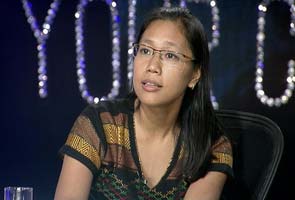
 India's youngest Minister of State, Agatha
Sangma, who is also one of the few politicians from the North-East at
the Centre, talks to NDTV's Sonia Singh about the recent mass exodus of
the North-Eastern population following rumours from cities like
Bangalore and Hyderabad.
Here's the full transcript of the interview:
In a week where everyone was saddened by the
departure of thousands of people of the North-East from different cities
around India, joining me tonight is one of the few politicians from the
North-East at the Centre, India's youngest Minister of State, Agatha
Sangma.
Agatha, as I just said, is one of the few politicians of
North-East at the Centre. When you watched what happened in Bangalore
how do you think it should be handled?
Agatha Sangma: To
be honest it was very, very disappointing to see something of this sort,
and the mass, you know, exodus in fact was something that we've never
seen before. And I think that it's something which is very difficult to
say how should it have been handled, because it eventually happened. And
people take precautions in today's world when something happens, you
know, we take precautions, so if an SMS comes that is threatening people
tend to take precautions and they flee. So in a way I do understand the
sentiments that were behind a lot of this sort of a movement that took
place, but I think that it is very important for us to build confidence
of the people, and to set examples where we can say that, yes, you know
we have an effective Government, we have an effective administration and
you will be protected. If we set that sort of an example I really don't
think that an SMS could really, you know, scare people off to that
extent.
NDTV: One sad aspect again is that even it was
seen as a fall out of what happened in Assam; that again the threats
were given randomly to all people from the North-East and I know that,
of course, it was an issue that saddens everybody from the North-East.
Even though that we know that there are so many different tribes and
different states, everyone from the North-East is blamed for an incident
in a part of Assam.
Agatha Sangma: It is very unfortunate
and it is something that is very difficult to contain, you know. This
is something that is, in a way, it was to someone like me, it felt very
inevitable that this situation would not have been contained within
Assam itself and it would have repercussions in the rest of the country.
In fact this is something that we had been saying from the past, that
this is the situation that needs to be looked at more closely, and I
would want to say that we must not look at it as an issue which is just a
communal issue. It is also an issue of the administration and we must
strengthen, you know, the immigration rules and the implementation of it
must be looked at, especially in the borders of the North-East.
NDTV: What
has the impact been even for you in your state of Meghalaya? Because
you know that the Congress government in Assam has been blamed for both,
pan politics for looking away because they were winning election after
election, and the situation has come to this stage. Currently of course
the NCP, the party to which you belong, is an ally of the Congress, what
would you say, what would your advice be to the Congress government in
Assam?
Agatha Sangma: Today to be honest, the borders in
the North-East are extremely poorish and I really feel that it has been
overlooked by the Government of India. We concentrate a lot on the
India-Pakistan border, but the kind of, you know, man power or the kind
of attention that the North-Eastern borders need to be given are not
being given. To be honest, my constituency borders with Bangladesh and
we feel that a lot of environmental, so called environmental refugees is
something that we see in every monsoon season, whenever the rains pour,
a lot of the Bangladeshi labourers, you know, tend to come and work in
my constituency and eventually it's a situation where you cannot you
know, you cannot close your eyes to a situation like that. And,
therefore, I think that when you can see that something is arising and
it needs to be looked at, one must not turn their heads and say that
there is no problem. You must identify that, yes there is a problem, and
accept it and then work on it.
NDTV: That's an important
point but just let's go across Agatha to some young people from
Bangalore. Now we know that it is one of the cities where many young
North-Easterners have left. Questions for you, who has questions for
you? Let's go across to Bangalore, go ahead with your questions for
Agatha Sangma.
Questioner 1: Good Evening Ma'am, this is
Salman from Bangalore. We seem to live in a country which is united and
secular but when situations like this arise, the indifference clearly
shows up and we seem to do nothing for it. How do we end this
indifference?
Questioner 2: Good Evening Ma'am, this is
Raul Paul. My question at this juncture is, number one what is being
done by the state and the central Government for the large number of
people who have been rendered homeless? And secondly the break down and
disintegration of the social order that we see today, is this the
reflection of the breakdown of the political system and our leadership?
NDTV:
Do you think one, individually you could have done more perhaps even in
Assam, gone as the politician of North-East and as a Central Government
representative? Do you think the Central Government should have done
more?
Agatha Sangma: First of all I would like to thank
those students, they have given really important questions and secondly,
yes, your question is, I mean I think this is definitely a situation
where we could have done more. But it is a lesson that one has learnt.
It is something that we were completely not prepared for at that point,
and no one expected that in a span of three days so many students or
people from the North-East would be fleeing, leaving their jobs you
know, leaving their lives and heading back to a place where, you know,
it's difficult for them to find employment, even if it's home. So it was
a tough decision that people made in a matter of a day or two and it
would determine their entire life. So I understand that it was a very,
very tough time for all the people who fled at that point, and my heart
really does go out for that you know. And I do feel that as an
individual, and as a politician, I ought to do more and I would you know
apologise, I suppose, for the failure that we have done in this
particular period of time. But I think that collective efforts need to
be made, as politicians we can do and must do our part, but as, you
know, regular citizens of this country too, we have responsibilities.
This was the situation that I suppose cannot be looked at only from the
communal angle, okay, not really be looked at from, you know, North-East
versus illegal immigrant angle, because it was a design that was
created by people we cannot even identify at this point of time. We
don't know who sent those SMSes, you know we don't even have a system
where we can distinguish and say that these are the people who have been
sending these SMSes and put them behind bars. So we do need to improve
on our intelligence of course and I would say in the larger picture
because the questions, there are lots of questions that students have
asked me, but in the larger picture I would say that it's very important
that we have some short term issues in place and we also have some long
term issues settled.
NDTV: As a young politician what can
you do for young people and especially, specifically I suppose, from
the North-East as well, but what can you do for young people?
Agatha Sangma: You
know Sonia this is one experience that I have had and this is an
experience I had after I became an MP and it has stayed with me for a
very long time. And it does make me wonder as to what I can do, or we
can do as a community to really be recognised and really recognised for
the contribution that we are making. You know this was something I, in
fact, have mentioned in an another interview and I would like to mention
it again, is when I was in a shopping mall, after becoming an MP, I was
shopping and I was just looking around and there was this women who
looked at me, and she asked me for a particular size. It was something I
had a bag with me and it was clear that I was actually shopping. But
the first impression that she had was that she cannot be shopping here
she is definitely working here. Now that's the kind of attitude I think
is something that is not welcoming. I think that we need to find a way
where we can say that, well yes, we work in the retail sector, we work
in hospitality, but we can also be working successfully in the media.
Look at Sandeep Phukan, look at Mary Kom. These are people who are real
good achievers, who have done something amazing and they belong to the
North-East and that must be recognised. So I think that attitude will be
changed only if we ourselves try and strive to do things that we always
wanted to do and excel in certain fields.
NDTV: You make
sure the pressure on students and recently of course the tragic incident
where a young girl from Meghalaya actually killed herself, and we saw
the Chief Minister ask for special laws and there was a huge furore over
it. How valid do you think that is also, when you talk about the issue
of integration? Do you think that is also, when you talk about the issue
of integration, do you think that there needs to be a separate step for
the students from North-East? What would your reaction be?
Agatha Sangma: I
am not aware of the suggestion that the Chief Minister made about
separate laws. I do agree, but there are situations that crop up where
it's a case of racial discrimination, but again I would like to say that
there are some situations which may not be the cases of racial
discrimination and we must not put everything in that light. It's very
important for us as a nation to not allow incidences to just divide us
for the sake of division. And I think it's important that students get
admission into good universities and it's important that institutes
don't have some sort of apprehensions admitting students from the
North-East, for the fear that there could be some legal action taken
against them. So I think we must be very careful when we make certain
allegations or we must be very careful in certain situations. I am not
talking about any specific situation, but I really think that there is a
need to be more trustful as well and if we are always defensive then
again there is going to be a problem, so there is a time we need to rise
above the situation and not feel victimised all the time. I think that
the situation that's happening very often these days where we tend to
feel victimised, and I am not saying that you know I happened to be a
Minister of State or I happened to be Mr PA Sangma's daughter, like I've
been a student as well and I never carried a name plate saying I am PA
Sangma's daughter, and yet I made my struggles and I did not always, did
not always think that I was being victimised. So I would really appeal
to my fellow friends from the North-East, that we must also walk our
bit. You know it's very important, it's a midway thing, you cannot
expect that everybody will walk towards you, you got to walk midway too.
NDTV: That's
really a very interesting perspective and you have mentioned that Pune
Incident. Let's just go across to Pune for someone who has a question to
ask you
Principal of ILS: Hello Agatha, how are you? You
have really made us proud by becoming the youngest Minister of the
Indian Parliament. Are you aware that in the Parliament at present there
are six students from the ILS? I hope you will form an ILS Alumni
Association and will come back to us in a group. I would like to put
only one question to you, that the studies you did at ILS, do you find
them useful? Are you supported by it when you are working as a Minister
in the present government?
NDTV: As a politician are you
frustrated at what's going on? We had a young boy talk about the lack of
leadership in this government, it is seeming directionless. Are you
frustrated by what's currently going on?
Agatha Sangma: But
it is really sad that we don't see the functioning that we used to. And
growing up as a politician's daughter I would watch my father come in
late, work for late. As a Speaker I saw him work sometimes till 12
midnight, running the House. And that really was one of the reasons why I
wanted to be in politics. But today the kind of non-functioning that
you see is not just disappointing, but it is also frustrating, because
there is so much more that we would want to do. And I suppose that I
cannot just complain because I am really part of that problem myself,
isn't it? I am part of that system and I think that we need to do more.
NDTV: Let me just, you talked about how your constituency; I have some questions from your constituents, let's go on to the people.
Questioner: Other
than being on record to have entered the Parliament for the first time
wearing garro, traditional dress, as you have claimed, what really
significant things have you done for the people of region? Your father
has represented Garro Hills for over three decades but till now we don't
even have basic amenities like decent roads, drinking water and
electricity and the list goes on, do you think you can do what your
father could not?
Agatha Sangma: A lot of the problems the
gentleman was talking about like roads, water and you know electricity
are all state subjects, and as a Parliamentarian we act as a catalyst in
ensuring those amenities reach the general public. And I think in my
tenure I have been voicing that and have been working towards that, but
it is something eventually that State governments do need to implement,
and I can't say that I am completely happy with the way it has happened.
But you know there is a system that is followed and we work for that
system and we are trying our best to ensure that the amenities reach to
the people. The vision I have for my constituency is that I want to see
it as more sustainably developed constituency, very mineral rich
constituency, we are rich in coal, we are rich in lime, in uranium. But
it has become a state where the minerals and the richness for it are
actually becoming a curse to my constituency because a lot of illegal
mining is taking place. A lot of environmental degradation is taking
place, a lot of health hazards, water is been contaminated and I think
it is very, very important that the mining policy be implemented
immediately. I have appealed to government several times and I am
working towards it, but eventually, like I said, it can be done by the
state government. So there is a difficulty here when you become a Member
of Parliament, it's not like that you can say there will be light and
there comes the light. You do eventually realise that you are human, you
have to work in those limitations. I think in my limited capacity, I
have been trying to do my best.
NDTV: The Sangmas and your family have dominated Meghalaya politics?
Agatha Sangma: Not dominated but...
NDTV: Who else has dominated?
Agatha Sangma: See, everybody is a Sangma there. Today our Chief Minister is Mukul Sangma, but he is not part of my family but you know so.
NDTV: But
PA Sangma and his family have in a sense dominated Meghalaya politics.
Two of your brothers are also in politics, how do you; when people say
one reason you know, that one reason we don't want the Women's
Reservation Bill is because it's only going to be daughters or daughter
in-laws of politicians who will actually benefit. Even when you see
women in Parliament most of them are related to powerful families. In
that sense do you agree with this family rule or hereditary rule which
has now become prevalent in politics?
Agatha Sangma: I
don't really agree with it. But I mean I cannot even claim to say that
it's all bad. This is something where there is always reservation, there
is always going to be a pro to it, there is always going to be a con to
it. So you cannot criticise something and say it's completely bad. I
really feel okay when there is a Women's Reservation Bill coming up and
it becomes a law. Yes initially you'll have women who come from families
who are politically influential. They may not contribute in Parliament
and they may not even contribute as Members of Parliament or as Members
of Legislative Assembly, but it is something that I feel, eventually it
will increase number of women in the Parliament and in the Assemblies,
and eventually it will bring about an improvement of the entire
situation, and you will have women who are loud spoken and who are able
to voice the concern of the constituencies. And I think in the
Parliament today there are a lot of young Parliamentarians. There are a
lot of relatives of Parliamentarians who are doing a lot of constructive
work as Parliamentarians or as MLAs. And there is criticism of course,
it doesn't mean it is all bad.
NDTV: There is a question,
your father, as you speak, has launched a new political party. The
contradiction some may say, that you are still in the NCP and you are
still a Union Minister of State. Yet when your father was campaigning
for President you accompanied him on some visit he made, and how can you
stay in this government when he's been very clear he doesn't believe in
it?
Agatha Sangma: Firstly I would like to clarify some
facts. I didn't campaign with my father. You know he's my father, and I
campaign and if I am seen with him because he's my father, one cannot
call that as campaigning. It was a very difficult situation and I didn't
see a point of justifying myself and I cannot obviously not be seen
with my father, he's my father and if he's campaigning and if he went to
meet political parties. There was a point where, as a tribal MP, I did
go and that time there was no UPA candidate so there was no question of
me campaigning against UPA candidate and campaigning for somebody who is
not acknowledged by UPA. Because at that point it was not even a
candidature, a particular person's candidature that we were campaigning
for. We were only meeting political party leaders and we were asking for
people from political parties, we were asking from leaders to
acknowledge that yes, we have never had a tribal as a President of this
country, and probably it's time. Now if in that group I am part of it as
a tribal, I don't really see there is anything contradictory in being a
MoS and doing something of that sort, because really it was on the
matter of principles.
As soon as it became an official election
and an official campaign, I didn't campaign. I was extremely careful and
I knew that I have a certain role to play and I did that really
responsibly. So I really don't see that as a contradiction. And today,
yes he's launching a new party and that is his call. You know we all
have a call in our life and his call is his life in politics and he
continues to do so, and I continue to do so, and I think we can co-exist
you know. And we can understand our responsibilities and we can
co-exist and there needn't be any clash because we belong to two
different political parties. India has seen various political families
and it will continue to see that.
NDTV: But will your
political party, will the NCP be mature enough to accept that? Because
there are reports if they were upset you may be dropped from the
Cabinet.
Agatha Sangma: Well I think they were all
probably rumours, or they were probably being incited by certain
segments who found interest in that. But I really think that if my party
chief had something against me, by now he would have taken some action
against me. And I would say I respect him dearly for all the good
treatment he has given me. I respect him and I respect my political
party. And I have been doing my job to the best of my ability, and
sometimes you know, something appears to look like they are in stress,
but I really think it's more of a speculation than anything else.
NDTV: You are not worried about your post as a Minister of State?
Agatha Sangma: Not really.
NDTV: You don't want to join your father's party?
Agatha Sangma: No
I am completely content with where I am right now and I believe I have
taken up a responsibility and it is my duty to fulfill it till it's
taken away from me, you know at the end of the term.
We actually
have MC Mary Kom on the phone now live, to ask you questions. So Mary,
hi, this is Sonia Singh, go ahead and say what you would like to, to
Agatha Sangma.
Mary Kom: Now in the North-East we have got
an Olympic medal and most of the sportspersons are inspired from me, so
if we give attention mainly in sports, all the facilities, that will be
very grateful to all the sports promotion.
Agatha Sangma:
Thank you Mary, I am a big fan of hers. In fact you know, I read a
story in Tehelka about Mary, and she spoke about how the first time she
discovered how she was good at boxing was when she was in her village in
Churachandpur, and she was going in a rickshaw and the rickshaw driver
tried to act smart with her you know, and she boxed him and that's when
she realised she's actually good at this stuff. So I think it's an
amazing story of somebody who finds opportunities in times of trouble,
and you know in times of hardships. That's something which is really
inspiring to me and I would say that North-East is very, very talented
when it comes to sports and when it comes to music. It is something
which is in our blood, you know it's in our nature, it's literally who
we are. So I would really do my best to ensure that we can do something
more, you know, to ensure that sort of talent is nurtured in the
North-East.
NDTV: Well we are almost at the end of the
show and we had Mary Kom and we also have a young sportsman from the
North-East, Baichung Bhutia to ask you this question.
Baichung Bhutia: I
know at this age you have been given a big responsibility, so do you
have time to hang out with your friends and go out clubbing, and hang
out with friends and also just wanted to know when are you getting
married, or you have found somebody, a good Meghalaya boy for yourself?
NDTV: That's the sweet question.
Agatha Sangma: Of
course I do have dinners with my friends and it's not as bad to be
honest, and I do get a lot of time for myself without really being seen
as MoS. And I can really get away with a pair of jeans and T-shirt and
no one can really tell it is me, so it's great.
NDTV: You are not answering the second part of his question.
Agatha Sangma: That's really not happening at the moment.
NDTV: Hopefully
that will happen soon Agatha, all the best. It's wonderful to speak to
an articulate young Minister. I wish you would speak more often because
it is really interesting talking to you. Thank you so much for coming
in.