12 May 2012

Census For Mizoram Chins

https://blogger.googleusercontent.com/img/b/R29vZ2xl/AVvXsEitSpXQCYvsirD6y-zn5cQld4nXj91sYGAUImxXLgw3KoGFuzalaleKu9LIy5JC3hboJklz80JP0RYQMA_tlY1ano8a6yXcTdaQ7n5hOwmPBM6rhX5_OKeSA3l1MKYQQRpWrPFVK06uED4B/Aizawl, May 12 : Aizawl-based Chin Society of Mizoram will conduct a census of all the Chins who migrated from Myanmar and are living in the eight districts of Mizoram, a press statement issued by the Chin Society of Mizoram said.

The statement said that the census would be conducted this month and the lists of names of Chins residing in Mizoram would be submitted to the Myanmarese government and the representative of the United Nations in New Delhi.

Though generals in plainclothes are still ruling the country, the Chins are optimistic that the new government would pursue reforms and gradually respect human rights, the statement said.

"We are optimistic that an opportunity would soon arise for those who want to return to Myanmar and the present government would open up to take them back," a leader of the Chin Society of Mizoram said.

There were many Chins who migrated to Mizoram, Delhi and Malaysia between 1962 and 2010 who were not registered or recognised as refugees by the respective governments.

"In order to ensure that they would be able to return to Myanmar when they want to, the census becomes extremely important," the Chin Society of Mizoram said.

According to rough estimates, there were around 70,000 to one lakh Chins staying in Mizoram due to fear of persecution by the military junta and also those who migrated to this tiny state for economic reasons.

Chins could easily mingle with the local Mizos as they speak the same language and belong to the same ethnicity.

The Inner Line

Tribhuvan Munirka Village South Delhi’s Munirka Village is home to many young Northeasterners. Most stay in paying guest accommodations here and work in malls and restaurants. Here, a group navigates the busy streets of the Munirka market.
northeast: ties that bind
Yes, the Northeast-‘mainland’ experience is a chequered one. That’s not all it is though.

By Amba Batra Bakshi, Debarshi Dasgupta
Lights From ‘There’
  • Ratan Thiyam: Manipuri thespian
  • Atsu Sekhose: fashion designer
  • Rudy Wallang and Tipriti ‘Tips’ Kharbangar: of band Soul Mate
  • Mary Kom: Olympian boxer
  • Baichung Bhutia: football icon
  • Mamang Dai: writer, Padma Shri
  • Renedy Singh: vice-captain of the Indian football team
  • P.A. Sangma: ex-Speaker, Lok Sabha
  • Somdev Devvarman: Tennis player
  • Norden Wangdi: fashion designer
***
The deaths of Dana Sangma in the capital and Richard Loitam in Bangalore have put the harassment of people from the Northeast back on our front pages. Although a racial motive has not been attributed to either death as yet, it reminded everyone about the persistent challenge of bridging the disconnect between the Northeast and the rest of India.
In extreme instances, as with Loitam and Sangma, the harassment escalates until it comes to a tragic head. For many others, it is a recurring reality imposed on them because of their ethnicity. C.P. Singh, a Manipuri scientist with the Central Forensic Science Laboratory in Delhi, is one such victim. Singh has filed a police complaint, alleging that his colleagues regularly call him “chinkie” and have thrown mud at his car and house. He also alleges that he has not been promoted because he is from the Northeast. But for every cautionary tale, there are the success stories—not as well spotlit. As many victims there are of prejudice, there are those who have overcome it.

Krishna Nagar Members of Mangalaz, a five-member metal band from the Northeast, rehearse during a jam session. Mangalaz is the first Hindi rock group to raise issues of social injustice and corruption through their music. (Photograph by Tribhuvan Tiwari)
Metros such as Delhi, Bangalore and Pune are attractive cities for migrants from the region. They come in search of educational and employment opportunities. An estimated 2 lakh people from the Northeast are said to be living in Delhi alone. Of these, 78 per cent claim to have faced harassment at some point, says a report released last year by the Northeast Support Centre and Helpline. Some of the problems that receives frequent citation in the report range from hostile landlords and eve-teasing to insensitive police personnel and sexual harassment. “There are many layers and levels of discrimination against people from the Northeast. It differs depending on the age group, nature of workplace such as bpos, restaurants, parlours and so on,” says Ninglun Hanghal, a social activist who lives in Delhi.

Krishna Nagar A young girl wearing short shorts walks past a fully ‘covered’ Jat woman on her way back from work in the narrow bylanes of Krishna Nagar, which is a primarily Jat and Gujjar colony in south Delhi.. (Photograph by Tribhuvan Tiwari)
The alienation they face goes much beyond name-calling and digs at their ethnicities and eating habits. Problems in finding accommodation seem to resonate the loudest. And it is not limited to just the college students looking for hostel accommodation but also professionals. “It took me four months to find an apartment when I first came to work in Delhi. I was often shown the door by landlords and even brokers warned us of certain areas and colonies that had low preference for people from the Northeast,” says lawyer Toshi Longchari. There have also been some serious incidents, like the case of Niang Mary from Manipur who was beaten up by her landlord in Gurgaon. Niang says her landlord forcibly entered her flat at 2.30 am despite being asked by both her and her flatmate to come back in the morning. “He assaulted us,” she says, adding, “We filed a criminal case but still have not got justice. I feel in order to change the mindset of people it’s not just the government that needs to take steps. I feel the judiciary too needs to issue strictures against those who discriminate.”
But it’s not all divisions. There are deep linkages in the experience as well. There are individuals who have establish themselves and even carve out a niche for themselves in the metros. Like Atsu Sekhose, a Delhi-based Naga fashion designer who has exhibited at India Fashion Week events. Rebecca Alemla Changkija, a Naga based in Mumbai, is another who overcame the travails of big city life to become a successful film producer. Having lived in the city for six years, she suffered through a regimen of harassment and eve-teasing, including one night when she and her sister found themselves up against three bike-loads of “lecherous men” surrounding, heckling and making sexual advances at them. “We should learn to fight back and speak up. If not, there will be more cases like Sangma and Loitam,” Rebecca says. Besides well-known successes in the fields of sport and entertainment, there are the smaller, less visible connections formed in less overt spaces: whether it’s synergic collaborations and friendships forged on college campuses or even in the personal sense. Marriage between Northeasterners and ‘mainland’ Indians is rare, but not unheard of. It’s just that the connections are often overshadowed by the breakages.

Breaking through Naga fashion designer Atsu Sekhose at India Fashion Week. (Photograph by Tribhuvan Tiwari)
What is also often—and easily—overlooked, however, is how some people from the region too have ingrained prejudices that can manifest in a certain clannishness, which leads them to sticking only with members of their community both outside and in the Northeast. For instance, a Garo will tend to stick to other Garos while a Mizo will hesitate to mingle with a Naga. To think of the Northeast as a homogeneous, happy and harmonious stock, then, would be plain erroneous. And any assessment would be incomplete without taking into account the harassment of outsiders in the Northeast. Take the plight of the tea garden workers. Or the incessant delays that plague Shillong’s municipal elections because of indigenous opposition to the presence of “non-local”—this, despite having spent years in the region—candidates and voters.
When Ananta Dey, a local Bengali businessman, dared to challenge this blatant racism and went ahead to file his nomination in 2000, he was gunned down by suspected militants opposed to non-locals. “What if a Naga or a Manipuri, despite having lived in Delhi for 20 years, is denied the right to vote or contest an election? Imagine the ruckus it would cause, but the same thing goes unquestioned when perpetrated in the Northeast,” says Gajendra Upadhyay, an IT professional who was born in Shillong and lived there until he was 22.

Mizo Church Churchgoers huddle together to offer prayers during a Mass gathering at Mizo Church in Mizoram House. (Photograph by Tribhuvan Tiwari)
Renedy Singh, currently the vice-captain of the Indian football team and a Manipuri, feels people from the Northeast should open up more to outsiders. “I really think we should mix more. That will make things a lot easier,” he says, adding that he always makes it a point to blend in with the teammates from outside the Northeast. Former chief election commissioner James Lyngdoh, who chose to live in Chevella in Andhra Pradesh and not back in Shillong where he hails from, agrees with Renedy. “One can understand them huddling together for security, but it can’t happen all the time. They really need to break up,” he says, adding that people from Shillong often pretend as though they have come to a “foreign land” when all they have covered is just a 100-odd kilometres’ travel to neighbouring Guwahati in Assam.
But there are encouraging signs that these walls are gradually crumbling and spaces, isolated for so long, are becoming more diverse. There was the memorable scene of a Mizo girl, decked in a puanchei, leading in the Indian contingent at the opening of the Commonwealth Games in 2010. Delhi and Bangalore have had recent openings of Northeastern restaurants like Nagaland Kitchen, North East Diner and Zingron. And the latest breach comes from the Shillong Chamber Choir, who have travelled all the way south to sing for forthcoming Malayalam film Goodbye December. They will sing in Malayalam.

By Amba Batra Bakshi and Debarshi Dasgupta

Mizoram Sends Police to Secure Villages

https://blogger.googleusercontent.com/img/b/R29vZ2xl/AVvXsEiw7PnVvZ_BfKNOm2VDzINHQz0S28yOVwSvABkLmxzV8K2ghN-QCmLNzxAiomHoKxeLy01Q4txnh-Bx0OTmX5_ujnVy84_kFfXg1vNrKQTDS1FZ0UAbyzh48i5_vn32F0oI_wzu-_4wgjbb/Aizawl, May 12 : A large number of armed police personnel were sent to the northeastern part of Mizoram adjoining Manipur to assure the people of the area inhabited mainly by Hmar ethnic group that they should have confidence in the government, state Home Minister R Lalzirliana said here on Saturday.

Lalzirliana said that the people of the area, being intimidated by the militants of Manipur-based Hmar People's Convention-Democrats (HPC-D) required assurances from the government.

"The state police marched in the area to instill confidence in the minds of the people," he said.

The move came close on the heels of HPC-D insurgents sending extortion notes to the village leaders of the areas and also intimidated Young Mizo Association (YMA) branches to abolish their units.

Lalzirliana said that the border police outposts in the area would be strengthened and better fire power and two or three additional police outposts would be established in the area to meet the latest challenges of the Hmar militancy.

Meanwhile, majority of YMA branches inside the 'Demand Area' of the HPC-D submitted their assets to the central committee of the YMA as ordered by the HPC-D led by its new leader H Sangbera.

The YMA and local people in Mizoram-Assam border Vairengte town and surrounding areas, however, defied the threats of the HPC-D and urged the Hmar militant group to explain their moves in return.

Manipur Faces Strike Over Kuki State Plea

Churachandpur, May 12 : After the Nagas’ demand to “sever all ties” with the Manipur government, the Kukis in Manipur renewed their demand for creation of a separate state for them, maintaining that the Kukis were never a part of Manipur.

To demonstrate that they mean business, the Kuki State Demand Committee has called a general strike throughout the Kuki-inhabited areas of Manipur from 6pm of May 12 till 6pm of May 15.

The general strike will be followed by an economic blockade along two supply lines of Manipur.

Imphal-Dimapur highway and Imphal-Jiribam highway, the only supply routes for Manipur, pass through Kuki-inhabited areas.

The economic blockade, which will start from 6pm of May 15, will continue till 6pm of May 19.

The demand committee is also determined to close all government offices in Kuki-inhabited areas during the economic blockade.

The proposed Kuki state includes all the Kuki-inhabited areas in Senapati, Chandel, Churachandpur, Ukhrul and Tamenglong districts.

The renewed demand came in the backdrop of the United Naga Council’s reiteration on May 6 of an alternative administrative arrangement for the Nagas living in Manipur outside the administrative jurisdiction of the Manipur government.

“When India attained Independence, smaller kingdoms merged with the Union while the Kukis and our lands did not merge (with India). We were waiting for a reward in view of the contribution made by us in the struggle for Independence, but no reward came. It led us to demand a separate Kuki state on March 24, 1960, in the general meeting of the Kuki National Assembly,” K. Khongsai, the spokesman for the demand committee, told reporters in the district headquarters of Churachandpur today.

The demand committee was formed in November 1990 to spearhead the movement for a Kuki state. It is headquartered at Sielmat in the district headquarters of Churachandpur.

The demand came at a time when nearly 20 Kuki militant groups, which signed a suspension of operation agreement with the Manipur government and the Centre, are insisting that political talks should start.

Some of the groups now in designated camps are demanding a separate state for the Kukis.

The demand committee organised a strike and a public rally in Kuki-inhabited areas last year to reiterate its demand.

“But the government of India remains a mute spectator. As such, to reiterate our demand for immediate settlement of the Kuki people’s long-standing demand for self-determination within the constitutional framework, the demand committee is compelled to launch another agitation,” Khongsai said.

The blockade will dislocate supply of all kinds of commodities to Manipur for four days, creating scarcity of essential commodities.

The committee said the media and medical services would be exempted from the purview of the strike.
11 May 2012

The Angry Northeast

Supporters hold placards and participate in a rally at the landmark India Gate in New Delhi on 2 May protesting the death of north east student DanaSangma, portrait seen, who committed suicide in her university hostel on 24 April. Family members and supporters allege that discrimination pushed Dana to commit suicide and have asked for an investigation into the case. AP (File Photo) Supporters hold placards and participate in a rally at the landmark India Gate in New Delhi on 2 May protesting the death of north east student Dana Sangma, portrait seen, who committed suicide in her university hostel on 24 April. Family members and supporters allege that discrimination pushed Dana to commit suicide and have asked for an investigation into the case. 


By Pramit Bhattacharya


To put it rather simplistically, the absence of an engaged state in the early years of independence bred insurgents, and army excesses to quell them led to further disenchantment

The uproar over the death of 19-year old Richard Loitam under mysterious circumstances in Bangalore and the suicide of 21-year old Dana Sangma in Delhi has brought into sharp focus the Indian heartland’s strained relationship with the Northeast. Loitam hails from Manipur and Sangma is the niece of the Meghalaya chief minister, and many see both as victims of racial discrimination.

The campaign for justice that has found hundreds of thousands of followers on social networking sites seems to say as much about the strengths of India’s relationship with her frontier as about its weaknesses.

Loitam’s alleged murder has sparked greater outrage probably because of the gruesome circumstances of his death. Although investigations are still on and it is unclear to what extent race played a part, Loitam has come to symbolize the face of racism that many Northeasterners living away from home endure, and want to put an end to.

The ease with which the personal has turned into a social issue shows the extent of mistrust that still exists between the so-called mainland and the frontier. The outburst of anger seems to stem from two key and disparate sources. The first is the angst of a people that faces stereotyping and struggles to break a wall of ignorance. It is similar to the angst of any other minority in the country who find the inclusive idea of India violated in reality.The second reason behind the anger is more complex and rooted in the history of the troubled relations between the Northeast and the Indian state. To put it rather simplistically, the absence of an engaged state in the early years of independence bred insurgents, and army excesses to quell them led to further disenchantment.

Partly because of a shift in state policy over the past two decades and partly because of the widely apparent failings of the insurgents themselves, secessionism has lost appeal even though a lingering sense of alienation remains.

The absence of rhetoric in the current campaign is an affirmation of the strength of the ties between India and the frontier. In most cases, the criticisms against state institutions, mainlanders or the national media — long seen as the willing accomplice of the state in projecting official versions — have been measured. The campaign in fact rests its hopes of justice on these once-reviled institutions, and that alone suggests a sea-change in attitudes, at least among the elites.

While the importance of resolving the Loitam case speedily cannot be over-stressed, discrimination can’t end through state fiat. There have been well-meaning calls to bridge the ignorance gap by promoting Northeast history in schools and so on. There is no harm in trying although one doubts how effective such Soviet-era strategies are.

Perhaps it is only time and an emerging breed of artistes, sportsmen and writers who will succeed in establishing a glorious new identity for themselves and the region. The greatest bridge between the region and the mainland was after all just one man: Bhupen Hazarika.

The role of the state should be to act as it ought to, and remove any basis for alienation among the youth. A good place to begin will be to document the state-sponsored abuses so far and seek redresses. The second step might be to put an end to draconian laws such as the armed forces special powers act (AFSPA). If Northeasterners are to be made to feel as equal citizens, the process needs to start at home.

The Cost Of Smartphone Component

Inside a smartphone: The component story
Nomura Equity Research recently released its "2012 Smartphone Guide," which offers a look at the components that go into phones and their providers' market shares. More than 25 parts are needed to make a modern smartphone. Ever wondered which is the costliest part? And also which are the companies providing these components?

Here are the key components that go inside your smartphone and their bill of materials cost.

NAND flash

NAND flash

Component makers: Samsung (31% marketshare), Toshiba (31%), Micron (27%) and SanDisk (9%)
Cost: $20-22

Display


Display

Component makers: Samsung (25% marketshare), Japan Display (20%), LG Display (15%), Sharp (10%), Chimei (10%) and AUO (10%)

Cost: $18-20

Applications
processors


Component makers: Qualcomm (35% marketshare), Texas Instruments (20%), Samsung (12%) and Nvidia (5%)

Cost: $15-17

DRAM


DRAM
Component makers: Samsung (38% marketshare), Hynix (21%), Elpida (16%) and Micron (13%)

Cost: $8-10

BASEBAND

Baseband
Component makers: Qualcomm (45% marketshare), MediaTek (13%), Intel (10%), STEricsson (11%), Broadcom (5%) and Marvell (3%)

Cost: $10-13

CAMERA MODULE


Component makers: Sharp (10-15% marketshare), LG Innotek (10-15%), Foxconn (8-10%), SEMCO (5-10%) and STM (5-10%)

Cost: $9-10

Touch panel

Touch panel

Component makers: TPX (15-20% marketshare), Young Fast (15-20%), Wintek (10-15%) and Nissha Printing (10-15%)

Cost: $7-11

Battery

Battery
Component makers: Simplo (40-50% marketshare), Dynapack (35-40%)

Cost: $5-8

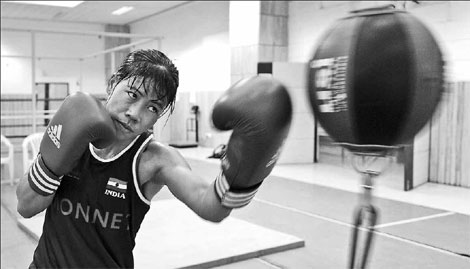
'Magnificent Mary' Eyes Olympic Gold

'Magnificent Mary' eyes Olympic gold


Indian woman boxer MC Mary Kom punches a speedball during a training session at the Balewadi Sports Complex in Pune last month. She is a five-time world champion. Punit Paranjpe

India's Kom battled long odds at home and in the ring to become country's best hope for a medal
The Indian heat is searing in the gym when the power goes out. A physio hurries over with an emergency lamp and boxing star MC Mary Kom resumes battering the punching bag. It's hardly an ideal training session for an Olympic hopeful, but glory never came easily for Kom.

From her beginnings as a poor farmer's daughter in a remote and troubled corner of India, "Magnificent Mary" has fought her way up to become a five-time world boxing champion.

The mother of two is now tipped as her country's best bet to win gold at London 2012 - a position few could envisage when she began learning to box.

"People were discouraging me, saying in India there are not women boxers. That was my first challenge. I took the challenge, I had to prove myself," she said in Pune, the western Indian city where she is training.
Kom - full name Mangte Chungneijang Merykom - was born 29 years ago in the northeastern state of Manipur, the eldest of four to parents who struggled to support their family through working on the fields.

Growing up with a love of action movies, Jackie Chan and her hero Muhammad Ali, the young Kom realized her passion for sport could provide a path out of poverty if she made it big.

"So I left studying and focused on training," she said. "I did everything in athletics: running, discus, javelin, so many. I can do everything."

When she heard that women's boxing would be included in the Manipur state championships in 2000, she took to the ring and won the tournament just four months later.

She tried to keep her new activity quiet from her parents, but when her victory was revealed in the local newspaper, her sceptical father summoned her for a talk.

"He was worried about me getting injured and that he couldn't support me financially. But finally I convinced him, and at the last moment he accepted," she said.

Her determination paid off, propelling Kom to a string of international boxing titles, national honors and financial rewards to help her family.

Along the way she found time to set up a boxing academy, get married and have twin boys, who are now aged four and looked after by her husband back home in Manipur while she trains.

Despite her obvious drive and talent, Kom said sponsorship deals were a long time coming and the lack of support sometimes upset her.

"I don't know if it's because we don't look like Indians," she said of people from her home state, who live near the Myanmar border and whose facial features are often mistaken for Chinese or Southeast Asian.

Tiny Manipur is home to 2.7 million people and is one of India's "Seven Sisters", an isolated group of states surrounded by five other countries and attached to the rest of India by a thin bridge of land north of Bangladesh.

Insurgent violence has for decades been part of daily life in the region, home to numerous rebel groups whose demands range from autonomy to secession, and whose rival agendas often erupt into bloody clashes.

Kom, who lost her father-in-law to rebel gunmen, has become a hero and a rare ray of hope in Manipur, where she set up her academy to give underprivileged girls and boys the chance to follow her into the ring.
"The youngsters came to me and asked for training and I couldn't say no," she said. "Most of them are very poor."

She now hopes to make her home state even prouder.

To compete at the London Games, where women's boxing is a full Olympic medal event for the first time, Kom must qualify at the world championships in China starting on May 9.

The 157 cm (5-feet, 2-inches) fighter faces the daunting prospect of taller opponents after switching from the 48 kg to the 51 kg weight category, the lightest of three groupings to be contested in London.

In preparation, she is sparring only with taller, heavier males.

Her British coach, Charles Atkinson, who trained a succession of Thai world champion boxers, believes the set-up could work to her advantage - as shown by her triumph in the 51 kg at the Asian Championships earlier this year.

"A lot of people in that category are reducing weight which can be very, very stressful," Atkinson said. "She should be 50.8 (kg) on fight day without killing herself. It's the perfect scenario for her."

Kom is Atkinson's first female trainee after decades in the boxing business, and it is clear she hasn't failed to impress.

"If anyone beats her they'll have to fight out of their skin," he said. "To me she's a fighter, with a fighting heart greater than some guys I have handled."

As she edges towards her Olympic dream, Kom's drive to be as good as the guys seems to keep her at the top of her game, in a country where "most of the women are looked down on", she said. "If the men can do it, why can't the women do it? That's my main challenge."

PM Assures Justice For Dead Northeast Students

New Delhi, May 11 : Prime Minister Manmohan Singh Thursday assured a delegation from the northeast of maximum efforts by the government to deliver justice in the death of a student from Manipur in Bangalore and the suicide by a Meghalaya student in Gurgaon.

The four-member delegation was led by Manipur MP Thokchom Meinya.

A member of the delegation, Malem Ningthouja, said after the meeting that the prime minister promised to recommend to the home ministry to expedite investigations into the death of both Loitam Richard and Dana Silva M Sangma.

The prime minister was also quoted as assuring maximum efforts to deliver justice in the two cases and measures to prevent such incidents from recurring.

The delegation expressed concern to the prime minister over targeted violence and discrimination on the students, migrant workers, job seekers, and tourists from the northeastern states in other parts of India.
"The prime minister also informed that there had been several instances of crimes against humanity and that the government had been taking up measures to control it. However, he denied racism in India and institutionalised discrimination against the people hailing from the northeast," Ningthouja said in a statement.
The delegation comprised representatives of Justice for Richard, and Manipur Students Association. The delegation gave a petition, which had gathered 26,250 signatures during a online campaign, to the prime minister.

Loitam, 19, was found dead under mysterious circumstances on April 18 in his hostel room at the Acharya NRV School of Architecture in Madanayakanahalli, some 30 km from Bangalore. He was lying dead cold in his room the next day with several marks of obvious assault on the face and head.

Sangma, a 21-year-old Amity University student and nephew of Meghalaya Chief Minister Mukul Sangma, committed suicide April 23 in Gurgaon after being allegedly insulted by an exam invigilator.