02 March 2012

Arunachal, Meghalaya Interested in Joint Package For Tourists

Shillong, Mar 2 : Arunachal Pradesh and Meghalaya have expressed interest in having a joint tour package for tourists in the North Eastern region.

"The chief minister of Arunachal Pradesh is enthusiastic about having a joint package for tourists in the region," Meghalaya Chief Minister Mukul Sangma told a workshop on 'Avenues for Entrepreneurship in Tourism' here.

He said, "When two states offers a package jointly, it becomes more attractive for prospective tourists."

Sangma has also suggested to his Arunachal Pradesh counterpart for a joint-workshop to push the idea forward.

He said, once the package was successful, other like minded states in the region would be roped in.
01 March 2012

Cyber Crime Rises in Mizoram

Aizawl, Mar 1 : The Mizoram government, rattled by the rise in incidents of crimes in the state, will set up a cyber crime police station in Aizawl, with staff well versed in the use of computers.

A police official in Aizawl said last night that the government wanted to curb cyber offences, from hacking to unauthorised viewing of pornographic videos in cyber cafes and reported attempts to tamper with ATM cards to illegally withdraw cash.

Chief minister Lalthanhawla, addressing a seminar in Aizawl on crimes against women last Sunday, had called for steps to tackle crimes against women.

There were 168 incidents of crime against women like rape, attempt to rape, molestation and trafficking last year while 19 cases were registered in the first two months this year.

At Hnahthial town of Lunglei on Sunday, a six-year-old Mizo girl was lured to the jungle from the church lawn where she was playing with her friends, by Lalthanzauva, aged 40, and raped.

Interim budget: The Mizoram government will present a truncated interim budget in its Legislative Assembly session on March 20, for four months only, from April this year. Sources in the Assembly secretariat said last night that the government was forced to present a curtailed budget in the ensuing session.

They said the Planning Commission had “failed” at the beginning of this year to allot a firm annual plan outlay to the government, led by chief minister Lalthanhawla.

Assembly secretary Ngurthanzuala said state finance minister H. Liansailova would seek a vote-on-account budget for four months only.

Brahmaputra Dries Up Arunachal! China Responsible?


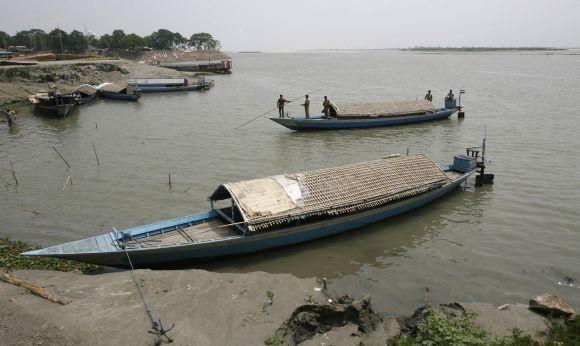
BSF soldiers patrol on a boat in the waters of river   Brahmaputra in Assam
Next
The Siang (Brahmaputra) river originating from Tibet was suddenly found to have almost dried up at a town in Arunachal Pradesh, a state government spokesman said on Wednesday night.

People of century-old Pasighat town in East Siang district found that the water level of the river receded so much on Wednesday evening that it almost dried, Tako Dabi said.

Dabi, also the political advisor to Chief Minister Nabam Tuki, expressed apprehension that China could have diverted the water of the river, which is known as Yarlong Tsangpo in Tibet, or there could be some artificial blockade due to which this has happened.
Image: BSF soldiers patrol on a boat in the waters of river Brahmaputra in Assam
Photographs: Reuters 

'The panic of the people cannot be simply brushed off'

Prev
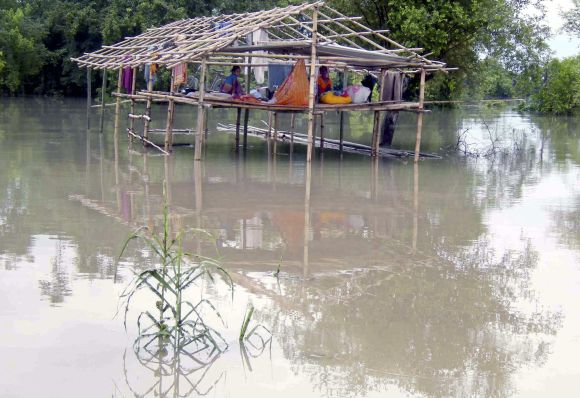
Flood-affected people sit in a damaged hut as they wait for relief supplies after an embankment of river Brahmaputra broke in Arunachal
Next
On June 9, 2000, the water level of Siang rose suddenly by 30 m and inundated almost the entire township causing widespread destruction to property besides claiming seven lives following the collapse of a hydropower dam in Tibet, said Dabi, who himself inspected the dried bed of the river.
Dabi suggested that the Centre and its agencies like the Central Water Commission should immediately conduct a study in collaboration with the state government to find the crux of the problem.
The panic of the people cannot be simply brushed off, he said.

Image: Flood-affected people sit in a damaged hut as they wait for relief supplies after an embankment of river Brahmaputra broke in Arunachal
Photographs: Reuters 

China's cascade hydropower dams a challenge

Prev
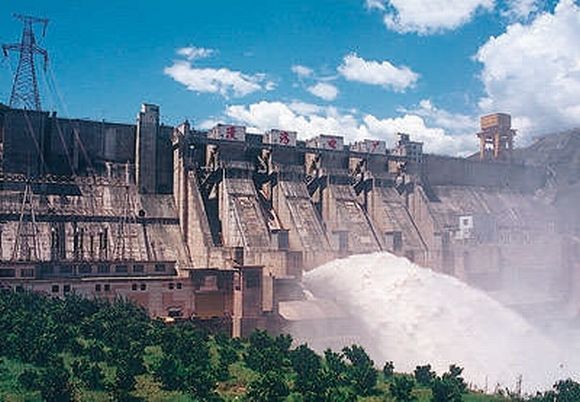
Manwan Dam
Next
Yarlung Tsangpo, the highest river in the world, is a watercourse that originates at Tamlung Tso Lake in western Tibet, southeast of Mount Kailash and Lake Manasarovar.
It later forms the South Tibet Valley and Yarlung Tsangpo Grand Canyon, before entering India at Tuting in Arunachal as Siang, takes the name of Brahmaputra in Assam and enters Bangladesh and is known as Megna.
In the Upper Mekong Basin in Yunnan Province, China has planned to construct eight cascade hydropower dams, the first of which, the Manwan Dam, was completed in 1996.

Image: Manwan Dam


Over 52,000 Nagas Meet To Chart A Path To Peace

The most important factor in any ‘peoples’ movement are the people. No solution is possible without them and though peace still remains elusive, this meeting— with its resolutions and recommendations—will make the groups accountable, and give the Naga people a stake in their future, says Avalok Langer
(From right to left) Thuingaleng Muivah and Isak Swu of the NSCN (IM), Gen Khole and Kitovi Zhimomi of the NSCN (KK) and Brig. Singnya and Zhopra Vero of the NNC/FGN at the meeting of the Forum for Naga Reconciliation on 29 February “The biggest hurdle in finding a solution to the 64-year-old Indo–Naga dispute is that the Nagas are confused. They do not know what they want; how will a solution ever come?” explained a government official to TEHELKA less than two weeks ago. However, on Wednesday 29 February, in Dimapur, Nagaland, 52,000 Nagas from all walks of life spoke in one voice and ratified four resolutions presented in the landmark meeting of the Forum for Naga Reconciliation. Spearheaded by the Naga National Council (NNC) in 1946, the Naga struggle for sovereignty, which they claim based on their historical rights, has seen many twists and turns. The movement that started under one leader, Dr AZ Phizo, the NNC has many claimants today, in seven different ‘underground’ groups. Despite a ceasefire with the Centre, infighting between the groups has ensured that peace and relative normalcy in Nagaland remains elusive.

What compounds the problem is that though the negotiations between Government of India and Th Muivah and Isaak Swu of NSCN (IM) are in their ‘final stages’, a lasting solution is only possible if all seven groups as well as the Naga people endorse the solution. In light of this, Wednesday’s meeting could be a step in the right direction.
Three ‘underground’ groups—National Socialist Council of Nagaland [Isaak-Muivah] NSCN (IM); National Socialist Council of Nagaland [Kitovi-Khole] NSCN (KK); National Socialist Council of Nagaland [Khaplang] NSCN (K); Naga National Council/Federal Government Nagaland (NNC/FGN)—along with 52,000 Nagas from different civil societies, villages, churches and states have ratified four resolutions. The main thrust of which are:
1: Admit that the long history of the Naga conflict has inflicted deep and inexpressible pain to the Naga people, own up to their own sins, acknowledge and support those who have apologised and sought forgiveness.
Impact: This admission of guilt and subsequent forgiveness has been seen as the first step to burying years of bad blood and reconciliation.
2: End all armed conflict as of 29th February 2012.
Impact: For years now, bad blood between the groups has resulted in violence. Sporadic violence continues, but the people of Nagaland are committed to peace, that is the need of the hour.
3: They acknowledged the role, commitment and contributions of the Naga National Counil, AZ Phizo, SS Khaplang, Myanmar-based chairman of NSCN (K), Gen (Retd) Khole and Brig (Retd) Singnya.
Impact: While this may seem trivial to some, it is a big step. Phizo, Khaplang, Khole and Singya have all played a significant role in the struggle and cannot be sidelined or forgotten. This seems to be a move to placate hurt sentiments and bring them into the peace process. This is also important in light of the recent statement made by the NSCN (Khaplang) leadership who want to re-engage in the reconciliation and peace process.
4: They agreed that sovereignty lies with the Naga people and their will is supreme. Any negotiation process must focus on how the Nagas can determine, safeguard and exercise their historical and political rights in a contemporary and inter-related world.
Impact: Sovereignty has been an uneasy topic amongst the Nagas, and with globalisation, the idea of sovereignty itself has changed. It is believed that ‘absolute’ or ‘complete’ sovereignty is no longer possible, but a special arrangement with the Centre which allows the Nagas to govern themselves could be the way forward.
The biggest impact of this meeting was the recommendation made by the Forum for Naga Reconciliation (FNR) to form an expert body or common platform. The body will comprise experts and intellectual who will debate, discuss and chart the next step in the Naga journey. Though the recommendation was not ratified, if created it will allow the Naga people to join and shape the peace process. The most important factor in any ‘peoples’ movement are the people. No solution is possible without them and though peace still remains elusive, this meeting— with its resolutions and recommendations—will make the groups accountable, and give the Naga people a stake in their future.
Avalok Langer is a Correspondent with Tehelka. avalok@tehelka.com

Naga Chilli Vodka is Enough to Make Grown Men Cry

While it’s not quite the as hot as the insane 2 million SHU Scorpion Pepper, the Naga Chilli Vodka is still criminally hot.

In fact, it’s so hot it almost took Philip Schofield off air when he tasted the spicy tipple – it even comes with a health warning.

It’s produced by infusing the vodka with Naga Jolokia chillies – so many in fact that it’s turned the vodka a kind of fire-orange colour.

The resulting poison ranks at 100,000 scovilles, substantially hotter than even most “hot” chilli sauces; a Jalopeno pulls in at a pathetic 5,000 SHU by comparison. It’s the kind of thing you’d normally see coming out of Mexico or South America, but it’s actually a crazy British creation.

Master of Malt, a Tunbridge Wells-based fine liquor retailer, has its creation up for just £31.95 a bottle – that’s only for 700mls though, so you might need a couple, especially if you want to prove your manhood to your avid party invitees. You are mega-chilli hard, right?

She Dresses For Success


East Shore Photos -- February 29, 2012
Beauty stylist Rakshandra Ahshan, right, poses for a picture with her prize-winning model, Precious Spring, at a recent fashion show.
DONGAN HILLS -- Born in India, Rakshanda Ahshan arrived on Staten Island 12 years ago. She came well-versed in glamorous transformations. She studied the art and craft of hair design and makeup on her home turf in Assam state in northeast India, earning a license there in 1990.

Now a Dongan Hills resident, she has provided bridal makeup and henna-tattoo services to the Indian community here. Her eye is focused on a more ambitious dream, though: Opening the borough’s first Indian-style beauty salon, she told the Advance.

Toward this goal, she participated in August in a four-week training program at the Center for Family Life Cosmetology Project in the Sunset Park section of Brooklyn, and earned a certificate. Next, she enrolled in a full-time, nine-month program at the Hair Design Institute in Bay Ridge, Brooklyn. She will graduate in April.

Ms. Ahshan’s instructors at the Institute encouraged her to enter its various themed contests: Bridal, Halloween, Christmas, Winter Wonderland, and Valentine’s Day. She did and — drawing on her ethnic background and skills — always dressed her models in elegant Indian style, including one outfit that she sewed by hand for the Winter Wonderland event.

“I won all the contests during the school year,” she proudly reported.

Her most recent first-place win was at the Valentine’s Day show, with Precious Spring — a Brooklyn resident and fellow student at the Institute — serving as her model.

The fashion show — with 29 models — featured two themes, fantasy and romantic.

“I choose fantasy, and again used Indian dress, jewelry, and makeup,” said Ms. Ahshan. Her model, Ms. Spring, “is an American girl who is beautiful, tall and very smart. When she presented herself, all the judges were surprised and stood up, and she was selected for first place.

“I was very happy, and thankful to all the judges, teachers and students who helped me. I wanted the Advance to write a story, to express my thanks, and show Indian beauty with an American girl,” Ms. Ahshan said.

And here’s more good news: The stunningly beautiful Precious Spring “got an offer for modeling, and she will start after she graduates from the Institute in March!” Ms. Ahshan happily reported.

Ms. Ahshan is the mother of two sons, Raheel, 11, in sixth-grade at Egbert Intermediate School, Midland Beach, and 5-year-old Rahan, in kindergarten at PS 52, Dongan Hills.

You can reach her by telephone at 718-987-0998 and 347-835-3087, or email at rakshandaahshan.2009@gmail.com.
29 February 2012

Oppn Parties Seek Repoll in Manipur Alleging Poll Malpractices


Manipur Polls Round Up<br>New Delhi, Feb 29 : Alleging poll irregular ties in Manipur assembly elections held on January 28, opposition parties in the state are seeking a repoll in some places and have knocked at the doors of the Election Commission.

The Election Commission is verifying the complaints of the opposition parties which were aired at its two meetings held with them before initiating any further action in the matter, said an election official here today.

"We have held two rounds of sitting with Election Commission and the EC has promised to initiate action and check the (alleged) poll irregularities pointed out by us," D Raja of CPI told reporters here today.

"We have alleged proxy voting in many parts of the state during the January 28 polls. Besides, we have pointed out to a fraud in postal ballots in the state," he said.

He added that the EC will consider requests for repoll in some places where complaints of proxy vote has been made by us. "It is question of democracy and ensuring free and fair polls in the state," said Raja.

Barring the Congress, all opposition political parties in Manipur including the BJP, NCP, CPI, CPI-M, JD-U, MSCP, Manipur People's Party, National People's Party and Manipur Pradesh Trinamool Congress came together on the issue of poll irregularities.

Among others who were also present today included Manipur's former chief minister Radhabinod Koijam, Nara singh of CPI's Manipur unit and Kim of Manipur Trinamool Congress, besides other leaders
28 February 2012

Mizoram Rice Production Increases

https://blogger.googleusercontent.com/img/b/R29vZ2xl/AVvXsEiE44EZIIy9dYZHtM046XjNHNrwqME292q1BFVEsCvFrNbpLNuna_cCR4JhueGwcQyVTYLVUV38tfEjyVq-t8qJM0Ich71OZsYyWBCX15hyphenhyphenc7ZOiVILxK-B-nT4qRWiZf3wDPR6vmQ0rQ22/Aizawl, Feb 28 : Mizoram has achieved 10.50 per cent increase in foodgrain production during 2011-2012 which had been declared bumper rice harvest year by the state government.

Mizoram produced 51948 metric tonnes of rice during the past year, a significant increase from 47,201 metric ton produced during 2010-2011. This was higher than the department's target of 52,000 MT.

According to sources from agriculture department, as the number of farmers cultivating rice decreased the area of jhum cultivation also decreased by 5.53 per cent. The 51948 metric ton of rice was produced from 2162 hectares of land. The increase in rice production was attributed to the new farming technology- system of rice intensification.

Rice produced from wetlands, however, witnessed 19.61 per cent increase. With the increase of 209 hectares of wetlands, rice produced from wet rice cultivation was 4061 metric ton.

As many as 540 metric tonnes of rice was also produced from 360 hectare of jhum land transformed into wetlands during the past year.

This was considered 100 per cent increase. In jhum cultivation, 146 metric ton of rice was produced, recording a 5.55 per cent increase, the source said.

This was despite sharp decline in the jhum cultivation that decreased by 2736 hectare, a 9.57 per cent low. The agriculture department had introduced the improved farming system in different low-lying areas of Mizoram.

It had been experienced that rice produce under SRI was double that of conventional farming system.

At present, Mizoram produces only 25 per cent of the total rice consumption which is about 1,80,000 metric tonnes.

The department targets to produce 52,000 MT of rice this year. It aimed at increasing rice produce per hectare of land in WRC from 1.6 MT to 2.5 MT and from 0.9 MT to 1.2 MT in jhum areas.