
09 November 2011

Manipur Sends For Fuel

1,900 vehicles to bring fuel, foodgrains

fuel station imphal manipurThe Manipur government on Monday sent around 1,900 vehicles with police escort to Silchar in Assam to bring foodgrains and petrol, with the state facing shortage of essential commodities due to the economic blockade, called by the United Naga Council (UNC), since August 21, officials said.

All the vehicles which left Imphal for Silchar would arrive with essential items and petroleum products in the next two days, they said.

Manipur has been facing acute shortage of foodgrains, petrol and life-saving drugs due to the economic blockade imposed by UNC on Imphal-Jiribam-Silchar and Imphal-Dimapur-Guwahati national highways to protest the demand of Sadar Hills District Demand Committee (SHDDC) to upgrade Kuki-majority Sadar Hills area in Naga-majority Senapati district into a full-fledged revenue district.

Manipur Chief Minister O Ibobi Singh has also appealed to the UNC to withdraw the blockade. "We are having patience but the government may take stern action if the situation does not improve," Singh said on Sunday.

The SHDDC had ended its 93-day-old economic blockade on the Manipur stretches of the two national highways on October 31 after an agreement with the state government which agreed to convert the area into a revenue district.

There was a four-km-long queue on Sunday at a petrol pump. Reports said only one pump was giving petrol but solely to school vans and buses on Monday with other pumps having gone dry. Petrol is being sold in the black market for Rs 200 per litre. Cooking gas is being sold in black market at Rs 1,650 per cylinder.

The reports said now the two commodities are not available even in the black market.

However, the government sources said some respite is on the way as an alternative route has been worked out for the supplies to come in.

During his recent visit to the state, Union Home Minister P Chidambaram had appealed to the people to settle all disputes through dialogue.

Fan Turns His Home into Altar for Bollywood Star

Shah Rukh Khan is one of the most popular actors in the world, but no one’s a bigger fan of the Bollywood actor than Vishal Singh, a man who has turned his home into an altar to the movie star.

The 38-year-old businessman who runs a homeopathic medicine business in Lucknow, India says there’s nothing he wouldn’t do to make Shah Rukh Kahn happy. So far he’s covered every surface in his house and even his car with photos of the Bollywood icon, changed his name to Vishahrukh Khan, and even spent his honeymoon in front of the actor’s mansion in Mumbai, hoping to catch a glimpse of his idol. Although he says no one cam be like Shah Rukh, he wanted to bear his name and even gave his children names related to the Indian actor. His son is named like Kahn’s child, Aryan, and his daughter Simran, is named after one of the female leads in one of the actor’s biggest movies, Dilwale Dulhania Le Jayenge.

shah-rukh-kahn-fan-550x366
Photo by Pawan Kumar/ REUTERS

Vishal admits his family didn’t exactly approve of his obsession with Shah Rukh Khan, but says his parents have come to accept it and know his love for the Bollywood superstar will never die. His wife Ruchi even agreed to spend their honeymoon in Mumbai, so her husband could hang around Kahn’s mansion hoping to see him. The die-hard fan has actually met the actor a number of times, and says Shah Rukh Kahn promised to visit Singh’s house. To convince him to keep true to his promise, the businessman says he isn’t going to open his new homeopathic medicine store until Kahn comes to cut the ribbon.

shah-rukh-kahn-fan2-550x357

Photo by Pawan Kumar/ REUTERS

shah-rukh-kahn-fan3-550x366

Photo by Pawan Kumar/ REUTERS

via MSNBC Photoblog

Mizoram Farming Policy Can Make Changes: Purusothaman

governor_VakkomAizawl, Nov 9 : Recently-inducted Governor Vakkom B Purusothaman today expressed optimism that the Mizoram government’s flagship programme New Land Use Policy (NLUP) could bring a paradigm shift to the state s economy. This is not a veteran Congressman lauding a Congress government s policy.

This is my personal opinion and not a political one, he said at the Raj Bhavan here during his first interaction with the media after he assumed the office two months back.

The farming policy aims at supporting 120,000 farming families over five years to help them do away with the destructive age-old jhum or shifting cultivation. Through this system of cultivation we were destroying vast forest which is the wealth of the state. The NLUP aims to restore ecological balance by providing the farmers alternative sustainable and permanent land-based means of livelihood, he said.

The NLUP aims to keep 60 per cent of the state s total geographical area under forest cover and the rest for land-based development and also create 21,480 hectares of bamboo plantation to benefit 10,740 families.

About 80 per cent of farmers in Mizoram still depend on jhum cultivation, which involves clearing forests and burning the slashed trees, weeds and bamboos. Expressing his strictly personal view on total prohibition of liquor in Mizoram, the governor felt that the Christian-dominated state would be better off without the controversial dry law. Prohibition has been tried throughout the world, but it has failed. It has been experimented in India when the country got independence.

It has been tried in my home state Kerala and many other states. The result was an increase in bootlegging and spurious liquor that killed many people, in addition to loss of huge revenue, he observed. It may be recalled that former governor A R Kohli had been criticised by the churches for calling the dry law a total failure .

Citing the US experience with prohibition, the governor also pointed out that the term bootlegging was coined during the prohibition when illegal sellers of liquor hid bottles in their boots.

Just like Kerala, which has liberalised liquor after a failure with dry law, Mizoram could earn huge revenue from excise duty.

The governor was well aware that there was plenty of liquor in Mizoram, only the prices were exorbitantly high and the quality of local-made rice beer was very poor.

The governor also believed that Mizoram has the potential to develop tourism industry just like his home state. Mizoram has so many things to sell, like culture, natural beauty, handloom and handicrafts. Tourism industry can generate a lot of employment opportunities and income, he said.

Mizoram People Forum Against Non-Local Traders

Mizoram People ForumAizawl, Nov 9 : Mizoram People Forum (MPF) has asked Mizos not to lend their trade license to non-locals.

In an appeal distributed to the people in the form of leaflets the MPF said, lending names and trade license to non-locals will soon lead to economic assimilations of indigenous people.

The MPF also said, the Inner Line Permit system enacted and enforced way back in 1930 by the British raj for protection of vulnerable tribals of the hills of the Northeast region continues to be an effective safeguard for the minority tribals and no one should try to violate or dilute the regulation.

''By lending our names to non-tribals, we are draining our economy for the benefits of outsiders,'' said the organisation.

There are over 260 Mizos who earn money just by lending their names to non-tribals so that the latter get trade license.

There are also a number of non-tribals who married Mizo girls in order to run business in Mizoram in the names of their wives.

In this process, the state government has also lost a huge revenue as the non-tribal traders have evaded income tax by trading under the guise of Mizo tribals who are exempted from the income tax, the Mizoram People Forum said.

This illegal practice, the MPF feared, posed threats to the social and economic security of the indigenous people of Mizoram who are specially protected from the threats of assimilation since the British time.

1.22 Lakh People Court Arrest in Tripura

Agartala, Nov 9 : More than one 1.22 lakh people today courted arrest throughout Tripura in response to a 'jail bharo' agitation launched by 11 trade unions including CITU and INTUC, CITU sources said.

Among others, CPI-M spokesman Gautam Das, CITU leader Shankar Dutta and Pijush Nag, Forward Block leader Biswanath Saha were arrested and later freed by the police.

CITU sources said the working people demonstrated before central government offices and railway stations throughout the state.

Police said the movement was peaceful and there was no untoward incident.

Eleven central trade unions, backed by the Left parties, Congress and Bharatiya Janata Party (BJP) called the country-wide 'jail bharo' movement to press for their six-point charter of demands.

The demands include rollback of petro product price hikes and check prices of essential commodities, and social security for the unorganised labourers.

08 November 2011

Manipur Shutdown: Whose Responsibility is The Northeast?

Akshaya Mishra

Up against blockade

New Delhi, Nov 8 : Is the North-East anybody’s responsibility? While the rest of the country remains obsessed with Team Anna and its unending antics, beyond the glare of the TV cameras and public attention, Manipur suffers. Intense ethnic politics has debilitated life in the state. Neither the Central government nor the state government seems too keen on breaking the cycle of economic blockades and counter-blockades which has been depriving the state of essential supplies.

As the blockade of the two national highways – NH 39, connecting Imphal-Dimapur-Guwahati, and NH 53, connecting Imphal-Jiribam-Silchar, reached its 100th day today, people in Manipur kept struggling for the bare essentials. Prices have skyrocketed across the board, hospitals are running short of medicine, potato, onion and cereals are virtually out of the market and petrol, diesel and LPG availability is close to drying up. Food riots have not happened yet. But they might soon.

The highways are the lifeline for the state since these connect Manipur to other parts of India. The ethnic Kukis had blocked these for 92 days demanding the conversion of the Sadar Hills area near Imphal into a full-fledged revenue district. Soon after the Sadar Hills District Demand Committee, which was spear-heading the movement, signed a favourable deal with the state government, the Nagas jumped into action in protest. Now, they are doing their bit to deprive the Manipuris of essentials.

An economic blockade is primarily a war-time measure, aimed at cutting off supplies to the enemy population. That the ethnic groups in Manipur would resort to starving their own people is bizarre. Creating a humanitarian crisis for ethnic-political ends does not make sense. Moreover, it only serves to aggravate and intensify the animosity between the Kukis, Meiteis and Nagas.

The extreme action seems to be the only option left for ethnic groups pushed to the margins by the Meiteis, who are perceived to be controlling the polity of the state. The highway blockades undertaken by the Nagas and Kukis are meant to make the government and the Meiteis sit up and take notice. Whatever the reason, the developments have been disastrous for the state’s economy. Those at the receiving end belong to all ethnic groups.

The only people benefitting from the blockades are the traders and hoarders across all groups. This group—some analysts do not rule out the possibility of the direct or indirect involvement of this lot in the blockades—makes a killing when essential items disappear from the open market. Interestingly, almost everything is available in the state in the black market during the times of the blockade.

During all this, the state government and the Centre do not seem anywhere in the picture. The Centre, too far removed from the ground zero of the ethnic politics of the state, has been clueless about a proper response. The North-East, in any case, does not form the political centre of gravity for Delhi. It partly explains the lack of seriousness on its part on issues relating to Manipur and other states in the region. The efforts of the state government do not seem to be adequate either.

But to be fair to both, it’s not an easy situation in Manipur. The roots of exclusivist ethnic politics run deep in Manipur.

The creation of a separate Sadar Hills district for Kukis out of the current Senapati district, which otherwise be a matter of simple administrative decision, is not easy given the history of ethnic rivalries in the district. Senapati is home to different communities of the Kukis and the Nagas. The Sadar Hills region is dominated demographically by the Kukis. Nagas fear that a separate district of the Sadar Hills would come in the way of creation of greater Nagalim. Both the communities have been in conflict over many decades over the bifurcation of the district.

The solution lies in both sides climbing down from their position. But it does not look possible. “Don’t blame the Nagas now for this deadlock. We want the people of Manipur to come out and question the government about the issue,” said S Milan, leader of the United Naga Council, which is spearheading the blockade by the Nagas even as the state turned into a lawless territory.

Clearly, the state government is incapable of bridging the wedge between the two groups. The Centre must intervene. If it has to use force to remove the blockade, it should not matter. It has to ensure that the supply of essentials are not hindered and people are not made to suffer because of the frequent agitations and the political agendas of ethnic groups.

New World Record Longest Headed Goal

longest headshotLongest Headed Goal 58 Meter headed by Ryujiro Ueda, FAGIANO OKAYAMA YOKOHAMA FC vs FAGIANO OKAYAMA

Assam's Pobitora Wildlife Sanctuary Opens For Tourists

A Great Indian one horned rhino at the Pobitora Wildlife. Pobitora is famous for the highest density of Great Indian One Horn Rhino within 42sqkm.

A Great Indian one horned rhino at the Pobitora Wildlife. Pobitora is famous for the highest density of Great Indian One Horn Rhino within 42sqkm.

Next

By K Anurag

Guwahati : As the autumn has set the stage for the winter to rule the atmosphere in the picturesque North East India's hills and valleys, enchanting destinations in the region are ready to welcome visitors in the coming tourists' season. K Anurag reports.

While the captivating rhino abode in Kaziranga National Park was thrown open for the tourists on October 28, three days ahead of the schedule, two other most-visited wildlife protection areas -- Pobitora Wildlife Sanctuary and Manas National Park -- in the state were opened for tourists from Saturday.

Pobitora Wildlife Sanctuary has the highest density of the rare one-horned rhinos on the planet. The 38 square kilometers park with a core area of 22 square kilometers have 84 one-horned rhinos s per the last headcount carried out in 2009.

A wild buffalo

A wild buffalo

Next

Already migratory birds of different hues have started flocking numerous wetlands in the park that is located about 35 kilometers away from the heart of Guwahati city and well connected to the arterial National Highway 37.

A few lush green tea estates and several ethnic villages on its fringes added value to the destination making it a heady package of one-horned rhino, ea estates and ethnic culture.

Declaring the park open for tourists, Assam Tourism Minister Rockybul Hussain informed that Pobitora had started attracting more and more tourists and the revenue earning from tourists have increased at least 16-fold since the year 2001.

The picturesque and sprawling Manas National Park spread over about 1000 square kilometer in western Assam bordering Bhutan Himalayas too was opened for tourists this morning by the Deputy Chief Executive Member of Bodoland Territorial Council, Khampa Borgoyari in presence of senior forest and wildlife officials.
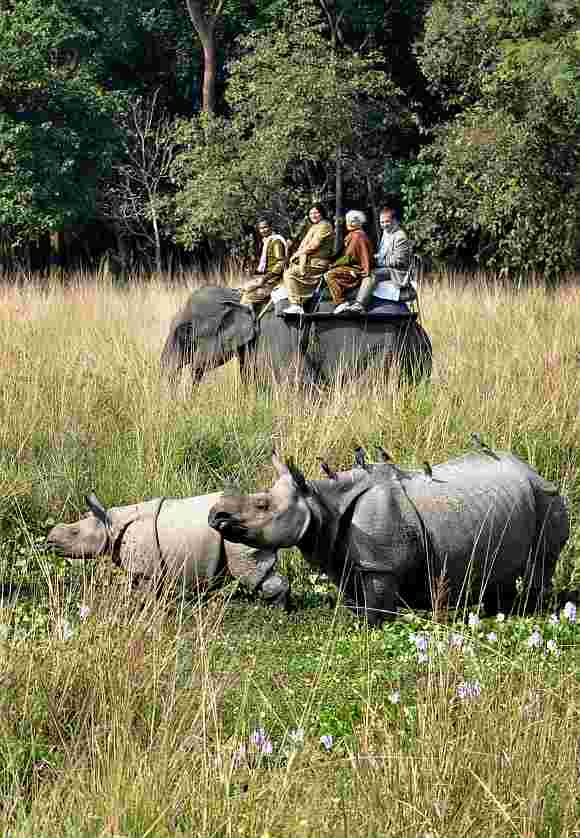
Visitors enjoying an elephant safari at Pobitora

Visitors enjoying an elephant safari at Pobitora

Next

A large number of tourists including several visitors from abroad set their feet inside the park on the opening day while all the travellers nests in and around the park are booked for coming days.

Words hardly suffice to describe that beauty and grandeur of a sprawling landscape called Manas National Park that converges to the banks of a majestic Manas river that cascades down from the Bhutan Himalayas.

The atmosphere inside is usually serene which is interspersed with occasional chirping of birds and gurgling sounds of the stream flowing by. The ubiquitous peacock would often crisscross your way.
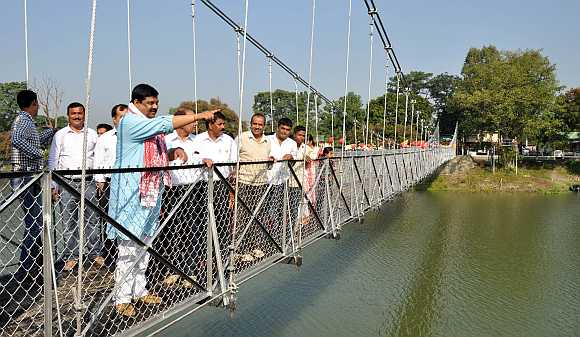
Assam Forest Minister Rockybul Hussaini at Pobitora

Assam Forest Minister Rockybul Hussaini at Pobitora

Next

The United Nations Educational, Scientific and Cultural Organisation World Heritage Committee in its 35th conference held in Paris in June this year has decided to restore the World Heritage status to Manas National Park in view of the improved wildlife protection measures and regained resources.

The tag was removed in 1992 as the park was facing major devastation due to social turmoil and insurgency in the area at that time.

It is a unique wildlife protection area in the country which has got five different conservation status -- tiger reserve, world heritage site, biosphere reserve, national park and an elephant reserve. Manas is arguably the only wildlife habitat which harbours more than twenty Schedule I species as listed in the Wildlife Protection Act of India.
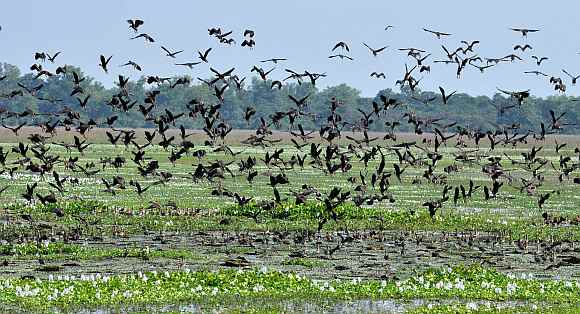
Thousands of Lesser Whistling Teal at the Pobitora Wildlife Sanctuary

Thousands of Lesser Whistling Teal at the Pobitora Wildlife Sanctuary

Because of the pressure from tourists, the most visited Kaziranga in Assam had to be opened on October 28 before schedule. Famous for its treasure trove of over 2,000 one-horned rhinos, Kaziranga Park also home to highest number of endangered tigers in the region.

Located along the NH 37, the park is very well connected to the rest of the country through road, rail and air.

Meanwhile, tour operators and the government of Meghalaya are expecting an increased flow of visitors to numerous scenic destinations in Meghalaya ( the abode of cloud) including Shillong, Cherrapunjee (Sohra), Mawsynram, Upper Shillong etc. Already people are thronging the annual Shillong Autumn Festival organised for three days since yesterday by Meghalaya Tourism Development Forum both in Shillong city and Orchid Lake Resort at Umiam in Borapani off Shillong.

The carnival organised in collaboration with Meghalaya Tourism Department has showcased colourful ethnic culture of all the eight Northeastern states to mark the beginning of a hectic tourists' season ahead.