02 November 2011

Planning Commission Lauds Mizoram Flagship Project

New Land Use Policy Mizoram LaunchAizawl, Nov 2 : Planning Commission member Secretary Suddha Pillai, who was on a two-day visit to Mizoram, today expressed her optimism that the state government’s flagship programme- New Land Use Policy had the potential to improve the state’s economy dramatically.

Suddha Pillai visited farms in Sihphir, about 15 kms from Aizawl, this morning where NLUP beneficiaries had cultivated Chayote and other crops.

At a brief function, Pillai mentioned her deep impression on their interest in NLUP which she felt had the potential to improve Mizoram economy dramatically.

She pointed out that all government schemes were for the benefit of the people and people were obliged to make full use of it.

Visiting the farms, Pillai felt measures should be taken to improve the drastic low prices farmers get for their produce so that they would receive appropriate benefits for their toil and urged the district authorities to look into it.

She also suggested that pictures should be uploaded on internet whenever new developments take place to serve as visual evidence.

In the first five years, the NLUP aims to support 1,20,000 families.

The departments of Agriculture, Horticulture, Veterinary, Industries, Forest, Fisheries, Sericulture and Soil and Water Conservation would be involved in the scheme.

About 80 per cent of farmers in Mizoram still depend on jhum cultivation that involves clearing of forests and burning trees, weeds and bamboos.

The NLUP aims to restore ecological balance by providing the farmers alternative sustainable and permanent land-based means of livelihood. It also aims to create 21,480 hectares of bamboo plantation to benefit 10,740 families.

Despite the slash-and-burn system of cultivation, Mizoram has a large forest cover area of 75.77 per cent of the total land.

The NLUP intends to keep 60 per cent of the State’s total geographical area under forest cover and the remaining 40 per cent for land-based development.

Lalremsiami Murder Accused Confesses Before Court

murder in mizoramAizawl, Nov 2 : One of the two accused in the sensational murder of Remsiami seven years back confessed before the court here on Monday to committing the gruesome crime at the behest of the victim’s employer, Muanpuii.

Lalremsiami was found dead in a pool of blood inside the store room of MP Garments on May 15, 2004, two days after she was murdered. The prime suspects Mohammed Mister and Mohammed Gulzar, who were working as porters in the MP Garments, where Lalremsiami also worked as an assistant, were arrested by Mizoram police on June 14 from Nepal.

Statement of the victim’s mother had implicated the MP Garments owner Muanpuii in the murder of her daughter. Muanpuii was initially arrested but was later released due to lack of evidence. The victim’s mother had suspected that her daughter was murdered out of jealousy.

Lalremsiami was a trusted assistant and all money transactions of MP Garments through the bank was done by her. Sources said Mister told the court of additional district sessions judge K L Liana that he murdered Lalremsiami at the behest of their employer Muanpuii.

When the court asked where was the money, Rs 4,14,000, which their employer told Lalremsiami to deposit in the bank that went missing after her murder, Mister said the money was taken by Muanpuii. Whether or not he was given reward for murdering the girl was not mentioned.

Mister also told the court that his friend Mohammed Gulzar was not involved in the murder. The controversial murder case was first taken up by ADM (J) Marli Vankung. After going through different judges, it finally landed in the court of K L Liana.

Quake Fault Line Touches Two Districts Of Tripura

Quake Fault LineAgartala, Nov 2 : Geologists today warned the Tripura Government that two hill-bound districts of North Tripura and Dhalai of the state have become more vulnerable as the fault line drawn after disastrous quake in Sikkim, intersects the entire area.

Talking to media here, state Revenue Minister Badal Choudhury said the latest National Disaster Management Authority (NDMA) communiqu asked all the northeastern states to enhance the disaster management infrastructure especially the preparedness to tackle high magnitude earthquake.

Tripura has high probability of earthquake because sedimentary rock underneath and most area is under 1st order topography of marine origin besides, poor houses including government infrastructures.

Moreover, According to Vulnerability Atlas of India, 1997, Tripura comes under the very high earthquake damage risk-zone (category V, magnitude 7.0 to 7.5) and most of the existing houses were not able to stand high magnitude tremor. Mr Choudhury however, stated that the state government had identified as many as 2000 building mostly government houses including existing Raj Bhawan as vulnerable to earthquake, which required retrofitting but the state government could not manage the adequate fund to execute the plan.

He also demanded provision of additional funds for building of earthquake resistant public houses and constructions under the special housing schemes like Indira Awas Yajuna (IAY) and Sarva Sikhya Abhiyan (SSA) and the quality disaster management training infrastructure in the state.

Mr Choudhury blamed the Centre for awarding only Rs one crore in a year by the 13th finace commission for disaster management activities in Tripura despite identifying the state as one of the most earth quake prone areas and all other states were awarded five crore every year.

To sensitise the key players of disaster management in the state for strengthening the disaster management responsibilities and further effective implementation of required action, the state has organised a two-day workshop from today in Agartala, Mr Choudhury said, adding as part of the workshop, an exhibition on critical equipment and skills was organised to understand the use of the equipment for supplementing the existing resources for saving loss.

Earlier, Tripura Governor Dr Dnyandeo Yashwantrao Patil asked the state government to shift his residence from the 95-year-old Raj Bhawan building in Agartala to a safer place after reviewing the earthquake warning from the scientists.

But the state government assured him that necessary protection had already been given to the building and till the completion of new Raj Bhawan, there was no other suitable accommodation for the governor.

Keeping the experts opinion and the region s topographical status, the Ministry of Urban Development had asked the state government to follow the recommendations in the following areas: policy, strategy, action plan, technical guidance for new buildings and retrofitting existing buildings.

Quoting National Seismic Advisor A S Arya s warning, officals said between 1792 and 2003, about 42 moderate to high- magnitude earthquakes occurred along the state boundary and within a 100 km area of the state. So far as wind hazards go, the wind speed in the state is cyclonic.

The government had also begun to train villagers and civil officials in dealing with both man-made and natural disasters. The approach and management strategies had been incorporated into the school curriculum.

Disaster management was included in environment studies at school level and Geographic Information System (GIS) mapping of the state s residential status had alerady been done besides formulating separate regulation for buildings in urban areas.

'Bio-Diversity in Northeast Under Threat'

Biodiversity in northeast IndiaShillong, Nov 2 : Though the northeastern region of the country is considered an ecological hotspot, large sections of the local people are not even aware that the region reservoirs of biodiversity are under constant threat.

Experts say that at present the region is suffering from destruction offorests that is threatening permanent loss of biodiversity due to unsustainable logging and jhuming (slash and burn method of farming).

In fact, scientists say that the rate of "biodiversity depletion" in the region is quite alarming than many parts of the world as there is an estimated annual conversion of three per cent of the primary forest into secondary or degraded forest mainly due to jhuming (shifting cultivation).

"The exotic pitcher plant found in the Garo Hills of Meghalaya, small variety of bamboo, stone moss and many other unidentified plants, most of them having medicinal value are facing extinction threats. Therefore, there is in an urgent need to explore ways and means to save the unique plants of the region," says scientist PK Das, who had carried out extensive research on the pine plantations in Meghalaya.

In fact, a unique feature of the region was prevalence of traditional institutions for maintaining biodiversity. However, sacred groves, protected by socio-religious sanctions are fast eroding with changing beliefs. At present, only about 10 per cent of the sacred groves are found to have crown cover of 100 per cent, studies conducted by the North Eastern Region Community Resources Management Project (NERCORMP) have brought to light.

"The need of the hour for policy makers is to hold serious deliberations on forests, wildlife, non-timber forest produce, medicinal and aromatic plants, joint forest management, agriculture, horticulture, water security and aquatic environment, traditional institutions and customary practices, gender perspective in conservation, environmental services and carbon trading," says the botanist, who is keen on launching an awareness scheme on the issue.

"Awareness on bio-conservation must be promoted among the masses and policy makers must be alerted on the impending need to protect, preserve biodiversity resources in the northeast, one of the richest bio-hotspots on earth," he iterates.

01 November 2011

Over 70 Per Cent of Mizoram Plan Fund Goes To Salaries

mizoram salaryAizawl, Nov 1 : The 60,000-odd state government employee get the lion’s share from the state's annual plan fund with more than 70 per cent spent on their salaries.

The state government spent 1080.60 crore for salaries of its 46,915 regular employees during the 2009-2010 fiscal.

The implementation of the Sixth Pay Recommendations required an additional fund of Rs 154.08 crores, official sources said.

As of March 3, 2011, there were 46,915 regular employees and 2421 contract and 8,410 muster roll employees under the state government.

There were 7173 vacant posts which were being filled on contract and muster roll basis.

Besides these, there are 6,663 employees in various boards, authorities and councils which also have 1,636 vacant posts.

Finance minister H Liansailova has stated in the recent budget session that there were 17,362 employees drawing salaries under the plan fund and Rs 12,56,93,02,725 was spent on their salaries.

These included 1,476 group A employees, 4,794 group B employees, 1,043 group C employees, 1,415 group D employees, and muster roll and contractual employees.

With Rs 1,256 crore required for salaries of government employees from the state annual plan fund of Rs 1,700 crore this year, only Rs 444 crore is left for development projects.

Congress Got Mizoram Into Financial Crisis: Zoramthanga

indian-rupees-mizoramAizawl, Nov 1 : Fund mismanagement by the Congress government has dragged Mizoram into a deep financial crisis, opposition Mizo National Front chief Zoramthanga alleged here today.

Chief minister Lal Thanhawla, despite his experience as a Chief Minister for 14 years and as a member of Planning Commission, has totally failed in financial management, Mr Zoramthanga said while addressing party workers at the MNF headquarters office Hnam Run.

Despite the fact that the state annual plan has increased to an average of Rs 1300 crore per annum during the last three years, compared to an average of Rs 500 crores annually during the MNF s rule for ten years, development has come to a standstill.

The state s exchequer has run short of fund for government employees, Mr Zoramthanga alleged. Though experienced, Chief Minister Lal Thanhawla, who held at the finance let more than Rs 70 crore lapses at the end of the last financial year while no single rupee lapsed during my ten years tenure as the chief minister holding finance portfolio, the former chief minister said.

Holding himself responsible for the lapse of fund, Lal Thanhawla handed over the finance portfolio to his senior cabinet minister, letting the people lose faith on him, he said.

The day after the Congress ministers were sworn in, they bought expensive cars and a good number of support cars to replace the cars purchased during the MNF government that were still in good condition.

The Congress government has no other option than to hike taxes and introduce new taxes to recover financial shortage resulted by implementation of its so-called flagship programme NLUP, he said.

All the roads have now deteriorated. Just like Myanmar, people have carried out community works to repair the roads, he added.

AFSPA Failed! Mizoram Way an Alternative

By Madhu Chandra

AFSPA in ManipurArm Forces Special Power Act 1958 (AFSPA) is a draconian and xenophobic law. Draconian because the Section 4 (a) of the AFSPA gives power to armed forces personnel to shoot at anyone suspicious; the Section 4 (b) to destroy the shelter of the armed rebels and the Section 4 (c) to search and arrest without warrant, which means any army personnel can shoot any one suspecting that she/he will have gun that may fire at him. Just a mere suspicious! The Section 6 of the AFSPA protects any armed forces personnel from prosecution, suit or legal proceeding except previous sanction by Central Government.

It is xenophobia law because it is selectively imposed upon seven North Eastern states; Arunachal Pradesh, Assam, Manipur, Meghalaya, Mizoram, Nagaland and Tripura, whose feature and ethnicity are different from rest of the country for first 40 years and now extended to the people of Jammu and Kashmir since 1990.

Need not to repeat that AFSPA has failed to suppress insurgencies rather caused increase. Less is debated on the ideology why the youngsters take up arms and can it be solved without using arm forces. It will be worth to focus on other alternative measurements to solve five decades old socio-political crisis in North East India region.

Today is 27th death anniversary of India’s first lady Prime Minister – Indira Gandhi’s assassination. The Ministry of Development for North East Region (DoNER) had an advertisement on Times of India, conveying a message of development initiated by India Gandhi in North East India!

Definitely, socio-political table negotiation was initiated in 1971 between Government of India with Mizoram’s separatist insurgents under the leadership of Indira Gandhi. Negotiation continued under Rajiv Gandhi.

The chapter of insurgency in Mizoram, begun from early 1961, finally came to a close with the signing of the Mizoram Peace Accord on June 30, 1986 between the underground government of the Mizo National Front and the Government of India. Under the terms of the peace accord, Mizoram was granted statehood in February 1987.

Dealing the challenges of insurgencies in North East India, could it be a means of solution by going the way of Mizoram, initiated by Indira Gandhi and concluded by Rajiv Gandhi? Perhaps, it will be a better option than utilization of arm forces.

Win People’s Confident is perhaps the need of hour!

The problem of insurgency came to the end after Mizoram Peace Accord in 1986, since then Mizoram is most peaceful state, not only in the region but for whole of India. Mizoram is highest literacy rate in whole of India; it would have never been possible without bringing the insurgency to the end.

Interesting, perhaps, not sure, whether there was any attempt to remove AFSPA from Mizoram after the state became an insurgency freed state! Wondering why, Central Government has not moved to remove the AFSPA from the state? Having done so, it might convey a message to whole of the region that AFSPA is not a permanent law and it goes when state returns to normal life. It is like a missile kept targeted upon the state though the state does not it any more.

Winning people confident is the need of hour perhaps best to begin could be by removing AFSPA from those states that have returned to normal life. Because it will convey a message to all states which are demanding the repeal of the act.

My Personal Observations

What does it matter for the people of Mizoram, who live in peace and normal life, yet they still have this draconian law? I have recently travelled from Aizwal, the state capital, to Champhai a small town at Indo-Burma boarder. Truly and honestly, I did not see single armed force personnel except one or two police personnel in uniform in check gates.

The shadow of draconian and xenophobia law of AFSPA covers whole state of Mizoram but its operation is almost absent because insurgency ended, peace and normal life returned for last 25 years.

Mizoram State Assembly must pass a resolution to recommend the Union Government of India to lift up the AFSPA from whole territory of Mizoram. It will give definitely a message to whole region that table negotiation following the footpath of Indira Gandhi and Rajiv Gandhi, could be a step to begin in bringing permanent and long lasting solution.

Lastly, not the least, after the fake encounter killing at Imphal on July 23, 2009, Tehelka exposed diktat nature of police commandos in the state of Manipur. The state kept burning for months and the Central Government got attention and gave strict order to law enforcing agencies to stop any forms of human rights violence. Since then, the killing has reduced and AFSPA was partially removed from Great Imphal areas. Union Home ministry must monitor the changes of the situation and consider paying attention of people aspiration.

About the author:

Madhu Chandra

Madhu Chandra is research scholar and social activist base based at New Delhi . He works as Spokesperson of North East Support Centre & Helpline (www.nehelpline.net).

Manipur: One Blockade Ends, Another Still Continues

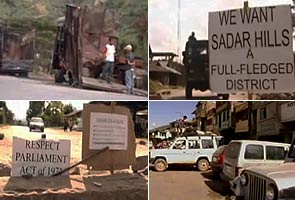
Imphal, Nov 1 : A 93-day economic blockade on Manipur's main national highway was lifted at midnight after the state government signed an agreement with the agitating group, demanding a separate Kuki tribe dominated-district to be carved out of hill areas near Imphal.

The agreement between the Sadar Hills District Demand Committee (SHDDC) and the state government was signed around midnight in capital Imphal with leaders of the Committee and senior officials present at the meeting. The government has agreed to upgrade the Sadar Hills area near Imphal to a full-fledged district at the earliest.

However, it remains to be seen whether this agreement will bring any relief to Manipur as Naga groups, opposed to this district, say they will intensify their counter blockade on the same highway as they are opposed to the government decision. The Naga counter-blockade is being spearheaded by the United Naga Council (UNC).

The SHDCC had launched the economic blockade August 1 on two national highways - Imphal-Dimapur-Guwahati (NH 39) and Imphal-Jiribam-Silchar (NH53) - to press their demand for conversion of Kuki tribal majority Sadar Hills area into a full fledged district.

The two highways are the lifeline to Manipur as supplies of all essentials are brought to the state from adjoining Assam and other parts of India.