01 November 2011

Shunned Mizo Girl Quits Delhi

Gangrape victim forced to leave job & return home after friends and neighbours ostracise her

IMRAN AHMED SIDDIQUI

fight for rightNew Delhi, Nov 1 : A Mizo woman who was gangraped in Delhi last November was shunned by friends and taunted on the streets, prompting her to quit her BPO job and return to Mizoram a couple of months ago.

Sources who had counselled the 30-year-old said her colleagues avoided her and even her friends, some from the Northeast themselves and thus expected to be a source of emotional support, had stopped meeting her.

“It became very difficult for her to live in Delhi. She was feeling ostracised by neighbours and friends,” the president of the Delhi Mizo Welfare Association, B. Lalzarliana, told The Telegraph.

Madhu Chandra, spokesperson for the North East Support Centre and Helpline, said he was “shocked” at the way the victim was ostracised. “Instead of helping such victims with their rehabilitation, our society makes their lives more miserable,” he said.

The victim’s plight may have been partly aggravated by the way women from the Northeast are perceived and treated by many in Delhi, including criminals and the police. Statistics complied by Chandra’s NGO suggest that nearly half the women harassed sexually in the capital are from the Northeast. “Northeast women are always targeted by criminals but the police do not act on their complaints, emboldening the criminals. In 40 instances in the past two years, the police refused to register a case when the shattered victims approached them,” Chandra said.

In another 20 cases, the accused are roaming free, Chandra said. He cited how two men recently molested a Manipuri girl inside her home and how Vasant Vihar police refused to register a case when her family approached them.

Ayangla Jamir, who is from Nagaland and works with a BPO, said the capital had become a frightening place to live in. “Women from the Northeast feel very vulnerable. Criminals are on the prowl but the government is least bothered. Even society, which should come to the aid of rape victims, makes their life more miserable,” she said.

The Mizo gangrape victim’s absence from Delhi, Lalzarliana said, could work in favour of her four alleged attackers whom the police eventually arrested after drawing a lot of flak. The trial is to begin soon. “She has to be present at the hearings. If she doesn’t come, it will have an impact on the outcome of the case,” Lalzarliana said.

The victim, who worked with a Gurgaon BPO, had arrived in Delhi five years ago and had been living with her sister in a rented flat in Motibagh, south Delhi. On November 23 night last year, she was abducted at gunpoint after the office car had dropped her near her home.

Four men dragged her into their mini-truck and took turns in raping her before throwing her out two hours later. Chandra said the girl’s was not an isolated case. Another Mizo girl, a 20-year-old Delhi University student, had been abducted from near the same spot and gangraped in a moving vehicle in 2005.

“She, too, returned to Mizoram. It took her three-four years to come out of the trauma. She got married this year,” Lalzarliana said.

Nearly 85,000 people from the Northeast live in the National Capital Region. Some 4,000 northeastern boys and girls enrol in Delhi University colleges every year and a large number works in BPOs.

People from the community had met chief minister Sheila Dikshit last year, extracting a promise to set up a hostel for working women from the Northeast, Chandra said. Such a hostel for 500 women has come up in Jasola, southeast Delhi, but only a handful have moved in because it’s located in a remote area and has poor security, he added. “After crimes against northeastern girls, we always remind senior police officers to intensify patrolling in south Delhi, where most of these girls live. We have also given a helpline number to the girls to contact us in distress,” Lalzarliana said.

Police spokesperson Rajan Bhagat said he was not aware of any instance of the police refusing to register a molestation complaint. Figures released by the home ministry yesterday show that Delhi recorded the highest number of rape cases (414) and followed by Mumbai (194) last year.

WITH ADDITIONAL REPORTING BY ANDREW W. LYNGDOH IN SHILLONG, KHELEN THOKCHOM IN IMPHAL & RUPAMUDRA KATAKI AND SANTANU GHOSH IN ASSAM

Source: Telegraph India

Tour Imphal? Rent a Bicycle

cycles on rent imphalImphal, Nov 1: Bicycles will be available on rent here from next month and people will also be able to rent one to pedal around inside the historical Kangla Fort.

The Manipur Cycle Club is launching the facility here in collaboration with the state environment and ecology department.

The club’s secretary, Niran Thongbam, said, “We are launching the rent-a-cycle facility in collaboration with the environment and ecology department on a pilot basis for daily commuters to Imphal. It is being started at Keishampat junction here on November 15.”

The department provided a sum of Rs 30,000 for starting the facility on an experimental basis.

The secretary said based on the results of the experiment, the club would introduce this facility along with cycle repairing and maintenance facilities in other locations from next year.

Environmentalists, professionals and government employees formed the club on January 23 this year with the objective of reducing pollution and volume of traffic in Imphal and also to reduce the rate of road accidents.

It is also supported by the European Manipur Association, a body of Manipu- ris living in European countries, where cycling is very popular.

The club has been organising events called Critical Mass, involving cycle rallies and distribution of leaflets, in different localities on the last Sunday of every month to create awareness about environmental conservation and health benefits of cycling.

The club, with 450 registered members, organised the tenth Critical Mass today.

Critical Mass, a global movement for popularising cycles, is very popular in 360 cities around the world.

The club has also started a campaign for creation of cycle lanes and cycle parking spaces along Imphal streets and has proposed to the art and culture department, which is taking care of the Kangla Fort, to declare the historical place a carbon-free zone to preserve its cultural heritage and the vegetation inside the campus along with introduction of the rent-a-cycle facility inside the fort.

Another programme on the list of activities of the club is to organise a five-day cycle expedition in collaboration with the Manipur Mountaineering and Trekking Association to Keibul Lamjao National Park in Bishnupur district during the Sangai festival.

The Manipur tourism department organises the festival every year in the park, which is home to the most threatened deer species in the world — Sangai.

The decision to introduce the rent-a-cycle facility has been welcomed by visitors in the city.

“I come to the city by bus from Nambol in Bishnupur district every day to attend office. From the bus stand, I catch an auto-rickshaw for Rs 50 to and from office daily. With the cycle facility, I will save Rs 40 and also improve my health,” N. Brojen, a government employee from Nambol in Bishnupur district, said.

Okram Bishwajit, president of the European Manipur Association, who is currently in Imphal, said people who cycled regularly had less chances of developing joint aches during old age.

'Many In Northeast Feel They Are Not Indians'

By Surajit Talukdar

Bertil Lintner

NextBertil Lintner

Bertil Lintner, a Swedish journalist, author and renowned scholar on Indo-Burmese affairs based in Thailand, has several chances of meeting with some of the dreaded militant leaders of north eastern region in India as well as abroad. He has long been closely following the ever evolving insurgency scenario in the north-east.

He is one of many blacklisted journalists who have not been allowed to enter Burma since 1985. Lintner was the first foreign journalist to learn about Aung San Suu Kyi's release from house arrest in 1995.

In an exclusive e-mail interview to Surajit Talukdar, Lintner talks about the recent peace initiative between ULFA and the government, and how the Myanmar government is not concerned about India's insurgency problem in NE, among other things.

Do you think that the current tripartite agreement for 'suspension of operation' signed in New Delhi among the United Liberation Front of Asom, Centre and Assam government will bring permanent peace in Assam?

It will certainly mean a lot for peace in the north-east and it is my impression that (head of the pro-talks faction of ULFA) Arabinda Rajkhowa is flexible and willing to discuss his demands with the Indian authorities. On the other hand, (head of anti-talks faction of ULFA) Paresh Baruah has vowed to continue the armed struggle, and it is unclear how many followers he has at the moment. But even a small group can create havoc.
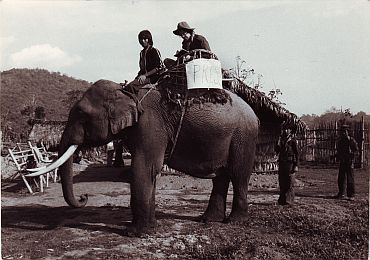
Bertil Lintner (on the elephant) on his way to an assignment in Kachin State in Myanmar

Next

Image: Bertil Lintner (on the elephant) on his way to an assignment in Kachin State in Myanmar
Photographs: Courtesy: Bertil Lintner

Paresh Baruah is still opposing the peace process initiated by Rajkhowa with the government. So, where will you see the solution lies?

Right now, it's not easy to find out any solution. I think it would be very difficult for Baruah to become a state politician, or even to enter into serious peace talks with the government of India -- unlike Rajkhowa and the others who have much less to hide.

Baruah has always had very close ties to (Bangladeshi intelligence agency) Directorate General of Forces Intelligence, the (Pakistani spy agency) Inter Services Intelligence and the Chinese intelligence, and I doubt whether those entities would allow him to come "over ground" so to speak.

He knows just too many secrets. He would have to watch his back -- for the Pakistanis and the Chinese -- if he decides to join the talks. He is cornered and he knows it, and that makes him potentially quite dangerous as well.

Are you in touch with Arabinda Rajkhowa or Paresh Baruah? What are their views on the solution to the government-ULFA tangle?

I first met most ULFA leaders at the then undivided Nationalist Socialist Council of Nagaland headquarters at Kesan Chanlam in northwestern Burma in 1985. Later, I met Baruah and some other ULFA leaders in Bangkok in March 1992 and in Dhaka in April 1996, and communicated with Rajkhowa by e-mail.

I met all of them again in Bangkok in June 1996, when they had to leave Bangladesh after the Awami League victory in that year.

When I met Baruah in a Bangkok coffee shop in March 1992, he made no secret of the fact that Pakistan supported ULFA and encouraged him and his comrades to step up their activities in Assam. I met Baruah in Dhaka four years later.

It was always my impression that Rajkhowa was much less dogmatic than Baruah, and more interested in Assamese culture and history than in carrying out any violent activity.
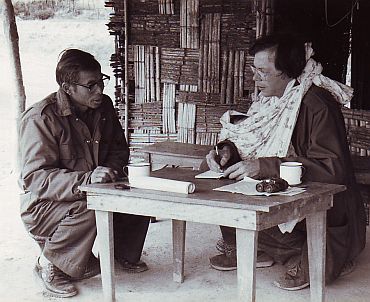
Lintner interviewing the chairman of the NSCN-IM, Isak Chisi Swu

Image: Lintner interviewing the chairman of the NSCN-IM, Isak Chisi Swu
Photographs: Courtesy: Bertil Lintner

Next

Is the Paresh Baruah-led ULFA faction in touch with any international human rights organisations to further its cause? Where is Baruah hiding these days?

I am not aware of any other foreign connections that Baruah might have right now. He seems to be fairly isolated. The ULFA has been severely crippled as an insurgent force since Rajkhowa and his comrades were released from jail.

I can state with some certainty that he himself is not staying in any jungle camp in northwestern Burma. I have been told by people who once were close to him that he feels completely safe only in China. Beijing doesn't mind him being there, as a tit-for-tat for India allowing the Dalai Lama to have a base in McLeodganj.

What is the recent status of the Indo-Naga peace process? Do you think that the NSCN-Isak Muivah leaders Thuingaleng Muivah and Isak Chisi Swu's dream of curving out a 'Greater Nagalim' will be a reality someday?

Endless peace talks have been held since the 1997 ceasefire with no concessions in sight from the government's side. In 2011, Muivah turned 75 and Swu 82. India is playing a waiting game, wearing them down and hoping that there will be no next generation of insurgent leaders among the Nagas. And, after more than a decade of ceasefire and fairly comfortable camp life at Hebron, Dimapur the ordinary and the NSCN-IM's younger soldiers may not be eager to take on the Indian army.

Nagaland is a land-locked territory with few natural resources. It's not even self-sufficient in food. Given those circumstances, it seems to me not to be a clever policy for any Naga group to have territorial claims. I can't possibly see other non-Naga groups agreeing to the 'Greater Nagalim' demand also.
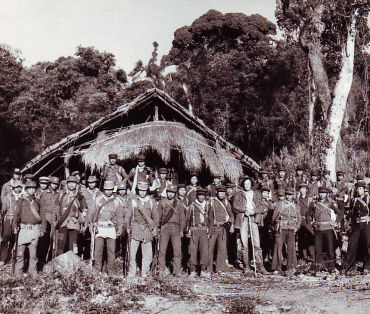
Bertil Lintner with the Naga and Kachin escorts in Myanmar

Image: Bertil Lintner with the Naga and Kachin escorts in Myanmar
Photographs: Courtesy: Bertil Lintner

Next

Are you in touch with Muivah and Swu? Are other international organisations supporting the cause of the NSCN-IM?

I met Swu in Bangkok over a year ago, but that is the only contact I have had with NSCN-IM leaders in recent years, apart from meeting sympathisers in Ukhrul in May 2010.

The NSCN-IM has its supporters, mainly some NGOs in the Netherlands, but those groups are not significant.

Do you think the recent peace initiatives taken by New Delhi with several militant groups in the north-east are sufficient to solve the insurgency problem in the trouble-torn region?

It's definitely a good step taken by New Delhi. The expulsion of ULFA leaders from Bangladesh, and the subsequent arrests of Anthony Shimray, the NSCN-IM's main arms procurer, and United National Liberation Front chairman Sana Yaima indicate that India is determined to wipe out insurgency movements in the north-east once and for all to clear the area for trade with Myanmar.

But the ethnic problems in the north-eastern India are not going to disappear even if the militants are neutralised; there are genuine grievances that has to be addressed as well. Many people in the region feel neglected and marginalised. Development has to reach those areas, and their ethnic identities have to be respected. Frankly speaking, many of them feel that they are not Indians.
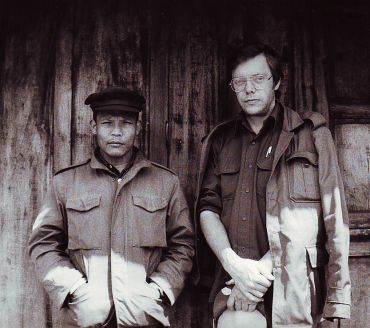
Bertil Lintner with the Manipur's People Liberation Army (PLA) leader Temba Singh in Myanmar

Image: Bertil Lintner with the Manipur's People Liberation Army (PLA) leader Temba Singh in Myanmar
Photographs: Courtesy: Bertil Lintner

Do the Myanmarese rebel groups still provide support to the north-eastern militant groups? Are there NSCN-IM and ULFA camps in Myanmar?

No, they do not have camps in Myanmar. In the past, the Kachin Independence Army trained Assamese and Manipuri rebels, and had contacts with several Naga groups as well. That, however, ceased in the early 1990s.

I know that India's security services believe there's still a connection because they have intercepted radio traffic between ULFA units in Myanmar -- in Jinghpaw, the main language of the Kachins.

ULFA and some Manipuri groups such as the Revolutionary People's Front, Manipur's Peoples Liberation Army, UNLF and Peoples Revolutionary Party of Kangleipak have camps in northwestern Sagaing division in upper Myanmar, as does NSCN-K, but, to the best of my knowledge, not the NSCN-IM which has no support base among the population across the border in Myanmar. The NSCN-K, of course, does have some support from Konyaks and others who live on both sides of the border.

What is Yangon's view on the insurgency scenario in the north-east? Is the Myanmarese government planning to take any action against the Indian insurgent groups which have their bases on their soil?

The Myanmarese government sees it as India's problem. Yangon is not really interested in cooperating with its neighbours when it comes to cross-border insurgencies. It fights insurgents on its own terms and doesn't want to get into the kind of joint operations that India wants.

The Myanmarese government just wants to keep India at arm's length, and is therefore not against having a 'buffer of instability' between themselves (the area in northwestern Myanmar which they control) and the Indian border.

92-Day Long Manipur Economic Blockade Called Off

By Priyanka Gupta

manipur economic blockadeNew Delhi, Nov 1 : The economic blockade that was in place in Manipur was called off on Tuesday after the State Government gave written assurance to upgrade Sadar Hills as a full fledged district after district re-organization committee submitted its report.

The agreement came after mid night and no decision has been made yet on the counter blockade imposed by the United Naga Council (UNC) who were opposing the upgrade.

UNC said it will not lift the blockade as of now. A meeting has been called on Tuesday afternoon to discuss the ramifications of the MoU signed between the government and SHDDC.

Official sources said on Tuesday that the Sadar Hills District Demand Committee (SHDDC), which had launched economic blockade on two national highways - Imphal-Dimapur-Guwahati (NH 39) and Imphal-Jiribam-Silchar (NH53) - to press their demand for conversion of Kuki-majority Sadar Hills area in Naga-majority Senapati district called off the economic blockade after talks with the government.

However, the blockade by the United Naga Council (UNC) on the two highways opposing the demand of the SHDC was still continuing, sources said.

Representatives of the SHDDC and the government held discussions over the issue on Monday night, the sources said adding the government had agreed to grant district status to Sadar hills area after receiving the report of the District Reorganisation Committee headed by Chief Secretary D S Poonia.

Sources said the committee would study the boundaries of all the districts in the state before taking any decision on Sadar Hills issue.

While SHDDC had launched economic blockade on portions of the two highways since August 1, the United Naga Council(UNC) had launched a stir demanding that they should be consulted before the government took any decision on the matter, also launched economic blockade on the same highways since August 21.

Reports from Senapati district said civil organisations have appealed to the UNC to call off the economic blockade since the SHDDC lifted the economic blockade but there was so far no response from the UNC.

Official sources said more than 400 trucks bringing in essential items from outside the state used to ply everyday but during the economic blockade only 300 to 400 trucks plied once or twice in a week with security escort.

Prices of essential items have sky-rocketed due to economic blockade. Market reports said there may not be much change in rices since UNC was still continuing the blockade.

The crisis began on August 1 when the United Naga Committee opposed the Kuki demand to turn Sadar Hills into a full-fledged district.

31 October 2011

Supplies in Manipur Fine But Costly: Chidambaram

New Delhi: Home Minister P Chidambaram said today that supplies are available in Manipur despite the blockade entering the 92nd day although he admitted that the prices are going through the roof.
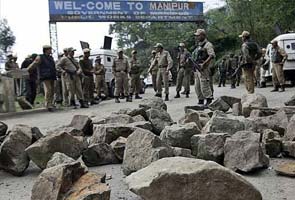
Chidambaram said the Kukis and Meitei's started two different blockades demanding two districts respectively.

“The chief minister has appointed a District Reorganisation Commission to look into the issue and the report is expected in a few months. I appeal to both the groups to withdraw the blockade,” he said.

The home minister said that the Centre and the state government are ensuring that 1,100 trucks reach Imphal every week to maintain supplies.

“The peculiar nature of the protest is that there is no protest in the Imphal valley. It is an issue that has been pending for many years. The groups have recently upped the ante in support of their demands,” Chidambaram said.

Blocking Manipur's Lifeline: 'My Way' Or The Highway, Say Protesters

Senapati (Manipur), Oct 31 : On the National Highway No 2 in Manipur's Senapati district, trucks burnt by protesters are a common sight now. This highway connects state capital Imphal to Assam, and is the lifeline for getting supplies into the state. The highway has been blocked for over three months now, paralysing life in the state capital and other districts.

Over the years, blocking highways has become the focal point of protests in Manipur. For the people of the state, it's almost like an annual feature of sorts now. The reason for blocking highways changes every year. What is constant is how these blockades have become a reflection of troubled times in this north-eastern state.

Last year, a blockade on this road lasted for 68 days. This time, it has been three months so far. A local group demanding a separate Kuki tribe dominated district to be carved out of Senapati district has called for the blockade. Opposing their demand are the Naga tribals, who have imposed a counter-blockade on the road, saying nothing can be done without consulting them. The conflict is the result of ethnic tensions between the Nagas and Kukis.

"Economic blockades have become a culture in Manipur. There is no other effective way of putting forward our demands," says Ngamkhohao Haokip, the president of Sadar Hills Districthood Demand Committee.

The opposing group too has its own justification for blocking the highway. "We have to choose how the government will listen. And we also have to attract the attention of the outside world," says S Milan, Information and Publicity Secretary of the United Naga Council.

Starting Tuesday, leaders heading the agitation have called a two-day strike across the state. The strike will be indefinite in Senapati district, the epicentre of protests.
Given the enormity of the situation, this response by a senior government minister may not seem adequate.

"They are our own people. We can only try and convince them and that we are doing," said N Biren Singh.

Politically, it is a tight-rope walk for the Manipur government as it is caught between the Kuki demand for a separate state and the opposition to this by the Naga tribe.
But what has also baffled many in Manipur is the cold response of the Central government to the crisis in Manipur.

So far, not one central minister has visited the state since the blockade was enforced. All eyes are now on Union Home Minister P Chidambaram's visit to Manipur on November 2. He is coming to inaugurate govt projects, but it is expected that he may spell out the central government's stand on the blockade.

For now though, with no clear direction from the state government or the Centre, the situation in Manipur seems to be going from bad to worse.

Nothing Else Mattered For Metallica Fans in Bangalore

metallica bangalore

Bangalore, Oct 31
: It was as good as attaining musical nirvana after riding the F1 fervour. When America's most-popular heavy metal band Metallica descended on Sunday, the city hit a different high.

Youngsters from across the country, and some from abroad, almost 20,000, and many among them flaunting the iconic band's T-shirt , flooded the IT capital to witness the gala event.

From New Delhi (where the concert was cancelled), to North-east , Bihar, Kolkata, Mumbai, Pune and Chennai, the 20-somethings flocked to Palace Grounds to listen not just to James Hetfield, but also to experience the sleek riffs of Kirk Hammett and groove to the drumbeats of Lars Ulrich.

The concert area, which was divided into three, saw the first portion packed with fans virtually clinging to each other and head-banging to some of the band's most-famous numbers . Boys let their hair down on a cool and wet evening, singing and dancing to chartbusters like 'Enter Sandman' , 'Unforgiven' , and 'Nothing Else Matters' .

While Hetfield captivated the audience with his 'metallic' voice, Ulrich was a stunner with the drums, especially with the 'Enter Sandman' number.

metallica bangalore1Lead guitarist Kirk Hammett's extended riffs and sudden shifts to melodic strains left fans asking for more. As always, bassist Robert Trujillo truly complemented Hetfield and Hammett.

The band played 'Wherever I May Roam' , 'For Whom the Bell Tolls' , 'Seek and Destroy' , 'Master of Puppets' , 'Of Wolf And Man' , 'Holier Than Thou' , 'Harvester of Sorrow' , 'Creeping Death' , 'That was Just Your Life' , 'Mama Said' , 'Whiskey in the Jar' and 'Die Die My Darling' .

The event began late in the evening but the mood was vivacious through the day. A middle-aged woman in a salwarkameez , wearing a Metallica T- shirt, stood patiently in a long queue to get tickets; young mothers were seen shaking a leg with their tiny tots; black was the colour of the day as a sea of fans proudly donned the T-shirts ; restaurants were packed with fans sipping beer, obviously as a build-up to the head-bang later in the evening.

Right from noon till 5pm, a black human chain was waiting along the boundary wall of Palace Grounds, stretching all the way to Mekhri Circle. Rain or sun, there was no stopping these music lovers. In big groups, they waited to get tickets , singing away popular numbers from the band's albums.

Many disheartened fans came from Delhi after the show was cancelled, determined to chase the band and rock with them. Crowds kept pouring in even an hour before the band started performing on stage.

metallica blore

Tripura to Get Northeast's First Textile Park

textile Park TripuraAgartala, Oct 31 : Northeastern India's first textile park will be set up in Tripura, a minister said here Sunday.

"The proposed park in Tripura is part of the 21 new textile parks to be set up under the Scheme for Integrated Textile Parks (SITP)," Tripura Industries and Commerce Minister Jitendra Chowdhury told IANS.

Quoting a letter from union Minister for Commerce and Industry Anand Sharma, who also heads the textiles ministry, Chowdhury said that the parks would be set up at a cost of Rs.2,100 crore in Maharashtra (six parks), Rajasthan (four), Tamil Nadu (two), Andhra Pradesh (two) and one each in Uttar Pradesh, Gujarat, Tripura, Himachal Pradesh, Karnataka, Jammu and Kashmir and West Bengal.

These parks would be set up over a period of three years on a public-private-partnership basis.

"A special purpose vehicle (SPV) would be formed to execute the project. The SPV would chanelised funds and supervise other aspects of the ambitious project.

"The Tripura government would extend all out support for setting up of the park. It would create new opportunities in the industry-starved northeastern region," he said.