01 November 2011

92-Day Long Manipur Economic Blockade Called Off

By Priyanka Gupta

manipur economic blockadeNew Delhi, Nov 1 : The economic blockade that was in place in Manipur was called off on Tuesday after the State Government gave written assurance to upgrade Sadar Hills as a full fledged district after district re-organization committee submitted its report.

The agreement came after mid night and no decision has been made yet on the counter blockade imposed by the United Naga Council (UNC) who were opposing the upgrade.

UNC said it will not lift the blockade as of now. A meeting has been called on Tuesday afternoon to discuss the ramifications of the MoU signed between the government and SHDDC.

Official sources said on Tuesday that the Sadar Hills District Demand Committee (SHDDC), which had launched economic blockade on two national highways - Imphal-Dimapur-Guwahati (NH 39) and Imphal-Jiribam-Silchar (NH53) - to press their demand for conversion of Kuki-majority Sadar Hills area in Naga-majority Senapati district called off the economic blockade after talks with the government.

However, the blockade by the United Naga Council (UNC) on the two highways opposing the demand of the SHDC was still continuing, sources said.

Representatives of the SHDDC and the government held discussions over the issue on Monday night, the sources said adding the government had agreed to grant district status to Sadar hills area after receiving the report of the District Reorganisation Committee headed by Chief Secretary D S Poonia.

Sources said the committee would study the boundaries of all the districts in the state before taking any decision on Sadar Hills issue.

While SHDDC had launched economic blockade on portions of the two highways since August 1, the United Naga Council(UNC) had launched a stir demanding that they should be consulted before the government took any decision on the matter, also launched economic blockade on the same highways since August 21.

Reports from Senapati district said civil organisations have appealed to the UNC to call off the economic blockade since the SHDDC lifted the economic blockade but there was so far no response from the UNC.

Official sources said more than 400 trucks bringing in essential items from outside the state used to ply everyday but during the economic blockade only 300 to 400 trucks plied once or twice in a week with security escort.

Prices of essential items have sky-rocketed due to economic blockade. Market reports said there may not be much change in rices since UNC was still continuing the blockade.

The crisis began on August 1 when the United Naga Committee opposed the Kuki demand to turn Sadar Hills into a full-fledged district.

31 October 2011

Supplies in Manipur Fine But Costly: Chidambaram

New Delhi: Home Minister P Chidambaram said today that supplies are available in Manipur despite the blockade entering the 92nd day although he admitted that the prices are going through the roof.
Chidambaram said the Kukis and Meitei's started two different blockades demanding two districts respectively.

“The chief minister has appointed a District Reorganisation Commission to look into the issue and the report is expected in a few months. I appeal to both the groups to withdraw the blockade,” he said.

The home minister said that the Centre and the state government are ensuring that 1,100 trucks reach Imphal every week to maintain supplies.

“The peculiar nature of the protest is that there is no protest in the Imphal valley. It is an issue that has been pending for many years. The groups have recently upped the ante in support of their demands,” Chidambaram said.

Blocking Manipur's Lifeline: 'My Way' Or The Highway, Say Protesters

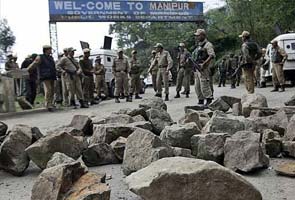
Senapati (Manipur), Oct 31 : On the National Highway No 2 in Manipur's Senapati district, trucks burnt by protesters are a common sight now. This highway connects state capital Imphal to Assam, and is the lifeline for getting supplies into the state. The highway has been blocked for over three months now, paralysing life in the state capital and other districts.

Over the years, blocking highways has become the focal point of protests in Manipur. For the people of the state, it's almost like an annual feature of sorts now. The reason for blocking highways changes every year. What is constant is how these blockades have become a reflection of troubled times in this north-eastern state.

Last year, a blockade on this road lasted for 68 days. This time, it has been three months so far. A local group demanding a separate Kuki tribe dominated district to be carved out of Senapati district has called for the blockade. Opposing their demand are the Naga tribals, who have imposed a counter-blockade on the road, saying nothing can be done without consulting them. The conflict is the result of ethnic tensions between the Nagas and Kukis.

"Economic blockades have become a culture in Manipur. There is no other effective way of putting forward our demands," says Ngamkhohao Haokip, the president of Sadar Hills Districthood Demand Committee.

The opposing group too has its own justification for blocking the highway. "We have to choose how the government will listen. And we also have to attract the attention of the outside world," says S Milan, Information and Publicity Secretary of the United Naga Council.

Starting Tuesday, leaders heading the agitation have called a two-day strike across the state. The strike will be indefinite in Senapati district, the epicentre of protests.
Given the enormity of the situation, this response by a senior government minister may not seem adequate.

"They are our own people. We can only try and convince them and that we are doing," said N Biren Singh.

Politically, it is a tight-rope walk for the Manipur government as it is caught between the Kuki demand for a separate state and the opposition to this by the Naga tribe.
But what has also baffled many in Manipur is the cold response of the Central government to the crisis in Manipur.

So far, not one central minister has visited the state since the blockade was enforced. All eyes are now on Union Home Minister P Chidambaram's visit to Manipur on November 2. He is coming to inaugurate govt projects, but it is expected that he may spell out the central government's stand on the blockade.

For now though, with no clear direction from the state government or the Centre, the situation in Manipur seems to be going from bad to worse.

Nothing Else Mattered For Metallica Fans in Bangalore

metallica bangalore

Bangalore, Oct 31
: It was as good as attaining musical nirvana after riding the F1 fervour. When America's most-popular heavy metal band Metallica descended on Sunday, the city hit a different high.

Youngsters from across the country, and some from abroad, almost 20,000, and many among them flaunting the iconic band's T-shirt , flooded the IT capital to witness the gala event.

From New Delhi (where the concert was cancelled), to North-east , Bihar, Kolkata, Mumbai, Pune and Chennai, the 20-somethings flocked to Palace Grounds to listen not just to James Hetfield, but also to experience the sleek riffs of Kirk Hammett and groove to the drumbeats of Lars Ulrich.

The concert area, which was divided into three, saw the first portion packed with fans virtually clinging to each other and head-banging to some of the band's most-famous numbers . Boys let their hair down on a cool and wet evening, singing and dancing to chartbusters like 'Enter Sandman' , 'Unforgiven' , and 'Nothing Else Matters' .

While Hetfield captivated the audience with his 'metallic' voice, Ulrich was a stunner with the drums, especially with the 'Enter Sandman' number.

metallica bangalore1Lead guitarist Kirk Hammett's extended riffs and sudden shifts to melodic strains left fans asking for more. As always, bassist Robert Trujillo truly complemented Hetfield and Hammett.

The band played 'Wherever I May Roam' , 'For Whom the Bell Tolls' , 'Seek and Destroy' , 'Master of Puppets' , 'Of Wolf And Man' , 'Holier Than Thou' , 'Harvester of Sorrow' , 'Creeping Death' , 'That was Just Your Life' , 'Mama Said' , 'Whiskey in the Jar' and 'Die Die My Darling' .

The event began late in the evening but the mood was vivacious through the day. A middle-aged woman in a salwarkameez , wearing a Metallica T- shirt, stood patiently in a long queue to get tickets; young mothers were seen shaking a leg with their tiny tots; black was the colour of the day as a sea of fans proudly donned the T-shirts ; restaurants were packed with fans sipping beer, obviously as a build-up to the head-bang later in the evening.

Right from noon till 5pm, a black human chain was waiting along the boundary wall of Palace Grounds, stretching all the way to Mekhri Circle. Rain or sun, there was no stopping these music lovers. In big groups, they waited to get tickets , singing away popular numbers from the band's albums.

Many disheartened fans came from Delhi after the show was cancelled, determined to chase the band and rock with them. Crowds kept pouring in even an hour before the band started performing on stage.

metallica blore

Tripura to Get Northeast's First Textile Park

textile Park TripuraAgartala, Oct 31 : Northeastern India's first textile park will be set up in Tripura, a minister said here Sunday.

"The proposed park in Tripura is part of the 21 new textile parks to be set up under the Scheme for Integrated Textile Parks (SITP)," Tripura Industries and Commerce Minister Jitendra Chowdhury told IANS.

Quoting a letter from union Minister for Commerce and Industry Anand Sharma, who also heads the textiles ministry, Chowdhury said that the parks would be set up at a cost of Rs.2,100 crore in Maharashtra (six parks), Rajasthan (four), Tamil Nadu (two), Andhra Pradesh (two) and one each in Uttar Pradesh, Gujarat, Tripura, Himachal Pradesh, Karnataka, Jammu and Kashmir and West Bengal.

These parks would be set up over a period of three years on a public-private-partnership basis.

"A special purpose vehicle (SPV) would be formed to execute the project. The SPV would chanelised funds and supervise other aspects of the ambitious project.

"The Tripura government would extend all out support for setting up of the park. It would create new opportunities in the industry-starved northeastern region," he said.

30 October 2011

Mobile Phones Revolutionizing Mizoram

mizoram mobile phonesAizawl, Oct 23 : Technology is a great leveler as it helps bridge gaps between people, it is evident from the fact that expanding telecommunications network in the region has brought Mizoram closer to the rest of the nation.

Mizoram is now well connected with rest of the nation through cell phones as most of the service providers have set up their shops here.

Cell phones were introduced in Mizoram in 2003 and since then have gained huge popularity over time.

"I have been using mobile phones for the past five years and it has quite some time now that mobile phones came to Mizoram. People from all walks of life use mobile phones these days," said V L Chhuanga, a Mobile User.

Today there are over six lakh mobile phone users in Mizoram - a number that is increasing at the rate of six percent.

"Most of the landline users have chosen to use mobile because they can carry it anywhere they want to and use it anytime they want to. So there are more people using mobile at all income levels from the richest to the poorest," said Mahaminga, a mobile shop owner.

It is reported that consumers spend more than six crore rupees on their mobile phone bills per month in Aizawl alone.

Metallica All Set To Rock Bangalore Today

By Deepa Balakrishnan

Bangalore, Oct 30 : Rock band Metallica's maiden Indian tour started on a dismal note when their concert was cancelled in Delhi but the band is all set to rock Bangalore on Sunday night and the fans are hoping that finally they will see the legends perform live.

20,000 lucky ones who have got tickets for Sunday's gig at the Bangalore Palace Ground are keeping their fingers crossed. Not wanting a repeat of the Gurgaon fiasco, die-hard fans from Kolkata, Mumbai and Pune have started congregating at their pilgrimage point a day in advance.

"I have come all the way from Mumbai just for this concert, I've been a fan of Metallica some ten years now," a fan at the Bangalore venue said.

Frenzy apart, there is a sense of nervousness at the long queues as fans wait to confirm bookings. Friday's no-show at Gurgaon has left people worried.

"I booked tickets online and yet I stood here for two hours. Now they're saying I can't get the ticket. What's the point?" a fan said.

Friday's flop show has been bad press for the organisers, DNA networks, but they insist that they are not taking any chances for Sunday.

PR Manager Karuna Prithvi said, “We've put in extra barricades and more security for the Sunday’s gig.”

The city police have granted permission for Sunday's concert that starts at 5 pm, even as serious concerns over the turnout and the security remain.

Lessons Not To Learn

By Shobhan Saxena

history of IndiaModern education is not just about developing a good temper or building loads of self-confidence , it's about experimenting with new ideas and challenging the old ones. A modern university is not just huge lecture halls, hi-tech labs and swanky cafeterias, it's a place that can take young minds to the frontiers of knowledge. But in 21st century India, the campuses seem to be either regressing or are still living in the past. A few incidents on some of our most prestigious campuses this month show how new ideas are being resisted and old, archaic thinking imposed on students by the people who are supposed to guide them.

On October 9, the academic council of Delhi University decided to drop A K Ramanujan's essay 'Three Hundred Ramayanas' from a course in the history syllabus after some faculty members objected to it for being "blasphemous" . A week later, at Jawaharlal Nehru University (JNU), the administration issued a showcause notice to the president of All India Backward Students' Forum for "denigrating" gods and goddesses after a section of dalit students decided to observe 'Mahishasura Day' to reiterate that the demon killed by Durga "belonged to a backward community" . Again, the move was called "blasphemous" , a word generally heard in medieval fiefdoms, not in secular democracies.

In both cases, as usual, the debate turned into a shrill slanging match between the right and left. The real point about academic freedom and free speech being curtailed on campuses was completely missed. "The lesson from this episode is to realize that any epic, phenomenon, event and text in history is multivocal; their meanings are multiple, alternative , complex, conflicting and not final. Undergraduate students have to be exposed to such cultural diversities, narratives and different perspectives. No academic council, administrative body or political group has the right to interfere in an academic course at the undergraduate level. Academic freedom and historians' territory should be protected from political attacks on history teaching and history-writing ," says Nonica Datta, who teaches history at Miranda House, Delhi. The problem is that history is not being left to historians . Everyone, including the lunatic fringe wings of political groups, has jumped into the debate. But the real problem could be the academics themselves. "The recent controversy in JNU is another instance of the oppressive mindset of the academia. JNU is considered an institution of excellence. But so-called Hindu orthodox organizations are trying to smash its secular fabric and forcing the administration to take action against backward caste students," says K P Singh, dean, school of humanities and social sciences and chief proctor of Gautam Buddha University in Greater Noida. "The academic system in most Indian universities is worse than the caste system. In social sciences if someone wants to research on issues related to caste, that scholar is judged not on the basis of merit of the subject matter but on his or her caste," says the social scientist who till recently taught at the Washington State University, Seattle.

Religious bias, caste prejudice, regional stereotyping and gender discrimination plague our universities for a reason. The campuses don't exist in a vacuum. They are merely showing symptoms of society at large. As the politics of intolerance grows, the universities , too, have fallen to the culture of hooliganism. Four years ago, Rohinton Mistry's Such A Long Journey was introduced in a course in colleges affiliated to Mumbai University. But in August 2010, Shiv Sena supremo Balasaheb Thackeray's grandson Aditya, a student of St Xavier's College, mobilized the party's student wing - Bharatiya Vidyarthi Sena - whose workers burnt copies of the book and asked the university's then newly appointed vice-chancellor Rajan Welukar to drop the book from the syllabus as it contained "matter that was anti-Shiv Sena" .

And the university obeyed the Thackeray scion's diktat without a murmur. "Timidity has no place in academia. Heads of such institutions must have the courage to face the music," says writer Aroon Tikekar. Prominent Mumbaikars, students and filmmakers defied the Sena workers by gathering at the Mumbai Press Club and reading out passages from the book. But that did little to change the stand of the university. The novel is still banned.

Indian campuses have been always prone to interference from political parties but the nature of intervention has changed dramatically over the decades . In the early and mid-1970 s, students and teachers joined Jayaprakash Narayan's "Total Revolution" and rose against the Emergency; now the climate on campuses is more conformist."The change happened in the early 1990s as the anti-Mandal agitation and L K Advani's rath yatra vitiated the social atmosphere . That also led to the rise of ABVP on campuses across the country and many academics, who were earlier shy of expressing their right-wing views, came out in the open," says a JNU professor. With the rise of backward politics coinciding with the growth of militant Hindutva, it's not surprising that most campus conflicts have happened around the issues of caste and religion. "In the undergraduate courses of Madhya Pradesh colleges they teach the virtues of the caste system. You can imagine what kind of students will come out of this educational system," says a lecturer in a Bhopal college who doesn't want to be named.

Regression is not just limited to syllabus and teaching. Some institutions have begun to give their students lessons in social behaviour too. In 2006, Bangalore University decided that boys and girls should sit in separate rows in class. "If sitting near a boy is being progressive, I do not agree with it," K Narahari, a former MLC who was part of the university syndicate that took the decision, had said as some students protested against the move. After creating gender segregation in the classroom, the university also tried to impose a dress code, but did not succeed. Still, many colleges in India's Silicon Valley have a dress code for students. "It's the security guard at the gate who decides whether we are decently dressed or not. If he thinks that we have a 'provocative' dress on, we are to go back and change and miss the first hour. What's decent and indecent for him, we have not yet figured out," says Smrithi R a final- student of Christ University.

Wearing jeans may not be a sign of a liberal mind, but in the eyes of university authorities it's definitely a symbol of decadence. In 2009, the fashion police cracked down on colleges in Kanpur, mandating that women teachers and students should dress "decently" to ensure discipline on the campus. The ban, 'unofficially' imposed by the management of four colleges, prohibited denims, long earrings, sleeveless blouses and high-heeled shoes. "I am a proponent of appropriate clothing on campus, but to say that all women who wear a pair of denims are dressed inappropriately is ridiculous. What we need are courses on gender sensitization, starting from school, to change this mindset; not some ridiculous rules about clothing," says Nishi Pandey, a professor of English at Lucknow University.

But that seems to be the last thing on the mind of the authorities even as students, especially those from the northeast, suffer in silence. "There is an immediate stereotyping of women from the northeast by the administration as well as by some other dominant, aggressive elements on the campus. These women face discrimination, sexual harassment and violence in their everyday life. Many of them, for fear of being attacked, are forced into confinement in hostels and colleges," says Datta of Miranda House. The curriculum imposes "limits" as well. "We don't have any references to the northeast in our undergraduate courses. Our curriculum has a strong north Indian bias and perspectives and histories from the south and northeast are not taught." Ramanujan's essay somehow bridged this gap as it mentioned 300 versions of the Ramayana in different languages and from different regions. Perhaps that's the reason it was dropped from DU's syllabus.

With reports from Hemali Chhapia,Mumbai; SruthySusanUllas,Bangalore; Swati Mathur,Lucknow; MRamya, Chennai; Manash Pratim Gohain,Delhi, and Somdatta Basu, Kolkata