30 June 2011

Mizoram Declared Smoke-Free State

smoke_free

Aizawl, Jun 30
: Mizoram, which had earned a dubious distinction of being the heaviest tobacco-consuming state, was today declared a 'smoke-free' state. Chief Minister Lal Thanhawla, who formally made the declaration during a ceremony at the CM's office here today, described it as a great achievement and attributed it to the 22-year-long untiring efforts of the Indian Society on Tobacco Health (ISTH) Mizoram Chapter, led by wife Lal Riliani.

"The declaration of smoke-free state means that smokers are being cornered," Lal Thanhawla said.

Pointing out that passive smoking is more harmful than smoking itself, Lal Thanhawla made a fervent appeal to all smokers to give up the bad habit for the sake of their health and that of others. "If we follow the Bible, which tells us to be Holy, we can make this Christian-dominated state a totally smoke-free state," he said.

The Chief Minister was happy to see a positive trend regarding smoking in public places.

Health Minister Lalrinliana Sailo, who graced the function as the guest of honour, said that smoke-free environment will make Mizoram a better and healthier place to live in.

Chief Secretary Vanhela Pachuau gave a ppt on COPTA 2003, putting emphasis on the responsibilities of government officials in enforcing the rules.

Dr Jane R Ralte, state nodal officer for Mizoram State Tobacco Control Society (MSTCS), reported that 3,077 persons have been arrested for smoking in public places following several raids conducted during October 2008 to June 2011.

A revenue of Rs 84,503 was collected from fines, she said.

The function also saw the presence of ministers, parliamentary secretaries, MLAs and officials.

Arunachal Pradesh Becoming Safe Haven For Militants

By Anurag K

naga_militants

Guwahati, Jun 30
: Arunachal Pradesh, which shares its eastern boundary with the troubled region of Myanmar, and has a large number of insurgents, has become a favourite transit route and operation base for several militant outfits from neighbouring Nagaland and Assam.

Besides the lack of coordination among state police forces of Assam, Nagaland and Arunachal Pradesh, the rugged and thickly forested terrain of the state has made it favourable for insurgents to escape the heat of sustained counter-insurgency operations in Assam and Nagaland.

Security sources said Arunachal Pradesh's eastern districts of Tirap and Changlang bordering Myanmar have become a hotbed of insurgents of late.

The area is infested with factions of the Naga rebels – National Socialist Council of Nagaland - Khaplang and National Socialist Council of Nagaland - Isak-Muivah – besides anti-talks faction of the National Democratic Front of Bodoland and United Liberation Front of Assam. The NDFB, in fact, has infiltrated the forested area in Arunachal Pradeah bordering North Assam.

The Naga rebel groups are notorious for their extortion operations in Arunachal districts besides engaging in the occasional turf war between them for control over not territory. Arunachal Pradesh does not have sufficient manpower as well as equipment to put up a strong challenge before rebel groups armed to the teeth with sophisticated weapons.
The NSCN rebels are constantly trying to expand their area of operation to other parts of the sparsely populated hill state.

The twin districts of Tirap and Changlang have become one of the few remaining strongholds of the anti-talks faction of the ULFA. The outfits, besides remote controlling its operations in eastern Assam's industrial belt, use the area as transit route to its Myanmar base.

The anti-talk faction of National Democratic Front of Bodoland is very active in districts of West Kameng, East Kameng, Papum Pare, West Siang and East Siang which share boundary with Assam.

All these insurgent groups of the neighbouring states have hatched a design to promote small local insurgent groups within Arunachal Pradesh during the last few years for their advantage. There have been reports that one of those small outfits, Arunachal Naga Liberation Front, recently merged with the NSCN-K.

However, the small Arunachalee outfits hardly pose as much a threat as the bigger outfits from the neighbouring states. The sparsely populated and thickly forested steep hills of Arunachal Pradesh have provided a natural shield to these outfits against security forces.

These outfits resort to rampant extortions in areas close to inter-state boundary with Assam and Nagaland. Politicians and government officials too face the threat of extortion in those areas.

Human Misery Of Drug Crossroads

Police reveal a hoard of spasmo proxyvon, a prescription drug which addicts mix with water and inject like heroin / Anjulika Thingnam - Panos London

Police reveal a hoard of spasmo proxyvon, a prescription drug which addicts mix with water and inject like heroin / Anjulika Thingnam - Panos London

By Takhelchangbam Ambravati

A popular joke among the people of Manipur is that A is for Arms, B for Bandhs (strikes), C for Curfew, and D for Drugs. This grim alphabet reflects the sad reality of the state. Tragically those that feel the impact most are women and children.

Manipur shares a porous border of almost 400km with Myanmar. Most of the arms and drugs, especially heroin, are smuggled into Manipur from Myanmar. Other abused drugs such as spasmo-proxyvon (SP) tablets are brought in from other parts of the country. These strong painkillers are usually prescribed for stomach cramps. In Manipur drug users mix the capsules with water and inject them. This produces a weak opium-like high lasting for a few minutes – but for much less money than heroin.

Generations have been wiped out in Manipur due to the abuse of heroin and SP. In fact, the high rate of HIV/AIDS in the state is mainly due to the transmission of the disease among intravenous drug-users (IDUs) who then pass it on to their sexual partners and then potentially to their children. As of January this year we have just over 38,000 people who live with HIV/AIDS, according to official figures. Roughly a quarter of them are women. Many other women, like me, struggle behind as widows of husbands who died due to HIV/AIDS.

In addition, lots of women are being used as couriers for drugs for petty amounts of money. There have been lots of cases where these women also became addicts. Many of the women who become addicts or who get infected with HIV through their spouses have been forced out of their homes. They are often forced to work as sex workers to earn their daily dose of drugs. Our society often looks with disdain at these women, but forgets that they too are victims of circumstances.

Would there be so many people abusing drugs if they were not abundantly and easily found on the streets of Manipur? Due to the ongoing armed conflict situation, Manipur must have one of the highest concentrations of state security forces in the country. There are so many checkpoints on the roads and so many policemen are recruited throughout the year. So how do these illegal drugs make their way into Manipur? How can we not suspect that there are many influential people, may be policemen or politicians, involved in the trade?

We might not have enough to prove this but the consequences of the illegal trade are quite visible. So many programmes and policies on HIV/AIDS have been framed and implemented by the government, but all these have failed to bring about perceptible signs of improvement. There is an apparent lack of political will in almost all issues in Manipur.

The state government formed the Manipur Legislative Forum on HIV/AIDS, comprising all Members of the Legislative Assembly (MLAs). Yet they failed to even evaluate how many people living with HIV/AIDS (PLHA) there are in their respective Assembly Constituencies or assess what their needs are.

We tried lobbying our own MLA to get whatever money was allotted for HIV/AIDS in his local area development fund used towards the nutrition, education and treatment of PLHA in his Assembly Constituency. But like the others, he also confined the activities to awareness programmes. There has been a lot of awareness programmes since the 1990s so I wish he had used the money in a new direction.

anjulika-thingnam1

As told to Thingnam Anjulika Samom

source: panos.org.uk

Assam Govt Targeting RTI Activist Akhil Gogoi?

By Sumon K Chakrabarti

Guwahati: He has rattled the government in Assam with his anti-corruption crusade for two years now. Award-winning RTI activist Akhil Gogoi's - who has exposed corrupt ministers - luck ran out after he led a protest of thousands against eviction of settlers in Guwahati last week. Police firing killed three protestors, including a nine-year-old boy.

Tarun Gogoi's government arrested him two days later on several serious charges - instigating violence, rioting, vandalism, destroying government property but his arrest has snowballed into a major controversy. On Tuesday, the Chief Minister charged him of having links with ULFA and Maoists but then admitted that there was no direct evidence.

There are several questions the government is unable to answer. Why was Akhil Gogoi arrested before a high-level committee even submitted their report on last week's violence in Guwahati? Why has no action been taken against police officers, who ordered to open fire on protestors, so far? Why did Chief Minister Tarun Gogoi make allegations against Akhil Gogoi without any proof?

These unanswered questions have led many to believe that the state government is trying to muzzle the lone voice against corruption in Assam. And Akhil Gogoi's supporters have not just decided to go on a hunger strike till he is released, they will also sue Chief Minister Tarun Gogoi for defamation.

29 June 2011

Mizos To Celebrate 25 Years Of Peace

Aizawl, Jun 29 : As the historic Mizo Accord turns 25 years on Thursday, Mizoram Chief Minister Lal Thanhawla today extended greetings to Mizos across the globe.

The Mizo Accord was signed on June 30, 1986 between then outlawed Mizo National Front, led by Laldenga and the Union Government, putting an end to the 20-year-long insurgency and ushered in a new era of peace in this Northeast Indian state.

In his message, the chief minister said his government accords top priority to the law and order situation so that the people of state can march forward to catch up with the rest of the country.

Stating that his government remains committed towards promoting the welfare of the poor, Lal Thanhawla said the flagship new land use policy, which aims to uplift the poor, has been launched.

To generate more power, the government had vigorously pursued big projects like the 210 MW Tuivai Hydel project, 60MW Tuirial Hydel project and 460MW Kolodyne hydel project while smaller projects like 3MW Maicham II small hydel project and 12 MW Serlui B hydel project have been completed, the chief minister said.

Among many others, the Mizoram Government had taken major initiatives to explore the huge sports potential in Mizoram, the chief minister said in his message televised from DDK and local cable channels.

The 25th anniversary of Mizo Accord will be observed under the aegis of Mizoram Kohhran Hruaitute Committee, a committee of major church leaders in Mizoram, at Vanapa Hall here on Thursday.

The state government has not arranged a separate function to mark the historic day. Chief minister Lal Thanhawla and main opposition party Mizo National Front president and former Chief Minister Zoramthanga will deliver speeches at the function.

The 'Remna Ni' or Peace Day is a landmark occasion for the people of Mizoram as they feel that it signalled renewal of hope for peace, progress and real development of Mizoram.

The political disturbances started during the tribulation of the bamboo flowering (Mautam) famine which left a deep scar on the minds of some Mizos and was interlinked with a secessionist movement that was to follow.

A voluntary organisation Mizo National Famine Front (MNFF) took up arms on February 28, 1966 in a bid to achieve its goal to separate the state from the India Union.

The Mizo hills were immediately declared a 'disturbed area' and security forces were inducted to maintain the law and order situation.

The disturbances lasted for two decades during which the land had to weather many storms.

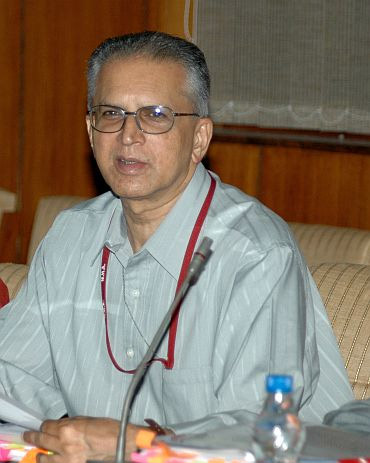
Home Secretary G K Pillai on his tenure

Home Secretary G K Pillai

Sheela Bhatt in New Delhi

Union Home Secretary Gopal Krishna Pillai is retiring on June 30 after 39 years in service. Bureaucrats in India are made of hard stuff but Pillai injected some soft power to the job by making the home ministry accessible to the media, by responding on his cell phone all the time, by giving quotes to television cameras parked outside his office and by implementing policy to the satisfaction of his boss, Home Minister P Chidambaram.

Pillai and his wife Sudha, also an IAS officer now retired and re-inducted into the Planning Commission, were dubbed as the "power couple". What worked for Pillai was his level of confidence in what he was doing. His father and grand-father were also civil servants.

Pillai knew how to approach files and dispense it with efficiency. He was quite clever, like many Indian bureaucrats, in not treading on political landmines. He earned kudos when he was joint secretary in charge of the north-east (1996-2000). He showed sensitivity in his approach and tried to bring the north-east closer to New Delhi.

As commerce secretary his stint got a mixed response. His penchant to fast-track approval for SEZs made many farmers, NGOs and activists unhappy. As commerce secretary his total commitment to the government policy on privatisation and liberalisation in the ministry made him unpopular amongst poor farmers and NGOs fighting for land rights.

However, no one can doubt that the man knew his job and also its potential early in life.

As district collector of Quilon, Kerala (1982-85) he showed his mettle. He helped Kerala's cashew, coir and handlooms industries in a big way.

As his distinguished career comes to an end, in a conversation with rediff.com's Sheela Bhatt, he shared a few thoughts on the socio-economical turbulence that India can't escape, on his boss P Chidambaram's intellectual honesty, on the Maoists unacceptable agenda and the important police reforms that he tried to implement.


'Unless you have well-trained policemen, you have lost half the battle'
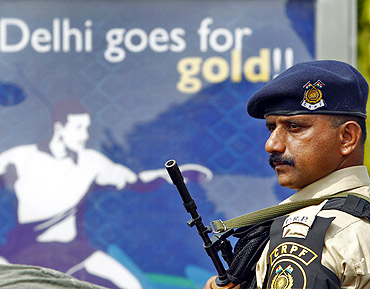
A Central Reserve Police Force trooper stands guard outside the Jawaharlal Nehru Stadium in Delhi

You were a richly-experienced bureaucrat before you became home secretary. What are the new things about India that you learned while sitting on this chair, particularly about India's law and order and internal security situation?

This was a very hectic, very tiring and very challenging assignment. We had our share of troubles, left-wing extremism and getting our act together in terms of shaping policy. I think, the most suffering I have gone through is due to lack of sleep. I think, throughout this assignment I have managed just five hours of sleep daily. I want to catch up on my lost sleep when I retire (laughs).

I think, my assignment has been satisfying. We have managed to put key focus on law and order and we have managed to keep the focus on important police reforms. Primarily, making sure that the recruitment of policemen is made more transparent and merit-based. If recruitment is not proper we will have weak characters remaining in the system. That is something which we have tried to tell our states.

We have tried to augment the capacity of the training system, substantially. Thanks to Vijay Kelkar of the 13th Finance Commission who provided us with Rs 2,200 crore for building up better infrastructure for police training institutions in the states.

We have vastly improved the training institutes of Border Security Force, Central Reserve Police Force, Indo Tibetan Border Police. I believe that unless you have well-trained policemen, you have lost half the battle.

If you look back at the last two years, what is your most important achievement?

You can't quantify. In the home ministry, when you come to office you never know how your day would end unlike the commerce ministry when I knew what and how I will do things in office hours. The developments of the day overshadowed my planning. It can be Gorkhaland, Telangana, the north-east, Maoists or Kashmir.

'We don't have a consensus on how to tackle left-wing extremism'
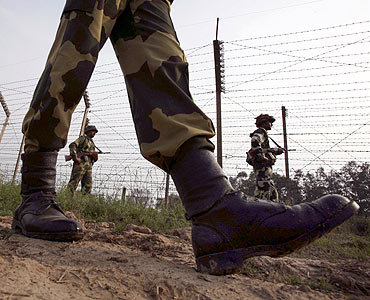
Border Security Force soldiers patrol the fenced border with Pakistan near Jammu

Which was the current affairs issue in which you invested your heart and brain, both?

I would say getting many difficult things through. Like, the merit-based system in police recruitment to which home minister was deeply committed to. I took a personal interest in improving the training of policemen. When the 13th Finance Commission was almost ready to file its report to the government, Kelkar included our request for funds for police training. We went at the last minute and he still incorporated it. In the home ministry we took key decisions within time-limits in spite of many problems.

What are your regrets?

I think, we don't have a consensus on how to tackle left-wing extremism.

We have not been able to get it in order. Not only amongst our political parties, even in the government itself, there is a lack of consensus. There is delay in the National Intelligence Grid and National Counter-Terrorism Centre. The NCTC hasn't yet come up. In fact, the NCTC is in limbo. The NATGRID is approved in principle but it's delayed substantially.

What could you not accomplish in spite of trying hard?

I think the Delhi police bill which I wanted to complete with all the elements of police reforms that we have envisaged. We wanted to make it the model bill for the rest of the country. Now, the draft resolution is ready and has gone to the law ministry.

The issues are resolved and it will take six months more. I would have loved to have done it when I was home secretary. It gives more independence to the police, it involves issues of fixed tenure, better system of recruitment, training and transfers. It has police accountability, community policing etc.

'Chidambaram only wanted results'
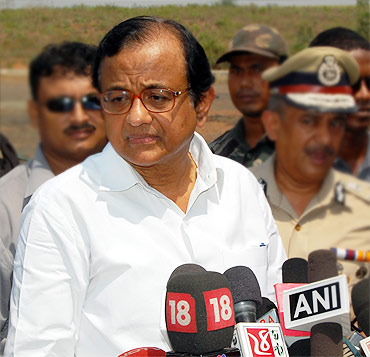
Chidambaram in Lalgarh in West Bengal

How did you find P Chidambaram as your boss? Is he arrogant, as many people allege?

In all my 39 years of service the most intellectually challenging years have been the last two years working with Chidambaram. He is a perfectionist, he wants results. He wants things to be done yesterday. We did so many things.

Chidambaram, in one sense, is the only minister who comes before the media every month and says what he did during the month. All the decisions, like purchases of weapons, setting up of institutions, regional hubs, training courses, he would share. We showed our performance. We put up everything on our website. It's there to check and verify. He provided true leadership and made us work to double our capacity.

Is he arrogant?

I don't think so. He is quite willing.

What's his biggest strength?

His big strength is his intellectual honesty. He is very clear what he wants. He is logical. Once he selects a particular plan, he will stick to it. He gives very clear directions. We all knew what exactly we have to do. There was no confusion at all. This is what you are supposed to do this month; this is what you will be doing next month.

It was a challenge to us.

What you are describing is his management capability to handle bureaucrats. But some ask, does he understand issues from the people's point of view?

I think his objective was very clear. He had come in at difficult times. He wanted results. He didn't care how you do it. He would ask, are you performing or not performing? That's all!

How To Watch 1000 Seasons Of US TV Free

By Nick Broughall

Hulu

What TV looks like in America, where internet services let you watch what you want, when you want. Picture courtesy Hulu  

  • Americans watch loads of telly
  • They watch it free, on computers

IMAGINE a world where you could legally and freely watch any episode of any TV show ever made.

A world where you could stream high-definition movies to your television for a couple of dollars a week, with an almost unlimited selection to choose from.

Customers in the US can almost experience this right now through internet services like Hulu and Netflix.

Hulu offers over 1000 seasons of television programming with more than 29,000 episodes available for free with a few minor advertisements, or $US8 a month for even more content.

Meanwhile, Netflix users pay $US8 a month to stream as many movies as they want as many times as they want.

But thanks to copyright law, anyone living outside of the US is blocked from using these amazing services.

Fortunately, there is a simple way to get around this restriction by using a commonplace technology called VPN.

VPN stands for virtual private network.

It’s most commonly used by businesses to let employees remotely connect to the company network without compromising security.

But it can also be used to convince overseas websites that you are in a country that has access to its services.

Here’s how it works: you set up your computer with either a free or paid VPN service and, once activated, point your computer’s browser at the Hulu or Netflix website.

The services you previously couldn’t access will now be available to you. It's as simple as that.

There are, however, a few downsides.

Firstly, VPNs can be slow. If your internet connection isn’t fast enough, you could find streaming video continually stopping to buffer, which would make the whole process more effort than it’s worth.

The second issue is that Hulu and Netflix know all about VPNs, and many popular VPN services are actually blocked by these sites.

Quite often this can be overcome by stopping your VPN and starting again, though.

The third issue is how you get the geo-restricted content onto your television.

Screen-sharing devices like the McTiVia, which bundles VPN software with each $299 purchase, encourage Australians to access Hulu on the big screen, but it's a substantial investment.

The other alternative is good, old-fashioned cables.

NOTE: The legality of using VPNs to access international entertainment services is debatable - copyright campaigners will argue it's illegal, but under Australian parallel import law it's not.

However, using VPNs to access services from Hulu or Netflix definitely contradicts each companies terms of service, although like the conditions attached to iTunes, they aren't necessarily enforceable by law.

So here's our list of the top five VPN Clients:

HotSpot Shield, (free)
Hotspot Shield is one of the most attractive VPN services on the market. It’s free, and it’s incredibly simple to setup. Simply download and install the software, and it will do the rest of the hard work for you.

Hulu does recognise computers using it though, so you might need to try a few times to get it to work for you.
Link to Hotspot Shield

Secret Neo-Nazi Symbols Revealed

Openly Nazi symbols such as the swastika are banned in Germany. Neo-Nazis get...

Peter Jülich

Openly Nazi symbols such as the swastika are banned in Germany. Neo-Nazis get around the law by using secret combinations of letter and numbers such as 14 and 88. A new book, "Das Versteckspiel" ("Hide and Seek"), explains the meaning of such codes. Here, a right-wing extremism with tattoos including the number 14 and the "white power" fist logo.

Very few people know the real meaning of such codes, says Michael Weiss, a...

Marek Peters

Very few people know the real meaning of such codes, says Michael Weiss, a German expert on right-wing extremism who is one of the authors of the brochure. Nordic-style symbols, as seen on the back of this man's jacket and as a tattoo on his arm, are also popular with right-wing extremists.

The number 8 is also a common neo-Nazi symbol. Extremists use it to stand in...

Marek Peters

The number 8 is also a common neo-Nazi symbol. Extremists use it to stand in for the letter H, for Hitler. Here the combination spells out the word "hate." Max H8 is a German streetwear label.

Some neo-Nazis have co-opted imagery previously used by the left-wing. The flag...

Marek Peters

Some neo-Nazis have co-opted imagery previously used by the left-wing. The flag symbols here looks similar to those used by German anti-fascists.

The demonstrator holding the bullhorn is sporting the Black Sun or sunwheel...

Marek Peters

The demonstrator holding the bullhorn is sporting the Black Sun or sunwheel symbol, which is popular with neo-Nazis, on his vest (2006 photo). The man on the right appears to have pieces of adhesive tape on his hoodie, which he could be using to conceal banned symbols.

Here, a right-wing extremist (holding flag) has clearly been inspired by Adolf...

Marek Peters

Here, a right-wing extremist (holding flag) has clearly been inspired by Adolf Hitler's personal look. The man next to him is wearing a T-shirt from the clothing firm Masterrace Europe, whose products are worn by neo-Nazis.

Some neo-Nazis have taken to wearing the kaffiyeh scarf (seen on the right), a...

Marek Peters

Some neo-Nazis have taken to wearing the kaffiyeh scarf (seen on the right), a symbol of Palestinian nationalism, "as a symbol of struggle against Israel," says Weiss.

The ancient symbol of the triskelion is also used by right-wing extremists. The...

Marek Peters

The ancient symbol of the triskelion is also used by right-wing extremists. The clothing label Fred Perry, which made the polo shirt seen here, has long been popular with skinheads of all political persuasions and is worn by some German neo-Nazis. The firm has taken pains to distance itself from the scene.

Neo-Nazis prepare for a demonstration in Dresden in February 2011. "Many of...

dpa

Neo-Nazis prepare for a demonstration in Dresden in February 2011. "Many of these people no longer stand out," says expert Michael Weiss.

Here, a right-wing extremist in Berlin wears a shirt featuring the inscription...

ddp

Here, a right-wing extremist in Berlin wears a shirt featuring the inscription "Frontbann 24," the name of an organization that was banned in 2009. The name is inspired by a Nazi organization that was founded in 1924.

Thor Steinar is one of several German clothing labels associated with neo-Nazis.

Marek Peters

Thor Steinar is one of several German clothing labels associated with neo-Nazis.

Thor Steinar is one of the clothing labels mentioned in the book, which is...

dpa

Thor Steinar is one of the clothing labels mentioned in the book, which is aimed at raising awareness of far-right codes.

One of Thor Steinar's logos is seen in a 2006 photo.

DPA

One of Thor Steinar's logos is seen in a 2006 photo.

Neo-Nazis have been adopting elements of other clothing styles in recent years....

DDP

Neo-Nazis have been adopting elements of other clothing styles in recent years. These right-wing extremists have a very similar look

... to these left-wing demonstrators protesting against a neo-Nazi rally in...

AFP

... to these left-wing demonstrators protesting against a neo-Nazi rally in Dresden.

The shaved-head look remains popular, though. Here, a far-right rally in Berlin...

AFP

The shaved-head look remains popular, though. Here, a far-right rally in Berlin in May 2010.