19 June 2011

3 Burmese Arms Smugglers Arrested in Meghalaya

the Burmese in custody of police

Umiam (Meghalaya), Jun 19
: Three members of a Myanmarese arms smuggling gang have been arrested in Meghalaya with a huge cache of arms, police said Sunday.

‘Acting on a tip-off, we arrested three persons late last night and seized eight AK-56 rifles and eight magazines from a vehicle at Lad Umroi area,’ Claudia A. Lyngwa, the police chief of Ri-Bhoi district, told IANS.

Lad Umroi area, about 15 Km north of Shillong, the capital of Meghalaya, is located at the trijuction (Shillong, Guwahati and Umri airport)of national highway 40.

The arrested smugglers, identified as Lalchawisanga Zahau, 45, C.L. Hlira, 47, and Lallawmzuala, 34, were travelling with the weapons from Piau village in Mizoram’s Champhai district bordering Myanmar, Lyngwa said.

The trio belongs to the Chin ethnicity of Myanmar, he added.

‘The weapons were hidden in a secret compartment under the seats of a Gypsy which the trio was travelling in, from Mizoram, believed to be meant for the outlawed ULFA (United Liberation Front of Asom),’ Lyngwa said.

Efforts are on to find out the actual suppliers and their links with the rebel groups operating in the northeastern states, she said.

India shares a 1,600 km unfenced border with Myanmar, with 404 km being shared by Mizoram.

If Indian intelligence agencies are to be believed, Myanmarese nationals have made Shillong their ‘rendezvous point’ for arms transactions with northeast rebels.

In fact, an intelligence agency had alerted the Meghalaya Police of former ‘captain’ of Chin National Army (CNA), Tialkulhtang, of smuggling arms and ammunition from Mandalay in Myanmar.

‘Tialkulhtang, a known arms smuggler, is in the process of smuggling consignment of arms and ammunition meant for some rebel groups operating in the region,’ an intelligence official told IANS on condition of anonymity.

The porous international borders, thick with forests, along the northeastern states of Assam, Mizoram, Nagaland, Manipur and Tripura have been used by the illegal weapons syndicate to smuggle small and medium arms and ammunition, besides explosives, to northeastern militant groups.

‘These Burmese Mizo (Myanmarese ethnic Chin) have made Shillong as their safe haven taking advantage of tribal Indian Mizos who have settled here,’ said a senior Meghalaya Police officer, requesting anonymity.

‘Many of these militants from Myanmar maintain a good relation with northeast groups and they are getting protection for procurement of arms and ammunition,’ he said.

The officer further added that although it is unclear where the arms and ammunition would land, it is certain that talks are on for a possible transaction in this regard.

Most of the weapons, including AK-47 and AK-56 assault rifles, mortars, 40 mm rocket launchers, pistols, revolvers and grenades come via the Arakans – a mountainous area in Myanmar – from parts of Thailand and Cambodia, he added.

The arms consignments are often routed by sea through the Bay of Bengal to its destination in the Arakan forest in Myanmar, which is across Mizoram, before making their way to rebel groups active in the northeast.

The area is controlled by Arakan insurgent groups opposed to Myanmar’s military junta.

Intelligence officials in the region have confirmed the presence of sophisticated range of weapons with militant groups in the northeast, including surface-to-air missiles.

Meet Sashi Naidoo, Voted The World's Sexiest Woman By FHM South Africa

Indian connection

Indian connection: South African model of Indian origin Sashi Naidoo, voted the world's sexiest woman of 2011 by 1.5 million readers of FHM South Africa, lives by the Gandhian motto - "Be the change you want to see in the world."

Naidoo, 30, heads the list of the 100 sexiest women in the world in the special July supplement of the South African edition of FHM.

The model said she approached everything she did "with love, discipline and focus, in her interpretation of Gandhi's famous words."

Although the title opens up new opportunities for the uber sexy model, who has already been dominating magazine pages for a decade already, Naidoo is determined to use it for the betterment of her charges at the company she heads - Alushi Model Management.

Conceding that she was "bowled over" when told of her latest accolade, Naidoo said her career success as a model had come after she went through high school with braces and teenage acne that left her as "the last girl to be asked to the matric dance."

Lauding Naidoo's win against stiff competition from beauties across the globe, including the likes of Angelina Jolie and pop singer Christina Aguilera, FHM Editor Hagen Engler said she deserved the title.

"Naidoo is everything a man could wish for in a woman gorgeous, vivacious, funny and exciting to be around," says FHM Editor Hagen Engler.

But despite being the dream of millions of men worldwide, Naidoo said her husband Marc Sandler was "rather blase" about her new title. "He said he didn't need anybody to tell him how beautiful I was!"

Naidoo also admitted that competing with the 18-year-olds in her agency was becoming more difficult.

"There comes a time when you have to hang up the bikini and I'm definitely reaching it. I'm not going to try to be sexy forever," a practical Naidoo said.

These Burmese Women in Delhi Step In As Changemakers

(June 20 is World Refugee Day)

By Madhulika Sonkar

iamburmesewomenindiaNew Delhi, Jun 20 :
Once dilapidated and dormant, flat number WZ-21 in west Delhi's semi-urban Budella area is now abuzz with activity.

The two-room accomodation serves as the office of the Burmese Women Delhi (BWD), where scores of women listen with rapt attention to a 20-year-old woman who speaks on topics as diverse as women's rights and personality development.

Meet Roisang, an ethnic Chin Burmese, who came to India in 2007 with the dream and determination of changing lives of hundreds of refugee women who have made the national capital their home away from home.

"When I came here, I realised that the women go through exploitation, restrict themselves in houses throughout the day, and carry the emotional baggage of being a refugee," Roisang told IANS.

With little formal education from her country, Roisang shuttles between her studies in the capital and the BWD office, where she also teaches English to the local Burmese women as they are not well conversant in either English or Hindi.

"I volunteered with the BWD, that was primarily meant to address the issues related to women. Burmese women also feel comfortable when they approach us," Roisang added.

Roisang is accompanied by two young Burmese women Saumte and Chhery, all now working to hold sessions on human rights, women's rights, violence against women, vocational training and asylum seekers from the United Nations High Commission for Refugees (UNHCR).

According to the UNHCR, around 3,700 refugees were given identity cards as asylum-seekers in 2010, while over 4,500 refugees are still on the waiting list.

The team runs the centre with the help of two computers and furniture that came as part of funds, with a portrait of Myanmar's pro-democracy leader Aung San Suu Kyi gracing the wall.

Home to over 8,000 Myanmarese refugees, Delhi has several ethnic populations, including the Chin, Arakanese, Kachin and Shan communities. They primarily live in Vikaspuri, Uttam Nagar, Asalatpur and Janakpuri areas of the capital.

The men in the community get jobs in factories and other places, while the women remain in the houses to take care of children and manage household chores.

Amid unhygienic conditions, poverty, lack of access to health facilities, stifling language barriers, and the worst problem in the form of discrimination that the Burmese population here battle on a daily basis, BWD assists women on all rights-based issues.

"Ever since we were formed in 2006, we were determined to reach out to the grassroots women population that hesitated to confide with the government authorities on their problems," Saumte, who came to Delhi in 2005, told IANS.

The BWD holds monthly interactive meetings, counsels victims of sexual harrassment, guides them on legal aid, conducts workshops on women living in countries under military rule and also engages with Indian women groups.

"The chance to speak freely and to practice their religion openly in India is welcomed, yet many Burmese refugees continue to suffer discrimination in areas of employment, food, healthcare, housing, and education," explained Roisang, who confessed to having "learnt ways of living in Delhi".

The women do not know the future of Burma that has been under military rule for the last so many years, but they are hopeful that the fate of the poverty-ridden Burmese women living in the capital will change.

"To think that the political situation will change is maybe too hopeful. But the fate of Burma lies in the hands of young people who are here in New Delhi," Chhery, a 29-year-old member of the BWD group, told IANS.

"We just want to make the women feel aware and responsible," she said.

(Madhulika Sonkar can be contacted at madhulika.s@ians.in)

SlutWalk in Delhi is 'Besharmi Morcha'

slutwalk_60

SlutWalk in Delhi will be called 'Besharmi Morcha'

THE SLUTWALK will be Indianised, now. The desi version of the walk will now be called 'SlutWalk 2011 arthart Besharmi Morcha'. 19-year-old Umang Sabharwal, who is organising the walk in Delhi, told MAIL TODAY that the name had been changed to make the SlutWalk- event more inclusive.

THE @#$%WALK will be Indianised, now. The desi version of the walk will now be called '@#$%Walk 2011 arthart Besharmi Morcha'. 19-year-old Umang Sabharwal, who is organising the walk in Delhi, told MAIL TODAY that the name had been changed to make the @#$%Walk- event more inclusive.

"We changed the name after a group meeting. Not all people in Delhi will understand the meaning of '@#$%'. So after a lot of debate and discussion, we have finally zeroed in on Besharmi Morcha . This way, more people in India will understand the real concept,” Sabharwal, a student of Kamla Nehru College, said.

"We changed the name after a group meeting. Not all people in Delhi will understand the meaning of '@#$%'. So after a lot of debate and discussion, we have finally zeroed in on Besharmi Morcha . This way, more people in India will understand the real concept,” Sabharwal, a student of Kamla Nehru College, said.

The walk, which was originally scheduled for June 25, has been postponed to the last week of July.

The walk, which was originally scheduled for June 25, has been postponed to the last week of July.

"We are yet to finalise the date and the venue,” Sabharwal said. The organisers are expecting more participation as the colleges will re-open by the end of July.

"We are yet to finalise the date and the venue,” Sabharwal said. The organisers are expecting more participation as the colleges will re-open by the end of July.

The Facebook page for the event — @#$% WALK DELHI — will soon be updated with the new name and the exact date of the event. Till now, about 17,000 people have confirmed their participation. 

The Facebook page for the event — @#$% WALK DELHI — will soon be updated with the new name and the exact date of the event. Till now, about 17,000 people have confirmed their participation.

This walk, the organisers hope, can bring about a change in the patriarchal mindset of the people in Delhi.

This walk, the organisers hope, can bring about a change in the patriarchal mindset of the people in Delhi.

The @#$%Walk was originally started by a group of women in Toronto in reaction to a Toronto Police-constable’s statement: "Women should avoid dressing like @#$%s in order not to be victimised.” The movement spread like wildfire to the rest of the world and now Delhi is gearing up for the same.

The @#$%Walk was originally started by a group of women in Toronto in reaction to a Toronto Police-constable’s statement: "Women should avoid dressing like @#$%s in order not to be victimised.” The movement spread like wildfire to the rest of the world and now Delhi is gearing up for the same.

Snake Trade: How China Mints Money

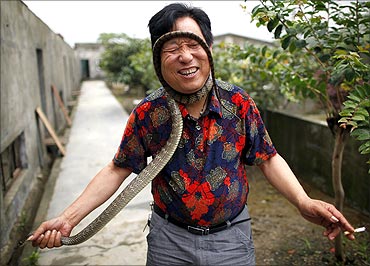
Yang Hongchang, owner of  a snake rearing company holds  a snake at a snake farm in Zisiqiao village.

Image: Yang Hongchang, owner of a snake rearing company holds a snake at a snake farm in Zisiqiao village.
Photographs: Aly Song/Reuters.

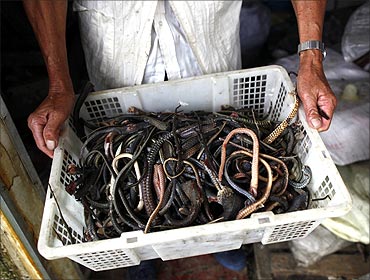
The Chinese love snakes and they mint a ton of money in snake trade. Their love for reptiles has grown so much that many species of snakes are facing extinction in China. Snakes have been used for food and medicine for centuries here.

Thousands of tonnes of snakes are sold in restaurants across China.

Residents of Zisiqiao Village, also known as the snake town, raise over 3 million snakes a year for food and medicinal puroposes.

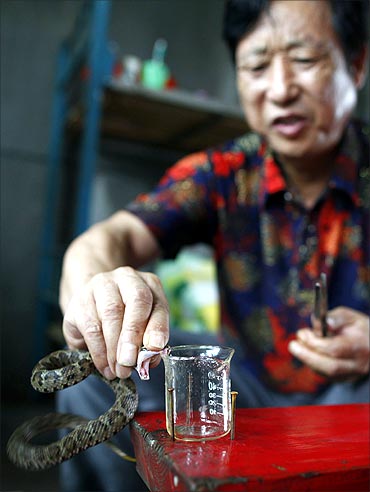
Yang Hongchang, boss of the snake rearing company extracts venom from a snake.
Image: Yang Hongchang, boss of the snake rearing company extracts venom from a snake.
Photographs: Aly Song/Reuters.

Vipers and cobras are the most-wanted after as their venom is highly sought after for Chinese medicine. More than 700 different types of snake products are found in Chinese markets.

"The global trade in snakes is an industry of considerable socio-economic importance for rural populations in several Asian countries," says John Scanlon, Secretary-General of the Convention on International Trade in Endangered Species of Wild Fauna and Flora (CITES).

CITES is the main international tool to regulate effectively international snake trade in many of these species.

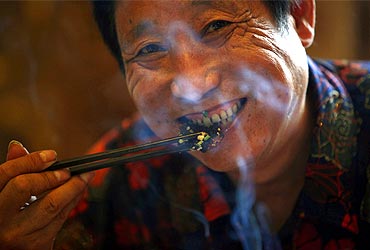
Yang Hongchang, boss of  a snake rearing company eats a snake at a restaurant in Zisiqiao village.

Snakes are also sold as pets. Their skin is used in expensive luxury leather goods and accessories.

Many wild snakes are traded internationally for the production of traditional medicine, leather and other products.

The wildlife protection laws are not enforced in most parts of the country, endangering several species of reptiles.

Yang Hongchang, boss of  the snake rearing company holds snakes at the snake farm in Zisiqiao.

Image: Yang Hongchang, boss of the snake rearing company holds snakes at the snake farm in Zisiqiao.
Photographs: Aly Song/Reuters.

According to a wildlife trade policy review conducted in Vietnam, the income from snake breeding is three to five times higher than the income generated by vegetable and crop cultivation, and several dozen times higher than the income from pig and cattle breeding.

A snake farm in Zisiqiao village.

Image: A snake farm in Zisiqiao village.
Photographs: Aly Song/Reuters.

"The harvesting of snakes, and in some cases the initial processing of their skins and other body parts, contributes important revenue to local communities in China and neighbouring countries," Su Chunyu, Executive Director General of the CITES Management Authority of China, explains.

"The Chinese government pays great attention to achieving a harmonious balance between conservation and sustainable use of Asian snakes," he added.

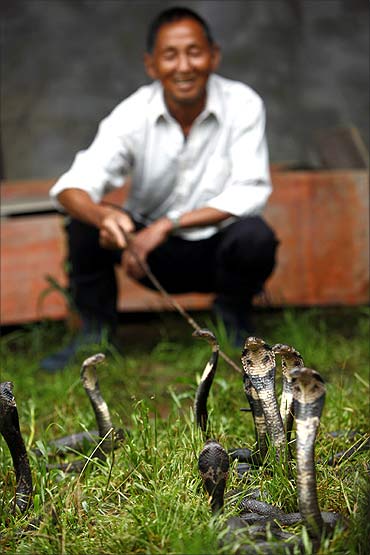
A resident squats next to cobras at a snake farm in Zisiqiao village.

Image: A resident squats next to cobras at a snake farm in Zisiqiao village.
Photographs: Aly Song/Reuters.

Asia's snakes have reared in large numbers for the skin trade since the early part of the 20th century.

A resident holds tails of snakes at a snake farm in Zisiqiao village.

Image: A resident holds tails of snakes at a snake farm in Zisiqiao village.
Photographs: Aly Song/Reuters.

Snakes play a vital role within their ecosystems.

If snakes disappear from the rice fields or other crop-producing landscapes of Asia, their prey (rodents) could have devastating effects on agricultural production, food security and national economies, according to a CITES release.

‘Hockey is Dying in Manipur’

By B Shrikant

Hockey in Manipur

Bhopal, Jun 19
: The Manipur team left Bhopal after their league match in the Senior National Hockey Championship on June 16. It will reach Imphal sometime on June 21. But if things remain as they are at the national level, players from Manipur will soon not take this much effort for hockey, says Olympian Thoiba Singh, the left-out who was known as “Maradona of Hockey” for his short stature and lightening fast runs down the flank.

“We take so much trouble to come for tournaments because youngsters see an opportunity to get out of the North-East where there are no job opportunities. But hockey in Manipur is dying because of lack of tournaments at national level,” Thoiba told Hindustan Times on Saturday.

“There was a time in the ‘80s when four of the 11 players in the Indian team were from Manipur. Now there very few of them at the national level,” says Thoiba. The team’s visit to Bhopal and other tournaments was funded by Thoiba himself or some well-wishers as there is proper administrative system in Manipur.

Thoiba was one of the best players to emerge from Manipur and along with Tikken Singh, Neelkamal Singh and Kuldeep Mitai were picked as juniors and made it to the National team.

Women players from Manipur are doing well but Thoiba is worried for the boys who are thirsting for opportunities in the absence of tournaments at junior level.

Thoiba says hockey has no future in Manipur because there are no tournaments at under-16 and 18 level. “Hockey India should start age-group tournaments or we will lose lot of talent from the North-East,” said Thoiba, the pain of a lost generation visible in his eyes.

US Experts To Help ONGC Cap Gas Leak at Tripura Well

tripura gas leakExperts try to cap a gas-bearing well at ONGC ’s Konaban site in Tripura on Saturday. A huge quantity of gas has been gushing out of the well since June 14, and efforts to cap it are under way

Agartala,  Jun 19 : State-owned exploration giant ONGC has sought US experts' help to plug a leaking gas well in western Tripura from which natural gas continued to gush out on Saturday, five days after it was first detected, a top officials said here on Saturday.

"Experts from the US-based Boots and Coots will arrive in Tripura Monday to help the Oil and Natural Gas Corporation (ONGC) experts and engineers to cap the well at Konaban village," ONGC group general manager and head of the Tripura asset K. Satyanarayana told reporters.

"We expect that the gas leakage would be contained within a week," he added.

Boots and Coots have world class expertise in controlling such leaks. "The ONGC has a contract with the US company to provide assistance in the event of gas leakage or oil or exploration related eventualities," Satyanarayana said.

He said experts from Ahmedabad and Mumbai arrived here immediately after the accident and modern machineries from Assam's Shivsagar ONGC complex are being ferried to Tripura.

"There were no immediate hazards due to the outflow of natural gas, though it contained 96 percent methane. We have appealed to the local villagers not to be anxious," Satyanarayana said.
"There would be no environmental harm due to the gas leakage," he added.

According to the official, the ONGC has so far drilled 22 wells in the Konaban area and of them 19 are gas bearing wells.

"There is very little chance of ignition as we are constantly spraying water on the leakage gas," the official added.

After using water cannons to spray chemical mud to cap the leaking well, ONGC experts have now resorted to technical systems.

"The leakage started Tuesday evening when corporation personnel and engineers were engaged in routine maintenance work at the pipelines and gas well," Satyanarayana said.

"The outflow could not be sealed so far due to high pressure of the gas," he said, adding that now the pressure has reduced from 200 kg per square cm to 107 kg per square cm.

Meanwhile, Tripura State Rifles (TSR) troopers guarded the area to prevent entry of people in and around the gas drilling areas in Bishalgarh sub-division.

"We are also closely supervising the situation. At the moment, there is no need to evacuate the villagers residing near the ONGC drilling areas," Bishalgarh Sub-Divisional Magistrate Prashant Kumar Goel said after visiting the site.

18 June 2011

Germany Helping Mizoram Fight Climate Change

climate_change

Aizawl, Jun 18
: A German development bank and the Mizoram government have signed an agreement to raise adaptive capacity of the people against climate changes.

Representatives of the German government-owned development bank, Reconstruction Credit Institute (KfW) signed an agreement with the Mizoram government here today to implement climate change adaptation (CCA) project in the state.

This was a fulfilment of an agreement earlier signed between the KfW and Indian governments DoNER ministry to implement the CCA programme in the five Northeast states of Mizoram, Nagaland, Assam, Tripura and Sikkim.

Before signing the minutes of meeting, a KfW mission team visited various parts of the state for four days and held meetings with officials from various departments and NGOs, official sources said.

The KfW representatives, who signed the document included technical expert Gunther Haase, project manager Nand Kishore Agrawal, and office director Oskar von Maltzan. On behalf of the Mizoram government, chief secretary Vanhela Pachuau signed the papers at his office in the presence of other senior government officials.

The CCA project will be implemented involving various government agencies, including Mizoram Environment Programme through Economic Development (MEPED) and NGOs, through micro-level planning and execution of livelihood programmes keeping in mind the challenges of climate change. Environment and forest department is made a nodal department. The programme, which is likely to take off by early 2012, is intended to enhance the resilience and adaptive capacity of rural people in Nagaland in the face of climate change and variability, officials said.

The KfW bank has allocated Rs 450 crore for the five states to implement the CCA Project, of which Rs 30 crore each will be received in the first phase.

Permanent farming, water storages, environment protection and soil conservation will be focused in the project which will be implemented in close convergence with the state governments flagship project New Land Use Policy.