12 April 2011

Refugee Repatriation To Mizoram Begins

bru refugees return to mizoramAgartala, Apr 12 : The long-awaited repatriation of tribal refugees from Tripura to neighbouring Mizoram began Tuesday but there is still uncertainty over whether all the migrants here will return home, officials here said.

"A total of 136 tribal families comprising about 755 men, women and children have been sent back Tuesday. By May 14, 800 families involving 4,300 people would be repatriated to their villages in western Mizoram," Kanchanpur Sub-Divisional Magistrate Dilip Chakma told IANS Tuesday.

He said: "A team of Mizoram government officials have been camping in Kanchanpur in north Tripura to take back the refugees. The Tripura government has been providing all logistical support for the purposes."

According to him, the repatriation of the remaining refugees is not yet finalised.

Since October 1997, over 41,000 Reang tribal refugees, locally called Bru, have taken shelter in six camps in north Tripura's Kanchanpur sub-division, adjacent to western Mizoram.

They had fled from their villages after ethnic clashes with the majority Mizos over the killing of a Mizo forest official.

Last month, as many as 17 people, including five children and nine women, were burnt to death March 19 when fire ravaged north Tripura's Naishing Para refugee camp, where over 15,000 tribals have been sheltered for the past 14 years.

More than 20 people suffered burn injuries and over 2,500 huts made of bamboo, weeds and polythene sheets, were reduced to ashes in the camp, some 165 km north of Agartala.

Over 1,400 children were among the affected.

During October-November last year, 523 tribal families comprising 2,610 people were repatriated to their villages in Mizoram.

Hundreds of refugees blocked the Tripura-Mizoram highway, protesting the non-settlement of their eight-point demands, including the signing of a four-partite agreement between the centre, Tripura and Mizoram governments and refugee leaders.

The Mizoram government then suspended the repatriation process.

The home ministry in January broadened the economic package for homebound refugees following mediation by the New Delhi-based rights group Asian Centre for Human Rights (ACHR).

"Apart from Rs.80,000, cash assistance to each refugee family and free rations for one year, the home ministry will support self-employment schemes to be initiated by the Reang tribals," ACHR director Suhas Chakma told IANS on phone from New Delhi

A special development project for the western region of Mizoram, where the Reang refugees are to be resettled, is also under consideration of the state government and the development of north eastern region (DoNER) ministry, Chakma said.

"If the refugees are keen to come to their homeland, the Mizoram government with the help of Tripura administration, would take back the refugees in a phased manner," a Mizoram government official told reporters in Kanchanpur.

The tribal refugees organised protest rallies recently to express their distress over Mizoram's apathetic attitude towards taking back the migrants.

They also sent a memorandum to Prime Minister Manmohan Singh demanding early solution to the issue.

Five People Die Of Indian Tick Typhus in Mizoram

Indian Tick TyphusAizawl, Apr 12 : The cause of the mysterious death of five people in a remote Thanzamasora hamlet in southern Mizoram last month was not malaria, as had been reported earlier, the state health department said today.

Health officials, during a meeting of Anti Malaria Month Advocacy here, clarified that the cause of the mysterious death was Indian tick typhus, a very rare disease, and not celebral malaria as stated earlier. The officials said that malaria, considered to be the biggest killer disease in Mizoram, has claimed ''only'' two lives during this year.

Dr C Lalthanmawia, director of health services, in his power point presentation on the scenario of malaria in Mizoram, highlighted that of the 17,002 blood samples collected during this year, 805 were found to be malaria positive. Of these, 768 were malaria pf. He said Mizoram has witnessed a fall in the number of malaria-related deaths in 2010 with only 31 people succumbing to the killer disease, as compared to 199 in 2009 and 99 in 2008.

According to the record of State Vector-Borne Diseases Control Programme (SVBDCP) of the 322,929 blood samples tested during last year 15,130 were found to be positive with malaria, of which 14,189 were malaria pf, more deadly than malaria pv. As many as 15,099 malaria patients were cured.

As many as 9399 people were tested positive for malaria, of which 7387 were malaria pf, during the year 2009. Of these 119 people died, the record said.

Among the eight districts of Mizoram, Lunglei district in southern Mizoram topped with 11 malarial deaths in 2010 and Champhai district bordering Myanmar did not have any death due to malaria, the record said.

According to the death investigation report of the health department, most of the malarial deaths happened due to negligence on the parts of the patients that led to delayed treatment.

"In 2009, malaria patients were on an average four days late when they took treatment. In 2010, they were on an average two days late. There was a sign of improvement due to extensive health awareness campaign through the media," officials said.

The health department has set up FTD/ASHA in all towns and villages to help malaria patients get treatment on time.

Wildlife Hunting On in Arunachal

arunachal wildlife huntingItanagar, Apr 12 : Hunting of wild animals continues unabated in Arunachal despite constant campaigns against animal killing by several organisations and leaders.

Since time immemorial, hunting has been a traditional practice of indigenous people in the State. The message of Chief Minister Dorjee Khandu, who has voiced concern over the rampant killing of animals, has had little meaning to the villagers who hunt seasonally as part of their traditions.

“The so-called traditional and seasonal hunting practices in the village level on the pretext of cultural rituals have been the impediments for the department to act effectively,” Principal Chief Conservator of Forests (PCCF) BS Sajwan said.

He, however, admitted that since tribals were dependant on animals and forest resources for their sustainability, their traditional rights could not be curtailed. “Nevertheless, the attitude and approach of villagers can be changed through massive awareness campaign in villages and in schools with the help of the media.”

“Students and panchayat leaders need to be involved in the awareness campaign to disseminate the importance of wildlife in conservation of the ecology,” Sajwan said.

Admitting lapses in the functioning of the department, he said, “We have directed the department’s enforcement wing to be more vigilant and conduct surprise checking and regular raids in all markets within and outside the capital to control illegal sale of wildlife meat.”

He asked the deputy commissioners of all districts to make efforts towards preventing hunting and take extra care while issuing gun licences.

Deputy Conservator of Forest P Ringu said the modern hunting technique was more dangerous than traditional and it inflicted larger threat to the existence of wildlife. “In traditional hunting, villagers follow conventional methods by using bow and arrow, but in the so-called modern hunting, modern weapons are being used,” Ringu said.

“The present situation can only be stopped and checked if buyers and poachers are punished equally,” he added.

11 April 2011

Mizo 'Tiger Head Dance' Wins Accolades in Delhi

photo_indira-gandhi-national-centre-for-the-artsAizawl, Apr 12 : The denizens of New Delhi heaped praises after seeing the rare performance of 'Sakei Lu Lam' or tiger head dance, a ritualistic dance of ancient Mizos, at the open air auditorium of the Indira Gandhi National Centre of Arts (IGNCA), Rajendra Prasad Road in New Delhi last week.

The cultural performance was part of the first North-East Indian Indigenous theatre festival workshop being held from April 2 to April 10 under the sponsorship of the IGNCA where 14 plays from the eight Northeastern states staged.

Two teams had represented Mizoram at the theatre festival.

The performance of the rare Mizo ritualistic dance by 25 actors and actresses of Mizoram Theatrical Guild (Khiangte Group, Mizoram-II) on the inaugural day of the festival took centre stage and drew the attention of a huge audience.

The 45-minute play, directed by the noted scholar Dr Laltluangliana Khiangte, depicted a warrior or hunter, who had killed a tiger, donning woman’s clothes to appease the spirit of the slain tiger.

The play was highly appreciated and the organisers requested the troupe to replay it on April 4, which, however, was declined due to the troupe’s scheduled programme.

''Among the participants, we were the only one requested to re-stage the play,'' the team’s director said.

''We had to decline the request due to pre-scheduled engagement of the team members to return from the capital city in the same evening,'' he added.

On March 24, the MTG had performed the play at the Kalakshetra open air stage of Guwahati, in the North East chapter of the festival of indigenous drama.

Bru Families' Repatriation To Mizoram To Resume

Suhas Chakma Asian Centre for Human RightsNew Delhi, Apr 11 : The Asian Centre for Human Rights (ACHR) on Monday said that a total of 142 Bru families consisting of 747 persons, including 592 adults and 155 minors, will be repatriated to Mizoram tomorrow.

The families will be repatriated from Naisingpara relief camp in Kanchanpuri subdivision of Tripura.

They will be resettled in five villages in Mizoram's Mamit district - 49 families at Damdial, 33 families at Khanthuam, 16 families at Bawngva, 22 families at Damparengpui and 22 families at Tuipuibari.

These returnee families were drawn from the families who were affected by the March 19 fire at the Naisingpara camp.

Over 17,000 Brus were displaced in the fire, while 17 persons were charred to death.

The repatriation of Brus, who sought shelter in Tripura in 1997, was suspended in November 2010 following a protest by the Mizoram Bru Displaced Peoples Forum.

Earlier, on 29 December 2010, ACHR Director Suhas Chakma had facilitated a dialogue between the pro and anti-repatriation factions of the displaced Brus who signed the Kanchapur Agreement.

The repatriation is taking place based on the written guarantees provided by the Home Ministry on January 5.

There are about 30,000 remaining Bru IDPs in the camps.

"The resumption of repatriation of the Bru IDPs who have been living in miserable conditions in relief camps in Tripura for 13 years is welcome. However, the Ministry of Home Affairs and the government of Mizoram must ensure that these returnee Brus are immediately resettled at the villages identified," Chakma said.

"A large number of previous returnees still living in makeshift camps in Mizoram following their return is not helping the repatriation process," he added.

Now, Check Your Income Tax Refund Status Online

By Ramya Ramachandran

Income Tax Refund

You have filed your income tax returns for the year and are eagerly awaiting your refund. Very often this wait could get quite painful. Weeks pass by, and tax payers are seldom aware of the status of their ITR, and as to when their refund would be sent to them.

To solve such concerns, the Income Tax department has introduced online availability of information regarding one's tax refund. With the click of a mouse, you could now check the status of your income tax refund online.

It is a quick, easy and safe way to know the status. Here is how you go about it.

The Refund Banker Scheme

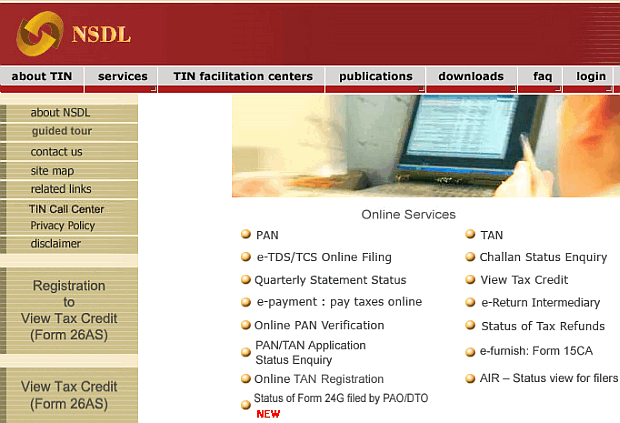
Titled the Refund Banker Scheme, the TIN-NSDL web site provides income tax refund status from assessment year 1998-99 to 2010-11.

Currently this scheme is restricted to non-corporate tax assessees in Delhi, Mumbai, Kolkata, Chennai, Bangalore, Bhubaneswar, Ahmadabad, Hyderabad, Pune, Patna, Cochin, Trivandrum, Chandigarh, Allahabad, and Kanpur, but should be extended to other cities soon.

The whole refund process would be handled by State Bank of India.

Checking your refund status online

Here is how you go about it.

  • Log in to the NSDL web site https://tin.tin.nsdl.com/oltas/refundstatuslogin.html
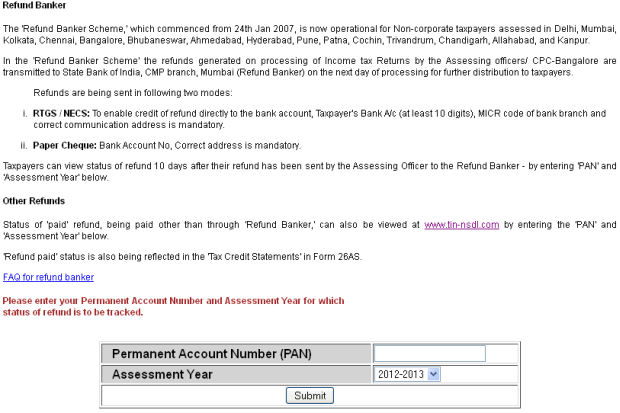
  • Enter your Permanent Account Number (PAN) in the available box. Choose the assessment year for which you desire to know the status and then click on submit. The NSDL web site is a secure web site, so one need not worry while entering sensitive information.
  • If your refund has already been sent to the refund banker, that is, to State Bank of India, the display would be something similar to the below image. State Bank of India transfers refunds to tax payers either through ECS, or by way of a cheque.

Remember: The status of the refund would be available for tax payers, only 10 days after the refund has been sent by the Assessing Officer to the refund banker.

Modes of income tax refund payment

Under the Refund Banker Scheme, there are two options to receive the income tax refund, either by way of ECS or through post.

For all ECS mode of payment, refund would be directly credited into the bank account. Thus, it is vital to provide accurate details of bank account number, bank name, branch, IFSC and MICR code, at the time of filing IT returns.

If such details are not provided with accurately, a cheque would be sent by State Bank of India.

What do I do if I do not receive the tax refund?

If you haven't received your tax refund, within a maximum of one year from the date of filing the tax return, you could visit the tax department's office for the follow up of the refund, or send a grievance letter addressed to the concerned Income Tax Assessing Officer, with the copy of the tax return acknowledgement.

For severe delays, a letter could be addressed to the Jurisdictional Chief Commissioner of the Income Tax, with a copy to the Grievance Cell and the concerned Income Tax Officer. Attach copies of any previous letters which may have been written to the Income Tax Assessing Officer, along with a copy of the tax return filed.

Keep in mind...

  • Refund status can be viewed only if you have received an acknowledgement from the IT department of having received the ITR form.
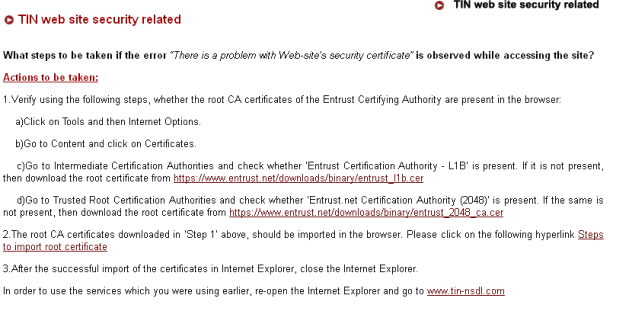
  • Before logging in with your PAN details, check if you are using the secure NSDL web site. The NSDL web site is encrypted and authenticated by Entrust.net.
  • Check for this secure sign before logging in. You are also recommended to close the browser immediately after you finish checking your tax refund status.

 
Source: Investmentyogi.com is a one-stop personal finance website which helps in managing finances, investments and taxes through services like financial planning, online tax filing, budgeting and 'Ask the Expert'.

Get Your MAH-MBA, MMS-CET 2011 Results: Get Them Here

dte-logoThe long wait for students who appeared for the Maharashtra CET exams (MAH-MBA/MMS-CET 2011) held on February 27, 2011 is finally over.

Directorate of Technical Education, Maharashtra, the institution that conducts CET exams in Maharashtra, has declared the MBA Common Entrance Test 2011 results and the same is now available on their web site at http://www.dte.org.in/mba/StaticPages/Default.aspx.

Students who had appeared for the exam this February can get their results by simply providing their Application ID (a six-digit number provided by Directorate of Technical Education, Maharashtra) and their roll numbers (also provided by Directorate of Technical Education, Maharashtra).

The same web site has also posted a detailed analyses of MAH-MBA/MMS-CET 2011 and is available at http://www.dte.org.in/mba/downloads/ResultAnalsysisMBA2011ForWeb.pdf.

As per the statistics provided here a total number of 92,166 students applied for this competitive exam while the students who actually appeared stood at 89,620.

Interestingly, the maximum marks scored out of 200 were at 172 and as many as 2,804 students scored marks less than 30 according to this analysis.

The servers hosting the MBA CET 2011 results are responding very slowly as a result of huge traffic directed towards the web site ever since the results were posted on the official web site since 5 pm today.

Women Hurdle Health Challenges to Save Manipur

By Anjulika Thingnam

manipur women in health campConflict has marked life in India's northeastern state of Manipur for over six decades now. It has affected the lives of people, especially women in many direct and indirect ways.

This is a region where even something as basic as clean drinking water is scarce. In many areas, people use either pond water or river water, neither of which is free from contamination. There has also been a substantial increase in malaria cases in the state, which rose from 708 in 2008 to 1,069 in 2009, an increase of 51 per cent.

Tuberculosis used to be a general problem, so it is not surprising that in a state with a significant number of people living with HIV/AIDS, HIV-TB co-infection is also manifesting itself.

According to Dr. M. Akshayakumar Singh, head of the Department of Clinical Psychology at the Regional Institute of Medical Sciences (RIMS) in state capital Imphal, social tensions and violence related to the ongoing armed conflict are affecting the average person both mentally and physically.

"Fear, anxiety, tension, stress and depression are the most prominent effects seen. It manifested physiologically as palpitations, ulcers, colitis, irregular bowel movements, dizziness, headache, backache and many other social diseases such as diabetes," he says.

Those on the frontlines of the struggle for justice in this violence-prone region have lived with deteriorating health for years. Take the Meira Paibis "torchbearers," a women's group that has a presence in almost all the nine districts of the state. The group has been actively engaged in fighting rights violations, whether perpetrated by local people or by security personnel.

Phanjoubam Sakhi, one of the pioneering leaders of the Meira Paibis, has worked tirelessly for almost as long as armed conflict had raged in her state, even though she is 75.

"At night I would open the cupboard as casually as possible, stealthily take out the clothes I would wear the next day and keep them by my pillow, to stop my husband from suspecting that I was about to set out early the next morning on Meira Paibi work. On my return, I would peek at the house from the gate and sneak in when he is not around," Sakhi recalls with an impish smile.

The years of work she has put in have earned her the epithet of Ima. But being called and honoured as "mother" has come at great personal cost and sacrifice. "

Such lives of uncertainty inevitably took a toll on the health of these women.

"Our circumstances affected our health a lot," says Sakhi, who is presently the president of the All Manipur Kanba Ima Lup (AMKIL), one of the prominent state-wide Meira Paibi organisations.

And it's not just Sakhi. Most Meira Paibi women complain of gastritis, insomnia, dizzy spells, anxiety and fatigue. "During the peak of agitations - which are very frequent - we would go to bed, yet lie awake unable to sleep for hours, thinking what would be the best course of action," Sakhi says, adding humorously, "Sometimes thinking about how to out-manoeuvre the police trying to stop or arrest us."

Their campaigns were by no means easy. Some senior Meira Paibi women even formed a group in support of the Sharmila Kanba Lup (SAKAL), which takes turns in staying overnight in a small lean-to, walled by bamboo mats, on the side of Porompat road in Imphal East district, a few metres away from the state-run JN Hospital where Irom Sharmila is kept under judicial custody and force-fed.

Another woman, Ima L. Gyaneshori, 60, always carries a pack of biscuits in her bag to counter any fluctuations in her sugar levels. She also makes sure that her pills for controlling her blood pressure are always at hand, a precaution that has become essential ever since she actively participated in the relay hunger strike for Sharmila, who has herself been on a decade-long indefinite fast for the repeal of the controversial Armed Forces Special Powers Act (AFSPA), 1958.

Dizziness and back pain also plague Ima Soibam Momon, 67, president of the All Manipur Tammi Chingmi Apunba Nupi Lup, another prominent Meira Paibi organisation, and she has developed some indigenous healing techniques to overcome them.

Agitations and protest movements have become everyday occurrences in Manipur given the high levels of violence. According to media reports, as many as 235 people were killed in the ongoing conflict between January and April 2009 alone.

And sometimes the years of pent-up tension, frustration and fury have found their manifestation in raw emotion. The nude protest of 12 Meira Paibi women in 2004, against the extra-judicial killing and rape of a young woman, Thangjam Manorama, alleged to be a member of an underground outfit by the Assam Rifles personnel, was one such moment.

The impact of conflict on the health of peace builders and human rights activists is rarely highlighted, much less understood. But its effects run deep nevertheless, as the words of Manipur's indomitable women activists prove.

Womens Feature Service covers developmental, political, social and economic issues in India and around the globe. To get these articles for your publication, contact WFS at the www.wfsnews.org website.