


By Karen Dias
The Indian government imposed the Armed Forces Special Powers Act in 1980 to deal with the armed rebellion, in what the government calls "a disturbed area".
The Armed Forces Special Powers Act, which is also applied in India-administered Kashmir, gives security forces the power to detain and arrest anybody on mere suspicion, enter and search without warrants. The armed forces are exempt from any investigation or prosecution under the law that many human rights activists dub draconian.
Under this Act, several human rights violations such as fake encounters, torture, sexual abuse and enforced disappearances committed by Indian armed forces have come to light.
Irom Sharmila, a human rights activist based in Manipur, had been fasting for the past 14 years demanding the repeal of this Act, which is arguably one of the longest protest fasts in history.
She was released from a prison hospital in Manipur on August 20 where doctors had force fed her to keep her alive. She was charged with the attempt to commit suicide, which is a crime under Indian law.
"It is hard for me to believe that I am free now. My battle against injustice and crimes committed by the army in Manipur will continue," Sharmila told the Reuters news agency on Wednesday.
In 2004, following the rape and murder of a young woman named Thangjam Manorama, widespread protests took place in the northeastern Indian state. Manorama's death triggered a protest by 12 middle-aged women who stripped naked and protested holding up signs saying "Indian Army Rape Us" in the state capital, Imphal, which made international headlines.
In January last year, the Supreme Court appointed a commission to make inquiries into these allegations after a public interest litigation was filed listing 1,528 people as victims of this draconian law. Six cases were pulled up at random and investigated, all of which were found to be fake encounters.
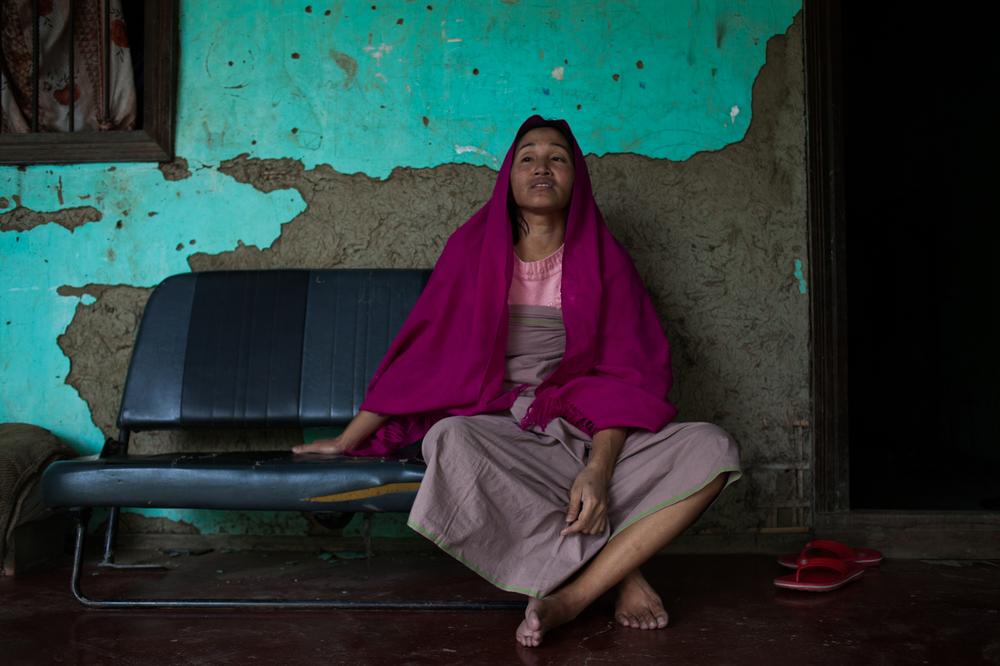 Gangarani
Kongkhang, 38, is a visually-impaired woman whose husband Deban
Kongkhang was killed after a hail of bullets were fired into the van he
was driving, allegedly by the Thoubal District Police Commandos at
Patpan Lamkhai in Imphal. The government vowed to punish the
perpetrators. She was promised a government job and financial
compensation but six years later she has received nothing. She lives on
handouts and takes care of her two children aged seven and 12.
Gangarani
Kongkhang, 38, is a visually-impaired woman whose husband Deban
Kongkhang was killed after a hail of bullets were fired into the van he
was driving, allegedly by the Thoubal District Police Commandos at
Patpan Lamkhai in Imphal. The government vowed to punish the
perpetrators. She was promised a government job and financial
compensation but six years later she has received nothing. She lives on
handouts and takes care of her two children aged seven and 12.
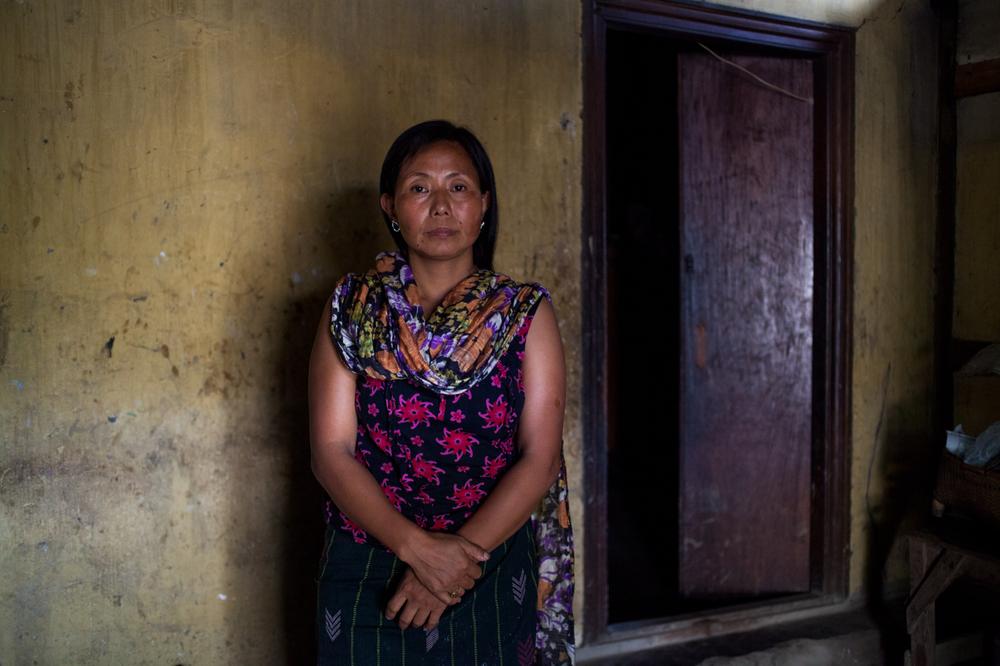 Wangkhem
Chandrakala's husband, Namoijan Lukhoi, was shot by two unidentified
men outside their home on April 21, 2008. She filed a police complaint
but gave up the case because she feared repercussions and worries about
the safety of her four school-going children. "Soon after my husband's
death, I went into depression and began to lose my senses. I would
wander off and find myself in the fields or in the crematorium. My
family members and neighbours had to keep an eye on me," she told Al
Jazeera.
Wangkhem
Chandrakala's husband, Namoijan Lukhoi, was shot by two unidentified
men outside their home on April 21, 2008. She filed a police complaint
but gave up the case because she feared repercussions and worries about
the safety of her four school-going children. "Soon after my husband's
death, I went into depression and began to lose my senses. I would
wander off and find myself in the fields or in the crematorium. My
family members and neighbours had to keep an eye on me," she told Al
Jazeera.
 Irom
Sharmila Chanu, known as "The Iron Lady of Manipur" has been on a
protest fast for last 14 years demanding the repeal of the Armed Forces
Special Powers Act. Here she is pictured in her Security Ward at the
Jawaharlal Nehru Institute of Medical Sciences in Imphal. She was
released on Wednesday.
Irom
Sharmila Chanu, known as "The Iron Lady of Manipur" has been on a
protest fast for last 14 years demanding the repeal of the Armed Forces
Special Powers Act. Here she is pictured in her Security Ward at the
Jawaharlal Nehru Institute of Medical Sciences in Imphal. She was
released on Wednesday.
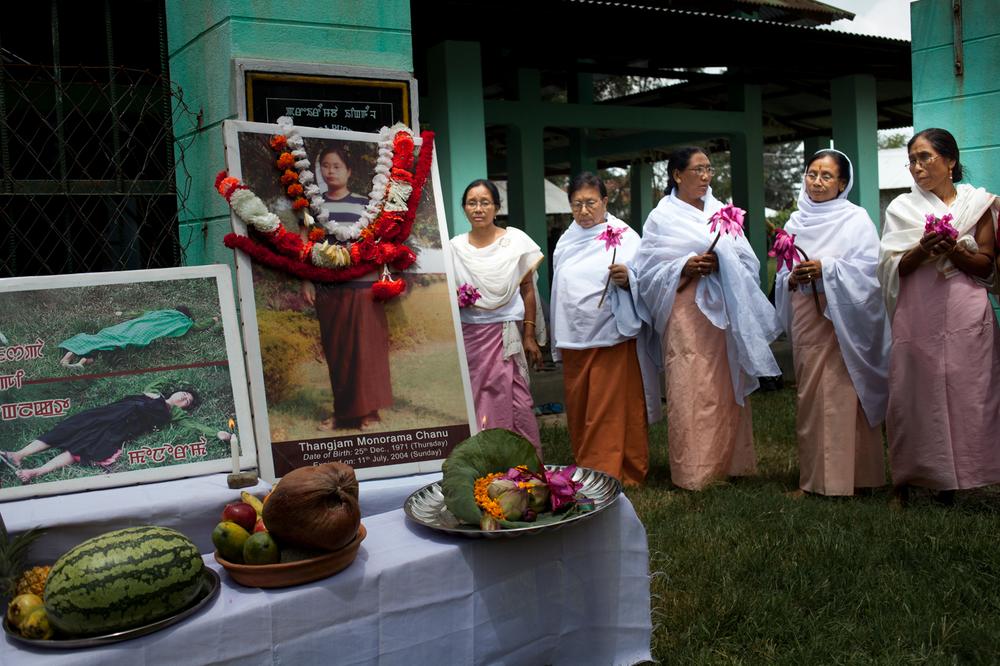 Family
members and local activists attend the memorial service held on the
tenth anniversary of Thangjam Manorama's death on July 10 at Bamon Kampu
Mayai Lekai in Imphal. Manorama was picked up on July 9, 2004 by the
17th Assam Rifles. She was found raped and murdered with bullet wounds
on her genitalia the next day near her home in Ngariyan Maring. Her
death sparked widespread protests in Manipur and other parts of India.
Family
members and local activists attend the memorial service held on the
tenth anniversary of Thangjam Manorama's death on July 10 at Bamon Kampu
Mayai Lekai in Imphal. Manorama was picked up on July 9, 2004 by the
17th Assam Rifles. She was found raped and murdered with bullet wounds
on her genitalia the next day near her home in Ngariyan Maring. Her
death sparked widespread protests in Manipur and other parts of India.
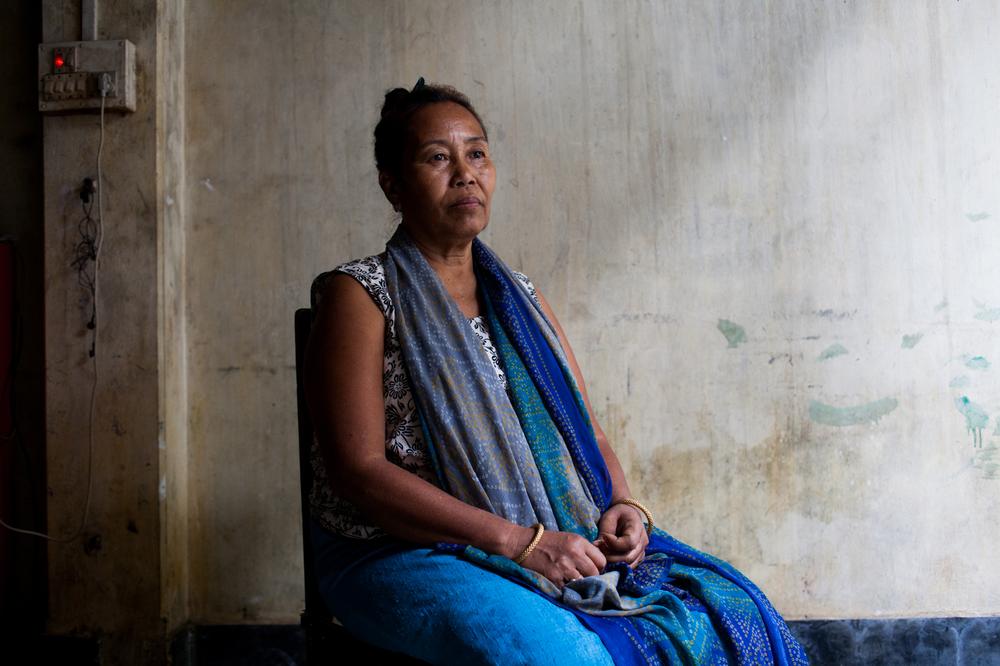 Khumbongmayum
Lata Devi's 20-year-old son Khumbongmayum Orsonjit Singh was killed by
the Manipur Police Commandos on March 16, 2010. His is one of the cases
concluded to be a fake encounter by a commission appointed by the
Supreme Court.
Khumbongmayum
Lata Devi's 20-year-old son Khumbongmayum Orsonjit Singh was killed by
the Manipur Police Commandos on March 16, 2010. His is one of the cases
concluded to be a fake encounter by a commission appointed by the
Supreme Court.
 Irom
Sharmila waits in her ambulance on July 7 as armed guards stand by
outside the Appellate Court in Lamphel. She began her fast on November
2, 2000 when 10 civilians were killed at a bus stop by the Assam Rifles
in the Malom district near Imphal airport.
Irom
Sharmila waits in her ambulance on July 7 as armed guards stand by
outside the Appellate Court in Lamphel. She began her fast on November
2, 2000 when 10 civilians were killed at a bus stop by the Assam Rifles
in the Malom district near Imphal airport.
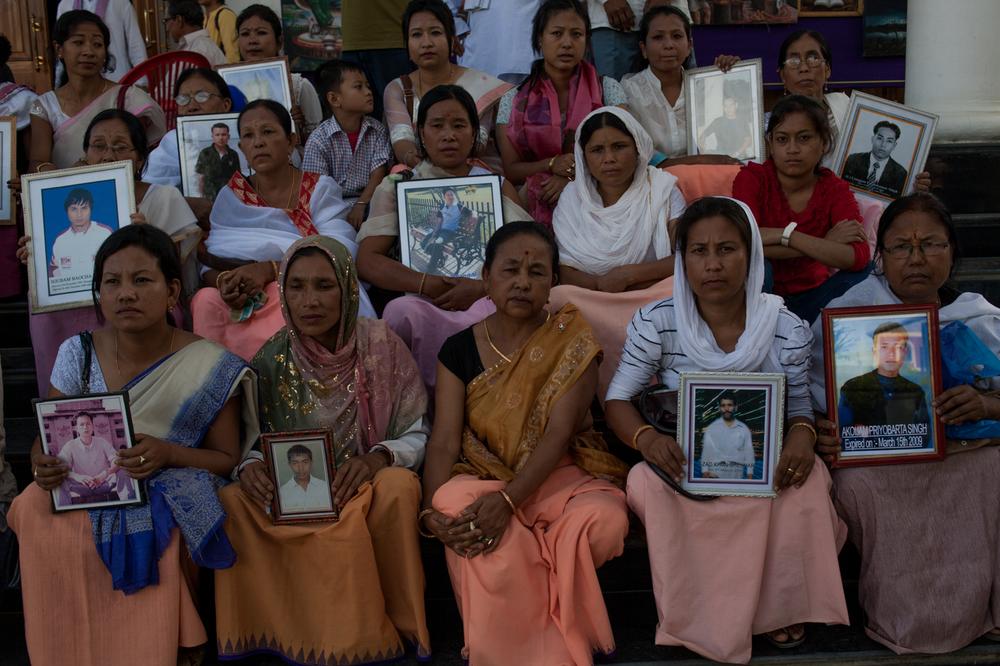 Women
who are part of the Extrajudicial Execution Victims Families
Association of Manipur (EEVFAM) pose for a photograph with portraits of
family members who were killed by armed forces on the fifth anniversary
of EEVFAM in Imphal. EEVFAM provides support and counsels families in
dealing with the loss of their husbands and sons and in dealing with the
stigma of their family members being labeled as underground rebels.
Women
who are part of the Extrajudicial Execution Victims Families
Association of Manipur (EEVFAM) pose for a photograph with portraits of
family members who were killed by armed forces on the fifth anniversary
of EEVFAM in Imphal. EEVFAM provides support and counsels families in
dealing with the loss of their husbands and sons and in dealing with the
stigma of their family members being labeled as underground rebels.
 On
January 24, 2009, Soraishem Joy, 40, was picked up from his home by
Assam Rifles soldiers and was blindfolded and beaten in an open field
and waterboarded at their camp in Patsoi, near Imphal. He was forced to
sign a blank piece of paper and was later thrown in jail for six days
after which he was released because villagers protested and pleaded his
innocence. "If it wasn't for my neighbours and family support, I would
have been a dead body like all those other fake encounter cases. I have
done nothing wrong," he says.
On
January 24, 2009, Soraishem Joy, 40, was picked up from his home by
Assam Rifles soldiers and was blindfolded and beaten in an open field
and waterboarded at their camp in Patsoi, near Imphal. He was forced to
sign a blank piece of paper and was later thrown in jail for six days
after which he was released because villagers protested and pleaded his
innocence. "If it wasn't for my neighbours and family support, I would
have been a dead body like all those other fake encounter cases. I have
done nothing wrong," he says.
 Flowers are placed in front of portraits of men who were victims of extrajudicial killings.
 RK
Surjalata Singh, 50, lost her 26-year-old son Irengbam Roshan on May 8,
2012. He was allegedly shot by the Assam Rifles in the Ukhrul district
in Manipur. Surjalata remembers her son's body at the morgue as having
burn marks from scalding water and bullet wounds suggesting torture
methods were used. Surjalata's younger brother, RK Khogen was also
killed in the 1995 RIMS (Regional Institute of Medical Sciences)
massacre in Imphal when security forces opened fire, killing nine
civilians.
RK
Surjalata Singh, 50, lost her 26-year-old son Irengbam Roshan on May 8,
2012. He was allegedly shot by the Assam Rifles in the Ukhrul district
in Manipur. Surjalata remembers her son's body at the morgue as having
burn marks from scalding water and bullet wounds suggesting torture
methods were used. Surjalata's younger brother, RK Khogen was also
killed in the 1995 RIMS (Regional Institute of Medical Sciences)
massacre in Imphal when security forces opened fire, killing nine
civilians.
 Neena
Ningombam, 33, lost her husband Michael Nongmaithem in 2008. Michael
was accused by the police of being a rebel and was allegedly shot for
trying to escape. After her husband's death, she joined other widows
whose husbands were killed by the Indian Army and started a campaign
against army atrocity. She has two sons, aged six and 12.
Neena
Ningombam, 33, lost her husband Michael Nongmaithem in 2008. Michael
was accused by the police of being a rebel and was allegedly shot for
trying to escape. After her husband's death, she joined other widows
whose husbands were killed by the Indian Army and started a campaign
against army atrocity. She has two sons, aged six and 12.
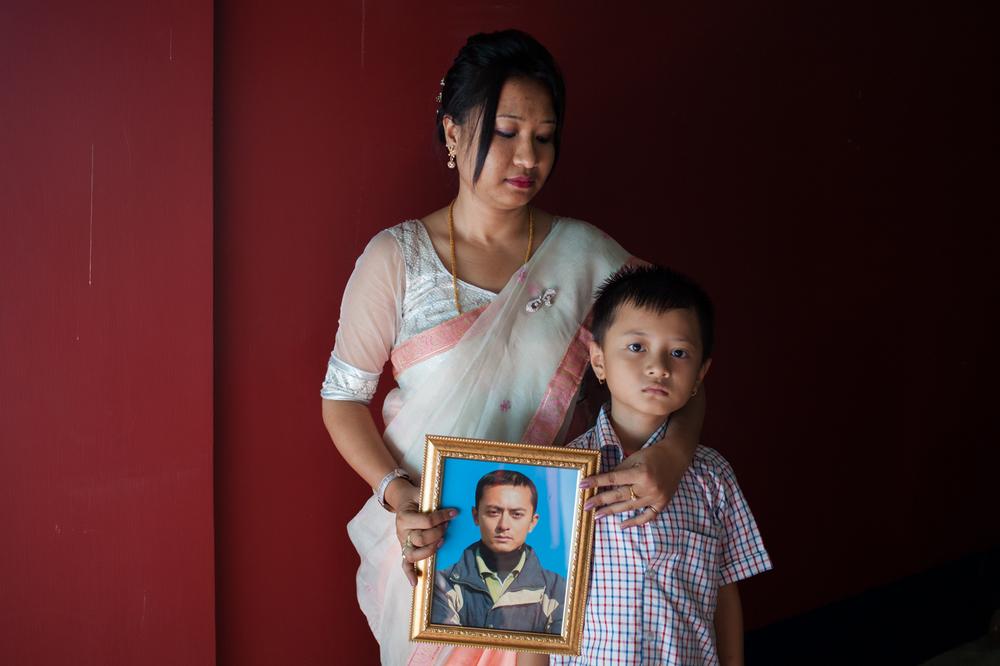 Roni,
30, with her nine-year-old son Mutum Mir. Her husband Mutum Herojit,
38, was killed in an encounter on October 13, 2008. "I want justice for
my husband. No other woman's husband should die in the future. I want to
tell the government that this killing should stop or else Manipur will
become a state of widows," she told Al Jazeera.
Roni,
30, with her nine-year-old son Mutum Mir. Her husband Mutum Herojit,
38, was killed in an encounter on October 13, 2008. "I want justice for
my husband. No other woman's husband should die in the future. I want to
tell the government that this killing should stop or else Manipur will
become a state of widows," she told Al Jazeera.Source: Al Jazeera



0 comments:
Post a Comment