10 August 2015

Meet Dipa Karmakar: From a flat-footed 6-year-old to India's top female gymnast


Fifteen years back when Tripura state gymnastics coach Bishweshwar Nandi took a 6-year-old girl from SAI center under his wing, he knew he'd found a winner. Fast forward to 2015, Nandi is lost for words on how proud he is of his charge, Indian gymnastic star Dipa Karmakar, who won bronze at the recently concluded Asian Championships in Japan.

"I am very proud of what I achieved in Hiroshima," Dipa told Firstpost. "I finished behind two gymnasts [China's Yang Wan and Japan's Sae Miyakawa] both of whom have been very competitive in the Youth Olympics."

The bronze at Hiroshima comes a year after she created history by becoming India's first ever women gymnast to win a Commonwealth medal, when she clinched bronze - again at the Vault table - in the 2014 Glasgow games.

"I still remember Dipa coming to me as a flat-footed kid, which is not good for a gymnast. It affects the spring in her jump," Nandi told Firstpost. "That was the hardest part to fix for Dipa, we had to work very, very hard when she was a little kid to get the curve in her feet."

"Only after coach Nandi corrected my flat foot, my journey began," adds Dipa saying she would be nothing today if not for her coach.

But since then, the desire to work hard has not diminished for the Agartala girl.

"I was so young when I tried gymnastics for the first time. My father was a SAI coach and he wanted me to try it, so I just went along with him. I wasn't really that interested in the beginning," Dipa said. "But in 2007 when I won at the Junior Nationals in Jalpaiguri I started gaining interest."
Then came the turning-point for Dipa. She was part of the 2010 Indian gymnastics contingent in the Delhi Commonwealth Games where, as a participant, she saw Ashish Kumar create history by winning India's first ever gymnastic medals at the games. "That's when I told myself I will win it for India in Glasgow four years down the line," said Dipa.

And so she did it in Glasgow - the same place where she is headed soon for the World Championships that begin in October and is a qualifying event for Rio 2016.

"I am working hard for the Worlds now. That is all my focus in on now It is a very tough event - all the top players will be there. Last time I finished 10th but now I am practising harder with increased difficulty levels. I am hoping to put my best effort and see if I can make it to the Olympics," she said.

As she prepares for the World Championships, Dipa trains from 9 am - 12: 30 pm and 5 - 8:30 pm every day - hoping to improve on her performance in Hiroshima.
The event from where the gymnasts who finish on the podium qualify directly for the Olympics is her toughest challenge yet. As she turns 22 on 9 August, she is growing 'old' by the standards seen in Gymnastics these days. The Gold and Silver medallists in the Hiroshima event were both 15-year-olds. But she doesn't see that as an issue.

"I still feel at the top of my game. There was an Olympian in 2012 who competed with the best when he was 39 years old! I still feel I have 5-6 years left in my game, no problem," she says with confidence. It's because there is still a place for
power gymnastics in international events, explains Nandi.

"Desire, hunger to do well in gymnastics. Dipa has that. She told me once 'Whatever you want me to do, I will not say no to you coach'," and except when she loses her temper with me, she has kept her word," Nandi laughed.

"Yes, I am a bit short-tempered," Dipa agreed with a sheepish grin. "I get angry a lot - some times at the coach when something he tells doesn't work but most times at myself for not doing the routine correctly. (I) Never get angry at my parents but when I am trying my coach is my father and mother, and we have gotten used to it," she adds.

Like with many other not-so-popular sports in India, 58-year-old Nandi said that gymnastics still has a long way to go before there are more like Ashish and Dipa. "Starting late last year, we had no facilities to practice at all for eight full months, because of problems with the federation. All we did was personal training, but without equipment Dipa lost eight months of training time," said Nandi.

"But thankfully, SAI (Sports Authority of India) organised a camp for two months starting June. I can honestly say without that camp Dipa would not have won Bronze in Hiroshima. Despite problems, we are grateful for what help we get from authorities," he said.

Dipa, who says she has been training at the vault table harder than ever, concurred that things have been different since she won the medal at Glasgow.

"Things have changed now. Before Glasgow, Indians hardly knew our women participated in gymnastics. Now they know there is someone who won a medal. Before, no one knew my name. Today, slowly and steadily, more and more people know there is someone called Dipa Karmakar," she said before excusing herself for her second training session of the day.

Discord Over Naga Accord

The Naga Hills
The Naga Hills
PM Modi called it a historic accord, but doubts and political points have been raised over the peace initiative that aims to end India’s oldest insurgency

Khonoma village is barely 20 kilometres from the Nagaland state capital, Kohima, but the drive takes a good hour. The metalled road turns into a bumpy highway before becoming a mud track clinging on hillsides. On the side of the road, standing out amid the lush green, are occasional patches of grey: Memorials to leaders of a parallel government, of a country that struggled for decades to be born. “Nagas are not Indians; their territory is not a part of the Indian Union. We shall defend this unique truth at all costs and always”, says a plaque quoting Khrisanisa Seyie, “first president of the Federal Government of Nagaland”. The memorial was unveiled in 2007. By then, the guns had largely fallen silent in the Naga hills, but the sentiment for freedom from India was still not quite dead.

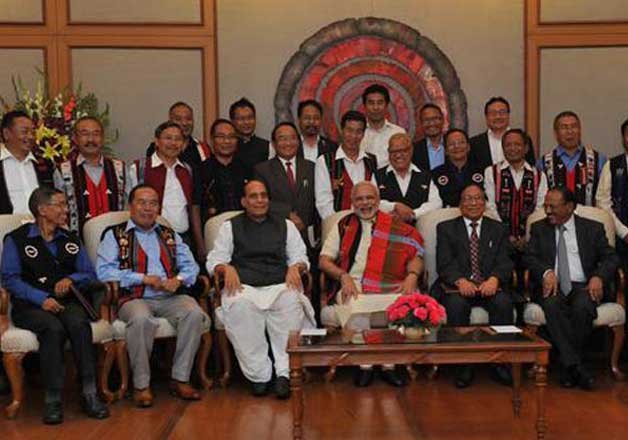
The announcement of a framework Naga Accord on Aug 3 by Prime Minister Narendra Modi and leader of the National Socialist Council of Nagalim (Isak-Muivah) Thuingaleng Muivah is a long, long way from that memorial on the road to Khonoma. A statement signed by Mr Muivah said that, “Better understanding has been arrived at and a framework agreement has been concluded based on the unique history and position of the Nagas and recognising the universal principle that in a democracy, sovereignty lies with the people.”

Prime Minister Narendra Modi described the occasion as “historic”.

The NSCN (I-M) has been the biggest and most powerful insurgent group in the Northeast for most of the last three decades. It was formed in reaction to another accord. In 1975, some underground leaders of the Naga National Council (NNC) signed a peace deal in Shillong. The Shillong Accord had three simple points: The signatories would accept the Constitution of India, lay down arms, and be given “reasonable time to formulate other issues for discussion of a final settlement.” Angami Zapu Phizo, the man from Khonoma who is regarded as the father of the Naga insurgency, was then in exile in London. He was not among the signatories; his brother Kevi Yalley was. Mr Phizo kept a stoic silence on the deal. Mr Muivah and Mr Isak Chishi Swu, the leaders of the NSCN, were then in the NNC at senior ranks. They had gone to China for training and weapons. They saw it as betrayal.

Instead of bringing peace, the Shillong Accord therefore sparked off the next 20 years of conflict.

Not Shillong Accord
This accord is very different from the Shillong Accord. It is not a product of the Emergency, and has the clear support of the most powerful group in the Naga insurgency, a large chunk of Naga civil society, and politicians of all hues. “It is an opportunity for Nagaland and the Northeast to come together and resolve this longest running insurgency,” former Nagaland chief minister and current MP Neiphiu Rio of the Naga People's Front said in a telephonic interview. Mr Rio added that he feels the accord should be given a chance since the problem it aims to solve is not a problem of the Nagas alone, but a national problem. “Even the Nagaland chief minister was not consulted, so question of consulting other chief ministers does not arise,” he said.

A lot of work has gone into creating conditions for the agreement. There is currently no opposition party in the Nagaland Assembly since all parties, from the local unit of the Congress to the local BJP, which has four MLAs, are members of an all-party government. Three of the four BJP MLAs defected from the NCP last year to pave the way for the all-party government. This year, eight MLAs of the Congress including the Nagaland Congress Legislature Party leader Tokheho Yepthomi were suspended by the All India Congress Committee in May for joining the government. In their reply to the show cause notice from AICC, the MLAs cited resolution of the Naga issue as their reason for joining the current Democratic Alliance of Nagaland government led by Chief Minister TR Zeliang.
Mr Rio pointed out that representatives of the joint legislative forum comprising members of all parties had visited Delhi and met Prime Minister Modi and Home Minister Rajnath Singh in July to press for an early resolution of the Naga issue. The Nagaland assembly had earlier passed a unanimous resolution to form the joint forum and press for early resolution of the Naga issue.

Nagaland BJP MLA Mhonlumo Kikon, welcoming the signing of the accord, said it was long-awaited and its signing would further strengthen peace and development. “We hope and expect that every stakeholder who is interested in peace and development of the Northeast region will welcome this and not be blinded by their political colours,” he said.

During the negotiations over the last 17 years, some constitutional issues had crept in and created apprehensions among neighbouring states, Mr Kikon added. “In light of past experience, the government of India in its maturity would have factored this in,” he said.

Details of the accord are still being worked out, which is why no one has been informed of those details yet. Meetings are currently on. The chief interlocutor on the Naga side is VS Atem, who retired as general of the Naga army. Mr Atem declined comment for this article saying he was caught up in meetings. The Indian government’s interlocutor for these talks has been RN Ravi, chairman of the Joint Intelligence Committee. Mr Ravi also did not reply to emails and messages.

Sudden preamble
The accord was announced suddenly on August 3, taking even the Home Ministry by surprise. Speaking to the Nagaland Post that day, Mr Ravi had said the agreement was signed following a request made by NSCN (IM) chairman Isak Swu, who wanted an agreement signed in his lifetime. Mr Swu, 85, was in the ICU in Delhi’s Fortis hospital and said to be critically ill. Mr Atem, on that day, had described the accord as a “framework” and a “preamble”.

This preamble is significant because it clearly lays out that the solution will be achieved peacefully within the Indian constitution. This is planned through some form of shared sovereignty, whose exact terms will be worked out in the following months. It is likely that Naga traditional institutions will be empowered to achieve a form of grassroots democracy.

The matter is an extremely sensitive one and will impact peace throughout the entire Northeast. There is potential for a bloodbath in Manipur if clashes break out.

The Manipur Assembly was burnt down by protesters in 2001 after the Naga ceasefire was extended to Manipur. The Meitei groups saw it as a step towards the redrawing of the state’s borders, which they were not willing to allow.

Reacting to the latest accord, Governor of Assam and Nagaland PB Acharya said in Guwahati, “As per my understanding, as told to me by the prime minister, there will be no territorial changes.”
It is widely expected that a settlement will involve the formation of autonomous district councils or territorial councils of some sort, to create enclaves for the Nagas living in Manipur, Assam and Arunachal Pradesh. Several such councils already exist, including in Manipur’s hill districts. The demand for extension of provisions of the Sixth Schedule of the Constitution (which gives enhanced administrative and judicial powers to autonomous local bodies) to Manipur’s hill districts goes back to 1978. This June, the Union Home Ministry wrote to the Manipur Chief Secretary asking for details of areas to be included under the Sixth Schedule. Assam already has the Bodoland Territorial Council, apart from district councils.

Party politics and perils
“Partisan political criticism does not need to be taken seriously. It is only the final step of the peace process with the NSCN(IM)”, says Ajai Sahni, Executive Director of the independent think-tank Institute for Conflict Management in Delhi. “The UPA government did not take the states into confidence any more than the NDA now has,” he adds. “The UPAs problem is one of sour grapes, because they weren’t able to push the deal to a conclusion within their tenure — though there were many occasions when a settlement was believed to be tantalisingly within reach.” However, Mr Sahni added a note of caution, saying that while the deal is certainly historic, it is not the end of troubles surrounding the Naga issue. This deal is overwhelmingly in favour of the NSCN(IM) and will create a vast space for dissent which other groups, most significantly the NSCN(K) but also others, would try to occupy, he said.

There are at least 35 Naga tribes, and inter-tribal politics is a major thing. Different insurgent factions are typically associated with particular tribes and have their own areas of influence. For instance, SS Khaplang, who heads the NSCN(K), is a Burmese Naga and has influence on that side of the border and among the Konyaks in Nagaland. Mr Swu, the ailing NSCN (IM) chairman, is a member of the Sema tribe, which is one of the largest Naga tribes. If he passes away, the group would have to appoint a new chairman, most probably from the same tribe. There is a good chance that a new appointee may have taken the negotiations back several years in the absence of any agreement being signed during Mr Swu’s lifetime.

All previous governments, from AB Vajpayee’s to Manmohan Singh’s, had conducted discussions through interlocutors without formally sharing details with any chief ministers of neighbouring states. Swaraj Kaushal, husband of Sushma Swaraj, was the first interlocutor. The current interlocutor, RN Ravi, a veteran intelligence officer with vast experience in Northeast India, was appointed by the Prime Minister who overruled the Home Ministry’s candidate for the job. The talks were directly monitored by the PMO. There were little rivalries — within the Naga movement, in political parties, and also between departments — that existed before this accord was announced.

Lhouvi Tsikhano, a votary of Naga traditional institutions from Kohima, said cadres of all groups would have to be given “their due”. He added that autonomy and power would have to be extended to Naga tribal institutions.

Even a successful conclusion to this accord may not represent a change in the Northeast’s relationship with India, says Prof Sanjib Baruah, an expert on the region who teaches political studies at Bard College in New York. “There is no question that there is an agitation fatigue among many. But I see more continuities than discontinuities in the energy of the campaign for ILP in Manipur or Meghalaya, or regarding the National Register of Citizens in Assam,” he says. What has brought insurgents, the mainstream, and street politicians together in many parts of the Northeast is “the inchoate presence of constituencies that feel unrepresented, or feel their voices are not heard. I don’t see a change in that condition,” says Prof Baruah.

As a member of Naga civil society who did not wish to be identified said ruefully, “To have a permanent peace, we have to go through a lot of problems. Peace cannot be achieved peacefully.”

This is the sad situation in that troubled region.

Northeast MPs Lock Horns Over Possible Alteration of State Boundaries

Northeast MPs lock horns over possible alteration of state boundaries

As the details of the peace accord between the Central Government and NSCN (Isak-Muivah) remain ambiguous, parliamentarians from Manipur and Arunachal Pradesh have locked horns with their counterparts from Nagaland over the possibility of altering their respective state boundaries.

Despite reports that the provision of redrawing the state's border to incorporate Naga-inhabited areas in 'Greater Nagaland' had been dropped, the Members of  Parliament said that the demand for Greater Nagaland had been the "most important demand" of the NSCN and reaching a conclusion without it would be "simply impossible".

"We welcome the peace accord because it is a  move to tranquilise decades long violence in Nagaland. But if the peace in  Nagaland is at the cost of our territories than we won't let it happen," Ninon Ering, Member of Parliament from East Arunachal Pradesh, told IANS.

He said It should be understood that Nagas staying in any other state apart from Nagaland "are an integral part of that state as they have been staying there for years.  Where does the demand for other states to give up its Naga-inhabited areas come from?" he asked.

Noting that there were only four Naga tribes living in Arunachal Pradesh, including the  Wancho, Tangsa and Nocte, Ering said: "At most the government can allow them to have autonomous councils, but giving up those areas to Nagaland won't be possible." IANS spoke to a number of MPs from the region.

On Monday, the NSCN-IM and the government had signed  the Naga Peace Accord, settling an almost 20-year-old peace negotiation process that started in 1997 after the group signed a ceasefire agreement.

NSCN-IM general secretary Thuingaleng Muivah, who signed the accord oat a ceremony at the prime minister's 7 Race Course Road  residence on Monday, had hailed it as a "momentous occasion".
Thokchom Meinya, Member of Parliament from Inner Manipur constituency, said that the  BJP-led government and the NSCN-IM were in "a hurry to settle their problems  without realising the harm caused" to other north-eastern states.
"The way  government is trying to keep the content of the accord confidential clearly  shows that it might have something which is not in favour of  Nagaland's neighbouring states," Meinya said. He added that the government  should have at least informed Parliament before signing the accord with the NSCN-IM. "Discussing in Parliament with all stake-holders was necessary," he added.

Nagaland  shares its boundary with Assam, Manipur and Arunachal Pradesh. At least three  districts in Manipur - Ukhrul, Tamenglong and Senapati as well as two in Arunachal  Pradesh - Tirap and Changlang  - are Naga-inhabited districts.

P.A. Sangma,  Member of Parliament from Meghalaya's Tura constituency, said: "End to the  conflict in the North-Eastern region is a must. But the government should be well aware that they can't keep Nagaland happy by making its neighbouring states sad."

However,  Nagaland's lone Rajya Sabha member Khekiho Zhimomi termed the objection raised  by the other MPs from the region "groundless" and said that "all the Naga inhabited areas in  the North-Eastern region belonged to the Naga ancestors" and should be made a  part of the Nagaland.

"It is a  positive development for Nagaland. The peace accord should be  completely in the interest of the Nagas regardless of whichever North-Eastern states they might be living in," Zhimomi said.
"Why should  they object to the Naga inhabited land being given to form Greater Nagaland? We  are only demanding our ancestoral lands in the neighbouring states where the  Naga tribes have been staying for centuries," said Zhimomi.

On Tuesday, former Nagaland chief minister Neiphiu Rio had told IANS: "The demand for Greater  Nagaland is the main demand of the NSCN - irrespective of which faction it is.  The question of dropping that demand does not arise as this is what the conflict  is all about."
07 August 2015

How an High Court Order is Helping Mizoram Tackle Land Compensation Demands

Aizawl, Aug 7 : Village Councils are the equivalent of panchayats, and the “passes” have traditionally acted as certificates of land ownership for agricultural purposes within the Council’s territory.

Worried about conflict and delays over compensation for land chosen as sites of infrastructure projects, Mizoram has circulated to its officials a High Court ruling that a widely-issued land ownership document could not be used to claim or allot compensation.

The Gauhati High Court’s Aizawl Bench passed an order in June saying Village Councils had no authority to issue “Garden Passes”, and that no claim for compensation could be made on the basis of these letters.

Village Councils are the equivalent of panchayats, and the “passes” have traditionally acted as certificates of land ownership for agricultural purposes within the Council’s territory.


“The power to issue a Garden Pass or a pass for any agricultural purpose to any person by a Village Council is not traceable to any power in any land laws prevailing in Mizoram…,” the court said, striking down an order passed by the lower court, which had awarded compensation to more than 100 petitioners.

The petitioners’ lands had been acquired by the government for the under-construction railway line from Assam to Aizawl as part of the North-East Frontier Railway’s plan to link all Northeastern state capitals by 2022.

The petitioners had approached the HC saying they had been compensated only for the crops on their agricultural land, and not for the land itself.

“The issuance of the same for any agricultural purpose does not give any right to such pass holders to claim any land value. As such, persons having lands covered by Village Council pass for agricultural purposes cannot be entitled to compensation, i.e. there cannot be any land valuation made in respect of those lands,” the court said.

Lalramthanga, Principal Secretary, Chief Minister’s Office, brought the judgment to the notice of participants at a meeting of top officials last week. The court order was discussed at length, and copies of it have subsequently been circulated among heads of various departments that are, and can be involved, in infrastructure projects and accompanying acquisition processes, according to several officials who attended the meeting.

Several infrastructure projects in Mizoram have been delayed and complicated due to land compensation claims, prompting Chief Minister Lal Thanhawla to declare in the Assembly recently that “We are a compensation community” — leading to a heated exchange between him and opposition MLA Lalruatkima, who demanded the CM’s speech be taken off the records.

Manipur goes without newspapers

title=Imphal, Aug 7 : Newspapers were not published in Manipur on Thursday in view of a 48-hour shutdown called in support of an inner line permit (ILP) system for the state.

The ILP is a special pass or permit required to enter the northeastern states of Arunachal Pradesh, Nagaland and Mizoram.
It originated during the British rule and is now essentially used as a mechanism to safeguard tribal people and culture from outsiders.
"The media fraternity in Manipur regrets to announce non-publication of daily news and electronic media on August 6 due to the intense nature of the bandh," said a statement by the Editors Guild of Manipur and the All Manipur Working Journalists Union (AMWJU).
The protest was called by the student wing of the Joint Committee on Inner Line Permit System.
"The decision was arrived at after a meeting of editors and members of the AMWJU," it said.
It said journalists and non-journalists could not reach the press. Similarly, reporters and cameramen could not gather news.
The 48-hour shutdown began at 6 p.m. Tuesday after police cracked down on students demanding an ILP system the previous day.
The demand for an ILP to check the unregulated entry of non-Manipuris into the state -- mostly in the Meitei-dominated Imphal valley -- has been simmering since the 2011 census came out.
According to figures, of the over 2.7 million population in Manipur, one million have their roots outside the state.
06 August 2015

General Strike Affects Life in Manipur, Clashes, Violence Reported

Imphal, Aug 6 : A 48-hour general strike imposed by Joint Committee of Inner Line Permit System (JCILPS ) students wing affected life in the state for the second day today.

Reports of clashes between strike supporters and police are pouring in from all parts of the state.

All main roads and by-lanes were barricaded to stop movement of vehicles.

The state has been witnessing turmoil since July 7 following demand to pass a Bill to check influx of immigrants by introducing Inner Line permit system which is prevalent in other neighbouring states.

Due to massive influx of immigrants from neighbouring countries like Nepal, Bangladesh, Myanmar and other parts of the country, the population of tribals has been exceeded by outsiders.

It was feared that within the next few years, the indigenous population will become a minority like it happened in Tripura and Sikkim.

As protesters came out in large numbers stopping movement of vehicles and people, police resorted to heavy firing to disperse them.

In spite of the firing by police, protestors continued to come out in hundreds shouting slogans.

The police used water cannons, tear gas shells, rubber bullets to control the stir. Sounds of firing were being heard since last evening.

All streets looked like a war zone. Educational institutes remained closed since the first week of July due to the crisis. Human chains were also formed shouting slogans for punishment of killing a student Sapam Robinhood in police firing.

They also shouted slogans demanding punishment to police men for allegedly beating up girl students.

Police officers were allegedly involved in brutally beating up girl students who took part in the stir.

Meanwhile, the state government has prepared a Bill to be introduced in the state Assembly. It was likely to be discussed by the state Cabinet soon.
05 August 2015

Autonomous Councils Key To Naga Deal Success


By Vijaita Singh & Anita Joshua

A day after the Naga peace accord was signed, a senior government official said here on Tuesday that the creation of “autonomous councils for Naga people outside Nagaland is under consideration.”

A similar peace agreement failed in 2011 as States with a sizeable Naga population such as Assam, Manipur and Arunachal Pradesh put up a stiff resistance to the formation of such councils. Though the Centre is yet to release the terms of the accord signed with the National Socialist Council of Nagaland (Isak-Muivah), government sources said a “redrawing of the internal boundaries of the States is not on the cards”, but the Naga people would have sovereignty. Autonomous councils are locally appointed governments that function in Assam, Meghalaya, Mizoram, Tripura, West Bengal and Jammu and Kashmir.

The NSCN has been demanding a “Greater Nagalim” comprising all contiguous inhabited areas.

Two months to fix ‘nuts and bolts’ of Naga deal

R.N. Ravi, negotiator for Naga peace talks, told The Hindu that the deal struck on Monday was not only a “framework agreement but indeed a peace accord” and once all the modalities were finalised, it would be sent to the Parliament for ratification.

Sources said the government has fixed a two-month limit for the “nuts and bolts” to be fixed.

Explaining the procedure involved, an official said the interlocutor has to prepare a draft note and send it to the Home Ministry, which would circulate it to the concerned ministries and the state governments. Based on their comments, a final Bill will have to be prepared and if agreed upon by all the stakeholders it will be presented before the Cabinet. Once the Cabinet gives the nod, the Bill is presented before the Parliament for ratification.

In the present case, no such steps have been taken till now and only the contours have been defined, an official explained.

Senior Congress ministers said a similar exercise was done in 2011 but it could not be signed due to opposition from the then Congress chief minister of Manipur, Ikram Ibobi Singh who opposed changes in status quo.

A similar deal was arrived at between the then interlocutor R.S. Pandey and Mr. Muivah, in a low key affair held at the Border Security Force (BSF) mess in Hazrat Nizamuddin area of Delhi on July 20, 2011.

Mr. Pandey told The Hindu: “There was a breakthrough earlier as well but it could not materialise due to differences of state governments. It would have been better had the other two groups — the KK and Reformation factions also come on board. Though the terms of agreement have not been released this is definitely a step towards the peace accord. This government was decisive enough to do it.”

CPI(M) general secretary Sitaram Yechury said: “What are the details of the Naga Accord? The Government has given the Opposition no opportunity to even discuss it. Normally, a statement is made by the Minister in the House before making such an announcement when Parliament is in session. They may take the plea that making a statement was not possible since proceedings are being disrupted. In that case, they could have at least tabled it.”

Anticipatory bail to Zirsanga, six others in education funds Scam

https://blogger.googleusercontent.com/img/b/R29vZ2xl/AVvXsEiCwDCpKXXW1Mlxj5f5dkNAnaRGJfuE1GPRppzXW6Y_8mUD3BvzQqE5AZyFfTeORszz_kM-1SwhFH9FhMb-QlZK0ZJ5Ypd0izuifFZKC63e_FgwLKZ3c0IspjxYQZTL4pRa8IiVJe3zt1o/s1600/Lai+Autonomous+District+Council.jpgAizawl, Aug 5 : The Aizawl Bench of the Gauhati High Court on Tuesday granted anticipatory bail to Chief Executive Member of Mizoram’s Lai Autonomous District Council, V Zirsanga and six others in a Rs 1.5 crores education funds scam.

Justice L S Jamir granted anticipatory bail to the accused, which include the District Education Officer, a high school teacher attached as cashier to the DEO and two teachers who head the main teachers’ body there.

They have been told not to leave Lawngtlai town (headquarters of the LADC) without prior permission, cooperate with investigators and not try to influence witnesses.

The men had earlier been granted interim bail by the same court on July 23, a day after the Aizawl District Court rejected their anticipatory bail plea after the investigating officer, an Anti-Corruption Bureau Inspector, said the court prosecution witnesses were turning hostile or were less enthusiastic about giving testimony.

The IO said he suspected it might be because the accused remained at large and lived in the same town as the accused.

LADC CEM V Zirsanga and the others are accused of illegally amassing about Rs 1.5 crores from the education scam.

According to the ACB, they did this by issuing fake pay certificates for 41 teachers, drawing salaries of some teachers more than once while apparently pocketing the salaries of several others.