08 June 2015

Chin State: Gateway to India

From this taxi stand, tourists can make a day trip to other destinations in Mizoram./EMG

A light drizzle was falling one Sunday morning in the border town of Rih Khaw Dar in Chin State. When I looked out the window of my motel room, I saw a red and white bridge over Ciau Creek with the border trade zone of India's Mizoram State in the background. Plantations dotted both side of the creek, and crows of roosters echoed through the hills.

Myanmar, Jun 8 : Perched on a hill on the Indian side and shrouded in dense fog, Zokhawthar village lies west of the border trade zone. Then I spotted two vehicles coming out of Zokhawthar and probably heading to Rih Khaw Dar. But strangely there were no cargo trucks inside the border trade zone. I found the answer during my breakfast at a teashop: most ethnic people in Chin State go to church on Sundays and so do the Mizo people of Mizoram State. So the trade zone was a bit quiet.

At the border crossing, Myanmar security officers told me that Myanmar nationals can cross the border freely without showing any identification and we could ride our motorcycles through the border crossing. Their only warning was that India uses left-hand traffic and that we need to put on a helmet.

Things were quite on the contrary in Moreh, an Indian border town in Manipur State just opposite Myanmar's Tamu in Sagaing Region. While Mizoram is relatively peaceful, everyone cast a suspicious glance at me when I was entering Moreh during my last visit.

At the border crossing, there were inspection gates on each side of the border. But we were not stopped for questioning. We went through the gate with our motorcycle and drove up the hill to Zokhawthar. Although Zokhawthar is only a village, it looks better than Rih Khaw Dar as it has more buildings, better road and electricity.

"Hey, drive on the left," shouted my friend on the pillion.

Two policemen whizzed past us on their motorcycle on their way to the trade zone. All roadside houses and shops remained closed. We saw some Mizo people going to church. We had no idea where to go and so we drove along the main road without turning to any street. We saw a signboard written in English with the word "Taxi". It must be a taxi stand, but no vehicles were in sight. There were stone pillars written in English and Mizo just opposite the taxi stand. Next to the taxi stand was a bus stop. We saw some people with their luggage but we could not speak Mizo and they could not speak Myanmar, so we ended up exchanging a smile.

A convenience store was open nearby, so we went in to buy things. The shop owner greeted us in Mizo. When we asked whether we could buy some drinks in the Myanmar language, the old woman said "yes" in Myanmar. We were glad to meet someone who could speak our language. My friend bought some snacks made in India. It was only then that we noticed that the store sold both snacks from Myanmar and India.

"Can we buy with Myanmar kyats?" I asked.

Sone Ban, the shop owner, said we could buy with either Myanmar or Indian money. In fact some shops accept both currencies while other shops only accept the Indian rupee. She said products from Myanmar were more profitable than Indian products. She calculated all items we bought, changing the prices in rupees into kyats. The exchange rate was Ks17 for one Indian rupee. The friendly shop owner also provided money transfer service extending as far as Kalay in Myanmar and Imphal in India.

She told us that she used to live in Myanmar where her husband was a soldier. Since her husband passed away, she had lived in Zokhawthar for over 40 years. All of her children lived in India and some of her relatives and friends still lived in Hakha (Chin State) and Kalay (Sagaing Region). It had been a long while since she last spoke Myanmar, but she could speak fluently and seemed very happy to chat with us. Her children grew up in India so they could no longer speak Myanmar.

Visitors can travel all the way to Champhai [in the same state] from Zokhawthar without the need to show any travel documents. A taxi ride to Champhai from Zokhawthar costs between Ks 15,000 (US$13) to 20,000 (US$19) and takes one hour and a half. It's possible to make a day trip to Aizawl [in the same state], but visitors need to have their passport stamped at the border gate.

I noticed the difference between Manipur State and Mizoram State. Border security is tight at Manipur and visitors are banned from taking photographs once inside the state. Sometimes you are subject to unexpected inspection. It's more laid back in Mizoram. Everyone greeted us warmly and we could take photos as we liked. It is truly a state with a refreshing sense of independence.

Just as I bid farewell to Zokhawthar, I was thinking of coming back again to observe how a country's principles impact on its socioeconomic development as well as health and education of the people living on either side of the border.

IOC to invest Rs.1,500 cr to ramp up storage in Northeast


title=Public sector undertaking Indian Oil Corporation plans to invest around Rs.1,500 crore in the Northeast to strengthen its various divisions, including storage and retail, over the next three-four years.

Indian Oil-AOD, the company's Northeast division, is scouting for land in states such as Assam, Tripura and Mizoram to increase storage capacities of petroleum products.

"Northeast is very important for us and we are focussing more to provide optimum services to the people of the region.

One of the most important issues is availability of products, keeping in mind the geographical disadvantages of the region," Indian Oil Corporation Executive Director (IndianOil-AOD) Dipankar Ray told PTI here.

Common people of the region, especially in hill states, suffer a lot whenever there is any natural calamity or political or social disturbances, he added.

"To mitigate this problem, we have decided to increase our storage capacities of petroleum products and LPG in every state of the region in a big way.

"For this, we will invest around Rs.1,500 crore over the next three-four years in the seven states," Ray said.

Out of this amount, about Rs.1,250 crore will be put in to ramp up the storages of petrol, diesel and kerosene, while Rs.150 crore and Rs.50 crore will go for enhancing LPG storage capacities and increasing the number of retail outlets, respectively, he added.

Ray said the company is looking for land in Assam, Tripura and Mizoram to increase its petroleum products' capacities.

"We have a depot at Missamari in Assam with a capacity of 19,000 kilo litre (kl). We plan to increase it to 25,000 kl at an investment of Rs.160 crore.

"The depot is surrounded by the Army cantonment and we are discussing with the Army for more land to enhance storage," he added.

In Tripura, the company plans to invest Rs.175 crore to have a new depot at Agartala with a capacity of 45,000 kl by closing its existing 9,500 kl depot at Dharmanagar.

"The Tripura government has identified a land parcel and we have seen it. We are at an advanced stage of negotiation for the land with the government," Ray said.

He also said that the company is in discussions with the Mizoram government over land to set up a new storage depot at Sairang with a capacity of 12,122 kl, entailing an investment of Rs.150 crore.

On the timeframe to complete these expansions, Ray said: "Usually it takes 24-30 months of construction time, excluding the period in inviting tenders. So we hope, these three projects will be completed in the next three-four years."
05 June 2015

Manipur Inspector Denies Link With Militants, Says Mizoram Home Minister Lying

Inspector Tlangthanzuol was accused of having links with the militants by Mizoram Home Minister R Lalzirliana.
Aizawl, Jun 5 : The Manipur police inspector Tlangthanzuol accused of being hand in glove with the HPCD militant group has issued a statement that he neither has links with the militants nor has he transported ammunition for them as alleged.

Inspector Tlangthanzuol was accused of having links with the militants by Mizoram Home Minister R Lalzirliana.

Tlangthanzuol, officer in charge of the Parbung police station in Manipur’s Churachandpur district, has called the neighbouring state’s Minister’s accusations “false and baseless” and that he is filing a defamation case against R Lalzirliana.

The Inspector has also said he had not gone to Tiaulien to investigate the encounter in which HPCD militant Malsawmkima was killed by Mizoram Police on the day R Lalzirliana alleged. He further said that he had gone two days later from a different route.

R Lalzirliana had said in a letter to Manipur’s Deputy Chief Minister that the inspector had transported about 500 rounds of ammunition in his official vehicle for the militants as he was visited the encounter site for an enquiry.

The policeman has been tasked with investigating the encounter.

20 Indian Soldiers Killed in Ambush in Manipur


By Hari Kumar

New Delhi, Jun 5 : At least 20 Indian soldiers were killed during an ambush Thursday by militants in the remote northeast of the country, in one of the deadliest confrontations in recent years.

The attack, in the Chandel district of Manipur State close to the border with Myanmar, was carried out against a small convoy of army vehicles traveling from one army camp to another in the hilly and forested area about 60 miles south of the state capital, Imphal.

“At least 20 soldiers were killed and 11 are injured,” said Col. Rohan Anand, an army spokesman in New Delhi. “The army convoy was first blasted using improvised explosive devices followed by rocket-propelled grenades and small-arms fire.”

Several similar attacks have been reported in recent months in the states of Arunachal Pradesh and Nagaland.

As Thursday’s ambush occurred in an area without phone communication, details were slow to emerge. “We are still waiting for the police party to come back,” said P. K. Tutusana, the spokeswoman for the Manipur police.

India’s defense minister, Manohar Parrikar, condemned the assault and vowed in a statement that “those who have committed this cowardly act will be brought to book.”

Manipur has 41 militant groups, though the government is currently in peace negotiations with 36 of them. However, the remaining five “are the most important ones,” said J. Suresh Babu the home secretary of Manipur. “This is a desperate attempt by militants to make their presence felt, and to try to make sure that people should not forget them.”

Bru refugees reluctant on identification for repatriation to Mizoram

Kaskau (North Tripura)/Agartala, Jun 5 : Mizoram Bru (Reang Tribes) refugees in Tripura are reluctant, none of them turning up for identification till the third day on Thursday at Kaskau relief camp in North Tripura district, officials said.

Mizoram-Tripura-Bangladesh border Mamit district Deputy Commissioner representative Victorladam Puiya who had gone for the identification at the Kaskau camp said, "Three identification teams from Mamit and one from Kolashib has come and started identification from yesterday but there is no turn out. We have been waiting from 10 AM today but till now no one has come. We will extend our wait till 4 PM today and tomorrow also we will be continuing this identification process, lest some of them turn up."

"Actually the camp leaders said that they are supporting everything and have conducted public meetings and encouraged everyone to come here. There is no major opposition but they also can't say why they (inmates) did not turn up. It's a bit confusing. We have informed everybody but not a single person has turned up, we don't know the exact reason," he added.

As per earlier tripartite talks between Mizoram Government, Mizoram Bru Displaced People's Forum (MBDPF) and Tripura Government, identification of bonafide residents of Mizoram for repatriation started at the Kaskau camp from July 2 June 2 but not a single family turned up.

The Mizoram Government made arrangements for resumption of repatriation of Brus from the six relief camps in Tripura and proposed to repatriate more than 3,500 families.

The preparations came after the Supreme Court instructed both the Centre and the Mizoram government to repatriate all the Brus within six months.

"We did not go because what is the use in returning as we will not be secure and have land to cultivate there. After two years when the package will be over who will look after us," said an inmate Parvati Reang.

Meantime, MBDPF general secretary Bruno Mesa speaking to ANI at Agartala said: "In this regard, MBDPF have been cooperating with both the government of Mizoram and Tripura and also trying to convince our people to return. To live in relief camp is very unwanted but our people have not turned out in this identification process because after viewing the road-map prepared by the Mizoram government, they found that there is no development and this road-map is very uncertain for their future survivor. The spots selected for rehabilitation is not satisfactory for the (Bru) people as it is mainly in Mizo dominated areas. Moreover, the demands which MBDPF had submitted are also not considered and there is no point agreed by Mizoram Government to be materialized. May be this is the reason why our people have not turned in the identification process."

The MBDPF demanded for allotment of sufficient land to each repatriated Bru family so that they can cultivate after constructing house in Mizoram.

They also demanded for reservation for the Bru people in Mizoram under the primitive tribal category.

The MBDPF leader said that the Mizoram Government needs to change their mindset in rehabilitating the Bru people in their territory so that the roadmap is acceptable to the Bru people who may feel secure after returning to their home state after 18 years.

Beside this they have also demanded enhancement of the repatriation package from the earlier demand of Rs 80,000 per family.

Around 35,000 Bru displaced people of Mizoram for the last 18 years have been living in seven camps in Kanchanpur of North Tripura after an ethnic violence flared up with the majority Mizos.

The Mizoram government had objection on the total number of Brus which according to them is much less.

For the identification of the Brus, the process was supposed to start from Kaskau camp followed by repatriation from June 8.

Will Nagaland Ever Have Peace?

Will Nagaland Ever Have Peace?
Image Credit: REUTERS/Adnan Abidi
Ever since Independence, peace and stability have been treasured luxuries in the Indian states of Nagaland and Manipur. In the last two decades, however, while peace talks may have produced little in the way of progress, ceasefire agreements with the various warring groups have at least provided a relative peace.

The Naga issue is the major threat to peace in India’s Northeast. Broadly speaking, the insurgent groups National Socialist Council of Nagaland – Khaplang (NSCN-K) and the National Socialist Council of Nagaland – Isak Muivah (NSCN-IM), which claim to represent the Nagas, demand that a territory known as Nagalim (or Greater Nagaland) – which would include the present state of Nagaland along with roughly four districts of Manipur and parts of Assam and Arunachal Pradesh where Nagas live – be carved out to address the Naga issue. The proposed region of Nagalim would also include a not insignificant chunk of Myanmar, making this an international issue.

Fifteen years back the Indian government agreed to a ceasefire with the two major Naga insurgent groups, and both sides called for solutions through negotiations. Unfortunately, nothing worthwhile was achieved, except the routine extension of the ceasefire. Then, in an unprecedented move, the Myanmar-based S.S. Khaplang faction of NSCN, NSCN-K unilaterally withdrew from the ceasefire on March 27. This move will have far-reaching repercussions for the local population. Once again, it seems, Nagaland is on the verge of a nasty bloodbath. In the last 14 years, with the NSCN-IM and NSCN-K observing ceasefires with the government, the Nagas have become accustomed to relative peace. Now the future appears uncertain.

This was brought home by an attack last month on Assam Rifles personnel in the Mon district of Nagaland, in which eight soldiers were killed by NSCN-K cadres. The attack underscores the political uncertainty and associated risk of violence in a region that otherwise has immense potential for development.

On close observation, there are three primary reasons for this move by the Khaplang faction of NSCN.

Loss of Public Support
First, over the years during which the ceasefire agreements held, the insurgent groups in Nagaland increasingly lost the public support they once enjoyed. Violence has given way to comparative peace and locals are realizing (even if slowly) that their grievances will not be solved through the barrel of a gun. The younger generation no longer has the same sympathy towards the insurgent groups that their parents did. They have been witness to development. Many have been exposed to life in cities like Delhi, Bangalore, Pune, and Kolkata. They have seen the possibilities the big cities offer. They have seen their counterparts elsewhere in India prosper and so are now more inclined to seek to make a living by hard work rather than by taking up arms. The floating population has also exposed those back home to the prospects of the cities, and this to a great extent has redefined their understanding of development. The message is clear, at least among youth, that violence is now a failed strategy.
Moreover, the ideology of the Naga leaders has stagnated. It has not evolved with the times. There is nothing new in their proposed glorious future nor is there anything fresh in their strategy to attain it. Put simply, Naga leaders are failing to capture the imagination of the present generation. This is an issue explored in a recent report in Nagaland Post – a leading daily from Nagaland – which appeared in the wake of the May 3 killings.

In a bid to make its presence felt in the Naga community and save itself from extinction, the Khaplang faction has ventured back onto the path of violence. But while the ceasefire agreement had its drawbacks, it at least ensured that no lives were lost.

Sidelined
Second, there was a general apprehension within the Khaplang faction that New Delhi is systematically sidelining it from the Naga talks. There is considerable merit in this apprehension. In fact, when the ceasefire was first announced it was with NSCN-IM, and not with NSCN-K. It was only later, following violent protests in Manipur and other regions, that the ceasefire was extended to NSCN-K. Throughout the talks on the Naga issue New Delhi in one way or the other has considered the Muhiva faction NSCN-IM to be the “genuine” representative of the Nagas. This is largely because NSCN-K is seen to have its stronghold in the Naga-dominated areas of Myanmar rather than in India.

Evidence of New Delhi’s indifference towards the Khaplang faction can be gauged from the Uninion Minister of State for Home Minister (GOI), Kiren Rijju’s statement in parliament. In a written reply Rijju said, “NSCN-K has walked out from the dialogue process with GOI. NSCN-K with its Myanmar based leadership is mainly interested in extortion and has nothing to do with Naga issues.” He added that “security forces would react accordingly” in response to the May 3 attack by NSCN-K and that “talks with NSCN (I-M) for settlements are continuing and interlocutor has been appointed for the purpose.”

This proximity of New Delhi to the Muhiva faction has made Khaplang prudent about its own position. Thus moving out of the ceasefire agreement at present provides the Khaplang faction with a chance to reposition itself in the Naga talks.

Infighting
Third, the Khaplang group has lately been troubled by ongoing infighting within its own ranks. Of late there has emerged a clutch of leading figures (among them Wangtin Naga, P Tikhak, and Wanglon Konyak) have favored peace talks with New Delhi and even diluting the group’s staunch demand of a separate Naga homeland. This, they believed, is a more realistic approach at the moment. However, Khaplang thinks otherwise and believes that any talk with India cannot undermine the principle of sovereignty of the Naga people. It is thus not surprising that the day NSCN-K walked away from the ceasefire agreements these rebel leaders themselves walked out of the group and formed one of their own called National Socialist Council of Nagaland – Reformation. Within days NSCN-R had signed a ceasefire agreement with the Indian government.

It is clear that the recent moves by the Khaplang faction are part of an effort to answer its own existential question and reposition itself within Naga politics. But this effort also jeopardizes the lives and liberty of the local population.

These developments in the Northeast have far-reaching implications for the stability of the region. It also clouds the future of India’s ambitious “Act East” policy, which aims to deepen trade relations with Southeast Asia. India cannot enjoy a healthy trade relationship with this part of Asia if it does not have a peaceful Northeast.

Further complicating the issues is the fact that NSCN-K has signed ceasefire agreements with the Myanmar government and that the Nagas have been accorded autonomous status in certain regions. Writing for the Indian Express Sanjib Batuah observed, “Increasingly, the Indian approach to the Naga conflict is at odds with developments across the border. The ceasefire between the government of India and the S.S. Khaplang-led faction of the NSCN has unraveled and there have been attacks on Indian soldiers by NSCN-K militants. But across the border, relations between Khaplang and the Myanmar government have been on the upswing. The group has signed a five-point agreement with the Thein Sein government. The terms include a ceasefire, the opening of a liaison office to facilitate talks and freedom of movement for unarmed cadres within Myanmar.”

The six-decade history of the Naga issue suggests that violence has done more harm than good. While peace talks are the only rational solution, New Delhi must realize that by sidelining a faction of the NSCN in the talks, it is only perpetuating the chaos and breeding future resentment.
New Delhi also urgently needs to boost its ties with Myanmar, not only in terms of trade relations but also to help it resolve the Naga issue, which troubles both countries. While Myanmar has been able to handle its problem with the Nagas quite well (mainly by according them autonomous status and entering into ceasefire agreements), India has allowed the issue to drag on for six decades. Nor is there any resolution in sight.

An early solution to the Nagas is in everyone’s interests. Only when peace is ensured can development can take place. The hills of Nagaland and Manipur will echo with bullets as long as the leaders continue to embroil local communities in their ambitious projects. It is time now for these same communities to make themselves the architects of their own future – a future that should be marked by stability, development, and peace.

Mukesh Rawat is a freelance journalist based in New Delhi and has spent seven years in various regions of Northeast India. mukeshrawat705@gmail.com Twitter: @mukeshrawat705
04 June 2015

4 Mizo Families, Who Fled After ‘prophecy’, Return From Myanmar

The group was detained by the Myanmar government at Tamu near Tahan in Myanmar’s Sagaing Division.

Mizoram, Mizoram family,  Aadhaar project, Aadhaar enrolment, india news, nation news
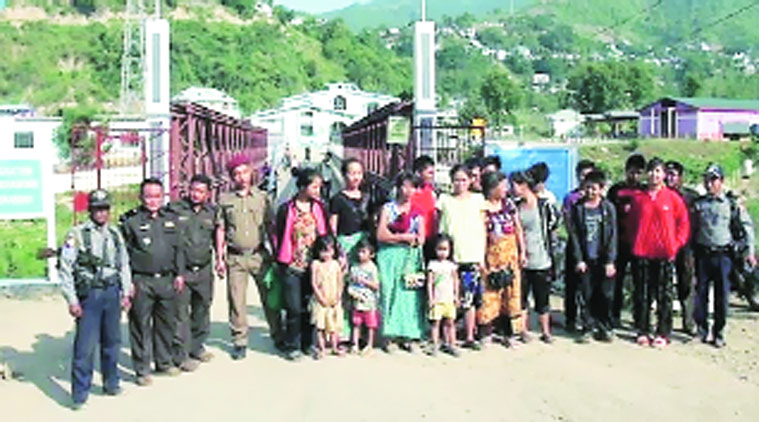
The group that returned from Myanmar at the international border near Zokhawthar. (Photo courtesy: DIPR Mizoram)

Aizawl, Jun 4 : Eighteen people from four families who undertook a journey on foot from Mizoram to China to “escape” from Aadhaar enrolment and what they believed to be “an impending darkness waiting to befall the state” returned home on Wednesday after spending over two months in captivity in Myanmar.

The group, including four minors and seven women, are members of a religious sect that lives in Tlangsam village near the eastern town of Champhai, close to the border with Myanmar.

An official from Champhai said they admitted to having been afraid of the Aadhaar project, which they interpret as the number of the anti-Christ prophesied in Christian theology. They also admitted to having undertaken the journey to escape a “blanket of darkness” that has in recent years been prophesied to befall Mizoram by some self-styled modern day prophets, the official said.

The group was detained by the Myanmar government at Tamu near Tahan in Myanmar’s Sagaing Division. Mizos who live in the region, including the late MLA of Tamu, D Thangliana and leaders of the Mizo Thalai Pawl (youth group), intervened on their behalf and tried to get them released. The efforts eventually paid off and the group was finally released.

NLUP Reduces Jhum Cultivation in Mizoram

Aizawl, Jun 4 : New Land Use Policy, the state governments flagship project, has significantly reduced the traditional shifting cultivation or jhumming, said a survey conducted by Consultative Committee for NLUP (CCN) today.

The CCN, comprising experts from the Mizoram University, found that families engaging in jhum cultivation has decreased from 66.

44 per cent of the total families in Mizoram to 46.

14 per cent, after the launching of the NLUP in 2011.

The area under jhum cultivation has also decreased by 22.

52 per cent, according to the survey.

At the same time, number of families engaging in wet rice cultivation have also gone up to 27.

20 per cent of the total families in Mizoram from 16.

19 per cent.

While the number of labour engaged in jhum went down to 29.

54 per cent from 47.

69 per cent, that of wet rice cultivation has gone up to 31.

14 per cent from 18.

17 per cent.

The number of NLUP beneficiaries having bank accounts has also increased to 98.

24 per cent from 46.

81 per cent.

The survey was conducted among beneficiaries who opted for orange plantation in the eight districts of Mizoram.

It covered 6,565 of the total 8,538 who are engaged in the trade.

The survey also found that 68.

35 per cent of orange trees have grown up and are expected to yield good harvest.

However, 25 per cent of the beneficiaries have lost 50 per cent of their orange trees to different factors, including diseases, the survey found.

The survey made several suggestions for improvement of orange orchards.

Orange plantation under NLUP is undertaken in 3100 hectares of land.

Expected to be harvested from 2017, the orange produced in Mizoram is expected to increase by 1095 MT and further to 7838 MT in 2020.

The report of the Study on the success and impact of NLUP under Horticulture Sector in Mizoram: Mandarin Orange was released by Chief Minister Lal Thanhawla.