11 November 2014

19th Century Railway Section in Assam Hills Yearns For Heritage Status

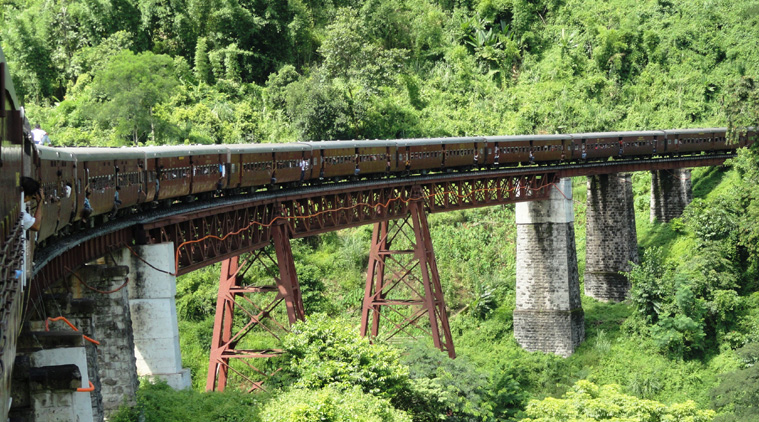
assamhilltrain02 A 47-km portion encircling the picturesque hill station of Haflong has remained untouched, including its century-old buildings mostly made of stones and timber. (Source: Samudra Gupta Kashyap)

By Samudra Gupta Kashyap

Guwahati, Nov 11 : Even as the railways are currently engaged in replacing the 111-year old metre-gauge Lumding-Badarpur Hill Section into a broad-gauge track, a 47-km stretch of the historic line, literally forming a garland around Haflong, Assam’s only hill station, is waiting to be conferred heritage status. The Assam government meanwhile has written to the railways asking them not to dismantle it, so that it could be promoted as a tourist attraction.

While the 225-km Lumding-Badarpur Hill Section – often described as the “most spectacular mountain line of Indian Railways” –  is currently in its last phase of gauge conversion – to be completed by April 2015 – a 47-km portion encircling the picturesque hill station of Haflong has remained untouched, including its century-old buildings mostly made of stones and timber. The 47-km portion has nine stations – Mahur, Migrendisa, Lower Haflong, Bagetar, Haflong Hill, Jatinga, Longrangjao, Mailongdisa and Harangajao – each one a heritage in its own right.

As a group of citizens of Haflong, highly concerned about preserving that 47-km stretch has asked the government to declare it a heritage track and promote it as a tourist attraction, the state government on its part has written to the Railways saying it was serious about retaining and promoting this 47-km stretch as a heritage track. The Hill Section that was considered as a “magnificent engineering feat” of the 19th century, the world’s steepest section (Harangajao-Jatinga) with a minimum gradient of 1:37 will continue to live once a final decision to preserve it is inked.
Officials at the Northeast Frontier Railway headquarters in Guwahati said they were waiting for a “concrete proposal” from the Assam government on how it wants to utilize the 47-km stretch that will be otherwise abandoned and dismantled. “While the Railway Board had recommended dismantling of the Mahur-Haragajao portion because it is not on the new BG alignment, we at NF Railways decided to ask the state government whether it wants us to retain it. The chief secretary replied in the affirmative. Now we are waiting for a concrete proposal from the Assam government,” NF Railway CPRO Sugato Lahiri said.

“The government has already asked the railways not to dismantle the 47-km stretch and the stations on it. We are drawing up a plan to preserve, maintain and promote this portion as a heritage track complete with steam engines and vintage salons,” Dhrubajyoti Hazarika, secretary, tourism, government of Assam told The Indian Express today.

Hazarika said while Jatinga, the village where birds mysteriously flock to commit suicide, has been a global attraction, all the other places along the track including Haflong town together would be promoted as a new package soon. While Haflong has an elevation of about 1685 feet, Jatinga is the tallest station in the Northeast, standing at 2156 feet above sea level.

The NF Railway had in May 2001 made an attempt to introduce what it called the Jatinga Steam Safari from Lower Haflong to Maibong, but that did not continue for long. With the Assam government willing to take it up, a journey on a vintage mountain train will once again become a reality. “Given the beauty of the Barail mountain, an imaginative planning can attract thrill-seeking and nature-loving tourists to this railway, especially because of the mystique associated with places like Jatinga,” said well-known writer Arup Kumar Dutta, whose “Indian Railways:The Final Frontier” is considered an authorative history of railways in the Northeast.

“We are happy that the broad-guage conversion of the Lumding-Badarpur Hill Section is nearing completion. But since the conversion does not affect the 47-km Mahur-Harangajao portion of it that also encircles Haflong town, it will be only too wise for the government to declare it as a heritage and use it for promoting tourism as early as possible,” said a memorandum signed by representatives of 14 organizations of Dima Hasao district.

The signatories also pointed out that the construction of this hill section that was opened in 1903 is inseparable from the story of development of the tribal communities of the district. “Wherever the railway track traversed, development was inevitable. Several small hamlets turned into towns here, while tribal communities moved closer to the railway track and sustained themselves. Now that the broad-guage track is coming up away from this 47-km stretch, the best thing to do is to preserve it, declare it as a heritage track and use it as a tourist attraction. This way the backward district will see a lot of economic activity,” the memorandum said.
31 October 2014

First Woman Chief secretary L Tochhawng of Mizoram Retires Today

Aizawl, Oct 31 : Mizoram Chief Secretary L Tochhawng retired from service today and would be succeeded by Lalmalsawma from tomorrow.

Tochhawng is the first Mizo woman to become Indian Administrative Service officer and also the first woman chief secretary of Mizoram.

Official sources said that Lalmalsawma has relinquished his duties in the Delhi government and was in Aizawl for his new assignment.


Pic source: hlakungpui.com
30 October 2014

Internal Elections Unlikely To Change Mizo National Front Leadership Line-up

By Adam Halliday

Aizawl, Oct 30 : In spite of suffering its two worst electoral defeats in the past decade, there seems unlikely to be any change in the Mizo National Front leadership as the party heads for internal elections next month.

The party that ruled Mizoram for two consecutive terms between 1998 and 2008 was decimated in the 2008 state-wide elections and reduced to occupying just three of the assembly’s 40 seats. It slightly improved its tally in 2013 and won five seats.

Nevertheless, the main opposition party’s top five leaders have once again been nominated uncontested for the exact same posts they have been occupying by the party’s National Executive Meeting on Thursday at Aizawl.

Significantly, both Zoramthanga and Tawnluia were re-nominated without any contestants for the post of President and Senior Vice President respectively.

In a way, the uncontested nominations show the party’s continued deference for leaders who once spent two decades as guerilla fighters in a bid to win an independent country for Mizos in India, Bangladesh and Myanmar.

The other three leaders re-nominated on Thursday were not part of the MNF uprising, as it is often called, a period that saw an entire division of the Indian Army (assisted in the beginning by the IAF) move into present-day Mizoram to subjugate the separatist movement.

The re-nominations also shows the unchanged leadership preference of most senior party workers in spite of staring at the prospect of spending a decade out of power.

Of the top five, only one (former MP Vanlalzawma) is currently an MLA. he has been re-nominated to be Treasurer.

Three others — former CM Zoramthanga, former Home Minister Tawnluia and former Health Minister R Tlanghmingthanga — have lost two consecutive elections.

A fifth (former Education Minister Dr R Lalthangliana) lost, albeit by a margin of less than a hundred votes, to a first-time Congress candidate in last year’s assembly polls. He has been renominated as one of the two Vice Presidents, along with R Tlanghmingthanga.

Although it will remain open for other party leaders to contest against any of these five leaders before party elections take place on November 14, it appears unlikely that will be the case.

Insiders said a move to introduce the secret ballot system in the party polls was shot down after prolonged debate at Thursday’s meeting, meaning the mid-November elections will be decided by a show of hands once again.

Mizo Contractor Supplied 5000 Quintals of Rice To Govt

Aizawl, Oct 30 : Rem Rem Enterprise, owned by Lalrindika, a contractor, of Aizawl had supplied 5,000 quintals of rice to Mizoram government which was stored at the FCI warehouse in Rangvamual near Aizawl, state food, civil supplies and consumer affairs minister John Rotluangliana today said.

Rotluangliana said that the contractor was appointed to procure 30,000 quintals of rice and the government would consider whether to procure more from the contractor.

The contractor supplied the rice to the state government at the rate of Rs 25 per kg.

Lalrindika, said that he procured the rice from Guwahati and might also procure good quality rice from Myanmar.

Mizoram government was compelled to procure rice from other sources than the FCI due to mega block caused by widening of railroad at the Lumding-Badarpur sector in Assam beginning from October one.

The centre's efforts to purchase rice from Myanmar ran into trouble as bids by prospective contractors were reportedly exorbitant.
24 October 2014

Mizo Brothers Fete 'Zo Rock' Rosangliana

Imphal, Oct 24 : The Shillong BSF Mizo Brothers organized a felicitation programme in honour of Mizo rock artist Rosangliana, popularly known as 'Zo Rock' today at Lalchand, Shillong.

Singer-songwriter Rosangliana, one of the most influential Mizo musicians of the present era will retire from service, after a fruitful career with the Jazz Band of the Border Security Force on Oct 31 .

Notwithstanding his retirement from service, people of Zo descendants or 'Zo nahthlak' are expecting him to continue to sway music lovers of the community, a statement said.

Rosangliana was born on October 10, 1957 at Khawkawn, a hamlet in Mizoram.

Music was in his blood since his childhood days.

His efforts to realize his dream of becoming a music giant landed him at the Jazz Band of Assam Rifles' music department in 1976.After a short stint at the AR Jazz Band, Rosangliana began a career with the BSF in July 1980 .

He was with the Jazz Band of 111 BN BSF Nagaland.

He was posted at IG HQ, BSF Shillong from 1991 till date.

Regardless of his old age, he continues to shake music lovers of the Zo descendants across the NE States.

He also made his presence felt even to neighbouring country, Myanmar.

To his credit, he has produced 12 music albums and 35 music videos.

He has written 115 songs.

He came out with his first album in 1991 from Rangoon.

The big success of the first album earned him the title 'Zo Rock' .

Married to Chingzahoih Gangte of Chiengkonpang, CCpur (Manipur) in 1984, the couple is blessed with five children.

During his remarkable career in the BSF, Rosangliana spared no efforts to take the Jazz Band to a higher plane.

His firm determination led him to achieve success in whatever projects he took up.

From a GD Constable, he will retire as a Sub-Inspector, it said.
23 October 2014

India Can Stop The Mauling, Harassing, And Killing Of Northeasterners—Yet Chooses Not To

Northeast-Rights The government has to create educational and employment avenues in the northeastern states.(Reuters/Adnan Abidi)

By Ragini Bhuyan

Everyone’s asking why.
There’s been another spate of crimes on northeast Indians this month—attacks on Manipuri students in Bangalore, on workers from Nagaland in Gurgaon, and the death of a young woman from Mizoram in Delhi.
But we’ve been here before—and convened inquiries, commissions, and reports. The results of the last time this happened—the so-called MP Bezbaruah committee report—had tangible solutions.
The problem is that nothing happened. Will this time be different?
The report examines the rise in discrimination against migrants from India’s northeastern states. The committee, which submitted its report in July, was constituted by the government after a 19-year student from Arunachal Pradesh, Nido Taniam, paid the price for his “chinky” looks with his life. Ironically, Lajpat Nagar, the Delhi neighborhood where he died, is an immigrant colony formed largely of Partition refugees, and the country’s capital has been built on waves of migration.
“There are two things—one is prejudice stemming from ignorance, which leads to taunts and subtle discrimination. This can be combated over the long term through cultural sensitization,” Bezbaruah said in an interview with Quartz.
For the second problem—to deter violent crimes, his report suggests the following:
  • special police units to probe such crimes.
  • fast-track courts so justice is served.
  • cases should be disposed of in 90 days.
“If criminals are dealt strong punishment, then it will not only be a deterrent in the future, but will also send a signal to migrants from the north east that the state is serious about their safety and well being,” Bezbaruah said.
The need for quick redress can be illustrated by the recent verdict on the 2010 Dhaula Kuan rape case. The case, ­which saw the gang rape of a call-center employee from Manipur, took four years before the court pronounced those involved guilty. The victim felt compelled to leave Delhi. Her father testified to a national daily that for months, they received threatening calls asking them to withdraw the case. The verdict came on the day three Manipuri students were beaten up in Bangalore for not knowing how to speak in the local language, Kannada.
The Bezbaruah committee report has noted that Delhi exhibits the worst discrimination among India’s metros. The answer might lie in the numbers. The committee quoted a study which found that more than 400,000 people have migrated from the northeast between 2005 and 2010, with Delhi being the preferred destination.
“There has been a change in the profile of the migrants, which could be a factor behind the rise in crimes. Earlier, it was mostly students. Now many come to work in the lower rungs of the service sectors. Preference for workers from the region in certain areas, like the hospitality industry, has fed resentment in a certain section of the local population,” Bezbaruah said. The report notes that many such workers live in affordable areas, which are essentially urban villages, and where their way of life comes into conflict with locals who are still rooted in conservative traditions.
The committee has called for amending section 153 of the Indian Penal Code to include stringent punishment for racially-motivated crimes, and to set up an implementation committee with civil society representatives in the ministry of home affairs. IPS officer Robin Hibu, who assisted the committee in its proceedings, has argued for an anti-racism law. “In addition, there should be dedicated nodal officers in the ministry of home affairs charged with the responsibility of monitoring crimes against people from the region in all those metro cities which have witnessed such crimes,” he said.
Though Delhi Police has a special unit that looks into issues troubling migrants from the region, Hibu points out that it is virtually toothless. “It does not have the power to launch investigations nor can it book FIRs,” he said.
Despite assurances that the government is examining the report, many who were consulted during its drafting are disappointed with the delay. “The government should promulgate an ordnance at the earliest to deal with such crimes. We need greater discussion about race crimes,” said Sanjoy Hazarika, a veteran journalist and author of several books about the northeast.
Kishalay Bhattacharjee, another journalist from the region, argues that strong policing and fast-track courts are only part of the solution. “There can be silent discrimination … This could happen at work. The real challenge involves changing mindsets. This will take a generation, so the government should seriously look at cultural sensitization. They could start with schools,” he said.
The committee found that many crimes go unreported due to police apathy. Taniam’s killing compelled writer Janice Pariat to “out” her own experience of being attacked in Delhi years before. She wrote, “Many post-colonial states, like India, have often become the bone of contention of different groups to assert their pre-eminence over the other.”
The government can do three things at the minimum:
  • start with strengthening law and order, and provide quick, legal redress
  • start a broader programme of sensitisation, whether that involves the police, resident welfare associations, or outreach programmes in schools and colleges.
  • spread the benefits of economic liberalisation. From Bihar onward, India’s poorer eastern half suffers from infrastructure deficit, a lack of industries, and educational and employment avenues. Lack of development has fueled insurgency. The government has to create educational and employment avenues in the northeastern states. It must value its people—if it wants others to do the same.

Mizoram Launches Captive Farming

Aizawl, Oct 23 : Mizoram launched captive farming in passion fruits under the RKVY and the state government's own New Land Use Policy.

The project captive farming in passion fruits for Tuikum cluster was launched by horticulture minister P C Lalthanliana during a function at Chhingchhip village today in presence of NLUP implementing board chairman and MLA, J H Rothuama and the beneficiaries.

The project will cover 612 beneficiaries (families) from ten villages - Khumtung, Baktawng Vengpui, Baktawng Tlangnuam, Chawilung, Chhingchhip Mualpui, Chhingchhip, Chhiahtlang, Hualtu, Hmuntha and Khawbel - under Serchhip district and one village Phulmawi under Aizawl district. The project will be undertaken by the state-owned corporation Mizoram Food and Allied Industries Corporation Ltd (MIFCO).

Rs 783.62 lakh has been allocated for the project, including Rs 521.12 lakh from RKVY and Rs 262.50 lakh from NLUP. Rs 15,000 has been deposited to bank account of each beneficiary as first installment. Each beneficiary will receive Rs 35,000 worth wire mesh in November.

Based on their performance, the beneficiaries will receive further installments of financial assistance, an official statement said. Meanwhile, the state government has sanctioned Rs 27.80 lakh (Rs 133 lakh for salaries and Rs 141.80 lakh as other financial grants) to MIFCO as a step to revamp the sick PSU.

Passion fruits farmers under this cluster are expected to supply at least 10,000 metric tons of passion fruits to a fruit processing plant at Chhingchhip owned by MIFCO.

Each beneficiary will cultivate passion fruits on at least one hectare of land. A beneficiary will be provided with 2000 saplings each and from this annual production of at least 20,000 kgs of passion fruits are expected.

The government has also decided to implement cluster farming in pine apple under RKVY and NLUP. Clusters and beneficiaries for the project have been selected. The project will be launched soon, officials said.

Half-Naked Woman Found Bound, Gagged in Mizoram Church

Aizawl, Oct 23 : A 19-year-old woman – half-naked and gagged, with her hands and feet tied up with ropes – was found behind the pulpit of a church in Aizawl early Wednesday morning.

Several members of the congregation who were making preparations for an approaching service after the early morning prayers at the Bethlehem Veng Presbyterian Church found the woman around 6.30 am.

The woman, who hails from Tlungvel village about 58 kms from the state capital, was lying behind the pulpit (a raised platform from where preachers deliver sermons) with her hands and feet bound with ropes, and a scarf tied around her mouth.

The congregation members untied her but she refused to say in any detail what had happened, only mentioning that two people – a man and woman she said she did not know – tied her up and left her there.

She also asked for another woman with whose family she had been staying for about a month in the locality. An eyewitness from the locality said the woman and her father came to identify her.

They confirmed she had been staying in their care and was being taken care of by the daughter, who has been volunteering to care for members of loose occult movements.

The police were informed and they have detained her for questioning.

They have also registered a case under IPC section 295-A (deliberate and malicious acts, intended to outrage religious feelings of any class by insulting its religion or religious beliefs.)

A senior police official said  the woman has not been responsive to police interrogators but that several angles are being investigated, including who were the people that tied her up and left her in the church, and even whether she might have been complicit in the incident.