21 November 2013

India losing the battle against TB?

Two people die every three minutes in a country that accounts for 26 percent of cases globally.
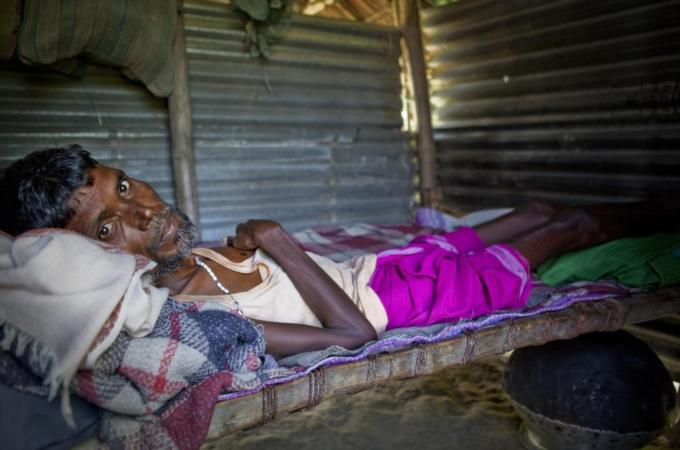
Rafael Hasta, 58, has yet to benefit from the world's largest free TB care programme [Bijoyeta Das/Al Jazeera]
The days Rafael Hasta coughs up blood, his son Samuel gives him mashed papaya with boiled rice and red tea. Hasta refuses to eat anything else.

Diagnosed with tuberculosis (TB) three years ago, Hasta - from Assam in India's northeast - has seen a doctor only four times. Samuel, 28, hired a wooden cart and took him to a public hospital in the town of Kokrajhar.
"I lose a day's work, wait for two hours, and the doctor meets the patient for only five minutes and never explains anything," he says. The doctor's visit was free, but X-ray and medicines cost $15 each time."

Rummaging under the bed, he pulls out four crumpled prescriptions and two fading X-rays reports. The $3 he earns as a day labourer feeds six people. Medicines for his father are "simply not possible."

Scared that the disease could spread, he built a shed with bamboo, tin and tarpaulin for his father. "I want to take care of him. I just don't know how," he says, pressing his father's scrawny hands. 

Many like Hasta are yet to benefit from the world's largest free healthcare programme for TB that India runs. India has the highest TB burden, accounting for 26 percent of cases globally.
It is the country's most fatal infectious disease and a rise in drug resistance has prompted many to ask if India is floundering to control TB.

India's TB burden
According to the World Health Organisation (WHO) 2013 Global tuberculosis report, 8.6 million people developed TB and 1.3 million died from the disease in 2012. The rate of new cases has been declining at 2 percent per year for a decade.
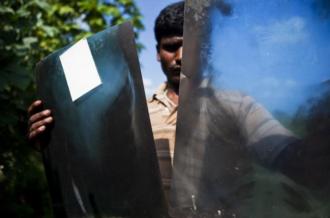
Earning $3 per day, Samuel says its "simply impossible" to buy medicines for his father [Bijoyeta Das /Al Jazeera]
The scale of India's TB control measures is laudable but population, grinding poverty and a doddering healthcare system cause the problem to dwarf all efforts, according to experts. Prevalence has reduced from 465 to 230 per 100,000 population and mortality from 38 to 22.
Yet, the scale of the scourge remains scary. Every three minutes, two people die of TB in India, and one out of every four TB patients in the world is an Indian.
"You are running very fast but you seem to be standing in the same place because so many are getting infected," says Virendar Chauhan, director of International Center for Genetic Engineering and Biotechnology.
For two decades, Indian government has been providing the WHO-recommended DOTS: Directly Observed Treatment courses under the Revised National Tuberculosis Control Programme (RNTCP). It currently reaches 1.5 million cases in the public sector.
But about half of those affected go to the private sector, which is not involved in TB control. "Government and private sector efforts should integrate. There should be a push-and-pull mechanism," adds Chauhan.
It is a cruel irony that India is a pharmacy to the world. It produces many of the TB drugs that people in other countries depend upon ... The government has not been upfront in recognising the shortage and ensuring availability.
- Mike Fricke, Activists of Treatment Action Group 
Routine DOTS saves lives but is not very effective in curbing transmission, says Madhukar Pai, associate director at McGill International TB Centre. "By the time patients end up in the DOTS system, they have likely infected many others."
Poor living conditions, malnutrition, overcrowding, smoking, indoor air pollution, HIV infection, and diabetes increase the risk of TB in India.
Pai says India's scale-up of new technologies has been disappointing. Countries such as South Africa and Brazil are actively investing in new tests such as GeneXpert to improve case detection and multi-drug resistant (MDR-TB) diagnosis, but India is yet to "take such bold steps."
"Even easily available tools like mobile phones and ICT are yet to be harnessed for notification and treatment adherence monitoring," he says.
According to Soumya Swaminathan, director of National Institute for research in Tuberculosis, poor access and ignorance about the national programme, unfriendly health services, and the attitude towards the marginalised are roadblocks in extending universal healthcare.
"Our studies have shown that there is a huge out-of-pocket expenditure by the time patients get diagnosed and treated for TB, and that stigma compounds the problem," she says.
The WHO says there is a funding shortfall of $2 billion a year for a full response to the global TB epidemic. But Indian health officials say India's TB control is a success and there are no funding gaps.
"India's TB spending has not slowed down and India's budget on TB control has increased by 300 percent in 12th Five Year Plan as compared to the 11th," says Niraj Kulshrestha, a senior official of the Central TB division at the Ministry of Health & Family Welfare. Spending on research increased by 80 percent since last year, he adds.
Fund shortage
International funds contribute 57 percent of India's total TB control budget. However, the RNTCP budget is only 2 percent of the total health sector budget. The ambitious National Strategic Plan that aims to treat 90 percent of TB cases by 2017 will cost $1.05 billion. But RNTCP has been allocated only $731 million.
Resistance to drugs is also compounding the problem. About half of the 450,000 MDR-TB patients are in India, China and Russia. Reports of recent drug stock-outs, particularly second-line MDR-TB, led activists of Treatment Action Group (TAG) to take over the stage with calls of "Shame India" and "the TB genocide must stop" at the 44th Union World Conference on Lung Health in Paris.

"It is a cruel irony that India is a pharmacy to the world. It produces many of the TB drugs that people in other countries depend upon," says Mike Fricke of TAG. "The government has not been upfront in recognising the shortage and ensuring availability."
Kulshrestha says there is no increase in MDR-TB and absolute numbers are high, proportionate to the population. "More cases are being reported because of diagnostic facilities made available by the government," he adds.
According to Leena Menghaney of Medicines Sans Frontiere,"Antibiotics are largely misused in the private sector, which is contributing to the rise of drug resistance in TB and needs to be regulated."
Often poverty makes people susceptible to TB, and TB worsens poverty, but it now affects all classes of people in India.
“If India and China are able to reduce the TB burden, it would mean progress for global TB control,” she adds.
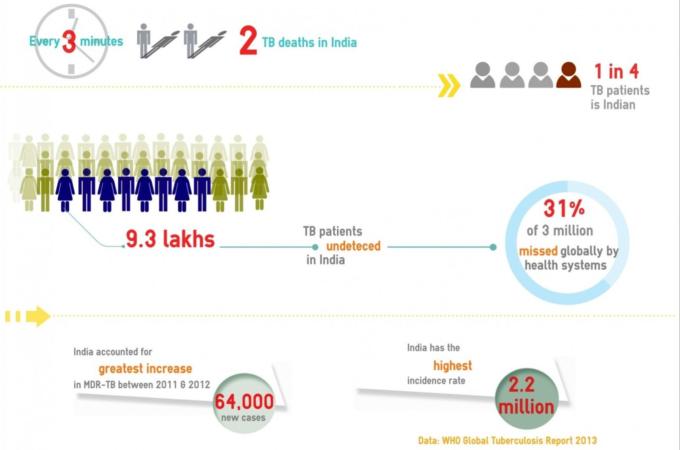
TB-Infographic [Bijoyeta Das /Al Jazeera]

This story has been written under the aegis of the International Union Against Tuberculosis and Lung Disease (The Union)'s Media Fellowships for Reporting on TB.

India Gets On The Highway to Growth in Southeast Asia

By Nayanima Basu

With the implementation of the India-Asean comprehensive economic partnership, the target for two-way trade has been set at $100 billion by 2015

As India readies to sign the free trade agreement on services and investment with the Association of Southeast Asian Nations (Asean), taking bilateral trade relations to the next level of a comprehensive economic partnership agreement, the focus is on the laying out of a massive road connectivity plan to tie the region together to boost economic objectives.

To start with, India has proposed extending the trilateral highway project connecting India, Myanmar and Thailand to neighbouring Cambodia and Vietnam. The idea is to set up special economic zones along this highway and provide seamless connectivity through these countries by 2016, by when the projects are expected to become operational. Right now, work is on to repair and strengthen 71 bridges that link this stretch.

To ensure greater success of this highway project, Prime Minister Manmohan Singh proposed an Asean-India Transit Transport Agreement (AITTA) at the India-Asean Summit in Brunei Darussalam last month. Once the agreement comes into force -likely by 2015- vehicles from association countries will be able to cross international borders without much documentation.

Total bilateral trade between Asean and India reached $75.6 billion in 2012, surpassing the target of $70 billion. Now, with the implementation of the India-Asean comprehensive economic partnership, the target for two-way trade has been set at $100 billion by 2015, for which an integrated transport network would be the key.

At present, the market is fragmented and the patchy road network is a stumbling block for free flow of goods and services. This, along with administrative and technical barriers, increases costs and leads to transportation delays, says a study by New Delhi-based think tank Research and Information System for Developing Countries on Asean-India connectivity.

While road links are being developed, the proposed AITTA will make crossing the border easier. "AITTA will allow vehicles to move seamlessly across international borders or regional and international trade transportation purposes. AITTA should be in position before the trilateral highway is operationalised in 2016. Potentially, it can be a game changer which will allow us to reap the full benefit of India-Asean free trade agreement, regional comprehensive economic partnership and enhanced connectivity," says Ashok Kantha, secretary (East), ministry of external affairs.

The master plan on Asean road connectivity was adopted at the India-Asean Summit in 2010. The benefits from the highways, which are scheduled to be completed by 2016, are manifold. They would improve connectivity, bring India closer to Asean, reduce trade costs, help exploit the country's comparative advantage in certain products, expand markets, as well as reduce poverty and improve the quality of life for the people in the region. A smooth road network would also provide substantial benefits to other countries, particularly to landlocked and island nations by giving them low-cost access to a wider market outside, the report said.

India already has a goods agreement in place. It came into force in August 2011 and provides tariff-free access to a range of products, including textiles, pharmaceuticals, chemicals, engineering goods, processed food and auto parts. The likely addition of services and investments to this list of free-trade items in the not too distant future would open up new opportunities for Indian IT and healthcare professionals, designers and researchers.

In addition, India is also contemplating expansion of rail network into Myanmar. The rail head terminates at Jiribam in Manipur. A project to connect Jiribam to the capital Imphal is under way and is slated to be completed by 2017, while proposals on connecting Moreh (Imphal) to Tamu-Kalay (Myanmar) is being considered by the external affairs ministry.

At the same time, work is also on for developing soft infrastructure such as trade facilitation centres and telecommunication, necessary for any economy to function and thrive. Boosting maritime connectivity is on the agenda as well. India has proposed the establishment of a Maritime Transport Working Group between India, Myanmar, Thailand, Cambodia and Vietnam to examine the feasibility of shorter shipping routes. This idea was initially mooted by Thailand which wants a more direct sea transport route to India via the Dawei port in Myanmar, which is a deep sea port. Right now ships have to be routed via Singapore to reach India.

"It is important that we identify economic activities that can be pegged to these corridors, which could attract private sectors from both Asean and India, including from India's Northeast," says a foreign ministry official.

Another project that India has shown interest in is the Mekong-India Economic Corridor (an offshoot of the trilateral highway) to link Myanmar, Thailand, Cambodia and Vietnam with India. The corridor- which might be funded by Asian Development Bank -will extend from Ho Chi Minh City in Vietnam to Dawei in Myanmar via Bangkok (Thailand) and Phnom Penh (Cambodia) and then on to Chennai in India.
20 November 2013

Mizoram: Rivals Come Face To Face On One Platform To Seek Cotes


By Arijit Sen


Aizawl, Nov 20 : Mizoram will vote on November 25 to elect a new Assembly and politicians are showing the way when it comes to campaigning. In this Northeastern state candidates from different political parties come together to face questions on joint platforms.

Like students getting ready for an exam, candidates from three different political parties competing for the Aizawl North Constituency must answer four questions on an open platform before a select audience in order to win votes.

"This is an excellent arrangement because you can express yourself to the people. If you call public meeting here in Mizoram only your party people come, rest do not come. Therefore it is a very good arrangement," says Congress MLA Lalsawta.

In Mizoram it is the church-sponsored Mizoram People's Forum, a self-appointed watchdog of elections that organises meetings.

The entire session is recorded and will be broadcast on local television stations for free.

"The main purpose is to have a peaceful election. Local forums are organising this so that candidates can explain their manifesto. The local forum is established by the Presbyterian Church. It is very effective and because of this it happens," says Rammuana of the Mizoram People's Forum.

Forget the Election Commission, in Mizoram it is the church-sponsored Mizoram People's Forum, a self-appointed watchdog of elections that organises meetings in which they get candidates from all political parties and they remind them what is okay to do and what is not when it comes to elections in the state.

Formed in 2006, they even have a 20 point MoU on dos and don'ts signed by political parties. But the question is, are they stepping into the Election Commission's shoes?

"Not at all, not at all! We are supporting, we are supporting, we don't go against the Election Commission. We are strengthening their hands," says Mizoram People's Forum activist F Lallura.

As 7,00,000 voters get ready to elect a new 40-member Assembly on November 25, when it comes to campaigns of the future, Mizoram is showing the rest of India the way.

Source: CNN-IBN

Mizoram CM: I Wiped Tilak Off, Can They Wipe Blood Off Their Hands

By Adam Halliday
Lal ThanhawlaThe CM with a tilak on his forehead

Serchhip, Nov 20 : Mizoram Chief Minister Lal Thanhawla has hit back at the opposition, which has been attacking him for sporting a tilak and charging him with forsaking his religion. "I wiped off the tilak on my forehead after the function, but how are those who took up arms and caused deaths of many innocents to wipe the blood off their hands?" Lal Thanhawla said Tuesday, in an obvious reference to the Mizo National Front, whose members fought a 20-year guerrilla war against the Indian armed forces for a separate Mizo country.

Speaking at a joint platform organised by the Mizoram People's Forum at his bastion Serchhip, Lal Thanhawla said the opposition has resorted to such tactics "because they cannot find any evidence of corruption against me and this is all they have to stand on". Rooting out corruption was the Congress's main plank in 2008, when it won by a landslide with 32 of 40 seats.

At the platform, the five-time chief minister came under attack from other candidates, particularly the Mizoram Democratic Alliance's C Lalramzauva and independent Lalawmpuia Renthlei. The ooposition has been charging the Congress with playing what it calls "Indianisation politics", tapping into the largely Christian Mizos' religious sentiment as well as widespread fears of being swamped by larger ethnic populations.

To this charge, Lal Thanhawla said, "God has sought us Mizos out with his spirit, and why should we, who believe this, fear being swamped? Will God not protect us, those he has found? He will not allow us to be swamped."

In a veiled attack on the CM, who has been targeted for sporting the tilak and taking part in pujas several times on visits outside, the MDA's Lalramzauva said in his speech at the joint platform, "Spiritual people have said these elections are not going to be fought between parties but between forces of good and evil, between believers and nonbelievers."

Renthlei, who is curiously contesting as an independent from the two seats that Lal Thanhawla is contesting (Serchhip and Hrangturzo), said in a speech filled with biblical allusions, "When the giant Goliath threatened the Israelites and the small boy David killed him, how did David do it? Where did he attack the giant?" To which someone from the crowd shouted, "On his forehead!" Renthlei continued, "It is written, 'You cannot drink from the same cup as that of God and of demons'. I ask the MDA and the Zoram Nationalist Party to join me in this fight."

As the audience cheered and hooted, Renthlei took his seat. Immediately after, Lal Thanhawla stood up without waiting for a formal invite from the platform's chairman, as is the norm, and hit back at his opponents.

In his capacity as CM, he said, he spends time with and visits people of all kinds of cultures and religions. "Sometimes I am greeted by half-naked people, sometimes by people wearing exquisite clothes, sometimes by people who bang gongs and sometimes by those who fire guns into the air," he said.

"I ask you, there are those who have paraded idols with 10 hands to protest my sporting a tilak. Are they not trying to use the power of these idols themselves?" he said, referring to an MNF-organised rally in Aizawl earlier this year to protest the CM's sporting of a tilak.

World's Largest Family Prepares To Vote in Mizoram Polls

By Manogya Loiwal

Serchhip (Mizoram), Nov 20 : Ziona, the head of family, has 38 wives, 32 sons, 18 daughters, 22 grandsons, 26 granddaughters and seven great grand children and all live under one roof.
Ziona, the head of family, has 38 wives, 32 sons, 18 daughters, 22 grandsons, 26 granddaughters and seven great grand children and all live under one roof. The largest family in the world is the star attraction in Mizoram and the mega family will be voting for a new government in the north-eastern state on November 25.

The family has 162 members out of which 98 are eligible to vote and they are attracting political parties.

Ziona, the head of family, has 38 wives, 32 sons, 18 daughters, 22 grandsons, 26 granddaughters and seven great grand children and all live under one roof.

With one the biggest houses in Serchhip district and Tuikum Assembly constituency located in the mountainous state sandwiched between Bangladesh and Myanmar, the family enjoys enormous respect and is the centre of attraction in the region.

Zaupuia, the grandson of Ziona, is proud to be a member of the most sought-after family in the state.

"My house's name is Chuenta Roon, which means house of the new generation. Our family consists of 162 members; my grandfather has 38 wives, 32 sons and 18 daughters," he said.

"There are a lot of grandchildren and I'm the grandson of Ziona. During elections, politicians receive 98 votes from our family. I'm yet to decide whom to vote for."

Managing a huge family like this is not easy. The family consumes 30 kilograms of rice for one meal of the day.

Most of the family members are carpenters and the rest take care of pig and poultry farms.

The family members share a cordial relationship and work is properly divided.

If seven wives cook, then the rest take care of the clothes and children. The seniors in the family are given adequate rest according to the age.

"We tend to face management problems since we're a large family. But if my baby is crying, others are always there to lend a helping hand," says Ramnandagi, the daughter of Ziona.

Congress, the leading political party in Mizoram, knows the importance of the highest number of voters in the village and hence is trying to woo them again.

Zasanga, the executive member of Mizoram Pradesh Congress Committee, is confident of getting the support of the family.

"They are our people, our citizens. So naturally they should come and cast their vote. The government has done good things for them. Like other citizens, they are being well-looked after and well-fed. Therefore we are looking forward to their support."

I have visited the huge family. They're a happy lot and nearly constitute one village. They are a religious group of people. Everything is controlled by the MPF i.e. Mizo People Forum."

Of the 40 Assembly seats, the Congress won 32 seats, Mizo National Front (MNF) three, and Maraland Democratic Front one in the last Assembly elections in December 2008.

The United Democratic Alliance's constituents - Mizoram People's Conference and Zoram Nationalist Party - got two seats each.

The Mizoram National Front, which ruled the state for 10 years till 2008, is the principal opposition party.

But the control is not with parties. It is with the churches. Almost 90 per cent of 10 lakh people in Mizoram are literate. Christianity being the main religion of the state, it is church bodies that are the deciding factors in the elections.

Mizo Peoples Forum, with more around six lakh followers, will be the deciding factor in this election.

"There are more than 50 churches and a lot of NGOs. The objective of the MPF is to ensure clean, fair and free election in Mizoram. In order to achieve this, we are working together with the Election Commission and the parties. We have signed an agreement with Mizo parties to work together to achieve our target," says Lairamliana Pachuau, president of Mizo Peoples Forum.

"We also wish to reduce the amount of money spent on election campaigns and therefore we are coordinating with the Election Commission. We also disseminated the election code of conduct. Apart from this, we organise joint platforms for candidates bringing in all parties."

The poll panel has fixed Rs.8 lakh as the maximum limit for election expenses to be incurred by individual candidates during polls and it will be monitored closely.

However, issues for the Assembly polls in Mizoram are no different from the rest of the country.

The locals however have concerns, says Ronalso Maiya.

"As localities, we look forward for a government that will be for the people and not for itself. We are waiting for someone to help eradicate corruption that has become synonymous with most political parties and help the poorest of the poor in the villages. We are hoping for a clean and a fair election this time.

The MPF was organised by our elders and therefore they play an important role in providing guidance to political parties in the right way and prevent them from misusing their powers," Maiya said.

The Congress, losing ground in the mainland, is however hoping to register a win in the polls and no wonder they are targeting the families that may make a difference.

NE Business Summit to address development issues of region

The Union Ministry of Development of North East Region (DoNER), along with the Indian Chamber of Commerce (ICC), has organized the ‘North-East Business Summit’ in Dibrugarh, Assam from November 22-24.

This will be the ninth edition of the summit, which is the largest trade and investment conference-cum-exposition on India’s North-East Region (NER). 

This is the first time that the event is being held in the interiors of the region, in Dibrugarh in Upper Assam, making it an ideal forum to address grassroots-level developmental issues, an official press release said.

Two Chief Ministers from the neighbouring country of Myanmar - U Thar Aye of Sagaing Region and U Ye Myint, Chief Minister of Mandalay Region - will attend the inaugural session of the summit.

This visit is extremely important, given that Myanmar is India’s true Gateway to the ASEAN markets, and that it has opened up its economy to Asia and the world, the release said.

The Ministry of DoNER is responsible for matters relating to the planning, execution and monitoring of development schemes and projects in the North Eastern Region. Its vision is to accelerate the pace of socio-economic development of the region so that it may enjoy growth parity with the rest of the country.

One of the prime objectives of the Ministry is to showcase the inherent economic, social and cultural strengths of the North East Region as well as to mainstream the region with the country.

The ICC has been assigned by the Ministry of DoNER to organize this summit as the nodal chamber for the North-East.

The Ministry of DoNER, over the years, has strived to showcase the economic potential of the NER to domestic and international investors through meaningful, and strategic initiatives with the help of ICC.

So far, the Ministry of DoNER has organized eight North East Business summit in various part of the country.
ADVERTISEMENT

The Indian Chamber of Commerce has also organized mega trade and investment shows on the North-East abroad, particularly in South and South-East Asian countries having potential to be natural trade partners of the North-East region because of its strategic location and proximity to these countries.

More than 500 delegates from across the country, and also from neighbouring countries are expected to attend the event, which will be chaired by Union Minister of DoNER Paban Singh Ghatowar.

Union Cabinet Ministers, Chief Ministers of North-Eastern States, policy-makers, industrialists, economists and analysts are also expected to attend the summit.

Guwahati’s Cosmetic Development

Police personnel patrolling the banks of Brahmaputra River ahead of Republic Day celebrations in Guwahati, Assam, on Jan. 23, 2009.
EPA
Police personnel patrolling the banks of Brahmaputra River ahead of Republic Day celebrations in Guwahati, Assam, on Jan. 23, 2009.
“I come from Guwahati—a small town in the northeastern part of India,” I used to tell my friends in Minnesota, until one person asked me how large is Guwahati. When I answered, he looked at me shocked, “A small town of only 1.4 million people?” I smiled sheepishly because it was partly true, and partly untrue. Untrue because I had grown up believing that my Guwahati is a small town. True because, nowadays even I suspect that during my absence over the years—like a young girl in a large family — Guwahati has as if stealthily grown up without my notice.

I spent most of my childhood in Jalukbari, a lovely area by the National Highway 31, somewhat on the outskirts, occupying a liminal position in the city’s imagination. The royal-poinciana shaded streets, hostels and classrooms of Gauhati University were also situated in Jalukbari. But one day, we had to take the hard decision of leaving Jalukbari. The armed separatist insurgency led by the United Liberation Front of Assam was at its peak. Calls for shutdowns — Assam Bandh — were routine. My parents’ workplaces were far. Not going to work, especially during a bandh, wouldn’t go down well in the high rungs of their offices since both of them were government officers.


Finally, in 1996, we moved to the All India Radio Campus, in Chandmari, a location at the heart of the city, a protected area because it is a central government enterprise. Almost every city bus in Guwahati has to go via Chandmari to go to different parts of the city. Unlike Jalukbari, this part of the city was trampled by history  —  things I discovered later from books; from conversations with nostalgic old neighbors who visited in the evenings. They stayed for long, lamenting about the Assam Movement. The failure of which, in a way, gave rise to extremism in Assam along with identity politics, which has now hopelessly balkanized the state that speaks in many languages, with Assamese as the lingua franca.

Our campus, where fallen laburnum flowers reigned after heavy rains, was established in 1948. When it was inaugurated, Guwahatians protested against playing the National Anthem at the event, because India’s National Anthem, penned by Nobel laureate Rabindranath Tagore, made no mention of Assam or Northeast. They didn’t want to let an institution that was to be the center of Assam’s cultural activities play that song on its first day; the song perceived as one of the many images of India’s denial toward Assam.

Now, when I walk out of the house, I reach the main road. During the Oil Blockade Movement of the Assam Movement, an injured protester called Dulal Sharma had written “I will give blood, not oil,” with his own blood. If I cross that road, walk down a little, I come across the Parag Das memorial – for the popular journalist who was fatally shot in front of his son’s school on May 17, 1997, for this robust critique of Delhi’s imperial presence in Assam.

I started liking Chandmari also for the woody wild beauty of the radio campus. When my friends came over for lunch, we walked in our calm, shaded lanes. I hung out with my new friends in the campus at the Anandaram Barua Flyover, popularly known as Chandmari Flyover. We believed it was the most romantic spot in Guwahati. Students from Commerce College and the Engineering Institute of Assam sat there in pairs, discreetly holding hands in the evening and whispering words into each other’s ears. We dreamed of dating like that, when we reached college.

During days I fought with my parents, I would sit on the flyover and wonder how sad and horrible my life was. When we patched up, I would tell my mother how I sat there, looking at the speeding cars below and thinking deeply about my sad and horrible life dominated by disagreeable parents. We would laugh, high-fiving.

Like many of my contemporaries, because of the separatist insurgency I left the state for higher studies in 2004. Years of armed conflict had led to massive underdevelopment. Studious ones couldn’t attend classes because of the frequent bandhs — the same bandhs that forced us to leave our beloved Jalukbari. Sometimes, when bandhs were called during exams by a major outfit, students stayed back with friends at the college hostel so that they could write their tests and not lose an academic year. My parents didn’t want me to have such a life full of uncertainty. From a young age, every relative, every family friend, told me to “get out of Assam and build a career outside.”
This summer, I was told that that trend of leaving Assam is reversing now. Guwahati, as people say, is “developing.” New educational institutions, private and public, have sprung up; some private venture institutions have been nationalized. Jobs are opening in the private and public sector since insurgency has been on the decline (though the reasons behind the insurgencies are very much alive like smolders.)

Because of this “development”, a lot of my contemporaries are returning to Assam from cities they had left years ago in search of better opportunities. But the new Guwahati that I encounter annually when I return from the United States to spend my summers is alien to me. Dappled with tall, glittering giant shopping malls that play terrible songs, Guwahati seems like a city only for the wealthy. In this city of the wealthy, there is no space for someone like our cook, who refuses to use the city bus and walks the one-hour stretch from home to work even after we decided to pay for her bus rides. She would rather save that money. Saving 20 rupees a day added up to 600 rupees, or $10, per month.

Those old neighbors who sensitized me about Chandmari’s history are no more to be found. They have moved out of Chandmari after retirement; some have died. Our campus is less woody now. Several trees have been cut down to make way for new apartment complexes for new employees. The quaintness of the radio campus is a happy nostalgia. I met a new batch of middle-aged men and women. When I was a school-going teenager, they were young and newly married, full of hope and enthusiasm. Like prophets, they lament that the future of Assam is dark, so is theirs because everyone is neck deep in corruption; that these shopping malls are ephemeral like seasons’ flowers. They don’t lament about the Assam Movement. Nor do they say things would have been different if United Liberated Front of Assam would have led an intellectual and cultural movement.

They allege that the large, new business enterprises – media, malls, coal mining, constructions, multiplexes, restaurants – have investments from surrendered militants and corrupt politicians; that those are ways to turn black money into white. I don’t know if that is true.

A woman carrying her goats on a raft in the flood affected Chandrapur area of Guwahati, Assam, on Sept. 25, 2012.
European Pressphoto Agency
A woman carrying her goats on a raft in the flood affected Chandrapur area of Guwahati, Assam, on Sept. 25, 2012.
Something deep inside tells me — when I see the water-logged streets of this “much developed” city, when I think about our cook, when I hear of a woman called Basanti Devi getting electrocuted after stepping onto a puddle of water on a rainy evening while returning home after buying vegetables for dinner to feed her three fatherless children — that this change of Guwahati is not natural like a snake shedding old skin to get a healthy one. It is like Lakme foundation cream hiding pockmarks for just a few hours; there is something reprehensibly wrong with it.

In my room, I talk to old friends who pat my back, questioning me about my sex life, who ask me if I would carry this or that for them in my next trip. Some of them have found jobs in the new, booming private television media where a lot of journalists I know of are paid less than 10,000 rupees, or $160, per month. In the prime-time programs, they appear looking almost white, sleek and glamorous in attires provided by their channels. But their jobs have no other benefits – no health care, no security, no retirement schemes.

One of my old friends is now a television anchor. When we go out to buy traditional weaves to stitch new shirts for myself from the handloom market, people stare at us. I feel proud. After shopping, when we sit down to eat momos, I ask him what are his plans, because he entered the industry as a stopgap arrangement. I suggest that he take some competitive exams. He changes the topic.
I want to tell him about an Assamese journalist who has worked for more than 20 years for a wealthy print media house but earns just around 20,000 rupees per month, or $320, but I don’t. You don’t talk about exploitation and the future over pork momos.

It is evening. We decide to walk down home because we always did that when we were younger and poorer, dependent on the monthly allowances of our parents.

When we reach the riverbank in Uzan Bazaar, a breeze touches us.

I ask him, Do you remember that urban legend?

What legend? he asks.

Remember, when we were in high school during the late 1990s, some people used to talk about secret treasures? Of large bags of extorted money buried by militants? A lot of them surrendered, got huge stacks of currency from the government to start businesses. But later, they dug up those bags also. According to another version, the militants who buried those bags were killed but they passed on the information to others before dying. After “coming back to the mainstream,” the former militants dug up those treasures and used up the money. (I didn’t tell him that I wonder if that money is used to actually “develop” Guwahati.)

Why are you telling me that? he asks.

Because I don’t think it was an urban legend, I say. It must be true. Remember last summer when I was here, after heavy rains, thousand-rupee notes and five-hundred-rupee notes started floating in a marshland in Guwahati?

Yes, in Chachal, he says. I heard one daily wage laborer collected 50,000 rupees. I think two people drowned in the marsh while money-fishing, no?

I say nothing. He stops an auto-rickshaw.

I think it is going to rain, he says. Even if it rains a little, the city will be flooded and we won’t be able to reach home. Let’s not walk, he suggests.

When we haggle over the fare with the driver, I think about our cook. When it starts raining, I think about Basanti Devi. She had three children. The children seemed as if they were too young to understand what her death meant. When TV cameras zoomed in to show their confused faces, I had found myself wondering if the correspondents were disappointed to find them so stoic, for not crying.

Aruni Kashyap is the author of the novel “The House With a Thousand Stories.”
19 November 2013

A Tilak Turns Poll Scenario Riotous


By Devirupa Mitra


New Delhi, Nov 19 : A tilak on the forehead of four-time Mizoram Chief Minister Lal Thanhawla has been raked up into a poll issue, as the Opposition in the north-eastern state take up Mizo nationalism as their main plank.

The main Opposition alliance Mizoram Democratic Alliance seems to be exploiting the frustration inherent from a highly-educated young population, who are currently seeing high levels of unemployment.

“The Mizoram Assembly election will be a landmark in the history of Mizoram as it is the battle between the devotees of Mizo nationalism and the leaders who want the Indianisation of Mizo nation,” said Alliance’s joint statement. Local reports added that the MDA also boasted that they were free from “idolatory, spotting tilak, and practice of offering money to poor people to tame them by taking the advantage of their poverty”.

The joint statement affirmed that the MDA was trying its best to establish the government adaptable to Zo nations which would protect the religion, culture and tradition of Mizo as enshrined in the Constitution of India.

It is not surprising that the opposition has been using religion as a plank, with the Church being a strong influence in the state which has a majority Christian population. One of the last posts on the alliance’s Facebook page has a photograph of the CM at a Durga puja pandal. It’s not a new allegation against the CM, who has been pilloried by MNF and other opposition parties for also breaking a coconut at a inauguration ceremony, terming it as a Hindu ritual.

A photograph of the CM sporting a tilak has also been in circulation, used by the opposition claiming that he is a “weak Mizo”.

The Congress defended the CM, by pointing that ‘tilak’ is not religion, but part of culture, as normal as a western handshake.