24 September 2012

Along the Assam-Bangladesh Border


Megha Bahree/The Wall Street Journal
At some spots, Bangladesh is about 150 meters across this river. But it’s close enough for the cell phone services to switch from Indian provider (Vodafone in my case) to Bangladesh’s Grameenphone. Shown, a BSF patrol boat near the Bangladesh border.
As violent ethnic clashes between Muslims and a local indigenous community of Bodos, which left nearly a hundred dead and almost half a million homeless, gripped the north eastern state of Assam, there was one explanation that was repeatedly offered for the tragedy: that the Muslims were illegal immigrants. They had found their way into Assam from Bangladesh through a porous border and had been displacing the Bodos for years in their own homeland and this was a matter of survival for the Bodos.

I went for a drive and a boat ride along 28 miles of the 167-mile border Assam shares with Bangladesh to see if we noticed any migrants pouring in and how difficult it is to man this border.
According to the Assam Accord, signed in 1985 by the government officials with the groups leading a six-year long protest against Muslim migrants, the central government was supposed to build a fence along the border with Bangladesh. Nearly three decades later, it’s finally coming up along most of it.

The fence is a giant wall of barbed wire, occasionally double layered, separating the two countries by a mere 150 meters, in parts.  Farmers till the land and cattle graze on both sides of this fence. Indian villagers go through big metal gates—which punctuate the fence and are opened at specific hours—to work on farmland on the Bangladeshi side. The Border Security Force, which patrols the area, controls the gates. The villagers are regulars who usually go in the morning and are back by late afternoon. They have to deposit their identity cards and sign in a register maintained by the BSF at these gates when they exit and on their return.

P.K. Wahal, Inspector General for the BSF in Assam, denies that there are any illegal immigrants coming through. His biggest problem, he says, is smugglers. Some of the more popular items that they try to sneak out of India include cattle, whisky, cough syrup, marijuana and motorcycle parts.
Megha Bahree/The Wall Street Journal
A BSF patrol boat near the Bangladesh border.
To do that, the smugglers come in hordes, in a coordinated attack from both sides of the border and attack the patrolling troops with bamboo sticks and a local instrument called “dhaan,” a 10-inch long blade, with a curved beak and set atop a wooden handle. As part of a treaty with Bangladesh, firearms are the absolute last resort for Indian troops. Mr. Wahal shows pictures of gashes and wounds sustained by his troops.

The BSF says that about 90% of the border has already been fenced. The areas that are still unprotected are so either because the government hasn’t yet managed to buy the land from the villagers in those parts, or because a river runs through it, making it impossible to put up a fence. But for the rest, troops, equipped with binoculars and night-vision goggles, man the border in six-hour shifts, round the clock. The one thing that is still missing here, according to the BSF, is floodlights. The area is supposed to get those, but is pitch dark at present, making their job harder.

One of the unfenced parts is Bina Char. Char means sand island. The quickest way to this BSF post, a tiny island, is by boat. With Bangladesh about 150 meters on the other side of the river, the residents in the area look similar, and share a similarity in dress, habits and culture, making it harder to tell—just on the basis of appearances—if someone is a local or not. BSF says it has sources in the area that help them figure that out.

The main problem here used to be cattle smuggling. Cattle can swim and so-called couriers would push a dozen, and more, at a time in the river, and swim behind them, holding on to their tails. But with an increase in boat patrolling in the last couple of years, that has decreased here. Cattle is smuggled partly for agriculture but also for consumption – Muslim-populated Bangladesh eats beef –  and for leather.

Some of the challenges can be domestic. In July, Bina Char was flooded with the rains swelling up the massive Brahmaputra river. BSF had to evacuate its men and they lived on civilian launches for a week.

Muslims make up 8.2 million of Assam’s 26.6 million population, according to census data. A common theory in Assam is that most of them are likely illegal. However, the Election Commission of India has questioned the identity of only about a 157,465 voters in Assam. Critics question that number and what to know how many others are there who aren’t registered to vote.

BSF’s Mr. Wahal doesn’t get into the politics of it. He says he doesn’t know if Bangladeshis poured through these borders in the past. Today they don’t, he says.

21 September 2012

Mizoram Church Bans Football On Sundays

Church diktat bans soccer on Sundays for Mizo youth Youth of Christian-dominated Mizoram are at a crossroads between passion and religion. The dilemma follows a recent appeal on a ban on playing football on Sundays by the Synod, the highest decision-making body of the powerful Mizoram Presbyterian Church.

Aizawl, Sep 21 : Youth of Christian-dominated Mizoram are at a crossroads between passion and religion.

The dilemma follows a recent appeal on a ban on playing football on Sundays by the Synod, the highest decision-making body of the powerful Mizoram Presbyterian Church.

A statement signed by Synod moderator Rev Thangzauva and Synod secretary "Upa" (elder) DP Biakkhuma says, "The Presbyterian Church Synod appeals to all people of Mizoram to refrain from any sporting activities on Sundays as Mizoram is a Christian state and Sunday is a sacred and important day for Christians."

It, however, expressed happiness over the success of Mizo youth in sports. The statement added, "The church appeals to all people to respect our sacred day."

Jonathan L Hnamte, a member of the Seventh Day Adventists Church, criticized the statement of the Presbyterian Church saying it clearly exposes the apathetic attitude of Mizoram's biggest church towards other Christian denominations.

"Members of the Seventh Day Adventists and also some other denominations, observe Saturday as the Sabbath just like the Catholics, the Presbyterians and the Baptists observe Sunday as the holy day," said Hnamte.

He added that they had tolerated people playing football or other games near their places of worship on Sabbath, while having church service, for years. He said the Presbyterian Church was powerful enough to dictate terms to the state government.

Accusing its leaders of acting like religious bigots, he added that issuing restrictions to the people of Mizoram revealed their arrogant attitude.

He said liquor was prohibited since the past 15 years as successive governments could not defy the church's "appeal" despite the state losing revenue.

Colours Fill Mizoram Anthurium Festival

Aizawl, Sep 21 : The three-day Anthurium Festival of Mizoram began today with a riot of colours at the green-covered Reiek tourist resort with Mizoram governor reiterating Mizoram too is God's own country, likening it to his home state of Kerala.

" Mizoram is a beautiful place with wonderful climate with beautiful cultures. If we can tap these potential to attract tourists, we can make Mizoram God's Own Country of the East, " Purushothaman said.

He appreciated the idea to organise Anthurium festival to attract tourists as Anthurium flowers have made Mizoram famous. The three-day festival is funded by the ministry of tourism with an aim to promote tourism industry in Mizoram since 2009.

Reddish Anthurium flowers and the beautiful traditional attires were the colours of the day. Different tribes, Mizo, Lai, Gorkha and Chakma showcased their cultural dances. The festival will last till Saturday.

Naga Band Video Nominated For MTV Europe Music Awards


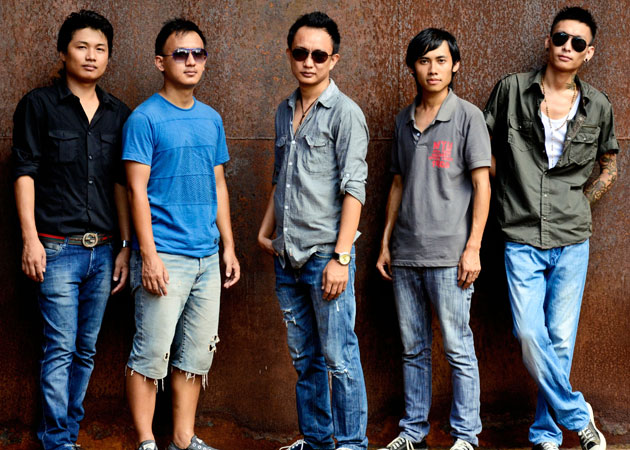
Painted Dreams by Alobo Naga And The Band from Dimapur in Nagaland has been nominated under Best Indian Act/Worldwide Act
A hit video by a band from Nagaland which featured in VH1's International Top 10 Chart Busters is among five Indian singles to be nominated for the MTV Europe Music Awards to be held in Frankfurt in November.

Painted Dreams by Alobo Naga And The Band from Dimapur in Nagaland has been nominated under Best Indian Act/Worldwide Act.

The other Indian groups in the list are Bandish Projekt (Lover Ft, Monica Dogra), the iconic Indus Creed (Fireflies) and Menwhopause (Easy) and singer-songwriter Oliver Sean (So good final movie).

The voting process has started in the MTV EMA 2012 official website and will end on October 14.

The video single Painted Dreams was the official theme song of prestigious 1st Guwahati International Short Film Festival (GISFF), 2011. It was conceptualised and directed by Prithish and Puja Chakraborty from Creovaent Productions, Guwahati.

"It's incredible; we are just speechless with the nomination. It's a proud moment for us and the entire northeast and especially for our musicians," said an excited Alobo Naga, the vocalist of the band.

"The nomination to this global platform shows the opportunities that are now open for western musicians from the northeast," said Prithish.

Painted Dreams was ranked among the Top 50 international music videos of 2011 by US channel VH1. It also featured at number four in VH1's International Top 10 Chart Busters, a list which had the likes of Lady Gaga, Christina Aguilera and Pitbull.

US Band To Rock Nagaland

Kohima, Sep 21 : Come Saturday, Kohima will be rocked by world famous Christian heavy metal band Stryper, from Orange County, California, US.

It will perform in Dimapur on Sunday.

This will be its first international concert in India.

The four-member band, a household name in Nagaland, will belt out their latest songs and collection of greatest hits like To Hell With The Devil, Honestly and Calling On You.

Michael Sweet tweeted that they were coming to India with certain amount of excitement. "God bless and see you," he tweeted.

Tickets are being sold like hot cakes for the Kohima and Dimapur shows at Indira Gandhi Stadium and Dimapur District Sports Complex.

The turnout in Kohima is expected to be huge as tickets are almost sold out, according to organiser Chakhroma Spor-ts Association. The tickets are pegged at Rs 1,000 and Rs 500.

The band members have already left for India from Washington DC, according to sources. The concert will also feature local bands Mengu Suokhrie and his group, Clueless Attention and Candence.

Stryper, originally known as Roxx Regime, was formed by brothers Michael and Robert Sweet and guitarist Oz Fox in 1984. Stryper stands for "Salvation Through Redemption Yielding Peace, Encouragement and Righteousness".

The Isaiah 53:5 under their logo is the Bible verse that states "by His stripes we are healed".

The band released its debut mini-album, The Yellow And Black Attack in 1984. Its first full-length release, Soldiers Under Command, sold over half a million units worldwide in the eighties, and stayed on Billboard's Top 200 album chart for over 40 weeks.

Manipur’s Oriental School Triumphs

Oriental English School, Manipur, winner of the Subroto Cup girls under-17 title at the Ambedkar Stadium in New Delhi on Thursday
A tactically brilliant Oriental English School, Manipur, got the better of Government Mizo High School, Mizoram, by a solitary goal to become the first girls’ under-17 champion in the Subroto Cup football tournament at the Ambedkar Stadium here on Thursday.
The Manipur girls began the summit clash as underdogs against the free-scoring Mizo team, whose star striker Offee Lalmingahualpuia had scored 14 goals in five matches before the final in the inaugural edition of the girls’ under-17 tournament.
But she was marked tightly throughout the final, and hardly got a scoring opportunity. The Manipur girls concentrated on fortifying their citadel and M.K. Kashmina showed brilliant presence of mind to nod home the winner in the 36th minute off a flag kick. It was to prove the winner.
With Lalmingahualpuia shackled, Government Mizo School seemed to lack a plan-B, and that cost them the match.
Manipur coach R.K. Amusana gave credit to the entire team for the success.
“We had specific plans for the match.
“We had studied the opponents and had ensured that Offee was marked well. Our players did a good job in executing the plan and that is the reason for our success,” said Amusana, who was later named the best coach of the tournament.
Kashmina, who had represented India at the under-13 level, was ecstatic after the final whistle and said she was overwhelmed by the fact that she had provided the team with the reason to celebrate. There was a goodly crowd to witness the final, prominent among them were Indian women’s team goalkeeper Aditi Chowhan, international Sushmita Mallick and India’s first women’s team captain Shanti Mallick.
The three were felicitated by the Subroto Mukherjee Education Sports Society and Indian Air Force for their achievements at the SAF competition which they won this week.
The winning team took home a prize of Rs.200,000 while the runner-up got Rs.100,000.
The results: Oriental English School 1 (M.K. Kashmina 36) bt Government Mizo High School 0.
Boys: U-17 (league): M.S.P. Higher Secondary School, Malappuram, Kerala 3 ( Sabith 2, Salman) bt St. Stanislaus School, Bhagalpur, Bihar 1 (Patras); Navyug School, Avenue I, Sarojini Nagar, New Delhi 1 (Suraj) bt Bangladesh Cadet College, Chittagong 0.
Other awardees: Best goalkeeper: K. Lalhruaizeli (Government Mizo High School); Best player: Lhingneikim Kips (Oriental English School); Highest scorer: Offee Lalmingahualpuia (Government Mizo High School).
Best coach: R.K. Amusana (Oriental English School); Fair Play: Ramakrishna Sarada Higher Secondary School, Tamil Nadu.
20 September 2012

Naga Church Team in Mizoram To Study Polls

Aizawl, Sep 20 : Leaders of the Nagaland Baptist Churches' Council (NBCC) recently visited Mizoram to study how free and fair elections are held here. Mizoram is considered a model state for free and fair polls by the Election Commission of India as the churches play a proactive role in curbing unfair poll practices.

Naga church leaders held discussions with the church-sponsored election watchdog, the Mizoram People's Forum (MPF). MPF leaders, headed by its chairman, Rev Thangzauva, the moderator of the Presbyterian Church Synod, informed the delegation that elections in Mizoram are always fair because churches, NGOs and political parties work in tandem and cooperate with government agencies.

NBCC delegates were also informed how constituents of the MPF and political parties work together during elections. NBCC leaders are members of the Working Committee on Clean Election, a forum formed by NBCC and led by its convener Hovithal Sothu. The other members are Panger Nungba, H Moba and Mong Zeuba.

The delegation also met leaders of the Presbyterian Synod, the central committee of the Young Mizo Association (YMA) and veteran politicians and former ministers, Zosiama Pachuau and C Chawngkunga.

Churches in Mizoram spread awareness before polling about the importance of electing the right candidate.

Mizoram District Councils Seek Direct Funding

Delhi hints at rejection of demand

By Nishit Dholabhai

New Delhi, Sep 20 : The Centre is unlikely to accept the demand of Mizoram autonomous district councils for direct funding.

The Lai, Mara and Chakma autonomous district councils of Mizoram had approached Prime Minister Manmohan Singh early this month with the request to fulfil the UPA government’s promise of direct funding and amending the Sixth Schedule made eight years ago by chairperson Sonia Gandhi.

“Rajivji gave you enhanced powers and more money by amending the Sixth Schedule in 1988. We are pledged to complete what was left incomplete by Rajivji — to further amend the Sixth Schedule and enhance your district council powers, including direct finance. But you too have to work hard and strengthen the party,” Sonia had written to Mizoram Congress workers in a Christmas message in December 2004.

Members of Direct Funding Demand Committee, led by Hmun Hre, recently reminded the UPA government of the promise.

A home ministry official, however, said, “It (direct funding) may not be possible”.

The Sixth Schedule grants autonomy to the hill districts in the Northeast but giving funds to autonomous councils remains under state control.

The Centre’s argument is that if it gives funds directly to the council, the existence of states would be rendered redundant. Citing the example of Meghalaya, home ministry officials pointed out that direct funding would create an abnormal situation as the entire state, except Shillong town, falls under Sixth Schedule areas.

Hre, the indefatigable septuagenarian leader from Lai council, however, is not willing to give up. “We have to complete several works, including linking the Kaladan project (an Indo-Myanmar joint project which will connect land-locked Mizoram with Sittwe port in Myanmar) and we are hopeful,” he said. For the Rangoon-educated leader, if the councils are not empowered and development brought about, the state of affairs would be similar to pre-Independence days.

Besides direct funding, the councils, which have a population of about 1.5 lakh, want to be re-christened autonomous territorial councils, want powers to decide on more subjects and want all centrally-sponsored schemes to be directly sanctioned and released by concerned ministries.

Asked if the government was in the process of amending the Sixth Schedule, Union home minister Sushil Kumar Shinde did not rule out action. “Not yet,” he told this correspondent.

Sources said if and when the Sixth Schedule comes up for amendment, several issues would be clubbed before bringing an amendment. “We can’t go to Parliament time and again,” one of them said.

Unlike opposition to direct funding by the Assam government, the Mizoram government is in favour of changes. In July 2009, chief minister Lalthanhawla had written to Sonia, acknowledging financial problems in the three councils that lie ensconced in the hills between Bangladesh and Mizoram.

“You may recall that you have even written to the Mara people before the district council election a few years ago that if we are voted to power in the council we shall take action for direct funding,” Lalthanhawla wrote in his July 8, 2004 letter.

The same month, Mizoram MP C.L. Ruala had also written a letter of support to the Prime Minister for direct funding to the councils.

Leaders of Mizoram’s autonomous councils have stepped up their campaign. Besides meeting Singh, they also called upon President Pranab Mukherjee and Shinde to press for their demand.

“Since Mizoram has been functioning as a full state…the three autonomous district councils have no option but to fall under their hegemony whether they like it or not,” the memorandum to Singh stated. It was signed by C. Ngunlianchunga, R.T. Zachono and Kali Kumar Tongchongya, the chief executive members of Lai, Mara and Chakma autonomous district councils, among others.