16 February 2012

Gorkha Leaders Seek Mizoram CM's Support

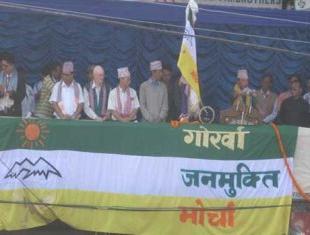
http://www.topnews.in/files/Gorkha-community.jpgAizawl, Feb 16 : A team of Gorkha leaders has sought the support of Mizoram Chief Minister Lal Thanhawla on the issue of a separate Gorkhaland in West Bengal, an official release said here on Thursday.

Siliguri-based Bharatiya Gorkha Parisangh (Federation of Indian Gorkha) leaders met the Chief Minister here Wednesday, the statement said.

The five-member team led by Parisangh secretary general Sukhman Moktam urged Lal Thanhawla to support their demand for a separate Gorkhaland in Darjeeling, it said.

"The Gorkha leaders requested the Mizoram Chief Minister to take up the issue with the central government at the earliest to form Gorkhaland."

On July 18 last year, a tripartite agreement was signed between the Gorkha Janmukti Morcha and the West Bengal and central governments to set up a new autonomous, elected Gorkhaland Territorial Administration, a hill council armed with more powers than its predecessor, the Darjeeling Gorkha Hill Council (DGHC).

Economic Activity Gains Momentum in Mizoram's Kolasib District

http://www.footprinttravelguides.com/content/India-New-Market-Aizawl-Mizoram_Vanessa-Betts_web.jpgKolasib, Feb 16 : Mizoram's Kolasib District is in the process of transforming itself into a centre for economic activity through the support of government schemes.ituated about 150 km north of Aizawl, Kolasib was once a safe haven for militants. today, it is witnessing rapid development as trade, and commerce activities have picked up in the region.

Busy roads and bustling markets clearly reflect this fact.

"I earn Rs 25,000 a month and my business is picking up. With rising incomes people are buying more and we are able to get more customers," said Vilkema, a shopkeeper.

"Infrastructure is improving in the area. The government is working well but there is a lot more that has to be done," said Lalsangpuii, a resident, Kolasib District.

Kolasib has an agriculture-dominated economy.

A large number of people here depend on farming and other agricultural practices for their livelihood.

They cultivate Beetle nut, oil palms, rice, wheat and fish, which is both consumed and exported to other districts and cities.

A new trend of entrepreneurship is growing among the farmers in the district.

Asha started here broiler-rearing business a year ago with help from the government.oday she rears 65 broilers and aims to expand her business.

"I am happy with the government help that I have received. I now want to sell fried chicken for which I am planning to buy a fryer. I aim to expand my business and earn more," said Enghluni, a beneficiary of government scheme.

The government has initiated several schemes like Indira Awaas Yojna, Mahatma Gandhi National Rural Employment Guarantee Scheme, Sarva Shikhsha Abhiyaan and New Land Use Policy Scheme for the benefit of farmers and local people.

"Mostly people here are tribals so most of the central government sponsored tribal schemes are active here in some form or other," said Niharika Rai, Deputy Commissioner, Kolasib District.

Kolasib is an important location in Mizoram as National Highway No. 54 passes through the district connecting different parts of the state to Assam.

It shares boundary with Assam's Cachar District and Hailakandi District on the north and North West respectively.

Bitter Irony: Meghalaya minerals not helping Locals

http://cache.daylife.com/imageserve/0gQ7cQp39iaNx/610x.jpg
Shillong, Feb 16 : The land in Meghalaya is rich - with minerals, flora and fauna in abundance - but the people of the state are still languishing in poverty. This is the irony with Meghalaya, which has large deposits of coal, limestone and even uranium, which, if judiciously exploited, could bring progress to the state and help alleviate poverty.

The fact that mining activities in Meghalaya have not really benefited the masses is perhaps one of the reasons why there has been consistent opposition to the extraction of limestone and proposal to mine uranium from various quarters and pressure groups. "The benefits have not percolated down to the grassroots," said a former legislator on condition of anonymity.

Citing example of the ongoing limestone extraction by a multinational company in Shella in East Khasi Hills for supply to a cement factory in Bangladesh, he rued the fact that raw limestone is being siphoned off without adding value to it. "It is not regenerating the rural economy, which is in a shambles. The limestone should have been taken to the clinker stage at least, if not used here itself to manufacture cement before being exported. This would have provided employment to the local people," he said. "The conveyor belt of the company was burnt down some years back perhaps because the locals were not happy as they did not get a slice of the pie."

On the other hand, the unscientific "rat-hole" coal-mining processes deployed in Jaintia Hills has not only damaged the ecology of the region, but has also failed to uplift the economic condition of the locals. It is the rich coal merchants who have benefited, while those who toil in the mines under life-threatening conditions continue to live in abject poverty.

The case with agro-horticultural produces is not much different either. "Whatever is taken out of the state - broom-sticks or fruits or other agricultural produces and minerals - should be processed here instead of being exported in raw form," said J Lyngdoh, an upcoming entrepreneur. "The income has to spread over a greater number of people and not benefit just a privileged few. Only then can we regenerate the rural economy."

"Bangladesh is importing fruit pulps from Andhra Pradesh. The same could have been done here in Meghalaya and we could be exporting local products to the neighbouring country, which is our natural market and not mainland India. Our fruits are either left to rot or exported in the raw form," he said.

Manipur Film Fraternity Protests Against Extortion By Militants

https://blogger.googleusercontent.com/img/b/R29vZ2xl/AVvXsEgFONvWAUpqRI6KVFdh1nFhIvqkd8MkOzsjjmMCzA8OJAn_l6-7VKYQVOt9Hk_-iLUC05EWskAHtlyPqjY1D_I69TeqE2YkLl7ulH_EcunL_Sa9zx9gmQ_d2DKhmfa2Ux-o1Zn4sEsekapT/Imphal, Feb 16 : Over the years, filmmakers in Manipur have been using cinema as a medium to expose militant outfits and present a real picture of the insurgency affected state to the world.

In retaliation, militant groups have imposed monetary demands and unnecessary guidelines on the film fraternity.

Cinema halls in Imphal were recently shut for 23 days in protest against threats by insurgents against film production houses. They wore a deserted look from January 9 to February 1 as insurgents demanded money and sent out guidelines about film productions.

"Some of the underground groups are demanding money from film production houses. We are producing films but it does not mean that we have lots of money. Instead we are struggling and working hard for our survival," said Oken Amakcham, a film director.

The film fraternity under the aegis of Manipur Film Forum condemned the threats.

The shut down affected nearly 3000 people associated with the industry. Though the strike has been called off now but uncertainty still exists in the minds of filmmakers.

Manipur film industry is not as big as Bollywood. It produces low budget regional films that have a smaller market. So there is not much for insurgents to extract.

"We want film and education to be a free zone. It is not good to disturb us in our work of film production. We appeal them from now onward not to disturb in our film fraternity," said Surjakanta Sharma, president, film forum Manipur.

" We urge the militant not to do any such demand, threaten and not to do anything, which is going to harm in our film production. We want to work peacefully without stopping or troubling us," added Memma Devi, a protestor.

Over the years, insurgents have been trying to control the entertainment industry in Manipur.

They banned Hindi films in 1990 that forced several halls to shut down as they lacked audiences thereafter. As of today there are only three theatres Usha, Mini Friends and Pratap Talkies in Imphal, all the rest have either been converted to schools or shopping malls.

In 2011 Kangleipak Communist Party had made similar demands that had lead to the closure of cinema halls for 10 days.
15 February 2012

India Undertakes $51m Railway Project to Link Akhaura With Agartala

By Nizam Ahmed and Jasim Uddin Haroon

New Delhi, Feb 15 : As part of its bid to harness all-out benefits from the proposed transit through Bangladesh, India has undertaken a $51 million railway project to connect Bangladesh's southeastern border town Akhaura with Agartala, capital of India's northeastern state of Tripura, officials said on Tuesday.

The implementation of the project is likely to start in a couple of months as the authorities concerned in India are expected to allocate the fund under the annual budget for the fiscal year 2013, to be announced in March next, they said.

"The project will be exclusively funded by Indian government, and Bangladesh will cooperate for its timely completion," a senior official of the ministry of railways told the FE.

The 15-km railway track project, when completed by the end of 2014, will open scope for movement of goods trains between Agartala and Kolkata, in Pachimbanga, drastically reducing the distance between the two state capitals, traders said.

Agartala, for instance, is 1,650 km from Kolkata and 2,637 km from New Delhi via Guwahati (Assam) and Pachimbanga, whereas the distance between the Tripura capital and Kolkata through Bangladesh is just about 350 km, railway officials said.

The 15-km railway track project comprising 5.0 km in the Indian territory and the rest in Bangladesh, when completed is expected to greatly hasten implementation of the proposed transit facility for India through Bangladesh.

However, India and Bangladesh presently in talks to implement the transit pledges, will require several more rounds of talks to evolve effective modalities for the desired facilities for India to carry consignments to and from its northeastern states via Bangladesh.

The latest round of a two-day talks between officials of Bangladesh and India to implement road and river transit ended inconclusively in Dhaka on Monday, officials said.

Meanwhile, the railways are seen as most effective and viable mode for transit, which can be implemented in the shortest possible time, while transit though roads and river protocols may take a long time for implementation.

For implementation of transit by road and river links, existing infrastructure are needed to be upgraded at a cost of millions of dollars and these up-gradations are likely to take a decade, experts involved in communications sector told the FE.

Due to poor infrastructure Bangladesh was compelled to stop a test transit through river protocol-cum-road-transit late last year, as existing infrastructure at Ashuganj river terminal and Akhaura land-port were very much fragile, port officials said.

The roads, bridges and culverts along the roads running between Ashuganj and Agartala were also found much brittle compelling the authorities to suspend the shipment of heavy consignments.

Traders said the existing railway connectivity between Agartala and other destinations including Kolkata via Dhaka was still better to withstand the pressure of transit movement, transport operators said.

However in addition to existing air connectivity, train and bus services for passengers were introduced between Kolkata and Dhaka several years ago to facilitate exchange of visits by people of Bangladesh and Pachimbanga.

The 15-km railway track when laid by India, will connect Agartala also with Bangladesh's capital Dhaka, main port Chittagong and the country's northeastern Sylhet, famous for gas fields and tea gardens.

The scheme to connect Agartala with Akhaura was mulled immediately after Bangladesh Prime Minister Sheikh Hasina had agreed to give transit facilities to India through Bangladesh, during her visit to New Delhi in early 2010.

"The railway project, when implemented, will help Indian traders avoid hazardous journey through mountainous region to carry goods between Agartala with Kolkata and New Delhi," a senior Indian railway officer told Indian press on Tuesday.

For carrying goods and heavy machinery to the northeast from abroad and other parts of the country, India has for long been seeking land, sea and rail access through Bangladesh.

Meanwhile, another FE report adds: India wants to put into operation transshipment through Ashuganj immediately to ferry cargoes to the north-eastern Indian states, official sources said Tuesday.

"For this, the Indian delegation stressed quick implementation of the construction of an inland container terminal at Ashuganj port," said a member of the Bangladesh-India standing committee under the protocol on inland water transit and trade.

The 14th meeting of the committee was held in Dhaka on Sunday and Monday between Bangladesh officials and an Indian delegation that left Bangladesh Tuesday after a two-day visit.

The two sides met in the city where Bangladesh agreed in principle to allow Indian bulk cargoes to use Ashuganj as transshipment terminal.

The committee member, belonging to the Bangladesh side, said the Indian delegation had expressed its interest to invest around Tk 10 billion to complete the remaining construction of the Ashuganj port.

He said Bangladesh government had taken a number of development projects to make the port operational.

The member, who wished not to be named, said once the infrastructural facilities were available, the port could be put into operation for Indian bulk cargoes.

"Bangladesh at the joint meeting agreed not to insist on bank guarantees as proposed by the Indian side," he added.

Currently, there is a system for bank guarantees while ferrying Indian cargoes through the Ashuganj port.

According to agreed minutes, both sides would take necessary steps for providing full-fledged facilities at Akhaura and Agartala land customs stations (LCSs).

Akhaura LCS is on the Bangladesh side, and the one in Agartala is on the opposite side.

However, Bangladesh will form a committee comprising members of Bangladesh Inland Water Transport Authority, National Board of Revenue and ship-owning companies in the private sector to make the cargo movement smooth along the water routes.

The committee was formed as the Indian side had wanted that its vessel operators be allowed to shift transshipment from deeper-draft vessels to shallow draft vessels, including their movement through midstream, and cargo carrying from water vessels to trucks, and vice-versa.

Earlier in September, three trial runs were conducted using Ashuganj as a transshipment port by India as had been agreed upon at the 13th committee meeting held in Goa in India.

Crime Against Women Rise in Northeast


New Delhi, Feb 15 : The northeastern states have recorded a sharp rise in incidents of crime against women, the Women Power Connect (WPC) said Tuesday.

Ranjana Kumari, the WPC president, said women were traditionally held in high esteem in northeastern societies.

Unfortunately the situation has changed and incidents of crime against women has been rising, she said.

“What is more worrying is the fact that sex selective abortions are on the rise in the northeast, a term quite unheard of till a few years back,” she said.

Ranjana Kumari was here to address a workshop on “Strategizing Advocacy for Effective Implementation of Women Friendly Laws” organized by Impulse NGO Network, a known anti-trafficking NGO working in the region.

“While poor economic conditions and increasing unemployment remained key factors, another factor that has played a major role for the worsening statistics is the abuse of drugs and alcohol among the young,” she said.
Ranjana Kumari is also the director of Centre for Social Research, a New Delhi based organization.

Chairperson of Impulse NGO Network Hasina Kharbiah said there was an increase of about 40 percent in incidents of crime rate against women in 2011 in the whole of the northeastern states compared to 2010.

Kerala Must Learn From The Northeast

Players of Josco FC (in red) and Malabar United FC vie for the ball during a tournament held in Kochi. Both the teams, which played second division last year, are now defunct.
Kochi, Feb 15 : Players of Josco FC (in red) and Malabar United FC vie for the ball during a tournament held in Kochi. Both the teams, which played second division last year, are now defunct.

While the football clubs from the State are groping in the dark, the country has found new champions in the North Eastern States as the teams from there have proved to be the best in the second division of the I League so far.

Exposure, skills and youth development are the fields in which Kerala lags while focus on the same has contributed to the growth of the football clubs from the States including, West Bengal, Assam, Meghalaya, Orissa and Mizoram.

The Kerala contingent for the second division consists of just three teams whereas last season it was five teams. Three teams, Chandni FC, Malabar United and Josco FC are not playing this season in the second division while the only additional team that is playing is Kozhiikode-based Quartz FC.

While the Kerala teams were losing emphatically, the clubs from these states were making strides in the group battling for the top position. “If we consider skills, they have improved a lot. Several young and energetic players have added value to the teams.

This is one of the main reasons, they are outplaying our clubs,” said Jo Paul Ancheri, the coach of Eagles FC, which is currently playing in the second division.

“Another problem is the lack of match exposure. A team from Kolkata or Assam is coming to the second division after playing their A division leagues.

This contributes a lot to experience to the players and subsequently they will be in a better position,” he said. Several players of our teams are also wooed by sevens tournaments and after playing there most of them will be unfit to play in the regular matches, he said.

The teams from North East States are also better at spotting foreign players, that is one of the major reasons of their wins. Most of the clubs have also youth teams and training programmes that ensure good bench strength, he explained.

Meanwhile, Kerala Football Association is trying to revive the state league, which was defunct for years. “From next season onwards, we will most probably have the state league. Until now, we were not able to conduct it but we have now understood the importance of the league,” said P. Anil, KFA secretary.

“Most of the clubs are free to participate in several all-India tournaments conducted in every state. So lack of tournaments is not a real excuse of the defeats,” he said.
14 February 2012

Save-Lives Campaign Mark Valentine's Day in Mizoram

Aizawl, Feb 14 : It is 'save your own life' and 'save others' lives' campaign that will mark this year's Valentine's Day tomorrow with one group organising an anti-suicide campaign and another a blood donation campaign.

A 19-year-old girl committed suicide in Aizawl on Valentine's Day last year after her boyfriend called it quits to their relationship via text message. Though this shocking incident was the only known suicide on a Valentine's Day in Mizoram, failed relationship was found to be the single biggest factor behind youth suicides in this Christian-dominated state during the last few years.

According to New Life Charity Society (NeLICS), an Aizawl-based organisation for mental health, a disturbing 24 per cent of 72 incidents of suicide were committed by lovers who felt rejected. This prompted the organisation to plan an anti-suicide campaign on this year's Valentine's Day. We recorded 72 cases of suicide during last year, of which 24 per cent was caused by failed love affairs.

We need public awareness on this disturbing trend, said Dr Zawmsanga Sailo, secretary NeLICS.

During last year, NeLICS provided counselling to 472 people having suicidal tendency of which were broken-hearted due to failed marriages and love affairs. We have saved a number of dejected lovers from suicides during last year, the NeLICS secretary said.

According to the doctor, the 19-year-old girl who killed herself last year, had talked to a friend over mobile phone in which she shared her problems. As I was walking on the road when she called me, I suggested that we discuss it later in the night.

But, she committed suicide before that could happen, he said. Besides anti-suicide campaign, mass blood donation will mark this year's Valentine's Day in Aizawl.

Under the theme 'Blood For Your Valentine', the V-Day blood donation programme was started by a popular local TV host Zikpuii since two years back. Last year, 340 units of blood were donated under this programme, an increase from 174 units of blood in 2010's Valentine's Day.