25 January 2012

Protected Area Permit Extended in Mizoram

http://theoff.info/wordpress/wp-content/uploads/2010/04/NERF.pngAizawl, Jan 25 : The Protected Area Permit(PAP) regime, in which foreigners desiring to visit some states are required to have special permit from the union home ministry has been relaxed for yet another year in three NE states with some conditions.

A letter from the Union Home Ministry to Mizoram chief secretary Van Hela Pachuau, today said PAP relaxation was extended for another year from December 31, 2011 in the states of Mizoram, Manipur and Nagaland.

Visitors from Afghanistan, Pakistan and China would, however, require prior permission from the union home ministry to visit the three states and those from Myanmar could cross the border and travel upto 16 km with permission from it.

All foreigners visiting the three north eastern states have to report themselves to Foreigners Registration Officers of the respective states within 24 hours and foreign Christian missionaries visiting the states were required to obtain missionary visas, the letter said.

Mizo Farmers Reap Benefit From Oil Palm Cultivation

Aizawl, Jan 25 : The Government of Mizoram is increasingly promoting oil palm cultivation in the state with multiple aim of generating jobs, benefiting farmers and attracting edible oil makers.

It has earmarked 1,33,000 hectares of land in Mizoram for oil palm cultivation as the region's climatic and geographical conditions are suitable for its growth.

Farmers can harvest oil palm seeds 3-4 times a year and a bunch of oil palms weigh nearly 30-35 kg. They sell the seeds to private organizations at a cost of Rs 4.75 per Kg from which edible oil is produced.

Over 3000 families are engaged in oil palm cultivation across Mizoram of which nearly 850 are in Kolasib district.

"Oil palm, sugar, vegetables, these are the main crops. We are giving our best advice to the cultivators by providing them field school lessons, giving field visits and other things so that the production can be increased," said K Zirliana, District Agricultural Officer, Kolasib.

R. Thansiama, a farmer, who have taken up oil palm cultivation, recently received Rs 45,000 monetary support from the state government under the New Land Use Policy Scheme to expand his farm.

He started planting palms in 2002 and owns over 1000 of these in his seven-hectare large farm.
"In the first year, I planted 300 trees, in the second year, I planted 500 trees and as of today I have more than 1000 trees in my farm," Thansiama, said.

Biggest Arms Surrender To PC By 9 Rebel Groups

By Prabin Kalita
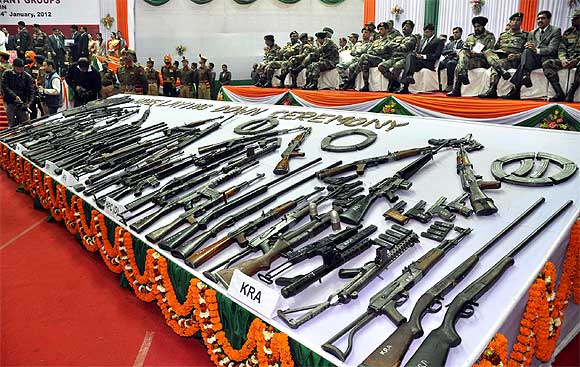
http://im.rediff.com/news/2012/jan/24slde1.jpg

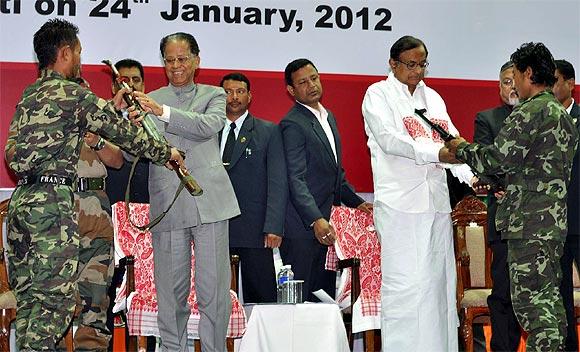
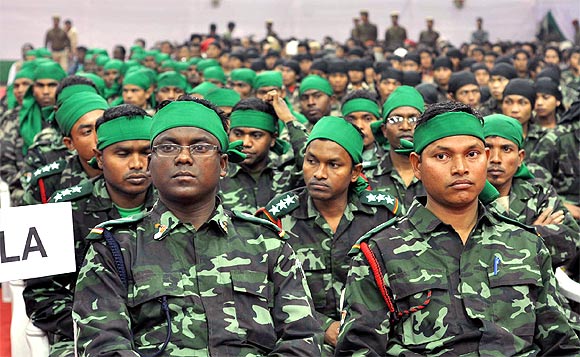
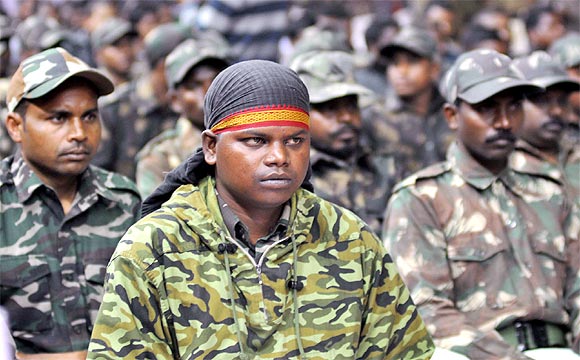
Guwahati, Jan 25 : Militancy-hit Assam was able to shirk off this tag on Tuesday with the biggest surrender of over 1,600 cadres of nine outfits in a day. However, a few remnant groups, including Ulfa hardliners led by Paresh Baruah, did not join the peace process.

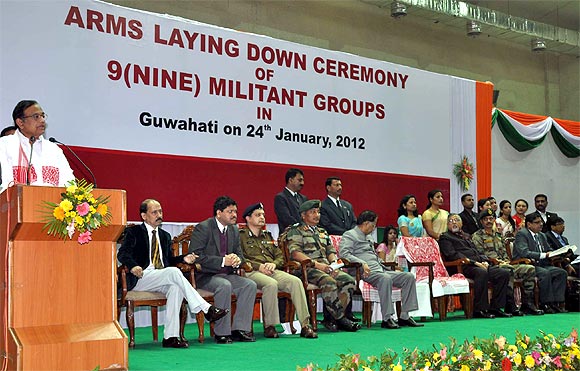
An assortment of about 201 small and big weapons were deposited by the groups comprising five Adivasi, three Kuki and a Hmar outfit, before Union home minister P Chidambaram and chief minister Tarun Gogoi. Welcoming the cadres back into the mainstream, the home minister said, "We can build a great India, a great economy and we ask you all to join us in this glorious task of nation building."

Gogoi, on the other hand, reiterated his appeal to Baruah and his group to join the peace process. "Our doors are open for those who are willing to join the peace process but we will firmly deal with hardliners," he said.

http://im.rediff.com/news/2012/jan/24slde2.jpg
Hailing the mega arms surrender ceremony, the home minister said, "Not often do we see so many groups, which have taken the path of militancy, returning to the path of peace, reconciliation and brotherhood. We believe that in our republic and democracy every voice deserves to be heard and all differences can be settled through talks and consultations."

Chidambaram said, "In the past couple of years, we have reached out to several outfits. We have signed the suspension of operation with the pro-talks faction of Ulfa, we have signed a memorandum of settlement with UPDS and negotiations with the DHD(J) are in the final stages. We expect a memorandum very soon, talks with DHD(N) are progressing well and talks with the NDFB (Progressive) will continue. Talks with the KLNLF are also progressing and the Ranjan Daimary faction of the NDFB has declared unilateral ceasefire."

The nine outfits, Kuki Revolutionary Army, United Kukigram Defence Army, Hmar People's Convention (D), Kuki Liberation Army, Adivasi Cobra Military of Assam, Birsa Commando Force, Santhal Tiger Force, All Adivasi National Liberation Army and Adivasi People's Army had earlier declared a ceasefire. Chidambaram added, "We assure you that the government of India and the government of Assam will treat everyone of you as equal citizens with honour and dignity."
http://im.rediff.com/news/2012/jan/24slde3.jpg
Also present at the ceremony were the 4th Corps GoC Lt Gen Shakti Gurung, 3rd Corps GoC Lt Gen Dalbir, director general of police and chairman of the Operational Group (Unified Command), J N Choudhury, GoC, Red Horns division Major General R N Nairand GoC Red Shield Maj Gen Binoy Poonnen.

The additional director general of Assam Police (special branch), who was responsible for the arms surrender ceremony, said, "All major outfits have finally come to the peace process except a few remnants and deserter groups."

http://im.rediff.com/news/2012/jan/24slde5.jpghttp://im.rediff.com/news/2012/jan/24slde4.jpg

Meghalaya To Train Teachers Online

Shillong, Jan 25 : Meghalaya government is tying up with IGNOU to train its elementary school teachers ‘online’ to save on teachers’ training programmes and cope with the demands of the provisions of Right to Education (RTE).

“We are tying up with Indira Gandhi National Open University (IGNOU) for imparting on-line ‘in-service’ training to the teachers of the state this year,” the Education Minister Mr Roytre C Laloo told reporters here.

“Besides, fresh teachers will also be given a two-year training course by DIETs of the state,” he said.

According to the minister, “The online concept of providing training to the teachers will, to a great extent, reduce the expenditure as the government has to pay two salaries for a given post when the teacher has to go for teachers’ trainings.”

Mr Laloo said, “The amount thus saved from in-service teachers would be used for sending those fresh teachers for trainings.”

At present, Meghalaya is facing shortage of trained teachers which is another challenge in implementing the RTE in the state, the minister said.

He further informed that an official committee of a six-member ministers including Meghalaya will hold a meeting to discuss on the draft rules to curb unfair practices by students and institutions.

“The meeting will be held by February 15,” he said.
20 January 2012

78 Lakh Trees To Be Felled For Tipaimukh Dam


By Roopak Goswami

Guwahati, Jan 20 : Seventy-eight lakh trees will be chopped as part of the forest clearance process for the 1,500MW Tipaimukh hydroelectric project in Manipur, an exercise that Prime Minister Manmohan Singh says will be taken up for “national interest”.

The project, which has been in the eye of controversies following opposition from Bangladesh, has received support from the Centre, which has promised not to take any steps that would adversely affect the neighbouring country.

The project near the Manipur-Mizoram border, 500 metres downstream of the confluence of river Barak and the Tuivai in Churachandpur district of Manipur, received environmental clearance in 2008.

Alarmed by the diversion of a very large area of forest land and felling of more than 78 lakh trees, the forest advisory committee, under the ministry of environment and forests, has recommended that a sub-committee, along with domain experts in the field of ecology, wildlife, hydrology and others, visit the project site to make an on-the-spot assessment of impacts.

The committee, which met on January 11-12 in New Delhi, also recommended that the sub-committee may suggest appropriate measures on further reduction in dam height to minimise forest land requirement.

The committee said the forest land proposed for diversion contains 78,16,931 trees and 27,000 bamboo columns.

Principal chief conservator of forests, Manipur, has been quoted in the report as saying “no compensatory measure would help in mitigating the loss caused by felling of such large number of trees as also the diverse impact on the habitat, flora, fauna, bio-diversity and environment, unless additional non-forest areas in affected districts or adjoining districts are taken up for compensatory afforestation”.

The per megawatt requirement of forest land at 16.22 hectares is also substantially high, the committee said.

Manipur had initially submitted a proposal to obtain approval of the Centre under the Forest (Conservation) Act, 1980, for diversion of 20,464 hectares of forest land, which was later revised to 25,822.14 hectares.

Later, according to the consideration of recommendations made by the northeastern regional office of the ministry of environment and forests, the area of forest land proposed for diversion was further revised to 22,777.50 hectares.

Mizoram also sent a proposal for diversion of 1551.60 hectares of forest land, which is being processed separately.

The total diversion is 24,329 hectares of forest land, of which 22,777.50 hectares is in Manipur and 1551.60 hectares is in Mizoram.

The project is being executed as a joint venture of the NHPC (69 per cent), Satluj Jal Vidyut Nigam Limited (26 per cent) and the Manipur government (5 per cent). It was initially proposed to be executed by the North Eastern Electric Power Corporation Limited.

The Tipaimukh project is expected to take 87 months for completion and will come up during the 12th Five Year Plan. The total cost of the project is estimated at Rs 9,211 crore at September 2008 price level.

Many project proponents, including government departments have been urging the Centre to expedite the process of granting environment and forest clearances as otherwise the projects were getting delayed.

Though the environmental clearance given in 2008 had said downstream impacts of the project in Assam should be studied because of construction of the dam, sources said nothing had been done till now.

The clearance letter had also said since the Tipaimukh project involved large submergence, a comprehensive study of the possible greenhouse emissions from the project should be carried out.

Sources, however, said this also had not been done. “How shall we kill ourselves in an age of climate change...let us count the ways. Instead of investing money in enhancing efficiency and making existing hydroelectric power projects deliver on failed promises, myopic planners in the Prime Minister’s Office and Planning Commission are laying out a silken trap for the Indian people...promising power and delivering a slow death from ecological instability instead,” wildlife expert Bittu Sahgal told The Telegraph.

“This is going to be an ecological disaster. There is great impact in the upstream area and one can very well imagine what may happen downstream, which has still not been studied,” Firoz Ahmed, wildlife conservationist from Assam, said.

“This will be transformed into a desert. This is an exceptionally rich biodiverse area,” R.K. Ranjan Singh, an environmentalist and adviser to the Manipur-based NGO Citizens’ Concern for Dams and Development, said.

“No project in the country, howsoever necessary, should be cleared by any authority if it involves large-scale cutting of trees. Such action is a disaster for the future of a nation and the country requires a strict land use policy urgently,” Valmik Thapar, eminent wildlife conservationist, said.

Tough Tipaimukh Test For Manipur’s Chosen One

By Naresh Mitra

tipaimukh-dam-map One point on the National Highway 53 in Manipur's Tamenglong district - where the Barak river flows quietly between lush-green hills before entering Assam to create the fertile Barak valley - has to be one of the most photoraphed spots in the state.

But one recent evening, when passengers of a bus travelling via the stretch stepped out to click some pictures with the setting sun in the backdrop, they were greeted by an ominous prophecy. In broken Hindi, a Zeliangrong youth, incidentally from a village also named Barak, said: "The river will be killed and it's beauty will never be the same again. And with the death of the Barak, our people will be in great danger."

The youngster was referring to the 1500-MW hydro-electric project at Tipaimukh in Manipur's Churachanpur district. His concern is shared by civil society groups in Manipur, but even with the assembly election approaching, politicians have ignored the issue which could imperil the safety and liveihoods of those living in the catchment areas of the Barak.

One particular tribe that depends on the Barak - or Ahu, as the river is known among locals - is the Zeliangrong Nagas of Tamenglong district. Zeliangrongs - an acronym coined in February 15, 1947 to represent Zeme, Liangmai, Rongmei and Puimei tribes under one name - are proud of their heritage and still recall the anti-British resistance under the leadership of Haipou Jadonang and later Rani Gaidinliu with pride. "A large chunk of Naga-dominated areas, including Tamenglong, will be affected, but surprisingly, even some Naga politicians in the fray are more concerned with the issue of integration of Naga-dominated areas rather than talking about the dam," an Imphal-based activist, said.

Pointing out that more than 100 villages are likely to be submerged once the project is complete, Aram Pamei, president of the Imphal-based Naga Women's Union (NWU) said politicians hardly seem concerned about the rammifications of the hydel project. However, Pamei observed that some Naga politicians are indeed voicing their concerns regarding protection and land and resources of Naga people. "There are a few Naga politicians who are raising the issue, but politicians and political parties on a wider scale should have shown more concern about the project in this election," Pamei observed.

Last year, the Congress-led Manipur government signed a tripartite MoU with NHPC Limited and Satluj Jal Vidyut Nigam Limited to implement the project, which has also met with some opposition in Bangladesh.

CPI candidate Letkhongam (Angan) Touthang, who is contesting from Jiribam constituency, has said that review of the Tipaimukh project is one of the major poll issue in this election. "Concerns over Tipaimukh is a people's issue. The project will not only affect people of Manipur but also Assam's Barak valley. Even my constituency faces the threat of submergence," he said.

Manipur government spokesperson and Congress leader, N Biren Singh said that project is going to usher in an era of development. "Power availability is a must for development, and Tipaimukh will aid Manipur's growth. Of course there will be submergence of areas, but there will be adequate rehabilitation for the affected people. We will take all the necessary care," he assured.

Meghalaya: Where Women Rule, And Men Are Suffragettes

By Timothy AllenKhasi women smiling

In the small hilly Indian state of Meghalaya, a matrilineal system operates with property names and wealth passing from mother to daughter rather than father to son - but some men are campaigning for change.

When early European settlers first arrived here they nicknamed it "the Scotland of the East" on account of its evocative rolling hills.

Coincidentally, today the bustling market in the state capital, Shillong, is awash with tartan in the form of the traditional handloom shawls worn ubiquitously since the autumn chill arrived.

Not far from here the village of Cherrapunji once measured an astonishing 26.5m (87ft) of rain in one year, a fact still acknowledged by the Guinness book as a world record.

But the rainy season is over for the time being and it is Meghalaya's other major claim to fame that I am here to investigate.

Men wearing tartanTartan, and pipes, are popular in Shillong

It appears that some age-old traditions have been ruffling a few feathers of late, causing the views of a small band of male suffragettes to gain in popularity, reviving some rather outspoken opinions originally started by a small group of intellectuals in the 1960s.

I am sitting across a table from Keith Pariat, President of Syngkhong-Rympei-Thymmai, Meghalaya's very own men's rights movement.

He is quick to assure me that he and his colleagues "do not want to bring women down," as he puts it. "We just want to bring the men up to where the women are."

Mr Pariat, who ignored age-old customs by taking his father's surname is adamant that matriliny is breeding generations of Khasi men who fall short of their inherent potential, citing alcoholism and drug abuse among its negative side-effects.

"If you want to know how much the Khasis favour women just take a trip to the labour ward at the hospital," he says.

"If it's a girl, there will be great cheers from the family outside. If it's a boy, you will hear them mutter politely that, 'Whatever God gives us is quite all right.'"

Map of India

Mr Pariat cites numerous examples of how his fellow brethren are being demoralised. These include a fascinating theory involving the way that gender in the local Khasi language reflects these basic cultural assumptions.

"A tree is masculine, but when it is turned into wood, it becomes feminine," he begins.

"The same is true of many of the nouns in our language. When something becomes useful, its gender becomes female.

"Matriliny breeds a culture of men who feel useless."

I talk to Patricia Mukkum, the well-respected editor of Shillong's daily newspaper. She assures me that her heritage is only one of the reasons why she has risen to the level she has and points out that the tradition of excluding women from the political decision making process is still very strong in their culture.

As a mother of children by three different Khasi fathers however, she is the first to admit that their societal anomaly has afforded her ample opportunities to be both a mother and a successful career woman.

Making reference to the routine problems facing women just over the border in West Bengal, Miss Mukkum is resolute.

"Our culture offers a very safe sanctuary for women," she declares.

I decide to see for myself in a remote village in the East Khasi Hills. After two hours walking through thick jungle I meet 42-year-old Mary.

She is a "Ka Khadduh", the youngest daughter in her family and consequently, the one destined to live with her parents until she inherits the family house. Her husband, 36-year-old Alfred, lives with them.

When I talk to her inside their home, Mary tells me that women do not trust men to look after their money so they take control of it themselves. I glance at Alfred for a response but he musters only a smile.

Mary goes on: "Most men in our village leave school early to help their fathers in the fields. This is a great detriment to their education."

I turn to Alfred once more. He responds with another shy smile.

Mary admits she has never heard of the men's right's movement, but thinks the system will never change.

A Khasi woman cookingKhasi women are in charge of running the household

Alfred maintains his Mona Lisa smile.

As we are talking, a praying mantis careers into our hut and slams into the side of my head.

After the laughter dies down, I take the opportunity to break the ice with Alfred by pointing out that female mantises eat their mates after sex, making a gesture with my arms mimicking the insect's claws, an action the Khasi called "takor" and one which turns out to be the gesticular equivalent of sticking two fingers up at someone. There is more laughter at my expense.

Forty minutes later however I have yet to get a comment from Mary's husband and all too soon it is time to leave.

I feel that the last word should come from Alfred so I ask my translator to target a simple question directly at him.

"What does he think of the matrilineal system?"

There is a long and considered pause. After what seems like an eternity the silence is finally broken.

"He like," pipes up Mary, and it is time to go.

How to listen to From Our Own Correspondent:

BBC Radio 4: A 30-minute programme on Saturdays, 11:30 GMT.

Second 30-minute programme on Thursdays, 11:00 GMT (some weeks only).

Listen online or download the podcast

Manipur & Its Search For Elusive Justice

By Meenakshi Ganguly

manipur peace

Manipuris want impunity to end. Not only has it shattered any existing faith in the justice system, many feel it has emboldened the security forces to commit further abuses.

Manipuris will soon stand in line to vote for a new state government. As with voters elsewhere, during the campaign they will be promised jobs, development and new infrastructure. The one promise on which successive governments have failed to deliver, however, is one of bringing justice to the people of the state.

Manipur has remained under the stranglehold of abusive armed groups and inept politicians. In each election, the armed groups — and there are many, with a range of political demands, though they are mostly extortion gangs — have called for a boycott of the polls. Those who participate, candidates and voters alike, risk violent attacks.

Things are so bad that earlier this month, all newspapers in Manipur published a blank editorial, in response to threats from armed groups that insist that the newspapers publish their statements. Newspapers face a double whammy: some militants have also demanded that they not publish statements of rival groups.

In the hope that an elected government will finally do its job, that of providing security and upholding fundamental rights, Manipuris have ignored the threats and turned out to vote. Yet, the government has failed to ensure even the most basic rights of life and liberty. Armed groups aside, Manipuris remain at risk of arbitrary arrests, torture and extrajudicial killings by the government’s own security forces.

The state government and local administration have also failed to address grievances that feed public discontent and support for militant groups. All of these problems are made worse, though, by Manipur’s climate of impunity. The Central government, while claiming to be committed to protecting human rights, has largely ignored serious violations by its security forces, at best attributing abuses to a few “bad apples”. But even in cases involving “bad apples”, the government rarely investigates, let alone prosecutes those responsible. Manipuris want impunity to end. Not only has it shattered any existing faith in the justice system, many feel it has emboldened the security forces to commit further abuses. Impunity, fostered both by a lack of political will and by laws shielding the abusers, has led to an atmosphere in which security forces are effectively above the law.

The lack of accountability has become deeply rooted because of the Armed Forces Special Powers Act (AFSPA), the 1958 emergency law under which the armed forces are deployed in internal conflicts and enjoy broad powers to arrest, search and shoot to kill. The law is widely despised among the population because it provides soldiers who commit atrocities effective immunity from prosecution.

When the Central government isn’t ignoring Manipur, it tries to sweep Manipur’s problems under the carpet. In December, the police in Delhi went so far as to refuse permission for a solidarity protest to support a decade-long hunger fast by Irom Sharmila, who has demanded the repeal of the AFSPA ever since soldiers gunned down 10 civilians in Manipur on November 2, 2000. She is nasally force-fed in judicial custody.

The AFSPA has led to abuses and serious hardships in other parts of the country. In Jammu and Kashmir, the repeal of the law has become a crucial election issue. Chief minister Omar Abdullah has spoken out against it.

But in Manipur, where the law has been in force much longer, political leaders have found neither voice nor wisdom. Irom Sharmila may have become known for her courage and her peaceful endeavour in India and beyond, but in Manipur’s capital, Imphal, the government has ignored her appeal. Instead, Manipuris remain hostage to an Army that claims it cannot operate without the powers and immunity provided by the AFSPA.

Hardly anyone in Manipur disputes that armed groups pose a serious security risk. Last year, two militant groups successfully imposed a three-month economic blockade on the surface supply of goods, crippling the economy and pushing prices out of control. Manipuris want law enforcement, but without human rights abuses or a blank cheque for the security services. The Army’s several decades of deployment in Manipur have not only resulted in widespread abuses but polarised the situation. The Army is damaging its reputation in India and abroad by insisting on protecting perpetrators of human rights abuses.

In 2004, following widespread anger over the custodial killing of a suspect, Manorama Devi, by the Assam Rifles, Prime Minister Manmohan Singh arrived in Imphal with a promise to review the AFSPA. The review committee — and several other experts since then — recommended repeal of the law. The Army opposes repeal. Now halfway through his second term, Dr Singh has been unable to prevail over his divided Cabinet to deliver on the promise.

Manipur erupts into national news only when the rage brings Manipuris out onto the streets. The Central government takes notice when the Assembly building is burnt down, elderly women strip and invite the Army to rape them as they have raped others, prices become ridiculously high due to weeks of blockade or when mothers and schoolchildren engage in weeks of demonstrations. It should not take such drama for the government to wake up to the problems in this corner of the Northeast.

The writer is the South Asia director at Human Rights Watch