19 December 2011

Aakash Tablet Now Available Online

Kapil Sibal's made in India low cost tablet is now available on http://www.aakashtablet.com/.

The Aakash tablet is available online only and the payment for the device can be made on delivery.

Once ordered, the device will reach your doorstep in seven days.

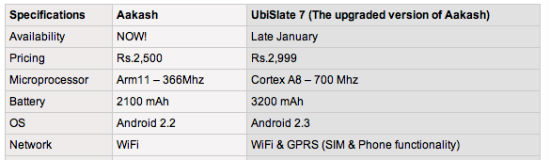
The Aakash tablet is available for Rs. 2,500 where as the UbiSlate 7 (the upgraded version of Aakash) is open for preorder and is priced at Rs. 2,999.

Take a look at the differences in specifications of both the devices below.

tablet-preorder2.jpg

People Power vs Power Plans

Agitators have hobbled government plans to harness the Northeast’s rivers — 168 dams have been planned in Arunachal Pradesh alone — to generate hydro-electric power for the country
By Naresh Mitra

Protests in Assam’s Lakhimpur district have stopped work on NHPC’s Lower Subansiri project

Protests have stopped construction of the country’s largest dam on the Assam-Arunachal Pradesh border. Though governments see big dams and hydro-power as the big ticket to the states’ future, but locals are out on the streets in disagreement, stalling a number of these projects.

The blueprint to turn the Northeast into the country’s powerhouse envisages the construction of dams across rivers in Arunachal Pradesh, Assam and neighbouring states. In Arunachal alone, 168 small and big dams have been planned. Estimates say the state has the potential to generate over 50,000 MW annually. India will, say experts, need an estimated 950,000 MW by 2030 to power its fast-growing economy. The current demand is 150,000 MW. Hydro-power is all the more critical as coal production, a key energy source, is likely to drop by 250 million tonnes by 2017.

PROTESTS STALL PROJECTS
But with construction under way at several projects, protests have broken out, led by civil society groups, activists and students’ organizations. Activists such as Medha Patkar have thrown their weight behind the agitators. 

In Assam’s Lakhimpur district, work at NHPC’s 2,000-MW Lower Subansiri Hydro-electric Project has stopped. Agitators insist they won’t allow construction of what’s billed to be the country’s largest dam at Gerukamukh on the Assam-Arunachal Pradesh border.

The protests started last month, Krishak Mukti Sangram Samiti (KMSS) protesters doing everything to stall construction. The Samiti draws support from the All Assam Students’ Union, the Assam Jatiyatabadi Yuva Chhatra Parishad, Takam Mising Porin Kebang, a students’ body of Mising tribals and 26 organizations representing Assam’s ethnic groups.

Activists have stopped trucks carrying supplies and equipment from reaching project sites. Since December 1, loaded trucks remain parked in a Lakhimpur field. Trouble began on November 30 when police lobbed teargas shells and baton-charged agitators. As violence spiralled, the Lakhimpur administration stopped truck supplies to Gerukamukh. The emboldened agitators stayed put in the field, determined not to allow any truck to slip past. “We have not left the place. Once we leave, the government will resume the movement of trucks. We are going to continue our protest here till the trucks are sent back,” KMSS member Chitra Gogoi says. 

Akhil Gogoi, who heads KMSS insists the government must stop construction of the Lower Subansiri project. “We will give our blood, but won’t allow the equipment to reach the construction site. The Lower Subansiri project will spell doom for the northern bank of the Brahmaputra, on the downstream of the project. Fertile land in Dhemaji and Lakhimpur already has sand deposits brought down by the Subansiri river after construction began,” he says. 

The protests have upset construction schedules. NHPC says the target for commissioning the Lower Subansiri project has been pushed from December 2012 to 2014. The delay has led to cost escalation from Rs 6285.33 crore to over Rs 10,000 crore. “Of course protests have affected the Lower Subansiri work. Construction material is not reaching the site,” says A K Chhabra, executive director of the NHPC project.

THE CONCERNS
Last year, experts from IIT Guwahati, Gauhati and Dibrugarh Universities said the Lower Subansiri fell in a seismic zone. They reported the possible adverse result of changing Subansiri’s water volume, impact on the river’s ecosystem, erosion of banks and severity of flooding. An Assam Assembly committee suggested no dams be built in Assam and neighbouring states without a “comprehensive and scientific downstream impact assessment”. NGOs have also voiced their fears: Construction of big dams in Assam, Arunachal and Bhutan will impact Assam’s two world heritage sites — Kaziranga National Park and Manas sanctuary.

    It’s not that the Union government is set on bulldozing opposition to the projects. Former environment minister Jairam Ramesh had written to the PM saying: “Some concerns cannot be dismissed lightly. They must be taken on board and every effort made to engage different sections of society in Assam and in other Northeastern states too. The feeling in vocal sections of Assam’s society appears to be that mainland India is exploiting Northeast hydel resources for its benefits, while the costs of this exploitation will be borne by the people of Northeast.”

WHY THE DRIVE FOR DAMS
Northeastern state governments believe these projects will spur industrial growth, the region envisaged as the nerve centre of India’s trade with south and South-east Asian countries. “This doesn’t augur well for the region’s economic, industrial and social growth. We have started almost two decades late,” says R S Joshi, chairman, Federation of Industry and Commerce of North Eastern Region.

Importantly, once these projects begin generation, Arunachal will draw 12% of power free from Lower Subansiri and part of the revenue. Assam will get 25 MW free. Assam power minister Pradyut Bordoloi says his state could buy as much as 600 MW. “It cannot be stopped at any cost. We want 600 MW from the project. If it gets delayed because of protests, power prices will escalate,” he says.

Unveiling Dark Times

ayel Dutta Chowdhury

The Muddy River
P A Krishnan
Tranquebar
2011, pp 245, Rs 250

Literature about North-East India abounds in tales of the troubled political climate, violence, backwardness, underdevelopment and poverty. The unique geographical positioning of the seven states and their equally different political, economic and social situations from the rest of the country have resulted in the rise of a body of writing that is onsidered to be different from mainstream Indian English literature.

P A Krishnan, in his latest book, The Muddy River, chooses Assam as the central location where the entire story unfolds. Krishnan also dwells on grounds of politics and corruption in narrating the story of Ramesh Chandran, a bureaucrat on a mission to rescue a hapless engineer who had been kidnapped by militants.

The author has juxtaposed considerable amounts of facts with fiction in portraying the different machinations of politics and corruption in the public sector of the state. Drawing from his personal experiences of being a bureaucrat, Krishnan lends authenticity to his narration of the kidnapping and the tangled web of politics surrounding it.

In representing the North-East scenario, the author brings to light the various intricate problems of the common people of the region, who are the ultimate sufferers. The suffering of the common man at the hands of the local police as well as the militants finds expression in the author’s ruthless unveiling of the different hands involved in terrorism and corruption. However, unlike many other books which dwell on such issues, Krishnan gifts the readers with a breath of fresh air, through his mastery of handling multiple themes, instead of giving them an overdose of typical problems of the North-East.

Although it isn’t a part of the main story, the narration gains its momentum and interest in the representation of Chandran’s relationship with his wife, Sukanya. Like any other husband and wife, their relationship also has its own ups and downs. After the death of their only child, Priya, life comes to a momentary stop for both.

The absence of the child has a profound effect on their marriage as well. Sukanya torments herself by withdrawing into a cocoon and Chandran attempts all the while to come to terms with reality, as well as his own marriage.

Chandran’s relationship with the other characters in the book, and his keen observation of them, makes the narration interesting. As he proceeds with his mission of rescuing the engineer, he encounters Bhuyan, a cynical police officer; Anupama, another officer torn between professional integrity and her love for Assam; the engineer’s wife; the ex-chief minister of Assam, a Gandhian; Khasnobis, a senior correspondent for an international news channel, and many others who either help him in his search or, as in most cases, make matters worse for him. “

The author scores his points by involving each and every character, even the peripheral ones, in unfolding the final mystery. While the rescue drama reaches its climax, Chandran also exposes a massive financial scandal in his company and pays the price for ignoring warnings that he might be pushing too far for an unashamedly corrupt society’s comfort. Without regard to his devoted service and unwavering courage in rescuing the engineer, he is given a notice of suspension!

Krishnan’s interesting narrative also dwells on Gandhianism in the form of Chandran’s father, a complete believer in the great leader’s philosophies as well as Rajbankshi, an ex-chief-minister of Assam reputed for being “the cleanest politician” of the state.

The author’s belief that “no person who is embarking on a life of struggle and service can ignore Gandhi’s methods” finds poignant expression in the book. The followers of the great leader may seem to offer no nstant solutions and the practitioners often stare at defeat and humiliation, still, Krishnan maintains that “mankind hasn’t yet come out with a better weapon against violence and bloodshed.”
The author, amidst all the tension and mystery, impresses his readers by bringing forth many under-represented, yet beautiful aspects of the region. Chandran’s visit to the Kamakhya Temple in the Neelachal Mountain and to Jatinga, “a charnel house of birds” with his wife, brings forth to the readers the fact that the North-East is not only about its seemingly unending problems, but also many other praise-worthy aspects.

Readers who are familiar with Krishnan’s first novel, The Tiger Claw Tree (1998), will find that he has evolved as a more mature narrator in his recent work. He breaks free from conventional narrative techniques and experiments with diverse story-telling methods, such as the epistolary form and the flashback technique. The Muddy River promises to be worthwhile and intelligent reading, filled with practical wisdom and humour. A must read.

17 December 2011

Meghalaya Top Woman Officer To Judge in Olympics

Shillong, Dec 17 : Meghalaya's top government woman officer and a former Federation Cup champion archer, Matsiewdor War, has been selected as one of the officials for the 2012 London Olympics.

The World Archery Federation officially informed Matsiewdor of her international appointment earlier this week.

Matsiewdor is the lone official from India in the archery event during the 2012 London Olympics which is slated to be held from July 27 to August 12, next year.

The 1985 Federation Cup champion, Matsiewdor is currently serving as Managing Director MeCOFED and as Officer on Special Duty for Cooperation department in the state.

Asked for her reaction, Matsiewdor said, "I am excited to be chosen to represent the country and North-East and my people at home.

"The former Sports and Youth Affairs director had qualified as an international judge after appearing for two examinations at Seoul, South Korea in 1994.

Matsiewdor said, "Even though I have not been able to make it big in international arena as an archer but I am happy to have been able to do this as an official judge. "Matsiewdor will be leaving for the London Olympics in the last week of July.

World Archery Federation had recognised Matsiewdor as one of its officials at the 2006 Doha Asian Games in Qatar and later at the Youth World Archery Championships at Ogden, Utah in 2009 besides other events in Bangladesh and other countries.

Election Commission Hawk-Eye On Manipur Polls

Election_Commission_Of_IndiaImphal, Dec 17 : To combat muscle and money power in the coming Manipur assembly polls, the Election Commission of India (ECI) is prepared to closely monitor the expenditure and activities of the candidates through 'effective' mechanisms.

The crucial tenth state assembly polls is most likely be held in February next year and political parties have already begun rolling out informal campaigns to woo the voters.

The election should be free and fair, peaceful and transparent, and maximum participation of the electorates needs to be ensured for a stronger democracy, said ECI (education, communication, information) director general Akshay Rout at a media conference in Imphal on Thursday.

On Wednesday, chief election commissioner of India SY Quraishi said the movement of individuals and goods along all routes in and out of the state would be closely monitored to check the use of black money in the ensuing polls.

Stating that media is the eyes and ears of ECI, Rout said media reports of violation of any provisions under the Representation of the People Act, 1951 and the election model code of conduct would be taken as (suo motto) complaint.

Pointing out that the one of the main challenging tasks for the commission is to fight 'paid news', he said a unit christened Media Certification and Monitoring Committee (MCMC) would be opened in all districts to combat this phenomenon.

"If any candidate is suspected to use 'paid news' to his advantage as per any media report, the ECI would send a notice to the particular candidate and take necessary action against him / her according to his / her replies," he said, adding that the incumbency power of the ruling party or parties is also one of the main concerns to be challenged.

Pointing out that the Systematic Voter Education and Electorate Participation (SVEEP) programme has also been launched by the ECI, Rout strongly advocated that people should not vote under the influence of bribe.

Echoing Rout, the commission's director general (expenditure monitoring division) P K Das said the commission would set up checkposts, flying squads, complaint cells and a toll-free hotline for the complainants to check bribing of voters.

Stating that both giving and taking of bribes are equally punishable, he said once the complaint is received, the flying squad would rush to the spot and take necessary action.

For effective monitoring of election expenditure, all candidates should open a separate account in the bank one day ahead of filing their nomination papers, he said, adding that income tax officials would also be deployed at strategic locations.

Nagaland: Rs 18-crore Gun ‘Misfires’, Blows Hole in Govt Coffers

CAG report points out massive financial fraud committed by Nagaland police brass in the name of raising six Commando Companies under the Neiphiu Rio government, which turned a blind eye to the forgery, Ratnadip Choudhury reports

Nagaland Chief Minister Neiphiu Rio constituted a committee to investigate the ‘fraud’ but the report was never made public

A “fraudulent” withdrawal of staggering Rs 18 crore by the Director General of Police (DGP) is only a “procedural irregularity”—that’s how the Nagaland government has rubbished the Comptroller and Auditor General (CAG) report on the ‘massive fraud’.

Last April, the 2009-2010 CAG report revealed in bold letters—“The Director General of Police, Nagaland, Kohima, withdrew an amount of Rs 18 crore against fictitious bills. The fraudulent withdrawal of Rs 18 crore, therefore, needs to be investigated”. The report grabbed headlines in the media, the Centre sent a strong memo to the Nagaland government and the Neiphiu Rio government constituted a high-power committee to investigate into the matter and asked it to submit the report within three months.

The committee’s report, which is being examined by the Public Accounts Committee (PAC) of State Assembly, has found only “procedural irregularities, not forgery”—as claimed by the CAG report—government sources told TEHELKA. Apparently, Nagaland Home Minister Imkong Inchen had turned a blind eye to DGP K Kire’s ‘forgery’.

While the media in Nagaland forgot the controversy, a citizen lodged a First Information Report (FIR) with the Nagaland Vigilance Commissioner against the government’s ‘inaction’ in the alleged scam on 2 December. TEHELKA has accessed copy of the complaint and bills submitted by the office of the DGP to the Accountant General (AG) through the State Treasury. Documents and the bills available with TEHELKA clearly expose the massive fraud.

The issue dates back to 2009, when the AG’s office received a fully vouched bill (No. 111, 15 June, 2009) with six sub-vouchers from the DGP’s office through the State Treasury. A preliminary review by the AG’s found ‘discrepancies’ in the bill. A full-fledged audit found prima facie evidence indicating forgery in all the sub-vouchers. “The fact remains that a fully vouched contingent bill was received by the AG’s office through the Treasury and all purchases shown in the sub-vouchers attached to the bills have been found to be fictitious,” the CAG report stated.

Copies of the alleged fraud bills obtained by TEHELKA support the CAG report. The Nagaland government, vide order No. POL-8/IRB/34/2008, dated 15.06.2009, sanctioned expenditure not exceeding Rs 18 crore to the DGP of Nagaland for purchase of arms, ammunition, vehicles and equipment for raising six Commando Companies during the 2009-2010 fiscal year. The Centre provided the funds under police modernisation schemes for northeastern states.

The first two sub-vouchers were allegedly issued by Ordinance Factory Khamaria (OFK), Jabalpur. Fully vouched contingent bills amounting to Rs 430.29 lakh (No. C/149/Nagaland, dated 05.05.2009) and Rs 148.28 lakh (No. C/150/Nagaland, dated 05.05.2009)—copies of which are in possession of TEHELKA—purportedly issued by MK Mohaptra, the Joint General Manager of OFK, were submitted. However, in response to AG’s query, OFK wrote a letter denying issuance of such bills. Besides, the ammunition mentioned in the supply list was beyond the factory’s production capacity, OKF added. TEHELKA has a copy of the letter.

Later, when a Right to Information (RTI) activist filed an application over the anomaly, the DGP office furnished copies of the two alleged fraud bills of OFK. Interestingly, the ‘signature of the issuing authority’ on the RTI annexure bills did not match with those submitted to the AG through the State Treasury. The DGP office has certified and verified the receipt of the items and made ledger entries on these bills—though it seems the items were never supplied.

The third sub-voucher was ‘issued’ by Bridgegap Associates, New Delhi, amounting to Rs 781.86 lakh (No. BA/NL/P/11/2009, dated 05.05.2009). When the AG inquired from the company, the proprietor in an official reply denied having been either paid any sum, or any entry in the company ledger of the items mentioned in the bills. The original letter sent by the south Delhi-based company to the AG is available with TEHELKA.

Later, in response to a RTI request, the DGP office provided a copy of the bill from Bridgegap Associates. However, the ‘signature’ on the bill provided as RTI annexure and available with TEHELKA did not match with that of the original bill.

The fourth sub-voucher was allegedly issued by Laggar Industries Ltd, Jalandhar (two bills—No.LIL/DD/18/09, dated 06.05.2009 and No.LIL/DD/18/09, dated 06.06.2009) amounting to Rs.1, 24, 31,500 and Rs 15,00,1000 respectively. On the AG’s inquiry, the Department of Trade and Taxes, New Delhi, informed that no such company existed.

The fifth voucher again exposes glaring forgery. Two bills (No. AO-GUW/Bill/25/09, dated 04.05.2009, of Rs 2, 02, 09,996 and No. AO-GUW/Bill/25/09, dated 04.05.2009, of Rs 1, 67, 78,446) were ‘issued’ by Tata Motors, Guwahati. However, Tata Motors informed the AG that it didn’t have any transaction record as mentioned in the bills.

The last voucher was from Sanchar Telesystems Ltd, Mumbai, (Bill No. STL/NPHG/2009/19 of Rs 87.9 lakh). Again on the AG’s query, the company denied having supplied any products, or billing. A copy of the reply is available with TEHELKA.

Highly placed sources in the police told TEHELKA that the money obtained through the payment of the forged bills was ‘siphoned off’ by the top brass.

Chief Secretary Lalthara told TEHELKA that the government was not trying to cover up anything. “The report has been forwarded to the PAC. Since it is examining it, thus the report has not been made public. The government has nothing to hide.”

However, the person who lodged the FIR with the Vigilance Commissioner is not hopeful. “The Chairman of the PAC, N Kire, is the elder brother of DGP K Kire. Therefore, the report will be biased,” he told TEHELKA.

Meanwhile, the main opposition party, Congress, has is pressuring the government to make the findings of the inquiry public. “This is a clear case of organised corruption. The government should make the report public and take action. Otherwise, we will launch an agitation and could even approach the court,” a senior Congress leader from Kohima said.

Ratnadip Choudhury is a Principal Correspondent with Tehelka. ratnadip@tehelka.com


Source: Tehelka

Rewben To Make Melody in Final Episode of Dewarists

By DIPANJAN SINHA

rewben

Rewben Mashangva

Calcutta, Dec 17 : It was a sunny yet chilly day. Nothing unusual in Shillong. From a cottage in the city floats music that makes one break into dance. Not very unusual here either.

What set the day apart, however, were the two artistes whose chords set the feet of passersby tapping in the musical paradise of Shillong — Naga folk musician Rewben Mashangva and innovator par excellence Raghu Dixit, collaborating for the final episode of the Dewarists on Sunday.

The Dewarists, part travelogue, part music show on Star World, will sign off with flourish with a performance in the city, renowned for its love of music. The show features some of the biggest names from across the globe, such as Grammy award-winning singer Imogen Heap and Indian Ocean among others, and allows them a chance to collaborate with other stalwarts like Vishal-Shekhar, Mohit Chauhan and Shantanu Moitra and create music.

While Guru Rewben Mashangva, performer, songwriter, music researcher and the “King of Naga folk blues” is the principal exponent of Hao music, the Raghu Dixit Project, founded by Raghu Dixit, encourages the amalgamation of the talents of artistes from different cultures.

When Dewarists approached the musicians to perform for the final episode, they were pleasantly surprised. The last time this dynamic duo had got together, they composed and performed onstage as part of the sixth edition of the Roots Festival in 2008.

With all the earnestness of a poet, Rewben Mashangva, says, “I like Raghu. We have so much fun when we perform together.”

Raghu puts forward a perspective that is beyond familiar comprehensions of language, culture or even inspiration.

He highlights the nuances that set the performers apart.

“Rewben and I have no clue about each others’ languages. My attempt is to recreate ancient Kannada poetry and make it relevant for the people of our time. It is about many things in this world that we have started taking for granted and should learn to respect. Rewben’s songs and music come from a very different atmosphere. His songs are a louder call in a conflict-torn place for peace, for life. Way more revolutionary,” Raghu says.

He then points at the bridge between the genres.

“But every time he performs or sings or plays, something within me is happy, an effervescent chord is touched,” he added.

In Shillong, the duo decided to go for a lighthearted, foot-tapping number and the end result was Masti ki Basti.

“We decided to do something that is fun. So the song Masti Ki Basti we composed is all about the celebration of life. It is fun and festive and calls all of us to groove to the tunes of nature,” Rewben said.

Raghu, who is steadily gaining popularity across the country, welcomes the fact that two episodes of the show, which has gained an international following, have been shot in the Northeast — Kaziranga and Shillong.

“It is a very positive sign that two episodes of the show have been shot in the region. I hope this brings to focus the immense musical potential there. I have to admit that we are sort of cut off from this part of our country culturally and emotionally. Despite the huge talent pool rarely do we see bands from the Northeast performing in south India,” Raghu said.

Girish Talwar of Babble Fish Productions, the house which showcased the journey, is spellbound by the beauty of the region.

“There is just so much beauty in the Northeast that we had to come twice. The culture is also encouraging. Everyone there sings or plays instruments. There is so much music all around,” he said.

However, the anticipation for the episode is accompanied by the laments of die hard followers of the show who were captivated by the medley of amazing music.

Nachiketa Parikh, a fan of the show from Gujarat, said, “The Dewarists was a journey through the India we hardly knew existed. A truly musical journey, awaiting a befitting end in Shillong.”

Northeast India Academy of Performing Arts

Northeast India Academy of Performing ArtsDimapur, Dec 17 : Youth in Nagaland see fashion as a popular career opportunity. Many of them aspire to become models, make up artists, fashion designers or beauty saloon owners.

There was no dedicated institute for fashion related vocational courses in Nagaland before the establishment of the Northeast India Academy of Performing Arts (NEIAPA).

Located in Dimapur, the fashion academy, offers short-term courses in make-up, spa, beauty techniques and modelling.

It works at sharpening the skills of the youth who intend to enter into fashion industry by providing them required training.

"The government is doing its best. They are helping us and we are getting students from all districts of Nagaland. The government is paying for those who cannot afford the costs. They are doing their best. By 2015, I am sure that this industry will be one of the biggest industries in Nagaland and I can see lots of potential in them," said Akuonuo, Director, NEIAPA.

The academy was inaugurated this year on April 15.he first batch of 25 students who passed out recently have been recruited in several top fashion companies, spa and saloons.he academy has collaborated with many companies who provide trained professionals as guest lecturers.

They have organized many fashion shows, events, and seminars to showcase the skills of the students to a wider audience.

These models and trainees have requested the government to provide them with wider exposure.

"I think, everyone knows that they haven't yet got a lot of exposure and, at the same time, they haven't got lot of opportunities to show what talent they have. I really see a lot of potential if you teach them right," said Garima Parnami, Executive Director, NEIAPA.