14 December 2011

Time Not Yet Ripe For Secular College in Mizoram

PCIAizawl, Dec 14 : Mizoram is not yet ready for a secular college, or such is the opinion of the Synod, the highest decision-making body of the Presbyterian Church of India, Mizoram. After deliberating for six days on the issue, the Synod rejected the proposal to establish a secular college in the state.

A Mizoram Presbyterian Church Synod meet, which started on December 6 and concluded on Sunday night at Khatla in Aizawl, decided that "the time was not yet ripe for establishment of a secular college by the largest church in the state."

The Synod also decided not to join the World Council of Churches (WCC) - another outcome of deliberations at the meet - as 29 Presbyteries voted against the move while only 14 approved of the Presbyterian Church being affiliated to the international church body.

Spiritualists, evangelists and even some theologians were against the Mizoram Presbyterian Church joining the WCC, due to diverse reasons. Theologians like P C Biaksiama, a church elder, objected that the doctrine of the WCC clashes with the main tenets of Christianity.

Some spiritualists and evangelists even predicted that the WCC would become an instrument of the Devil as it is already marked with the number of the Biblical Beast as foretold in the Book of Revelations.

The Synod also approved in principle the amendment to the decrees regarding punishment and pardon of divorced couples and also of people of the same sex living together. The Synod executive committee was authorized to prepare the final amendments.

The committee, while screening the agendas to be deliberated in the Synod meet, earlier rejected the proposal to ordain women as priests and church elders.

Now Nagas Ban Railway Works in Manipur Hills

Jiri_Tunnel construction manipurGuwahati, Dec 14 : Ban is the bane of life in the frontier state of Manipur that is plagued by myriad troubles ranging from insurgency, ethnicity to underdevelopment. Till ten days back the state was being crippled by unrelenting economic blockade along the two arterial national highways connecting it to the rest of the country.

Another ban of a different kind which will have adverse impact on its development process, is staring at the state.

The United Naga Council (UNC) of Manipur has imposed ban on construction of Jiribam-Tupul broad gauge railway line for two months effective from December 16 in protest against the recent statement of the Prime Minister Dr Manmohan Singh about the Centre’s remaining committed to protect the territorial integrity of Manipur.

The UNC has also imposed ban on exploration of hydrocarbon that is being taken up by public sectors undertakings/private companies in Tamenglong district of Manipur with effect from December 16 till further notice.

The UNC which supports the Naga rebel group NSCN-IM’s demand for a ‘greater Nagalim’ comprising all Naga-inhabited areas of the Northeast including those in Manipur, has been frustrated by the PM’s statement made in Imphal on December 3 last.

The UNC which has close links with Naga rebel group NSCN-IM , has been engaged in dialogue with the Centre as well as Manipur government over is demand for an alternative administrative arrangement for Nagas in Manipur.

The ban on works on the railway tracks construction comes close on the heels of suspension of the 120 days economic blockade by the UNC on Imphal-Dimapur and Imphal-Silchar highways just ten days back.

It was called from August 21 by the UNC to stymie creation of a separate revenue district for Kuki-tribe dominated SADAR hills areas in Naga –majority Senapati district of Manipur.

The PM during his public address in Imphal on December 3, also said that works on the 125-Km railway line from Jiribam via Tupul was under progress and likely to be completed by March ,2016, after completion of the Jiribam-Tupul portion by March, 2014 .

According to sources in Northeast Frontier Railway (NFR) here, the construction of Jiribam-Tupul board-gauge railway line was started from 2003-04.

There will be nine stations between Jiribam and Tupul at Jiribam, Bolakhan, Keimai road, Kambiron, Thingu, Molsang, Noney and Tupul.

Construction of 10 out of total 35 tunnels to be built has so been completed and with the completion of survey works, construction works for another five tunnels have started.

Fourteen large bridge and 73 small bridges are being constructed along the railway line.

The longest bridge (500 meter) on this stretch is being constructed across Maku River while the longest (5.9 km) tunnel is located at Kambiron.

Endosulfan Poisoning Rivers of Northeast India

ban_endosulfanEndosulfan is a pesticide gradually being phased out from use all over the world because of its toxic properties and health hazards to humans and animals.
But in Northeast India, it is the same chemical that is being used in deathly doses by people to poison rivers and catch fish.

India is world’s largest producer and exporter of the hazardous Endosulfan. But the chemical’s use was hotly debated almost all this year as it was found to cause health hazards in humans as well as wildlife. In India the Supreme Court banned the use of Endosulfan in May 2011.

But despite the ban, the poison is still used extensively and much to the disbelief of environmentalists it is being used abundantly in the North east states of India by men who simply mix the pesticide in rivers upstream. When the deadly water flows down, it kills fishes, turtles and other amphibians in hundreds each day.

Illegal use of Endosulfan has been especially recorded in River Manu that originates from the state of Tripura. Traders, in order to make a fast buck mix the pesticide upstream and then it is carried by the current all the way down to Bangladesh where the River Manu merges into the River Kushiara.

Aquatic animals like fish, mollusks and amphibians have been found to be affected by endosulfan most drastically. Bioaccumalation is a constant threat and because the chemical can easily flow and retain its properties for a long time, its effect may be felt quite far from the area of origin.

Many fish species resultantly of the area are doomed. Some have already become extinct and of few others, the numbers are shockingly low.

In the list of the vanished species are Tiger fish, Dwarf Goonch and Ar – giant fishes that the river was once famous for. Even Sind Danio, Wallogo, Indian river shad, and turtles which were commonly found even 10 years ago are now extremely rare.

Natural Poison

Locals living on the riverside villages though have a siginificant information to share. They say that the tradition of poisoning rivers was always followed in these parts of the country. It was a convenient way to catch fishes in large numbers.

But what has changed over the years is the kind of poison used.

According to Renuka Dutta, a local, “Every winter – around January/February, people used to collect vishlat – a poison ivy found in abundance in the nearby forests and extract the juice to put that in the river as due to cold fishes would not come to the surface too often. Once mixed in water, the juice would blind the fish temporarily, but would do no harm to humans.’

Now though the traditional herb has been replaced by a chemical leading to much more tragic endings.

Amar Mitra, a local farmer and a fishing enthusiast says, “When poison ivy was used, we could see fish thrashing around in the water blindly. But now we see dead fish floating.”

Killer at Large

Endosulfan is still easily available in local markets. It is also very easy to sprinkle the chemical in the river waters and wait for the fish to just gulp down the poisonous water and die. With fish being a staple, the market demand too is quite high with one medium size fish easily fetching Rs.300-350.

Hence, the rampant use of chemicals by illegal traders. In the past one month alone thee have been four incidents recorded of river poisoning.

But the cases of human poisoning too have risen.

More people are suffering from water borne diseases such as dysentery and gastroenteritis in villages along Manu, as well as Deo – a tributary of river Manu which has also seen fishing by endosulfan poisoning. Once seen as ‘monsoon sicknesses’, now such diseases are also becoming common in winter, thanks to endosulfan.

Yet again, rash and inconsiderate practices taint man’s hands with blood of innocent creatures. If the chemical’s use this way is not stopped immediately, it can only bring death and devastation to an ecologically significant region of the country.

13 December 2011

Lives in Peril: Inside Manipur's Drug Zone

Heroin-in-Manipur

Churachandpur (Manipur):
A litter of cigarette stubs, abandoned syringes and used contraceptives greet a visitor to one of the four drug hangout joints in Manipur's second largest town where red-eyed, stoned and slightly feverish youngsters huddle together.

Churachandpur, 60 km to the south of state capital Imphal, is a hub of injecting drug users (IDUs) thanks to its proximity to the Golden Triangle, notorious for opium and heroin production. The Golden Triangle, in narcotic parlance, includes the contiguous border area of Thailand, Laos and Myanmar from where drugs are sourced and peddled to northeast India and beyond.

"The injecting drug users mix heroin with water and inject in their body with the help of a syringe," a member of the NGO SHALOM, which works with drug users, told IANS.

The town, along with Ukhrul and Chandel districts, have the most number of IDUs in the state. There are an estimated 38,000 IDUs in Manipur, which has a population of around 2.5 million.

Heroin, locally known as No.4, a small chit of heroin costs anywhere between Rs.50 and Rs.300 in Churachandpur.

"Lack of socio-economic development and proximity to drug trafficking routes make the problem worse for youngsters who are unemployed. They get into drugs and never come back," Chhakchuak from SHALOM told agency.

Manipur recently saw a crippling economic blockade for over 120 days that worsened the situation for residents.

There are four hangout zones -- locally known as hot spots -- in Churachandpur where the IDUS indulge in drugs.

At one of these places, a 16-year-old fiddles with a syringe which contains some fluid. Her kohl-lined eyes are burning red, not with anger but with the effect of drugs. Ask her what her name is and she tells you to "get lost" without batting an eyelid.

What is most concerning is that these drug users share needles with each other, increasing the chances of contracting HIV. Locals say these places also see a lot of sexual activity.

According to NGOs in Manipur, out of 38,000 injecting drug users in Manipur, 5,000 are female and highly vulnerable to HIV.

As per independent estimates, HIV prevalence among IDUs was over 15 percent in seven districts of the country in 2008.

While Amritsar topped with 30.40 percent, Churachandpur was second, with 28 percent of IDUs suffering from HIV.

"A majority of the female IDUs are sex workers who peddle drugs in the state from neighbouring Myanmar," said an NGO functionary in Imphal.

According to the state Narcotics Control Bureau (Imphal Unit), heroin manufacturing units have mushroomed in Manipur.

In a press conference in Imphal earlier this month, Bijoy Shahni, assistant director of the Narcotics Control Bureau (Imphal Unit), said heroin was being illegally transported from Myanmar through Manipur to other parts of the country via Nagaland and Assam.


Likewise, he said drugs like Ephedrine and Pseudoephedrine tablets are also smuggled to Myanmar through Manipur.

To reduce the looming health threat local NGOs like SHALOM and SASO provide fresh needles to IDUs and advise them not to share needles. While they have been able to make some impact, Manipur still has a long way to go.

New Land Use Policy Scheme Pays Dividend in Mizoram

nlupAizawl, Dec 13 : The new land use policy scheme (NLUP)of the Mizoram Government is helping to generate employment for thousands of people living in the rural and far flung areas of the state.

After being unsuccessful in getting a job, Rinawma, a young graduate living in the Kolasib district of Mizoram, registered himself under the New Land Use Policy Scheme of the state government and got a loan of Rs 20,000 with which he started a video making business.

“Since the state government introduced this scheme, I have received help from them to start my business. And, I am hopeful that I will be successful in life,” said Rinawma.

Today, he earns enough to take care of his family.

The New Land Use Policy Scheme is a state government project.

It consists of eight departments – agriculture, industry, animal husbandry, fisheries, horticulture, industries, sericulture, soil and water conservation and environment, from which people can receive help.

Rinawma received help from the industry department.

There are about 3813 beneficiaries in Kolasib district alone who have received monetary and technical support.

The help provided to beneficiaries depends on several parameters like marketability of the product and physical condition of the area.

Niharika Rai, Deputy Commissioner, Kolasib District, Mizoram, said NLUP helps in providing permanent livelihood to those who have no source of earning a livelihood or involved in Jhum cultivation.

“We are in New Land Use Policy Scheme and under this we provide a permanent source of livelihood to those who do not have it all and are involved in the Jhum cultivation,” said Rai.

The scheme has been successful in reducing employment and given impetus to development activities in the region.

Development activities in Mizoram have picked up pace after militant activities came to an end in the state two decades ago.

Both the state and the centre are making concerted efforts to speed up the development process in the region by implementing various schemes like Sarva Shiksha Abhiyaan, and Mahatma Gandhi Rural Employment Guarantee Program.

What is Manipur's Future?

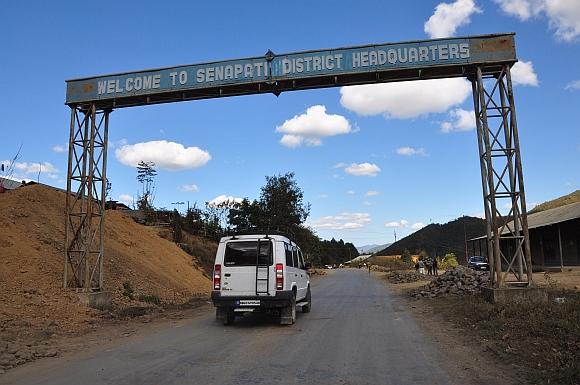
Entrance to the headquarters of Manipur's Senapati district. The tussle between the Kuki and Naga tribals over the proposed division of the district resulted in the 121-day economic blockade of Manipur

Next

In the northeastern Indian border state of Manipur, there is a lot to despair over. But there is also hope, finds Sumit Bhattacharya.

In Manipur, it is difficult to go into the interiors if you don't have someone local with you. You are told stories of what happened when a media team went into some remote villages in the hills.

Someone had set it up -- for the media team to visit -- with one of the state's nearly 40 militant groups. Somewhere along the line the communication did not reach. So, the driver of one of the media team's cars spent two hours cleaning his car window -- just to not attract attention to himself -- while the reporters had guns pointed at their heads. The communication was being sorted out.

For someone not used to living with insurgency, Manipur is a different world. Everything you take for granted -- like electricity, Internet, ATMs, cell network -- needs a recheck.

In Imphal, the capital city of Manipur, an average household gets six to seven hours of electricity -- unless you have a 'VIP' connection.

Corruption is rampant, all pervasive. It is supposed to be a dry state, but you can choose what you want to drink. There is something called a hawa bill, which means the government is billed for a project that does not exist in reality.

In February 2009, Dr Thingnam Kishan, a sub divisional officer, objected to National Rural Employment Guarantee Act development funds being looted by fudging population figures in Ukhrul district. He was hacked to death along with two of his staff.

Even now, top government officers are scared that if you quote them by name, militants will kill them.

A lot of central funds are also being poured into Manipur. On December 3, Prime Minister Manmohan Singh said in Imphal that New Delhi is considering incorporating Rs 6,000 crore for the state in the 12th Five Year Plan.

Image: Entrance to the headquarters of Manipur's Senapati district. The tussle between the Kuki and Naga tribals over the proposed division of the district resulted in the 121-day economic blockade of Manipur
Photographs: Chitra Ahanthem

'They look upon the northeast simply as a transit point'
Prev

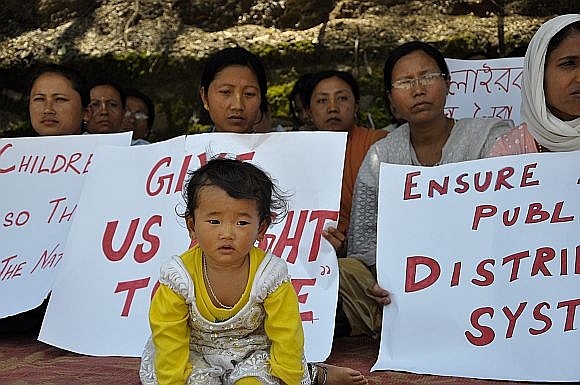
An anti-government protest in Imphal. Corruption is rampant in Manipur

Next

India's foreign policy now has a Look East doctrine, which is also encouraged by the United States. What it means is that New Delhi is looking to do more trade with South East Asia. And Myanmar -- Burma of yore -- is expected to emerge from its isolation and become a huge market that will buy goods from India.

But on the ground, the situation is different: The United Naga Council, an umbrella body of Naga tribal organisations, has already vowed to stop work on the trans-Asian railway line from India to Myanmar from December 16.

"India is looking east from Delhi and Calcutta," says Irengbam Arun, editor of the Manipuri daily Ireibak. "While they should be looking east, west, north, south by standing in the northeast. It's the big industrialist in Delhi or Calcutta that is looking east. They look upon the northeast simply is a transit point."

"There is no governance (in Manipur)," says human rights activist Babloo Loitongbam. "In the heart of Imphal West, schools don't work. The Pubic Distribution System does not work. There is no sanitation..."

The problem is also of legitimacy, he points out. In 2006, Dr Singh assured the people of the northeast that his government would replace the Armed Forces Special Powers Act with a 'more humane law'. Five years later, when he visited Manipur on December 3, he made no mention of the AFSPA at all.

He inaugurated a host of buildings, including the new assembly secretariat and the high court, and spoke of a train line by 2016, new highway by 2013, a 1,500 megawatt electricity project, schools, four more hospitals in hill areas, etc.

It was not lost on anybody that the prime minister and his party chief Sonia Gandhi came visiting just as the state begins the run-up to the elections in February. Manipur has been ruled by a Congress-led coalition government for the last 10 years.

"Pouring in money means nothing," says Arun. "Because the leaders have been brought up in the culture of corruption. Politicians here, most of them big contractors, have begun to think that money can always buy votes. These big thekadars will construct lanes, nursing homes from their own pocket. In a nearby constituency it is said that one big thekadar distributed Rs 3,000 for every household. A new breed of politicians has come up -- these big thekadars -- so the professional politicians also seem to have no other option but to follow suit. They are also getting into the contracts business and (getting) funds by establishing NGOs. Big funds from central ministries taking up big projects like for weavers, handloom, etc."

Just an example of what he is talking about: A fertiliser monitoring committee found on December 11 that out of Rs 2 crores meant for fertilizers to farmers during the blockade, only Rs 78,10,600 was used for fertilisers and the remaining Rs 1,21,89,400 was 'misused'.

Image: An anti-government protest in Imphal. Corruption is rampant in Manipur
Photographs: Chitra Ahanthem

'When the ADC elections were held the Nagas suddenly stood up'
Prev

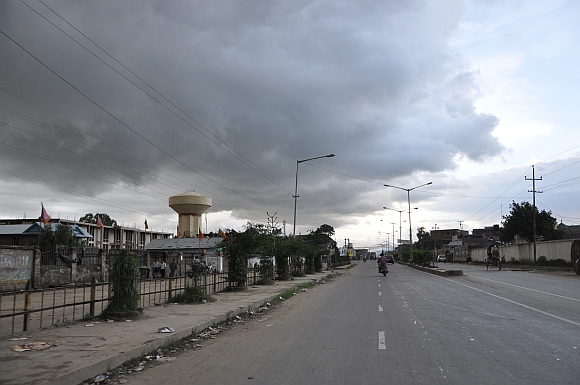
One of Imphal's main roads, during one of the innumerable bandhs

Next

The prime minister, addressing 50,000 people -- despite the mandatory bandh call by some militant groups -- at the Kangla Fort in Imphal on December 3, also lauded the state government for holding elections to autonomous district councils after 20-odd years.

The Naga tribals object to such councils, saying that they violate their age-old village elders system. Others say the people in the hills want the ADCs, but the leaders do not.

"A former governor told me that the hill leaders did not want it (ADCs) and the people were demanding it," says Pradeep Phanjoubam, editor of the Imphal Free Press. "When the ADC elections were held the Nagas suddenly stood up (against it). So I think that protest was a proxy protest by the (outlawed) NSCN-IM (Nationalist Socialist Council of Nagaland Isaac-Muivah faction) which doesn't want to dilute its claims for a Greater Nagalim. The Sixth Schedule (Provisions for the administration of tribal areas in Assam, Meghalaya, Tripura, and Mizoram) thing was also almost given -- these kinds of things they (the Naga leaders) never bring up."

"The tribal leaders are also so rich," says Loitongbam. "Whose money is it? Just sending money is not the solution. The problem is that people here are seen as the problem."

Manipuris, once you get to know them, are incredibly warm-hearted.

In Naga houses, you will be fed the best pork you will ever eat.

In Kuki areas, people force-feed you tea and spicy chana (incredibly hot!) if you just sit down to talk to them.

In Meitei homes, you will be stuffed with every kind of local delicacy possible even during a four-day bandh.
Strangers will help you out. And if you bump into someone you knew ages ago, he will abduct you from your hotel room and make sure you stay with him.

Image: One of Imphal's main roads, during one of the innumerable bandhs
Photographs: Chitra Ahanthem

'Whatever you say, people still work'

Prev

US Secretary of State Hillary Clinton and Myanmar's pro-democracy opposition leader Aung San Suu Kyi speak to the media at Suu Kyi's residence in Yangon on December 2. Clinton held a second meeting with Suu Kyi as she wrapped up a landmark visit to Myanmar which saw the new civilian government pledge to forge ahead with political reforms and re-engage with the world community

Next

There is hope for Manipur because of its people, believes Phanjoubam.

"Whatever you say, people still work," he says. "Those in the government services get lazy, but those who are fending for themselves really fend for themselves. They will work for a pittance, without complaining too much because they know it's the only thing available."

"A few years ago, some people from (South) Korea came here," he explains. "And they said it's very much like Korea 30 years ago. Although the non-government sector (employees) are still very poor, that work culture is there. If there is a larger policy to nurture them they can really grow. And they will be the saviours, not the government sector. The government sector is already saturated."

"They are good carpenters, they are good with their hands. Which if they find a market they can sell, as in the case of Bangladesh where the multinationals are now rushing for their factories. Same with South East Asia and China, where it all began. So, if that value-addition kind of industry is there. Say, you want to assemble Bose speakers and sell it to Burma; if you want to have an assembly plant in Manipur you'll have enough people to work for that. Because there are people who have those skills."

He adds, "And Burma is opening up. This can really be an opening for the entire northeast."   

India's Look East policy, coupled with the opening up of Myanmar, can be a "booster for the northeast," he believes.

"That country is hungry," Phanjoubam says. "All their neighbours have been growing and it's the only one left behind. The people there are hungry for development. I think it's going to grow fast."

Image: US Secretary of State Hillary Clinton and Myanmar's pro-democracy opposition leader Aung San Suu Kyi speak to the media at Suu Kyi's residence in Yangon on December 2. Clinton held a second meeting with Suu Kyi as she wrapped up a landmark visit to Myanmar which saw the new civilian government pledge to forge ahead with political reforms and re-engage with the world community
Photographs: Reuters

It's Already Like Christmas in Twinkling Northeast

christmas in Shillong

Shillong, Dec 13
: The Northeast is already in a mood for Christmas and New Year. Shops here are loaded with Yuletide goodies and the stocky Santa Claus. As a choir group in one of the churches sings the popular carol, "It's beginning to look a lot like Christmas, everywhere you go", people break into a jig.

"Everyone here is drowned in a celebratory mood," said Avner, a college student.

The single symbol of hope, love and divinity that glows throughout the region this time of the year is the Christmas star. Paper stars lit with electric bulbs have already started twinkling at every house, shop, bank and office.

Christmas, in fact, is a month-long affair here. It is said that Christianity, the commonly practised religion here, united the region that was divided because of linguistic, ethnic and geographical reasons in the past. Christmas here is celebrated with family traditions, gifts and greetings.

The NE is also known for its versatile choir groups. They perform in national channels on television during Christmas spreading the message of peace and love. In the picturesque hill station of Shillong, the capital of the predominantly Christian Meghalaya, choir groups belt out carols in churches and public places.

"This is the season of happiness and rejoicing," said a Baptist church pastor and leader of a choir group.

"The flow of shoppers has increased and we are open till late night. People buy gifts for friends and families," said the owner of a leading shopping mall in Shillong, the fashion capital of NE.

With many shopping arcades coming up in the region, shopkeepers also resort to a variety of marketing tricks to woo customers. "You buy goods worth Rs 1,000 and Santa Claus is going to give you a gift amounting to about Rs 500. This new offer has become an instant hit and we are unable to cope with the rush," said the manager of a garment outlet.

The celebration apart, the catchword in the entire region is peace. This is natural for a region where thousands have succumbed to insurgency. "Everybody is impatiently waiting for Christmas. Let us all join together in praying for a new dawn of peace and hope in the region," said Rev. Dominic Jala, archbishop of Shillong.

List of Earthquake Monitoring Centers in Northeast India

Earthquake Monitoring Centers in Northeast IndiaNew Delhi, Dec 13 : Minister of State in the Ministry of Science and Technology and Earth Sciences Mr.Ashwani Kumar inform in Rajya Sabha today that there, are seven seismic observatories functioning in Assam, located at Dhubri, Jorhat, Silchar, Lekhapani, Tezpur, Guwahati and Dibrugarh under India Meteorological Department (IMD).

Under the national seismological network seismic observatories are located at Lekhapani in Assam, Agartala in Tripura, Shillong and Tura in Meghalaya and Imphal in Manipur and Gangtok in Sikkim.

Recently, all the above mentioned six observatories have been upgraded with state-of-the-art broadband systems with VSAT communication systems.

In addition to the above observatories, 15 more new stations have also been established at Dhubri, Jorhat, Silchar, Tezpur, Guwahati and Dibrugarh in Assam ; Ziro, Itanagar, Tawang and Pasighat in Arunachal Pradesh; Kohima and Mokochong in Nagaland; Belonia in Tripura; and Aizawl, Sahia in Mizoram.