13 December 2011

What is Manipur's Future?

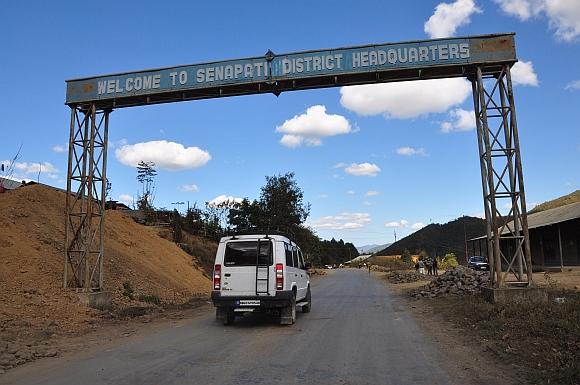
Entrance to the headquarters of Manipur's Senapati district. The tussle between the Kuki and Naga tribals over the proposed division of the district resulted in the 121-day economic blockade of Manipur

Next

In the northeastern Indian border state of Manipur, there is a lot to despair over. But there is also hope, finds Sumit Bhattacharya.

In Manipur, it is difficult to go into the interiors if you don't have someone local with you. You are told stories of what happened when a media team went into some remote villages in the hills.

Someone had set it up -- for the media team to visit -- with one of the state's nearly 40 militant groups. Somewhere along the line the communication did not reach. So, the driver of one of the media team's cars spent two hours cleaning his car window -- just to not attract attention to himself -- while the reporters had guns pointed at their heads. The communication was being sorted out.

For someone not used to living with insurgency, Manipur is a different world. Everything you take for granted -- like electricity, Internet, ATMs, cell network -- needs a recheck.

In Imphal, the capital city of Manipur, an average household gets six to seven hours of electricity -- unless you have a 'VIP' connection.

Corruption is rampant, all pervasive. It is supposed to be a dry state, but you can choose what you want to drink. There is something called a hawa bill, which means the government is billed for a project that does not exist in reality.

In February 2009, Dr Thingnam Kishan, a sub divisional officer, objected to National Rural Employment Guarantee Act development funds being looted by fudging population figures in Ukhrul district. He was hacked to death along with two of his staff.

Even now, top government officers are scared that if you quote them by name, militants will kill them.

A lot of central funds are also being poured into Manipur. On December 3, Prime Minister Manmohan Singh said in Imphal that New Delhi is considering incorporating Rs 6,000 crore for the state in the 12th Five Year Plan.

Image: Entrance to the headquarters of Manipur's Senapati district. The tussle between the Kuki and Naga tribals over the proposed division of the district resulted in the 121-day economic blockade of Manipur
Photographs: Chitra Ahanthem

'They look upon the northeast simply as a transit point'
Prev

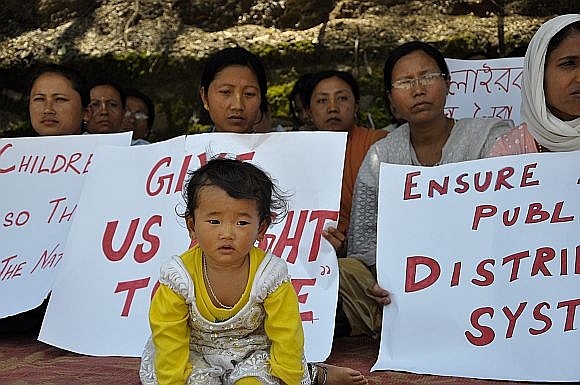
An anti-government protest in Imphal. Corruption is rampant in Manipur

Next

India's foreign policy now has a Look East doctrine, which is also encouraged by the United States. What it means is that New Delhi is looking to do more trade with South East Asia. And Myanmar -- Burma of yore -- is expected to emerge from its isolation and become a huge market that will buy goods from India.

But on the ground, the situation is different: The United Naga Council, an umbrella body of Naga tribal organisations, has already vowed to stop work on the trans-Asian railway line from India to Myanmar from December 16.

"India is looking east from Delhi and Calcutta," says Irengbam Arun, editor of the Manipuri daily Ireibak. "While they should be looking east, west, north, south by standing in the northeast. It's the big industrialist in Delhi or Calcutta that is looking east. They look upon the northeast simply is a transit point."

"There is no governance (in Manipur)," says human rights activist Babloo Loitongbam. "In the heart of Imphal West, schools don't work. The Pubic Distribution System does not work. There is no sanitation..."

The problem is also of legitimacy, he points out. In 2006, Dr Singh assured the people of the northeast that his government would replace the Armed Forces Special Powers Act with a 'more humane law'. Five years later, when he visited Manipur on December 3, he made no mention of the AFSPA at all.

He inaugurated a host of buildings, including the new assembly secretariat and the high court, and spoke of a train line by 2016, new highway by 2013, a 1,500 megawatt electricity project, schools, four more hospitals in hill areas, etc.

It was not lost on anybody that the prime minister and his party chief Sonia Gandhi came visiting just as the state begins the run-up to the elections in February. Manipur has been ruled by a Congress-led coalition government for the last 10 years.

"Pouring in money means nothing," says Arun. "Because the leaders have been brought up in the culture of corruption. Politicians here, most of them big contractors, have begun to think that money can always buy votes. These big thekadars will construct lanes, nursing homes from their own pocket. In a nearby constituency it is said that one big thekadar distributed Rs 3,000 for every household. A new breed of politicians has come up -- these big thekadars -- so the professional politicians also seem to have no other option but to follow suit. They are also getting into the contracts business and (getting) funds by establishing NGOs. Big funds from central ministries taking up big projects like for weavers, handloom, etc."

Just an example of what he is talking about: A fertiliser monitoring committee found on December 11 that out of Rs 2 crores meant for fertilizers to farmers during the blockade, only Rs 78,10,600 was used for fertilisers and the remaining Rs 1,21,89,400 was 'misused'.

Image: An anti-government protest in Imphal. Corruption is rampant in Manipur
Photographs: Chitra Ahanthem

'When the ADC elections were held the Nagas suddenly stood up'
Prev

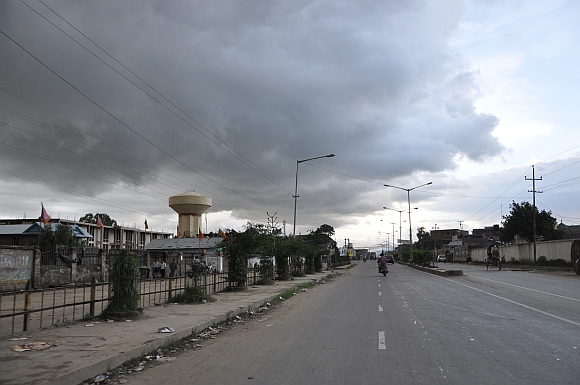
One of Imphal's main roads, during one of the innumerable bandhs

Next

The prime minister, addressing 50,000 people -- despite the mandatory bandh call by some militant groups -- at the Kangla Fort in Imphal on December 3, also lauded the state government for holding elections to autonomous district councils after 20-odd years.

The Naga tribals object to such councils, saying that they violate their age-old village elders system. Others say the people in the hills want the ADCs, but the leaders do not.

"A former governor told me that the hill leaders did not want it (ADCs) and the people were demanding it," says Pradeep Phanjoubam, editor of the Imphal Free Press. "When the ADC elections were held the Nagas suddenly stood up (against it). So I think that protest was a proxy protest by the (outlawed) NSCN-IM (Nationalist Socialist Council of Nagaland Isaac-Muivah faction) which doesn't want to dilute its claims for a Greater Nagalim. The Sixth Schedule (Provisions for the administration of tribal areas in Assam, Meghalaya, Tripura, and Mizoram) thing was also almost given -- these kinds of things they (the Naga leaders) never bring up."

"The tribal leaders are also so rich," says Loitongbam. "Whose money is it? Just sending money is not the solution. The problem is that people here are seen as the problem."

Manipuris, once you get to know them, are incredibly warm-hearted.

In Naga houses, you will be fed the best pork you will ever eat.

In Kuki areas, people force-feed you tea and spicy chana (incredibly hot!) if you just sit down to talk to them.

In Meitei homes, you will be stuffed with every kind of local delicacy possible even during a four-day bandh.
Strangers will help you out. And if you bump into someone you knew ages ago, he will abduct you from your hotel room and make sure you stay with him.

Image: One of Imphal's main roads, during one of the innumerable bandhs
Photographs: Chitra Ahanthem

'Whatever you say, people still work'
Prev

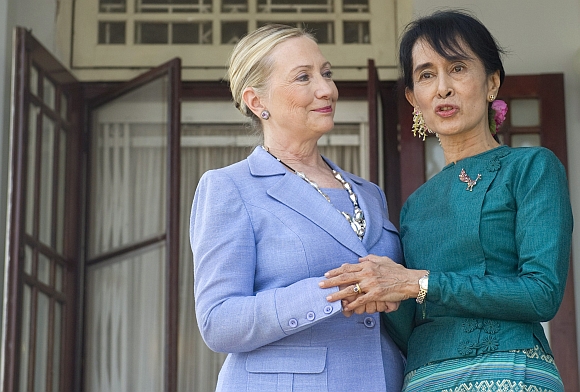
US Secretary of State Hillary Clinton and Myanmar's pro-democracy opposition leader Aung San Suu Kyi speak to the media at Suu Kyi's residence in Yangon on December 2. Clinton held a second meeting with Suu Kyi as she wrapped up a landmark visit to Myanmar which saw the new civilian government pledge to forge ahead with political reforms and re-engage with the world community

Next

There is hope for Manipur because of its people, believes Phanjoubam.

"Whatever you say, people still work," he says. "Those in the government services get lazy, but those who are fending for themselves really fend for themselves. They will work for a pittance, without complaining too much because they know it's the only thing available."

"A few years ago, some people from (South) Korea came here," he explains. "And they said it's very much like Korea 30 years ago. Although the non-government sector (employees) are still very poor, that work culture is there. If there is a larger policy to nurture them they can really grow. And they will be the saviours, not the government sector. The government sector is already saturated."

"They are good carpenters, they are good with their hands. Which if they find a market they can sell, as in the case of Bangladesh where the multinationals are now rushing for their factories. Same with South East Asia and China, where it all began. So, if that value-addition kind of industry is there. Say, you want to assemble Bose speakers and sell it to Burma; if you want to have an assembly plant in Manipur you'll have enough people to work for that. Because there are people who have those skills."

He adds, "And Burma is opening up. This can really be an opening for the entire northeast."   

India's Look East policy, coupled with the opening up of Myanmar, can be a "booster for the northeast," he believes.

"That country is hungry," Phanjoubam says. "All their neighbours have been growing and it's the only one left behind. The people there are hungry for development. I think it's going to grow fast."

Image: US Secretary of State Hillary Clinton and Myanmar's pro-democracy opposition leader Aung San Suu Kyi speak to the media at Suu Kyi's residence in Yangon on December 2. Clinton held a second meeting with Suu Kyi as she wrapped up a landmark visit to Myanmar which saw the new civilian government pledge to forge ahead with political reforms and re-engage with the world community
Photographs: Reuters

It's Already Like Christmas in Twinkling Northeast

christmas in Shillong

Shillong, Dec 13
: The Northeast is already in a mood for Christmas and New Year. Shops here are loaded with Yuletide goodies and the stocky Santa Claus. As a choir group in one of the churches sings the popular carol, "It's beginning to look a lot like Christmas, everywhere you go", people break into a jig.

"Everyone here is drowned in a celebratory mood," said Avner, a college student.

The single symbol of hope, love and divinity that glows throughout the region this time of the year is the Christmas star. Paper stars lit with electric bulbs have already started twinkling at every house, shop, bank and office.

Christmas, in fact, is a month-long affair here. It is said that Christianity, the commonly practised religion here, united the region that was divided because of linguistic, ethnic and geographical reasons in the past. Christmas here is celebrated with family traditions, gifts and greetings.

The NE is also known for its versatile choir groups. They perform in national channels on television during Christmas spreading the message of peace and love. In the picturesque hill station of Shillong, the capital of the predominantly Christian Meghalaya, choir groups belt out carols in churches and public places.

"This is the season of happiness and rejoicing," said a Baptist church pastor and leader of a choir group.

"The flow of shoppers has increased and we are open till late night. People buy gifts for friends and families," said the owner of a leading shopping mall in Shillong, the fashion capital of NE.

With many shopping arcades coming up in the region, shopkeepers also resort to a variety of marketing tricks to woo customers. "You buy goods worth Rs 1,000 and Santa Claus is going to give you a gift amounting to about Rs 500. This new offer has become an instant hit and we are unable to cope with the rush," said the manager of a garment outlet.

The celebration apart, the catchword in the entire region is peace. This is natural for a region where thousands have succumbed to insurgency. "Everybody is impatiently waiting for Christmas. Let us all join together in praying for a new dawn of peace and hope in the region," said Rev. Dominic Jala, archbishop of Shillong.

List of Earthquake Monitoring Centers in Northeast India

Earthquake Monitoring Centers in Northeast IndiaNew Delhi, Dec 13 : Minister of State in the Ministry of Science and Technology and Earth Sciences Mr.Ashwani Kumar inform in Rajya Sabha today that there, are seven seismic observatories functioning in Assam, located at Dhubri, Jorhat, Silchar, Lekhapani, Tezpur, Guwahati and Dibrugarh under India Meteorological Department (IMD).

Under the national seismological network seismic observatories are located at Lekhapani in Assam, Agartala in Tripura, Shillong and Tura in Meghalaya and Imphal in Manipur and Gangtok in Sikkim.

Recently, all the above mentioned six observatories have been upgraded with state-of-the-art broadband systems with VSAT communication systems.

In addition to the above observatories, 15 more new stations have also been established at Dhubri, Jorhat, Silchar, Tezpur, Guwahati and Dibrugarh in Assam ; Ziro, Itanagar, Tawang and Pasighat in Arunachal Pradesh; Kohima and Mokochong in Nagaland; Belonia in Tripura; and Aizawl, Sahia in Mizoram.

Mizoram Presbyterian Church Elects New Leaders For 2012

Mizoram Pres Synod

By KK John

This year's gathering was hosted by the Khatla Presbyterian Church in Aizawl.

Aizawl, Dec 13 : The Synod of the Mizoram Presbyterian Church has elected new leaders for the year 2012.

The 88th Synod Conference which began on December 6 and concluded on Sunday, December 11, elected Rev Thangzauva as the new moderator and Rev PC Pachhunga and Upa DP Biakkhuma as the secretaries.

The Mizoram Presbyterian Church, which is the largest in the northeast state of Mizoram, is one of the main constituent bodies of the Presbyterian Church of India.

The Synod Conference, where major decisions for administrative matters are taken every year, was held on the theme 'Holiness' based on 1 Peter 1:15-16.

This year's gathering was hosted by the Khatla Presbyterian Church in Aizawl.

Along with the new moderator for 2012, this year's Synod also chose the moderator-elect for the year 2013.

Rev Lalramliana Pachuau, who is the Chairperson of the Commission on Tribals & Adivasis, NCCI, was chosen as the moderator-elect. The NCCI on Friday conveyed heartfelt congratulations to Pachuau.

The Mizoram Presbyterian Church was established in the year 1896, and is a member of the National Council of Churches in India (NCCI), Christian Conference of Asia (CCA) and the World Communion of Reformed Churches (WCRC).

Meanwhile, it is being reported that the Synod this year has decided not to join the World Council of Churches (WCC).

Some 29 Presbyteries of 43 were against the church joining the ecumenical body.

The Mizoram Presbyterian Church currently has some 1,861 churches and 450 ordained pastors across the state.

Source: christiantoday.com

2012's Hottest Color Is ...

orange-dress

Orange is bold and upbeat—but may not last

Orange is making a comeback in everything from dishware to dresses to eyeliner in 2012, the Wall Street Journal reports. Don't quite believe it? Well, Sephora is designing orange eyelashes from feathers, and Pantone is calling "tangerine tango" the color of the year.

It apparently boosts sales, too: "If you've got a bunch of products on a shelf, it can't hurt to have an orange one," says a color expert who advises retailers on how to make products stand out.

So why orange? A paint manufacturer says it's a "powerful mood modifier, reflecting passion, power, and festivity"—in other words, an antidote to the recession.

But orange was hot in the 1920s, '60s, and '80s, all economically heady times. Perhaps it's part of a renaissance of Asian colors, says one analyst.

Either way, buyer beware: It may be too loud to last. "Our thing is to provide quality fashions that will last a long time," says one California boutique owner. "Orange might not be around" for long.

Lindsay Lohan Edition Playboy 2012 (nsfw)

lohan-playboy-2012-1
We all knew this was coming and we've been waiting but the wait is over. Here it is.... the Lindsay Lohan Playboy Edition 2012. Nothing else to say really... enjoy!

lohan-playboy-2012-2lohan-playboy-2012-3lohan-playboy-2012-4lohan-playboy-2012-5lohan-playboy-2012-6lohan-playboy-2012-7lohan-playboy-2012-8lohan-playboy-2012-9lohan-playboy-2012-10lohan-playboy-2012-11


Click here for more celebrity nude photos.

Click here for videos and cams.

12 December 2011

Scattered Mizos Must Live in Unity, Lalthanhawla

Manipur-MIZO-meet

Imphal, Dec 12
: Mizoram Chief Minister Lal Thanhawla Monday stressed that Mizo people living in various regions, including Mizoram, Manipur, Tripura and neighboring Myanmar, must live in unity for the harmonized progress of their society.

"The scattered Mizo entities from different regions must come under one umbrella and hopefully in the future under one political unity. To live peacefully with each other and be an example for others to follow, the united existence is vital," he said, addressing a "Mizo Meet" at Churachandpur in southern Manipur.

"For the development of Mizos' traditional life, culture and livelihood, living in unity was indispensable."

The first ever "Mizo Meet" was organized aiming to bring together all Zo tribes to enhance fraternity among themselves as well as to discuss inter-tribe and intra-tribe issues.

After the Nagas, the Mizo tribals in northeast region have been trying to live in unanimity in a region or area specific to them.

Mizos are close-knit society with no class distinction and no discrimination on grounds of sex.

Ninety percent of them are cultivators and the village exists like a big family. Birth of a child, marriage of a couple, and death of a person are important occasions in which the whole village is involved.

The Mizos follow their faith of Christianity with so much dedication and submission that their entire social life and thought process have been altogether transformed and guided by the Christian church organisations directly or indirectly and their sense of values has also undergone drastic change.

Accompanied by several ministers and senior Mizo leaders, Lal Thanhawla, in his speech, reiterated that the main priorities of his goverment were poverty alleviation, fighting against corruption, ushering in all-round development in the state with focus on education and encouraging the youth in pursuing careers in sports and military.

"Besides development of various infrastructure, setting up of power projects, improvement of rail, road and air connectivity with the rest of India and neighbouring Myanmar and Bangladesh are the other priority sectors of the Congress government," the chief minister added.

Sucker Punch (Manipur)

By Rabi Banerjee

Ethnic conflict traumatises India’s Olympic medal hopefuls from the northeast

Our mummy strongest: Five-time world champion Mary Kom often worries about her family in Manipur; Photo by Salil Bera

Living in war zones can make people battle-ready. Kim Rose, 15, believes she already is. A resident of Manipur's Senapati district, a hotbed of insurgency, she grew up watching gun-battles between security forces and separatist militants.

Kim's generation has been witness to how conflict has bloodied the lush farms and shattered the serene beauty of Manipur. Perhaps because of the aggression instilled in them at a tender age, many children here want to become pugilists.

Kim is no exception. She does not like studying, as she believes being educated does not get one anything in Manipur, and that only sports (boxing in her case) can improve the lives of people here.
But, Kim's father had disagreed. Youngest among his three daughters, Kim was a pampered doll. Jang Khogin would not let her play the “deadly game”.

Six months ago, she fled to her uncle based in a housing village in Imphal, where many shining sports personalities of Manipur stay. “Life in this part of the world is deadlier than boxing,” says Kim. “Some friends told me that they were going to train in the recently-launched boxing academy of the golden daughter of Manipur, M.C. Mary Kom, who made India proud through boxing. So I decided to join them.”

However, today, Kim is disillusioned. Owing to the blockades imposed by two separatist groups for last five months, the friends who inspired her have left the academy, as their families were under severe financial strain.

First, the Kuki tribals imposed a blockade on the state from July 31 to October 31. Their demand: a new district called Sardar Hills to be carved out of Senapati. Then, the United Naga Council, a separatist front of Naga tribes, imposed a blockade from August 21 to November 29. Their demand: no Naga-dominated region (Senapati) should be bifurcated.

The Nagas, who lifted the blockade ahead of Prime Minister Manmohan Singh's Manipur visit on December 3, have now threatened to resume it from mid-December.

People went through hell, as the separatists blocked all entry points into Manipur, virtually cutting off trade links with the rest of the world. The state, which was left numb after the Armed Forces Special Powers Act was imposed many years ago—thanks to the more than 40 rebel groups active in Manipur—slipped into paralysis. The people were forced to buy essentials at many times the actual price.
The cost of farming skyrocketed, as fertilisers and fuel became costlier. Petrol and diesel are sold in the black market at 1200 per litre, and LPG at 12,000 per cylinder. Consequently, prices of food products leapfrogged five times.

“National food inflation usually does not affect us, as our state produces huge quantities of vegetables and pulses. But because of the blockade, prices of food items in Manipur reached price levels found in metro cities for the first time,” notes Thangjem Kyoun, an NGO worker in Manipur. “The per capita income in Manipur is lower than the national level. How can the people here bear this huge price rise?”

The blockades have left Manipur's jewels—the star pugilists—distressed, too. Mary Kom, Sandhya Rani, Suranjoy Singh and Devendra Singh are toiling to make it big in the London Olympics. The tension at home has made their preparation all the more stressful.

Trouble and the troubled: The five-month economic blocakde imposed by separatists caused acute shortage of essentials such as fuel, food and medicines ; Photo by Salil Bera

“What can I tell you about my problem? Living in Manipur itself is a challenge for anybody. Forget about me, everyone would have to face a lot of problems, socially and financially, if he or she wants to become something here,” says Mary Kom, a five-time world champ.

Even while camping in Delhi, concerns about her family trouble her, says the Khel Ratna awardee. Hailing from conflict-marred Thoubal district, Mary Kom lives in the games village in Imphal with her husband and two kids. But her father and siblings live in the village.

Mary says she gets calls from home even during practice sessions, as her farmer father cannot meet family expenses because of the blockade. “Trust me, I could not concentrate while practising in Delhi after hearing the plight of my parents and siblings,” she says.

Mary shuttles between Delhi and Manipur often, suspending her practice sessions, to look after father and siblings in Thoubal, and her husband and kids in Imphal, who are often hassled by extortionists. Despite the state being under CRPF cover, underground elements often demand money from the relatively affluent people like Mary Kom.

Shanti Singh, brother of boxing hero Dingko Singh ; Photo by Salil Bera

That she is a national star or, even worse, that she is a deputy superintendent of police, do not deter the extortionists. Says Mary Kom: “Their attitude is horrible. They don't even request, they yell at us that money has to be paid. Oh my God, this is my Manipur!”

Mary Kom has got a security guard from Manipur government, but he is unarmed and cannot deal with any “real threat”. However, the four dogs she  bought over the past four years offer a sense of security. “They look after my family when I am away. They are the real security guards for me,” she says with a smile.

Determined to bag a gold medal in London, Mary Kom is so immersed in boxing that she sometimes forgets her husband's profession or the date of birth of her twins. Like her disciple Kim, she had once defied her daddy's diktat not to take up boxing, as it was deemed unsuitable for women. But today the sport has turned out to be a godsend for the entire family.

LPG price zooming up, boxer Suranjoy Singh had to rely on firewood for cooking at his wedding ; Photo by Salil Bera

“Like my case I tell everyone that they should let their sons or daughters to play whatever sport they want. Otherwise, they cannot survive in Manipur,” adds Mary Kom.

Agrees Suranjoy Singh. “To be honest there is hardly anything left for the youth of Manipur other than sports,” says the Bangkok Asian games bronze winner and a London Olympics hopeful. “Can you imagine a situation where you have to buy petrol paying five times more than the actual price? Nobody cares! The nation has allowed this plight to continue for months.”

Though posted in Mumbai, Suranjoy, like Mary Kom, feels the heat whenever his family is in trouble. “Often I would get calls from home explaining how survival is becoming difficult for them. I send them money and essential goods, but the anxiety about their situation remains,” says the Navy officer. “You cannot imagine how hard the last few qualifying rounds have been for me. I lost a couple of times; I could not concentrate.”

Suranjoy, who got married on November 7, says he would settle down in Mumbai, like another boxing hero from Manipur, Dingko Singh. The former Asian Games gold medallist shifted base to Mumbai a few years ago to stay away from the heat of insurgency.

“He told us that he does not want to return, but he regularly helps us financially. My brother's money came as a great relief for us during the blockade,” says Shanti Singh, Dingko's brother, who lives in Manipur.


“Trust me, I love my Manipur, like every son of the soil does. But I am sorry to see the situation there,” says Dingko, a boxing coach now. “We should not blame the insurgent groups alone... the government should have acted sensibly. Which nation allows a blockade for six months? This is amazing!”