25 November 2011

Dream Come True For Mizoram Lad

Accidental player Renthlei hopes to make it big in snooker

By Sidney Kiran

Bangalore, Nov 25 : Lalrina Renthlei’s foray into cue sports might have been a pure accident, but the confident and multi-faceted youngster is on the threshold of realising a big dream.

Two years after he embraced the sport for the second time after completing his 12th grade, the 20-year-old from Aizawl in Mizoram, will be competing at the World Snooker Championship that is scheduled to kick off here at the KSBA on Monday.

“It is a dream come true,” gushed Renthlei. “Ten years ago, when I first started to play the game I never imagined I would be competing at the world stage. When the national federation (BSFI) called me and told me that I would be playing in the world championship, I initially thought it must be for pool.

“I was reluctant to play because I wanted to concentrate only on snooker. A couple of days later, the Mizoram federation secretary called me to his office and showed me the mail from BSFI. Only then I realised it was for the snooker championship. I just couldn’t believe it and immediately sat and finished all the necessary formalities,” remarked Renthlei here on Thursday.

Renthlei’s tryst with cue sports and subsequent rise is stuff of a fairytale. One evening after a game of basketball in Aizawl, his friends forcefully took him to a pool parlour. Just 10 years old then, Renthlei looked completely out of place, and when he tried to push his way out, he was forced back in by his friends and was handed a cue stick.

A few days later, the youngster stumbled upon a snooker match on television and the game caught the teenager’s fancy then. “I was completely bowled over by the way those guys kept potting ball after ball. I wanted try my hand and took up the game immediately.

I played for a few years but had to discontinue due to academics. Now that I’ve completed 12th grade, I am fully focussed on making it big in snooker,” said Renthlei, who has represented his State several times in basketball national championships and is a quality drummer as well.

Unlike many youngsters of his age, Renthlei is good at both pool and snooker -- two completely different disciplines of cue sports. In 2010 nine-ball pool nationals, he knocked out defending champion Rafath Habib in the round of 64 before falling short in the next round. In this year’s nationals, he finished fifth in the eight-ball event and lost to eventual champion Alok Kumar in the nine-ball event. This August, he gave enough evidence of his multi-tasking skills, clinching the junior national snooker title in Chennai.

Renthlei, however, wants to channel his energies only on snooker now. “Pool is fun while snooker is for the intellectuals. There are no flukes and one needs to be really good to succeed. My aim is to play professional snooker and I see this event as a huge stepping stone. I believe I am destined to play snooker and I am going to give it everything,” he signed off.

'Gandhian Anna Like Taliban'

'Anna wears a Gandhi cap but thinks like Taliban'

'Anna wears a Gandhi cap but thinks like Taliban'

New Delhi, Nov 24
: Anna Hazare's prescription to flog drunkards to curb alcoholism invited sharp reactions from politicians and activists Wednesday.

Terming Anna's remedy as reminiscent of the Taliban, Samajwadi Party leader Mohan Singh told IANS: "While he wears a Gandhi cap, Hazare's thoughts are akin to that of Taliban."

"This statement has dented his image," he added.

Criticising the anti-graft campaigner for the comment, Communist Party of India-Marxist (CPI-M) leader Nilotpal Basu said: "There is no need for self-appointed guardians in our society."

While agreeing that Anna's cause was right, social activist Ranjana Kumari said his ways "are not acceptable".

"Flogging people is taking law in your hand, you can't do that," she said.

Anna recently told a TV channel that drunkards should be flogged so they drop the habit.

His encouraging women in his native village Ralegan-Siddhi to flog the errant menfolk reportedly "cured" the place first of liquor and then gutka and paan.

Myanmar Exporters Eye Fish Trade in Manipur

myanmar fish exportImphal, Nov 25 : Taking into account the huge demand of fish in Manipur, a delegation of Myanmarese businessmen has expressed their willingness to export fish to the state.

According to Manipur fishery department officials, normal production of fish crop in the state is 19,200 metric tons per year and the requirement for the same is around 27,500 metric tons. The deficit of 8,300 metric tons is being bought from outside the state, including Andhra Pradesh.

"Upon learning of the huge requirement of fish in your state, we are ready to export whatever you require to buy, provided the item is listed officially in the ongoing Indo-Myanmar commercial agreement," said Win Myint, managing director of Shiwe Si Soe Co, Ltd.

The Sagaing division businessman, who exports fish to Thailand, China, Cambodia, and also to some American countries, said once the business materializes, the items, including local and sea fishes, could be transported easily to Imphal via Moreh, the commercial hub of the two countries.

Responding to queries during an interaction programme, organized by the Indo Myanmar Fraternal Alliance (IMFA) at Imphal on Thursday, Myint said people of Northeast India are buying fishes from his company in retail from their respective markets bordering Myanmar in any case.

Economists and experts, who joined the interaction session, said currently fish is not a permissible item in the Indo-Myanmar trading activities, as certain infrastructure is needed to examine edible items for human consumption. Once the required infrastructure is set up in Moreh town, the transportation rate of any item in the corridor would be much less than from other states of India.

IMFA president R K Shivachandra appealed to people, mostly young business enthusiasts, to embark upon the Look East Policy for better prospects for the state. Sundergopal Sharma, alias U Htun Shwe, a Myanmarese-Manipuri, who is the managing director of Mandaley-based Man Giri Industrial Co Ltd, said he would extend maximum efforts in developing any new trading activities between the two countries.

The 11 Myanmarese delegates are currently in Imphal at the invitation of the state government for the ongoing 10-day-long Manipur Sangai festival.

24 November 2011

Bangladeshi Envoy To Visit India Over Tipaimukh Dam

Tipaimukh Dam BangladeshDhaka, Nov 24 : Bangladesh Prime Minister Sheikh Hasina said Wednesday that a special envoy would be sent to India soon to discuss the Tipaimukh Dam to be built on the Barak river, that flows down into Bangladesh, in India's Manipur state.

Speaking during a question-answer session in the national parliament, Hasina said her government had already sought clarification from Indian government about the reports on 'Promoters' Agreement' on the Tipaimukh Dam Project, Xinhua reported.

Stating Bangladesh must be included in the survey if conducted by India on the Tipaimukh Dam, the prime minister said: 'Unilateral survey (by India) will not be acceptable.'

Earlier, Bangladesh's leader of opposition Khaleda Zia urged the Indian Prime Minister, Manmohan Singh, to allow a survey by experts before proceeding with the dam project in northeast India.

Khaleda, also chairperson of the Bangladesh Nationalist Party (BNP), made the request in a letter written to the Indian prime minister Tuesday in the wake of growing resentment in her country over the recent signing of an agreement for the construction of Tipaimukh dam and a hydroelectric project on a common river Barak in India's Manipur state, said Shimul Biswas, special assistant to Khaleda Zia.

The proposed dam is to be constructed near the confluence of Barak and Tuivai rivers in Manipur and within 100 km of Bangladesh's border.

A pact in this regard was inked Oct 22 among India's National Hydroelectric Power Corporation, or NHPC Ltd, the Manipur state government and another state enterprise Satluj Jal Vidyut Nigam Ltd (SJVN) to form a joint venture company to implement the project.

The project, estimated at a cost of $1.7 billion, is aimed at producing 1,500-megawatt hydropower. It's site is located in India's Manipur state that borders Bangladesh.

Water experts and environmentalists in Bangladesh say the proposed Tipaimukh project would adversely impact on Bangladesh.

CBI Names 2 Politicians in NC Hills Chargesheet

cbi nc hillsGuwahati, Nov 24 : The CBI on Wednesday filed chargesheets relating to financial scams during 2008-09 in three departments of the NC Hills Autonomous Council at the court of the special judge here.

A CBI spokesman said the entire quantum of financial irregularity in one single year in the NC Hills Autonomous Council was Rs 52 crore. "The NIA, while investigating the NC Hills Autonomous Council case for siphoning of development funds to militants, found allegations of white collar crimes too and, subsequently, the state government handed us five cases in 2010 and another four in 2011. We have been given the mandate for an inquiry into the scam committed during 2008-09 only in these nine departments," the spokesman said.

The NC Hills scam was reported to be worth Rs 1,000 crore, spanning over a period of 10 years from 2001, and there were allegations of involvement of politicians of the state. The CBI chargesheet has named just two politicians, both former heads of the council, Depolal Hojai and Mohet Hojai. The spokesman said, "No other politicians were questioned as we had to go by the strength of the FIRs lodged by the police."

The CBI chargesheets submitted on Wednesday are on investigations into siphoning of funds worth Rs 1.74 crore in the PWD department of the council; Rs 1.98 crore in the public health engineering department and Rs 25.75 lakh in the agriculture department.

Nine persons, including Depolal Hojai and four engineers, have been named as accused in the scam in the PWD while five others, including Mohet Hojai, have been named in the scam in the PHE and another two in the agriculture department.

"We are investigating the remaining six cases and the chargesheets in these will be submitted soon," the spokesman said.

The National Investigation Agency (NIA) had earlier completed investigation in the militants-politician-bureaucrats nexus in diversion of public funds from the council and found fraudulent withdrawals of Rs 16 crore, which was siphoned off to Dima Halam Daogah (Jewel) from two departments between 2008 and 2009. The diverted funds, meant for development in the district, were used for buying arms and ammunition by the outfit.

The NIA investigation found that the funds siphoned were "channelized through hawala operators at Guwahati and Kolkata to reach armed smugglers, who smuggled in arms and ammunitions and supplied it to DHD(J) to commit Acts of terror and violence and to wage war against State with a view to overawe its legitimate authority."

The NIA in its charge-sheet in 2010 named 16 persons as accused , including Mohet Hojai, former deputy director of social welfare department in the council, Md Redaul Hussain Khan, DHD (J) chief Jewel Garlosa alias Mihir Barman alias Debojit Singha Mizo gun runners Vanlalchhana alias Vantea alias Joseph Mezo, Malsawmkimi and DHD (J) c-in-c Niranjan Hojai besides many contractors entered into criminal conspiracy during November 2008 at Haflong to divert the funds.

23 November 2011

As Parliament Meets, What About Manipur?

By Jyoti Malhotra

People walked past empty trucks parked on the outskirts of Imphal, Nov. 8.

When India’s Parliament opened for its winter session on Tuesday to the sound and fury of ideological attack and retreat, neither the treasury benches nor the opposition spared much thought for a corner of northeast India that has been reeling under severe shortages for nearly four months.

Since August 1, two ethnic groups — the Kukis and the Nagas — have in turn blockaded two major national highways that connect the state of Manipur to the rest of the country, because they have clashed over the federal government’s decision to create a separate Kuki-majority district called the Special Area Demarcated Autonomous Region, or SADAR, out of the existing Naga-majority Senapati district.

Earlier this month, federal Home Minister Palaniappan Chidambaram gave in to the Kuki demand and agreed that SADAR would be created. The Kukis gave up their protest, but it was now the turn of the Nagas to retaliate with their own blockade of the same highways.

As a result, Manipur has virtually been shut off from the rest of India. Trucks bringing in essential supplies from the plains now travel only once a week, under police protection, into the capital Imphal.

That means prices of essential commodities have gone through the roof. Cooking gas cylinders cost nearly 2,000 rupees ($39), which is about 10 times more than before the blockade began. The sale of fuel is restricted to five liters a day per person, hospitals are running out of drugs, and fresh fruit and vegetables are either prohibitively expensive or simply not available.

Stranger still is the eerie silence from New Delhi, confirming the widely-prevalent feeling in Manipur, as well as in the rest of the northeast, that distance dulls the Centre’s interest. Even after Mr. Chidambaram’s visit to Manipur earlier this month, neither the Kukis nor the Nagas have been invited by the state’s chief minister, Okram Obobi Singh, for talks to settle the problem.

In an editorial earlier this month, the Imphal Free Press, an independent newspaper in the Manipuri capital, asked: “Has the Central government lost its plot in the Northeast? At this moment there seems to be an utter lack of focus on its dealing with the Northeast. It has special full-fledged ministries and departments meant to look after the Northeast Region….Yet, there seems to be such an abysmal lack of coordination or a composite blueprint to which each can contribute.”

Ira Joshi, home ministry spokesperson, told IRT that the central government is still waiting for a report from Manipur on the district reorganization committee.

“In a democracy things takes time, you have to take everybody along,” she said.

Political observers in Delhi and Imphal, who spoke to IRT on the condition of anonymity, believe that the reason for the blockade either reaches back into the decades-old conflict between the Nagas and the Kukis, or is simply a cynical political game masterminded by the Congress chief minister and the party high command in Delhi to keep the Nagas and the Kukis politically divided so that a third ethnic group, the majority Meitei's, remains in control.

According to the first school of thought, the federal government’s decision to carve up Senapati district constitutes a big blow to the decades-old Naga demand for a Greater Nagaland, which in its ideal version would tag parts of Manipur – like Senapati district -, and parts of Arunachal Pradesh and Assam to neighboring Nagaland.

Not surprisingly, the Kukis as well as the Meitei's, who are mostly settled in the valley around Imphal, are dead against the idea of dividing up Manipur.

Pradip Phanjoubam, editor of the Imphal Free Press, told IRT that the “deep-seated conflict between the Nagas and the Kukis goes back such a long way that choosing one over the other, for example on the matter of creating a separate district, amounted to choosing between the devil and the deep sea.”

Mr. Phanjoubam also indicated that there was more to the crisis than met the eye. For example, he asked, why wasn’t the federal government, “which controls the two national highways leading to Manipur, not able to break the blockade and bring succor to the hapless people of the state?”

According to a seasoned analyst of the northeast region with close links to the governments both in Delhi and Imphal, Manipur’s chief minister Singh has persuaded the party leadership in Delhi to give him a free hand to deal with the crisis, arguing that it will benefit the party when elections are held in February 2012.

According to this analyst, who spoke on condition of anonymity, “Ibobi Singh, a Meitei himself, believes that the crisis over the Kuki-Naga division of Senapati district will anger the majority Meitis to such an extent that they will vote for the Congress to restore stability.”

Between them, the Kukis and the Nagas only control 20% of the 60-member state Assembly, while the Meitis largely control the remaining 80%, the analyst said.

Moreover, Congress high command “had bought the plot and even told Mr. Chidambaram to go slow on cracking down on Ibobi Singh,” the analyst added.

A federal home ministry official, who asked not to be named, told IRT that the ministry had sent a message to the state government to try and break the blockade by sending in additional convoys carrying essential commodities and fuel, but that the state government had taken no action so far.

The federal home ministry didn’t respond to an emailed request for comment.

But former home secretary G. K. Pillai told IRT: “This is a cynical political game all sides are playing.”

Mr. Phanjoubam pointed out that the current crisis was a fit case for dismissing the state government and imposing President’s rule, which would give the central government control of the state and allow it to break the blockade and restore normalcy.

“The constitutional clause invoking President’s rule is often abused by federal governments especially when they want to dismiss a state government which belongs to another political party. But in this case, when we need President’s rule in Manipur, nobody’s bothered,” Mr Phanjoubam said.

Jyoti Malhotra is a freelance journalist based in New Delhi. She writes for India’s Business Standard daily and for Pakistan’s Express Tribune.

What Makes Assam's Muga Silk As Expensive As Gold!

By K Anurag

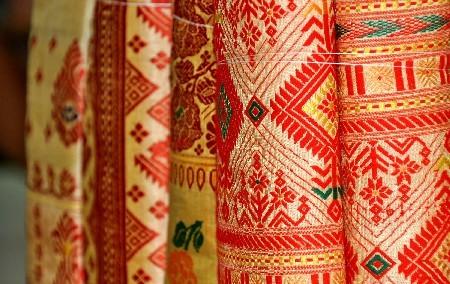
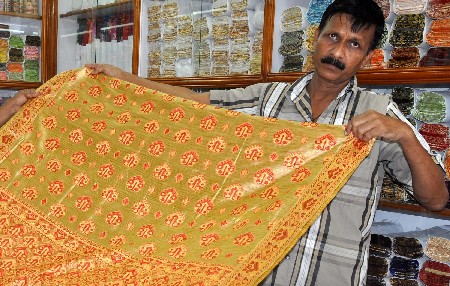
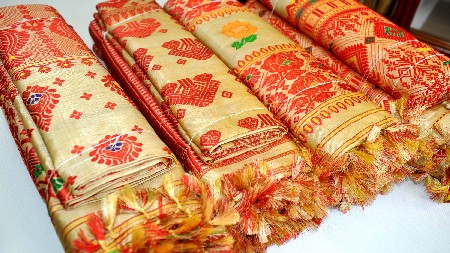
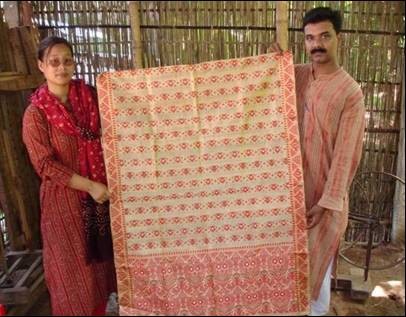
Guwahati: A dazzling traditional dress (mekhela chadar) woven with 'Muga' silk is indigenous to Brahmaputra Valley in Assam. In fact, it is one of most expensive gifts an Assamese young man can pick to win the heart of his woman. Why, not? This silk is simply magnificent, and almost as worthy as gold!

Muga silk (Muga Paat) or the golden silk is not only a nature's gift to Assam, but also a symbol of rich Assamese culture. It represents the brilliance of traditional attire of the region. The most significant characteristic of 'Muga silk' is its golden bright hue.

Its name is derived from Assamese word 'Muga', which means yellow. The fabric is superior in every respect in comparison to the normal white silk that available all over the world. It is also much more durable.

With time it only becomes more beautiful. Muga silk's brightness improves with every wash. It's no wonder that Muga silk is one of the costliest silks available in the world. Today, the cost of Muga silk is so high that for a middle-class woman in Assam it has become a prized possession, just as her gold ornaments.

Assam received the Geographical Indication (GI) tag for Muga silk in 2007. It was estimated that over 27,878 people were involved in the entire process of production of Muga silk and dress materials at that time.

The GI tag is registered in the name of Patent Information Centre, Assam Science Technology and Environment Council (ASTEC). It is valid for 10 years.

Handweaving of Muga silk

There are two kinds of registration under the GI Act - registered proprietor and registered users. While the registered GI is the ASTEC, there are hardly any registered 'users', even though there are plenty of traditional Muga silk worm farmers, fabric manufacturers and weavers in the state.

"There has to be about 27,000 registered users at the time of renewal of the GI Tag for Muga silk, otherwise the tag will be taken away from Assam," said an official of the ASTEC.

He said 'users' primarily mean families involved in cultivation of cocoons, weaving and post production work. The user has to apply in a prescribed form along with prescribed fee to the GI registry in Chennai.

"The lack of registered users is basically due to lack of awareness among people who are traditionally involved in production, manufacturing of Muga silk. We are taking steps to reach out to these people and enlighten them about the need for registration as users so that GI tag for Muga protected," the official said.

Muga is produced from cocoons of 'Antheraea Assamensis' which is available only in Assam. Muga worm ('Muga Polu' in Assamese language) also has the same lifecycle as that of a silkworm.

Traditionally Muga silk is used to make mekhela - chadar for women/girls and kurtas for boys and dresses made of Muga silk is considered most sophisticated and are expensive in Assam.

Antheraea Assamensis moth's eggs are laid out on the Som tree leaves to hatch out into caterpillars of about 2mm long. They grow rapidly, eat voraciously and grow as along as 30 mm in length after four to five weeks.

During this time, they change their skin four times. After the final skin change straw frames are provided, the silkworms make its cocoon in it.

The making of cocoon then takes eight more days. The worker interferes this life cycle at the cocoon stage to obtain the dream golden silk thread, which is used by the artisans to weave the enchanting Muga fabric.

"The demand of Muga silk is rising every year. As of date average quality Muga silk mekhela chadar or saree costs minimum Rs 10,000 in Assam. The price only rises when it is sold outside the state," said Hasna Shyam, an expert tribal weaver who has been in the business for years.

According to Shyam, the cost has shot up as the production of Muga silk has declined in comparison to its rising demand.

"The key reason for decline in production is because of the hazards posed to rearing of Muga polu in Som plantation under individual holding, due to rampant use of pesticides in mushrooming small tea gardens in the state," Shyam said.

Emily Scott Plays in the Backyard

emily-scott-sprinkler-4
Australian hottie Emily Scott has one of the finest bodies on the market. So when that rare set of images of Ms.Scott hit the net I just gotta grab em and show em off!

emily-scott-sprinkler-1emily-scott-sprinkler-2emily-scott-sprinkler-3emily-scott-sprinkler-6emily-scott-sprinkler-7emily-scott-sprinkler-8emily-scott-sprinkler-9emily-scott-sprinkler-10emily-scott-sprinkler-11