25 October 2011

Mizoram Rides High On Loans

Loans MizoramAizawl, Oct 25 : Loans disbursed to state governments by NABARD crossed rupees 1, 00, 000 crore cumulatively and stood at Rs 1, 02, 844 crore as on September 30, 2011. These included loans disbursed to 28 states and union territory of Puducherry as well as to the NRRDA to support the rural roads component of Bharat Nirman.

Sources said in Mizoram, 178 projects have been sanctioned to the state Government involving RIDF loans of Rs 361.54 crores. Of these, 141 projects have been completed and NABARD has released Rs 200.79 crore under the various projects so far.

Maximum funds were utilized for rural roads and bridges (52 %), small hydel projects and rural drinking water supply (14 % each) and Drainage & flood protection (8 %), Minor Irrigation (6 %). RIDF was set up with NABARD by the Govt. of India in 1995-1996 with an initial corpus of Rs 2,000 crore.

The funds were sourced by the Reserve Bank of India (RBI) from Scheduled Commercial Banks in proportion to the extent of their shortfall in agriculture lending. For the current year (under RIDF XVII), an amount of ` 2,000 crore has been earmarked specifically for creation of warehousing infrastructure in different states.

Some of the projects involving large financial support from NABARD in Mizoram are Tlawva Small Hydel Project in Champhai district, W. Phaileng - Marpara road and number of drinking water project including Rural Drinking Water Supply project at Durtlang.

A few special innovative projects sanctioned during 2010-2011 include Slaughter house and Meat marketing Network and Drainage-cum-Flood Control at Aizawl. Implementation of these sanctioned projects will create man days of employment, besides the long term, multiplier benefits to the economy of the States and provide essential social infrastructure like drinking water supply benefiting thousand of people.

Evaluation studies conducted elsewhere in the country have observed that NABARD has played a very proactive role in financing and management of infrastructure projects in rural areas. Further, RIDF supports to State Governments give a fillip to public investment in infrastructure in rural areas that makes positive impact on the otherwise declining rate of capital formation in infrastructure for agriculture development.

Acknowledging the need for investing massive financial resources in further developing the infrastructure in rural areas, NABARD has now designed a new financial product viz., Nabard Infrastructure Development Assistance (NIDA) for this sector outside RIDF as well.


Source: Newmai News Network

Airstrips For Northeast India

By Mihir Mishra

airstip repair in northeast IndiaNew Delhi, Oct 25 : The Northeastern region will get better air connectivity under the 12th Five Year Plan as the government plans to build airstrips in this part during the 2012-17 period. The move was being made considering the poor flight services in the region comprising Assam, Arunachal Pradesh, Manipur, Meghalaya, Mizoram, Nagaland, Tripura and Sikkim, Planning Commission member B K Chaturvedi said.

“The other major investments under the Plan will be in the GPS-aided geo-augmented navigation system and in the city-side development of the Airports Authority of India airports,” he said. During the 11th Plan period (2007-12), the government had announced to build three greenfield airports — one each at Pakyong in Sikkim, Itanagar in Arunachal Pradesh, and Chiethu in Nagaland.

The AAI is implementing the Rs 774-crore Gagan project in three phases through 2008, with the help of the Indian Space Research Organisation. This system will provide navigation system for all phases of flight over the Indian airspace and in the adjoining area. Now, the state-owned airport operator plans to develop the city side of 15 airports in the country on a public-private partnership basis.

The aviation sector has been one of the best performers during the 11th Plan Period (2007-12). It was during then that the government had announced to build three greenfield airports — one each at Pakyong in Sikkim, Itanagar in Arunachal Pradesh, and Chiethu in Nagaland. Aviation in the country has been growing (in terms of passengers) by 20 per cent during the current plan. This growth is one of the highest in the world.

However, the period also saw merger of erstwhile Air India and Indian Airlines, which did not yield the kind of results as expected. The merged entity is under losses of Rs 20,000-crore accumulated since the merger in 2007.

In the airport sector, the period saw AAI upgrading 35 non-metro airports, likely to be completed by 2012.

24 October 2011

150 Hmar Refugees Return to Assam

refugees in MizoramAizawl, Oct 24 : With the improvement in law and order situation in Dima Hasao district of neighbouring Assam, around 150 Hmar refugees belonging to 20 families who had taken shelter in Mizoram have returned, a senior police official today said.

The official told PTI that most of those who returned to Dima Hasao (erstwhile North Cachar Hills) were mainly from Bairabi, the only rail link in the state, where majority of the refugees took shelter in the homes of their relatives.

"If the situation continues to improve, we hope that all the refugees who entered Mizoram since October 16 last would return to Assam," he said.

Around 200 refugees have come and taken shelter in Mizoram-Assam border Kolasib district following ethnic clashes between majority Dimasas and non-Dimasas in Dima Hasao district.

23 October 2011

Mizo National Front Celebrates 50th Anniversary

Laldenga MNF MizoramAizawl, Oct 23 : Opposition Mizo National Front (MNF), which had struggled for the independence for Mizoram, today celebrated the 50th anniversary of the formation of the state. At the main function held here, former chief minister and party president Zoramthanga said that the MNF was formed on October 22, 1961 by a few Mizo leaders at the house of the late founder president Laldenga.

"The MNF came into existence with the objective of the survival of Mizoram and the Mizo people," Zoramthanga said, adding that the peace accord was signed in 1986 with the Indian government with the same objective.

The MNF Golden Jubilee celebrations commenced last evening with camp fires being lit in all the villages by the party units and the Golden Jubilee memorial stone was unveiled by Zoramthanga this morning.

The MNF, formed in 1961 during the devastating Mautam famine after rechristening the Mizo National Famine Front (MNFF), declared independence from the Indian Union on March one, 1966 throwing Mizoram into a struggle for the next 20 years.

After the Mizo accord was signed on June 30, 1986 with the Centre, the erstwhile underground MNF became a regional party again and won the first election to the 40-member state assembly (after Mizoram attained statehood on February 20, 1987).

The MNF government led by Laldenga was toppled in August 1988 and the party lost two consecutive state assembly polls in 1989 and 1993 before returning to power in 1998 and 2003.

However, the MNF government was voted out of power in 2008 with the Congress storming back to power with a thumping majority in the December 2, 2008 assembly polls.

Nagas Fancy Eating Snakes, Rats, Squirrels, Dogs, Cats, Spiders!

By Prasanta Mazumdar
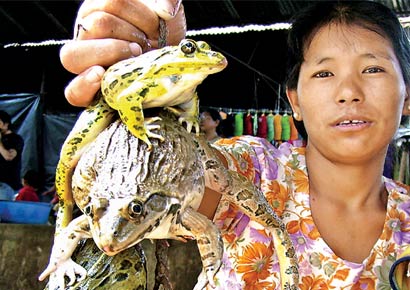
A female holding frogs Photo by Caisii Mao

Dimapur, Oct 23 : The Nagas eat anything that moves. They do not even spare insects and worms. But what they relish most is the meat of wild animals. Warriors as they are by nature, the Nagas love hunting, and the meat of wild animals fills them with great delight.

Rice is their staple food, which is taken with meat. The meat is mostly pork, beef and chicken, but it can also be snakes, snails, rats, squirrels, dogs, cats, mithuns, buffaloes, deer, spiders, birds, crabs, monkeys, bee larvae, shrimps, red ants, and almost everything that is wild. Elephants included. No part of an animal is wasted — even blood, skin and intestines are eaten. Occasionally, however, they let the skin be, and use it to make shields.

“We have feasts throughout the year and no festivity is complete without meat. We rear pigs, dogs, cats, chickens and buffaloes but the meat of wild animals is always preferred,” says K Sangtam, a Naga elder. “Hunting is something the Nagas have practiced for ages and it’s a matter of pride for a hunter if he has the highest number of kills,” he adds.

There are 16 recognised tribes and a number of sub-tribes of Nagas in Nagaland. They also have a sizeable population in Arunachal Pradesh, Assam, Manipur and eastern Myanmar. Their food habits are different from those of other tribals in the Northeast — both in terms of the animals they eat, and the style of cooking. They smoke their meat at home over a kitchen fire and apply axone (fermented soya bean) to create a pungent aroma in the dishes. Some love their meat with anishi (a
preparation made of dried yam leaves).

‘Frog is like chicken’
Most meat dishes are boiled with suitable ingredients and spices. Frogs, bee larvae and insects are cooked till dry (with ginger, garlic and chilly). Snail is cooked with a lot of chillies. For dog meat, the best spices are ginger, Naga pepper and dried red chillies. Meat is also cooked with lettuce and spinach leaves. Chilly, mostly ‘bhut jolokia or Naga mircha’, and bamboo shoot are equally popular.

Not all species of dogs, frogs, snails, worms and insects are eaten. The Nagas say frog meat tastes like chicken. The

‘Wednesday Bazaar’ in Dimapur is very dear to these tribals for the array of animals, insects and worms sold here. A dog is sold (alive) for Rs500-Rs600. Frogs and (river) snails cost Rs200-Rs250 a kg. The river snails, which are very small in size, are cooked with ‘daal’ and sucked. The bazaar teems with customers every week. The sellers are mostly locals and they deal in local fruits, animals, insects, worms, vegetables, traditional utensils, garments, ornaments, handicraft items, etc. Nagas from all walks of life — some from remote areas — come here for shopping.

I remember once eating a pork dish at a friend’s place in Dimapur. He is a Sumi (tribe) Naga and an inspector in Nagaland police. The Sumis are known to cook the best smoked meat dishes with axone. So, one day he called me home for lunch. He told me he had slaughtered a pig. I had eaten pork before but had never had it with axone. Initially, I was a bit hesitant as I did not like the smell. It stank. But once I got over the smell, I relished the dish. The riceI had with the meat was equally yummy.

Women can’t eat monkeys

On another trip to Dimapur, I got to taste a different pork dish at the residence of a journalist friend. It was cooked with spices and the blood of the animal. Honestly, I could not enjoy it as the thought that I was drinking (or rather, eating) blood made me uncomfortable. Generally, when an animal is slaughtered, the Nagas drain the blood into a big bowl, and use it in meat dishes once it turns cold. (The blood turns into a solid, paneer-like substance once it gets cold. It is then cut into pieces and used to prepare a curry.)

The Nagas have a taboo on consuming the meat of certain animals, as they fear the qualities of the creature will be transferred to the user. “We do not allow a woman to eat monkeys for we believe that will make her extravagant,” says Joseph Sumi, a professional. Despite the taboo, a lot of Naga women eat monkeys these days. Nagas, he says, do not allow a pregnant woman to eat bear meat since it is regarded a stupid animal. Sumi adds that tigers and leopards are also not eaten because of an old belief that man, tiger and spirit were all brothers at the beginning of creation.

The Nagas also believe that the meat of wild animals, insects and worms can cure a number of diseases. “The meat of a type of kingfisher, which we call stone bird, is very dear to us. The bird eats stones and there is a traditional belief that its meat is a panacea for renal diseases,” says Francis Lotha, a university student, adding, “Frog, snails and bee larvae are eaten when one is injured (believed to quicken the healing of skin and bones), local chickens and legs of pigs are eaten during pregnancy, and dog meat is believed to be a cure for pneumonia."

Eric Angami, a scribe, claims monkey meat gives one quick relief from extreme physical weakness or lethargy. “Believe me, it enlivens you,” he insists.

“The marrows of stags and wild goats are believed to heal fractured bones faster, and an earthworm is taken to neutralise the venom of a snake bite,” says P Shimray, a lover of monkey meat. He adds, “Once my mother was bitten by a poisonous snake. She was writhing in pain. But she recovered within half an hour after being administered a fluid full of earthworms.”

James Angami, a teacher, says the elders encourage the youth to eat snakes in the belief that it makes them immune to the reptile’s venom. “Our food habits haven’t changed much over the years. We love meat as much as our forefathers did. The only difference is that we’ve learnt to use spices,” says Roland Ao, who has a weakness for snails. So would he love to eat the meat of a rhino? “Oh yes,” he smiles. “But sadly we don’t get it here.”

m_prasanta@dnaindia.net

Source: DNA

'Racial profiling' of Northeast India Students in Hyderabad University

By Nikhila Henry & Mahesh Buddi

A University of Hyderabad "initiative" to end drinking and drug use on campus took an ugly turn as the vice-chancellor suggested to faculty members they begin with students from the northeast.

Hyderabad, Oct 23 : A University of Hyderabad "initiative" to end drinking and drug use on campus took an ugly turn as the vice-chancellor suggested to faculty members they begin with students from the northeast.

Describing it as a case of "racial profiling", students held daylong protests on Friday, ending in the official apologizing in writing for the "inadvertent" move.

Vice-chancellor Ramakrishna Ramaswamy's concern on alcohol and drugs on-campus grew over the past 20 days when in two incidents of violence, students were found to be inebriated.

Students from the northeast said they had been singled out in both cases, though others were involved as well. On October 17, Ramaswamy sent a letter to faculty members from the northeast, saying he wanted to meet them regarding "consumption of alcohol and drugs on campus".

At the meeting, he informed them that the university administration would carry out a series of reform measures to curb consumption of alcohol and drugs on campus and that he would "start" with the northeastern community.

Furious at the statement, students held a rally, demanding the V-C apologize for "shortlisting" them. "Alcoholism or drug abuse affects people across the world. So when it comes to reforming student community on campus why should the V-C call up the faculty members of northeastern community?

It is a clear case of racial profiling and we are not ready to put up with this," said a student of the university. "This will continue if we do not protest," said another.

The incident appeared to add to already simmering resentment. Northeasterners said they were teased and branded "fast" and treated "differently" by others and the V-C's statement was a damaging reflection of how they were being perceived. The agitation of north-eastern students was supported by other students as well.

"The university is an egalitarian space and the fact that the head of a university thinks that a certain student community needs to be profiled, counselled and corrected corrupts the very nature of that space," said a student.

By the end of the day, Ramaswamy said he had merely consulted faculty members on the incidents of violence in the past, which "inadvertently gave the impression of profiling". "If it has hurt your sentiments, it is deeply regrettable," he said in a written statement, which was circulated in the university.

Dean of student welfare, B Rajashekhar, said that it was norm in the university to involve faculty members to resolve student issues and the latest move was no different.

NSUI Forms Northeast Cell To Woo Votebank

By Sanjib Kr Baruah and Aurangzeb Naqshbandi

http://www.hindustantimes.com/Images/HTEditImages/Images/23_10_pg04a.jpg

New Delhi, Oct 23 : Prompted by Congress general secretary Rahul Gandhi, the National Students Union of India (NSUI) has set up a Northeast cell to woo more than one lakh students from the region's eight states in Delhi. The move by the Congress party's student wing comes a year after the BJP had set up the

Northeast Sampark (contact) cell to build its base among the ever-increasing student population from the Northeast.

The NSUI's Northeast cell, comprising 11 members, will operate out of its Raisina Road in the Capital.

"Representatives of various Delhi-based Northeast student organisations will meet Gandhi soon, who is taking keen interest in this regard," said Sanjoy Takam, Lok Sabha MP from Arunachal Pradesh.

Takam along with party official Girish Chodankar has been entrusted with the task of implementing the decision.

As a first step, the cell has arranged for an interactive session between Gandhi and students from the Northeast in Delhi on November 4. The support of Northeastern students is said to have been crucial for NSUI in clinching the president's post in Delhi University elections this year. "Such a platform will be apt to air issues and problems facing the community in the capital," Takam said.

The total population of people from the region, including students, is estimated to be about five lakh. Five years ago, it was just about 80,000.

"It is good that the Congress has also decided to set up such a cell. It is high time that we pay attention to our people who are being looked upon as foreigners in their own country," said Sunil Deodhar who leads the BJP's Northeast Sampark Cell.

Source: Hindustan Times

Sharmila, The Light of Manipur

By Bula Devi

WHEN WILL THE FAST END? Will there be light at the end of the tunnel for Irom Sharmila? File Photo: Ritu Raj Konwar

WHEN WILL THE FAST END? Will there be light at the end of the tunnel for Irom Sharmila? File Photo: Ritu Raj Konwar

Irom Sharmila has been leading an unnatural life, out of choice and goaded by the Manipuri society, especially civil society groups. For nearly 11 years now, it has become a routine for her to remain housed in hospital, in judicial custody, with a tube dangling from her nostrils to force-feed her. Always flanked by cops rather than relatives and friends, she visits the court every fortnight in an ambulance and says “no” on being asked if she will end her fast.

Her resilience to carry forward the silent protest since November 2000 against a draconian law, the Armed Forces (Special Powers) Act (AFSPA), has earned her the title Manipur's ‘Iron Lady.' She has put little known Manipur on the world map with probably the longest running hunger strike in recorded history. She has become an iconic figure for the entire Manipuri society; she is the torchlight-bearer of the people against a law that gives the security forces power to kill with impunity.

AFSPA is in force in the ‘disturbed areas' of Assam, Manipur (excluding the Imphal municipal council areas), Nagaland, parts of Arunachal Pradesh, 20 km in Meghalaya bordering Assam, a few police stations in Tripura, besides Jammu and Kashmir. Her hunger strike began following an incident in which the security forces allegedly sprayed bullets and killed 10 innocents at a bus stop in Malom town. Since then the incident has been known as the Malom massacre. The civil society groups are proud of Irom Sharmila for carrying on with her crusade on behalf of the people.

How long will she fast is anybody's guess? She is 39 years old and already past her youth. When she acknowledged to a journalist about her fondness for a man called Desmond Coutinho, a British national of Goan origin, whom she met only once in March this year following a yearlong exchange of letters, there was an element of disdain for her by those who used to shower her with praise and affection.

In one fell swoop, their pride in her has crashed. Why? Is this feeling out of desperation because all along, they supported her and probably in the process pinned their hopes on her “sacrifice”? Did they in the process start misreading “her” struggle as “our” struggle? Is this why her willingness to lead a normal life jolted them?

The civil society groups' struggle, however, appears a long-drawn affair. There has been no progress to replace the Act with a more humane law as was promised by the Union government in 2004. The reason being the security establishment, particularly the Army, is opposed to the idea of tinkering with the Act. Home Minister P. Chidambaram has also admitted the lack of consensus within the government on the issue.

No doubt, Manipur's young and old have had their own share of struggle and apathy. But does it mean that Sharmila has no right to lead a normal life? She has, of course, said she will marry only after the Act is repealed. Whether she is being tricked in this love affair as suspected by many

Babloo Loitongbam, human rights activist from Manipur and Sharmila's long associate from the Just Peace Foundation, refuses to comment on her personal life. “She can stop her fast whenever she wants, she can marry whoever she wants. There will be no interference from our side.”

But what about the Meira Paibis, who took up the cudgels against wrongdoings in the State? In July 2004, Meira Paibis made the headlines worldwide when they stripped themselves — the ultimate form of protest — in front of the Kangla Fort, against the excesses committed by the security forces on the people. Why did they not support Sharmila? Why did they not stand up for another woman's cause?

Interested parties see a conspiracy and burnt copies of the newspaper that published her interview and banned the newspaper in Manipur. Why? According to some civil rights activists, a relationship has surely developed between Sharmila and Desmond. But the venom is against the reportage. “In the backdrop of Anna Hazare's fast against corruption, the article was more about her love story than the cause for which she has been on a hunger strike for more than a decade. The write-up also tried to create differences between her and us. …why?…how can we intrude into her personal life when we are not even allowed to meet her?” asks a civil society activist.

But, how long will the civil society groups ride on Sharmila's shoulders? On the one hand, these groups strongly support freedom of the press and, on the other, they ban the newspaper in Manipur for publishing Sharmila's interview. Why this double standard?

Whatever the case, Sharmila should not be allowed to end up like Bobby Sands, the revolutionary spirit of freedom who represented the Irish nationalist aspirations and died on the 66th day of his hunger strike in May 1981. Or like Pedro Luis Boitel, a political revolutionary from Cuba, who died in jail in May 1972 following his fast unto death. Potti Sreeramulu, the Amarajeevi (immortal being), died in December 1952, following his fast for linguistic re-organisation of the States and achieving Andhra Pradesh. And, there are also others who have died — unsung heroes like Swami Nigamanand in June 2011 after fasting in his quest for stopping quarrying in the Ganga.

(A Delhi-based independent journalist, the writer's email id is: bula07@ gmail.com)