06 October 2011

Steve Jobs: Inventor, Innovator, Visionary, Entrepreneur, World Changer

Steve Jobs, the co-founder of Apple, has died, according to the company. He was 56.

The hard-driving executive pioneered the concept of the personal computer and of navigating them by clicking onscreen images with a mouse. In more recent years, he introduced the iPod portable music player, the iPhone and the iPad tablet -- all of which changed how we consume content in the digital age.

Jobs had battled cancer for years, took a medical leave from Apple in January and stepped down as CEO in August because he could "no longer meet (his) duties and expectations."

The Internet Pays Tribute To Steve Jobs

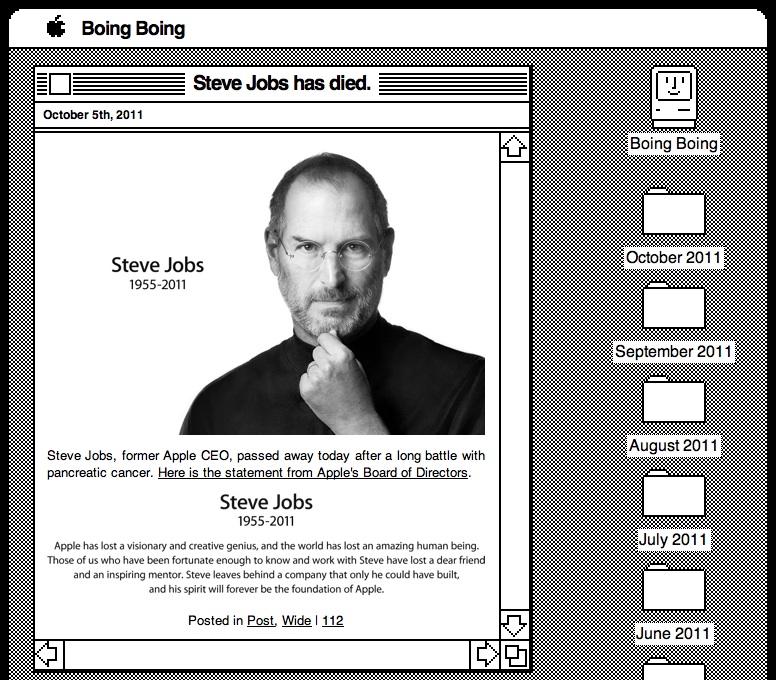
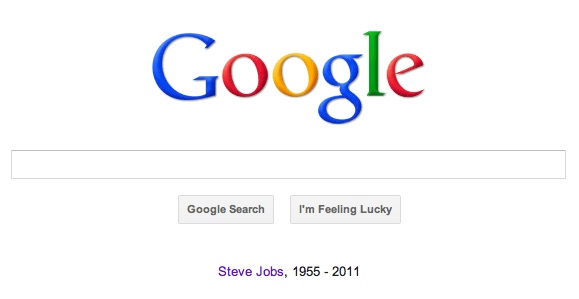
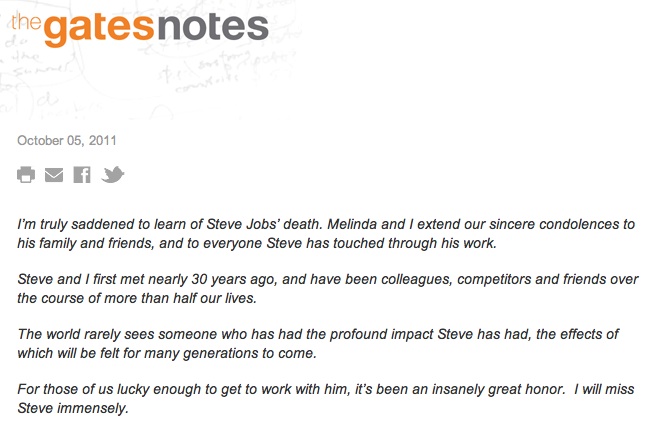
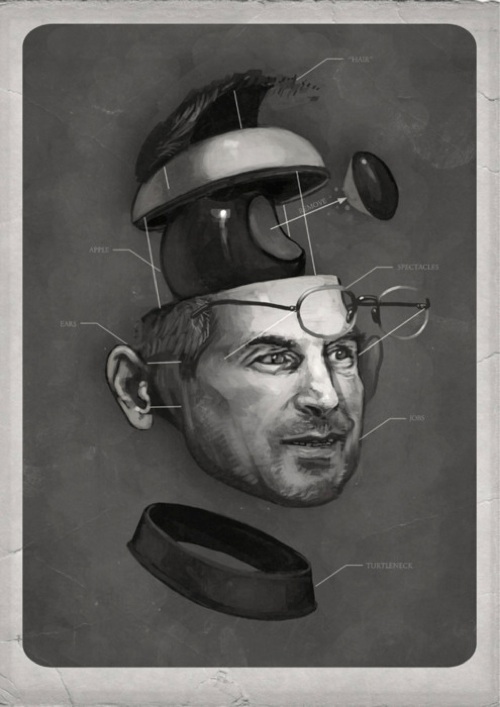
Here are some tributes to Steve Jobs that have showed up following Apple’s announcement that he had died.

boing-boing

wired

google-steve-jobs

bill-gates

apple-steve

by Jonathan Mak Long via J. Adam Moore

steve-jobs

by Mike Mitchel

someecards

05 October 2011

A Conversation With: Anna Hazare

By LYDIA POLGREEN AND HARI KUMAR

Anna HazareAdeel Halim for The New York TimesAnna Hazare

When we arrived in Anna Hazare’s village, the famous Ralegan Siddhi in rural Maharashtra, late last week, an aide had a curt message for us. Anna-ji, he said icily, was recovering from a long journey the previous day and would not be receiving any visitors.

Apparently Mr. Hazare hadn’t received the memo. We found him sitting beneath a vast peepal tree in the courtyard of the village’s Padmavati Temple, a sprawling compound which serves as both office and residence for Mr. Hazare. He was dressed in his usual outfit of white khadi kurta pajama topped by a jaunty topi, listening to the complaints of some local auto workers. If he was tired he didn’t show it. Once the meeting wrapped up he beckoned us into the small, pink-walled room where he sleeps on an iron cot.

In the weeks since he ended his 12-day fast, he has largely been resting in Ralegan Siddhi. Sitting cross-legged on a thin mattress, a chipper and smiling Mr. Hazare spoke to us about Mahatma Gandhi, the rifts within his social movement, how he spends his days and his plan for politics.

Q.

Some people compare you to Gandhi. How do you feel about that comparison?

A.

That is not fair. I am not able to even sit at Gandhi’s feet. But I try to follow his philosophy.

Q.

Your fasts have been called political blackmail. Is that fair?

A.

What do you mean, blackmail? Am I asking for money? They have forgotten the constitution. In 1950, the people became owners of this country. Because all the people cannot go to Parliament, we have elected [politicians] to make good laws and to take care of the treasury. If they are not making good laws and not keeping the treasury clean, if I protest against that, it is not blackmail.

Q.

How do you spend your day?

A.

I get up at 5. I do one-and-half hours of yoga, pranayama, than meditation. At 8:30, people start coming. This continues till evening. In between I find time to write letters. I sleep at 10.

Q.

What do you eat every day?

A.

Roti and vegetables, one time per day. In the morning I take milk. In the evening I take one glass of juice.

Q.

Thousands of people came out to support your fast. Are you worried that people’s expectations of change are too high?

A.

This question occurs to me, also. I don’t have wealth. I live in a temple. How can a man like me, who lives in a temple, fulfill the expectations of people all across the country? What can I do? But I have faith in God that whatever the expectations of the people, somehow God will find a way for these things to be done.

Q.

What is next for you? What are your aspirations?

A.

I don’t have any aspirations. I do my selfless work.

Q.

Do you want to be prime minister? Get into politics?

A.

This is muck for me. I will neither contest elections nor make a party nor go into politics. But in four or five years, if I get good people, I will ask them to fight elections.

Q.

Some accuse you of having contempt for democracy.

A.

People of character and principle should sit in these positions. [Parliament] is the holy temple of democracy. Holy people should go there. In our Parliament today there are 150 people with criminal backgrounds.

Q.

Among your allies are Prashant Bhushan, who criticizes economic liberalization, and Arvind Kejriwal, who has been criticized for saying overly harsh things about the prime minister. Do you agree with them, and is there disunity among your senior leaders?

A.

I will try to change them. There were some ego problems. From the government side it was Chidambaram and Kapil Sibal. From our side also there were some issues. I was not getting the right feedback, nor was the prime minister. That complicated the issues. Later, Vilasrao Deshmukh and another minister got involved and direct contact with the prime minister was established. I have an old relationship with Vilasrao. Then the issues were resolved. They [Mr. Bhushan and Mr. Kejriwal] are good people. I need to change them. I will change them.

source: blogs.nytimes.com

Financial Assistance to Mizoram

indian-rupees-mizoramAizawl, Oct 5 : Union Finance Minister Pranab Mukherjee has agreed to give special plan assistance to the Mizoram Government even though the ministry had earlier rejected the proposal of the State Government.

The decision was conveyed in person to State Chief Minister Lal Thanhawla during a 40-minute meeting with Mukherjee in New Delhi.

Lal Thanhawla also urged the finance minister to allocate more funds to meet the additional expenditure arising out of the implementation of enhanced salaries to the state government employees as per the recommendations of the central sixth pay commission.

Please Come Shop. US Woos Indians With Easy-To-Get Visas

By Uttara Choudhury

Uncle Sam wants your shopping dollars, and he's willing to ease your visa process. Reuters

New York, Oct 5 : Desperate times call for drastic measures. Washington has come up with an ingenious way to help keep the US out of recession: import consumers from India, China and Brazil with money to burn by making it “easy as pie” for them to get tourist visas to travel to the US.

To boost the sagging economy, lawmakers and White House officials are courting newly-moneyed shoppers from the emerging countries to fill up luxurious US shopping malls as American consumers tighten their hold on purses. Among the incentives to foreign shoppers would be coupons, beauty contests – and lax visa rules.

An official from the bureau of consular affairs told Firstpost that travel to the US on a B1/B2 visitor visa would soon become “easy as pie” as steps were being taken to tackle long visa wait times in Brazil, India, and China, in particular, by increasing staff at US consular offices.

A bill has also been introduced in the US Congress, which would require visas to be processed in 12 days and authorise the use of videoconferencing to conduct visa interviews.

“By making it easier to travel to the United States without compromising important national security safeguards, we can stimulate local economies and help our businesses grow and thrive,” said Democrat Senator Amy Klobuchar.

Senator Klobuchar, along with Republican Senator Roy Blunt, introduced a measure on Tuesday that would cut short the wait for visas for foreign travellers to enter the US. Both senators head up the Senate tourism caucus.

US policymakers estimate that if the red carpet were rolled out, shoppers from overseas could spend $859 billion over the next decade, creating 1.3 million new jobs. President Obama’s jobs council has deemed international travel to be the “low-hanging fruit” for stimulating the economy.

“The appeal of this idea is that it is a potentially politically palatable way to deal with a fundamental economic problem that is keeping companies from hiring — excess capacity,” Peter Cohan, author of the new book Export Now, wrote in Forbes.

“The beauty of importing these consumers is that it’s so easy — all we have to do is let them know where they can buy their bargains and make it quicker for them to get visas to enter the US.”

Cohan said a brief review of the performance of leading upscale US retail brands revealed “eye-popping growth thanks to demand from the globe’s nouveau riche.” He said that Tiffany, Coach and Ralph Lauren all expected to grow on the strength of expansion in Asia.

David French, senior vice president for government relations at the National Retail Federation, described the US efforts as the retail industry’s own little “stimulus program.”

Although the bulk of American tourism dollars still come from Canadian, Japanese and British tourists, there was a 39 percent pop in 2010 Chinese tourism spending in the US to $5 billion; a 30 percent increase to $6 billion from Brazil, and a 12 percent increase to $4 billion from Indian tourists.

“The trend underscores the depth of the United States’ reliance on countries once considered to be at the bottom of the global totem pole,” observed the Washington Post wryly.

China’s consumers already exhibit world-beating tendencies. They spend almost 10 hours a week shopping compared with 3.6 hours for the typical American, a 2007 survey showed.

Spending by American shoppers, long considered the engine of the nation’s economy has slowed to a crawl. America is now waking up to the fact that it has been relatively stingy with tourist visas for free-spending Indian, Chinese and Brazilian tourists, while being overly generous to the Koreans and Europeans.

Where The Promise Of A Free Computer is An Incentive To Study

By Samudra Gupta Kashyap

Assam CM LaptopAsk any high school student in Assam what his or her immediate aim is, and the usual reply is securing 60 per cent in HSLC, as the Class X final is called, so that he or she also wins a free laptop from the government.

Introduced by the state government in 2005, and named after Anundoram Borooah, the first Assamese and fourth Indian officer in the Indian Civil Service of the British era, the scheme has so far touched 1.11 lakh students across the state. And it has also helped students change their outlook to life, says a recent study.

“No other state in the country has taken up such a scheme. This has brought about a sea change not just in education, but also in the society as a whole,” says Education Minister Himanta Biswa Sarma, who had envisaged this scheme during his tenure as IT minister.

The Anundoram Borooah Award with a free computer is given to every student securing 60 per cent in the high school finals under state boards (including the State Madrasa Board and State Sanskrit Board). The number of winners has gone up from 12,756 in 2005 to 19,540 this year. “The government spent Rs 25 crore in the first year. But with laptops being given instead of desktop computers since last year, the expenditure has risen to Rs 52 crore this year,” Sarma said.

The study has related three trends to this scheme — a considerable increase in the number of first-division scorers, students becoming IT-friendly and getting encouraged to opt for science courses, and, most importantly, better societal recognition of girl students.

“With 43 per cent of the laptop winners being girls, recognition for the girl awardee has been a major positive factor among families and has helped improve societal attitudes to educating women,” says the study by tech@edu, a Delhi-based group . “What is more encouraging is that the proportion of female awardees has witnessed growth by two per cent over the past five years.”

The study has found that 58 per cent of the recipients are from households with income below Rs 15,000 per month, and 37 per cent from households earning between Rs 15,000 and Rs 30,000. “This highlights the fact that majority of the beneficiaries of the award may not be otherwise able to purchase PCs that are priced at more than a month’s household income for them,” it says,

The scheme, the study claims, has also increased a recipient’s social standing among peers. “This has been especially relevant for the standing of the girl awardees. Over 77 per cent of the recipients feel that the award helps in enhancing the standing of the girl students in society. This was corroborated with a large majority of 86 per cent of the girl awardees stating so,” the report said.

A number of students, however, have sold off their computers for reasons such as their family’s financial problems. The majority of these households earn less than Rs, 5,000 per month, the report says.

In a number of cases, the computers, especially the desktops given till 2009, are lying in the students’ homes because it is not possible to take them along to a hostel. “That too has a positive side; it has been helpful in exposing parents and siblings to technology. With laptops, however, things have changed,” the report says.

Road Rage In a Far-Off Place

manipur trucks burntNew Delhi, Oct 5 : Manipur has just entered the third month of a blockade of its two major highways. The hardship this has imposed on its residents is hard to imagine, even if it has made news in recent days

Manipur has just entered the third month of a blockade of its two major highways. The hardship this has imposed on its residents is hard to imagine, even if it has made news in recent days. The blockade—its reasons and its effects—has important lessons for the Union government.

Since 1 August, the state has witnessed blockade and counter-blockade by Kuki and Naga groups. Kukis—a group that is geographically interspersed with other communities in Manipur’s ethnic patchwork—have demanded a Kuki majority district in the Sadar Hills region of the state’s Senapati district. Senapati has a numerical preponderance of Nagas. Two national highways—NH-39 and NH-53—remain blockaded.

Soon enough, Nagas, who fear that the state government dominated by a third ethnic group—the Meiteis—could try and divide this Naga majority district, imposed a counter-blockade, so to speak.

From that time, the prices of essential goods have shot up to rather painful levels. There is a thriving black market for all supplies in Imphal. The state government claims it is supplying these goods through its own distribution network, denies the existence of a black market, but cannot explain black market prices.

Blockades are not new in Manipur. Last year, the state government barred the general secretary of the National Socialist Council of Nagaland —Thuingaleng Muivah—from visiting his birthplace in the Ukhrul district. The result was a Naga blockade. The state government did not let Muivah enter Manipur as it feared that it would be the first step in the creation of a “greater Nagaland”, one that incorporates part of Manipur, further truncating one of the smallest states in the country.

Manipur is a good example of politics based on sub-regional identities going haywire. It shows that there’s no end to the process of linking territory with ethnic identities, a divisive process that can go way beyond what is administratively feasible and politically reasonable. States can be divided into districts and sub-divisions made new districts and finally new states pulled out like rabbits out of a hat. Once the word Punjab came to one’s mind; the current expression is Telangana.

The Union government needs to be aware of the ill effects of giving into such demands. The risk to the unity and integrity of the country cannot be overstated.

source: livemint.com

04 October 2011

Mizoram's Senior Citizens Feel Neglected

Mizoram Upa Pawl meetingAizawl, Oct 4 : Senior citizens in Mizoram have felt that the state government has neglected them regarding certain benefits the Centre has made for them.

Speaking to a source on the occasion of International Old Age Day yesterday, Mizoram Upa Pawl (MUP) or senior citizens’ association general headquarters president K Malsawma accused the state government of not implementing different old age schemes in the state.

He urged the state government to expeditiously set up geriatric ward in all district civil hospitals as per the Centre.

Mr Malsawma termed the state government’s 'inaction' despite repeated pleas from the organisation as a failure to realise the importance of the scheme.

He said with increasing number of octogenarians and above in Mizoram, geriatrics wards were need of the hour.

Informing that 23,547 persons in Mizoram were at present getting old age pension, the MUP president pointed out that beneficiaries were not getting equal amount, with some getting Rs 250 per month while others get Rs 200 per month.

He also alleged that the Rs 500 per month pension for people of above 80 years old is yet to be implemented in Mizoram due to the state government’s failure to meet its matching share.

A survey has found that senior citizens in rural areas are not getting enough care, comfort and nutrition compared to their counterparts in the urban areas, Mr Malsawma added.

Government Asks PSU Banks To Open More Branches in Northeast India

banking in northeast IndiaKolkata, Oct 4 : The government of India has issued a directive to public sector banks to open branches in every un-banked block in the North East by September next year. The seven sister states - Arunachal Pradesh, Assam, Meghalaya, Manipur, Mizoram, Nagaland and Tripura - are home to 70 unbanked blocks and 55 under-banked districts as banks have generally shied away from this economically backward terrain mired by insurgency.

The progress under Reserve Bank of India's (RBI) viability gap funding scheme for opening branches in this region has also been slow.

Development of the North East assumes great importance to the UPA-2 government as the region is a prominent gateway for the country's border trade with Bangladesh and Myanmar. In step with this, the RBI has decided to open offices in all seven northeastern states. It recently opened one in Agartala, Tripura.

The government, has written to the chairpersons of public sector banks to prepare individual plans for improving bank penetration in the North East. Two senior banking executives confirmed having received such a letter from the ministry of finance.

Banks had earlier decided to open 26 branches in brickand mortar form and a total of 400 banking outlets in this region. The government feels there should be at least one branch for every village with a population of 5,000. Severe communication bottlenecks in the remote areas of the North East have stifled economic and banking development here over the years.

To surmount these hurdles, the Usha Thorat Committee had advocated IT adoption levels and usage of intermediaries like business correspondents and business facilitators to serve people in these areas. In the last few years, however, banks have grasped the business potential of the region as branches here significantly help improve current and savings bank account ratios. Various banks have opened around 400 branches in the seven states in the last six years. But the government, concerned about the dismal level of bank penetration, wants to do more and reach out to every unbanked block in the next year.