04 September 2011

New District Demand Business Booms in Manipur

Manipur Map breakup district demand

Sinlung Says
:
Besides the UPF raising demands for another state from Manipur. The district demand business in Manipur is picking up steam. Every tribe with a name wants a separate district. Is this possible? Why is that only tribal organizations in Manipur are so adamant in getting district or separation from the Valley.

GROSS NEGLIGENCE? INDIFFERENT ATTITUDE OF THE VALLEY? THE FEELING OF STEP MOTHERLY TREATMENT…pushed down to the tribals?

Whatever reasons…From the look and feel, no one cares for Manipur.

So let’s go.. GREATER MIZORAM, NAGALIM, ZALENGAM…

Imphal, Sep 4 : There have been new districts demand boom in Manipur. The latest has been the Tongjei Marin District Demand Committee (TMDDC) reviving its latent demand for creation of separate district by bi-furcating the existing districts of Churachandpur, Tamenglong, Jiribam (in Imphal East) and Senapati.

This demand is being revived even as the ongoing agitation across Sadar Hills under the aegis of Sadar Hills Districthood Demand Committee (SHDDC), demanding a full fledged district is wedged in political battle. The agitation by SHDDC has stifled National Highways 53 and 39, passing through the contiguous area, for the 34th day today, thereby effectively shutting the state off from mainland India.

Convener of Tongjei Marin District Demand Committee (TMDDC) Abon Kamei today told the media at Manipur Press Club here that a memorandum to this effect had already been submitted to the then chief minister of Manipur as early as July 11, 1998 and the memorandum submitted on August 30, 2011 is only a reminder. 

With this, there are currently five now-active-now-latent movements demanding the creation of full fledged districts in Manipur---Tongjei Marin, Phungyar, Sadar Hills, Jiribam, Tengnoupal.

An area of 952 sq. km encompassing Tamenglong district’s Lower Lukhambi to the north, Churachandpur district’s Tuangtu and Tuiphai (Thanlon-Nungsei Kolhen Chothe Munpi of Henglep subdivision) to the south, Senapati district’s Sadar Hills’ New Keithelmanbi and Chini-Inkhol to the east and Imphal East’s Jiribam’s Gularthol and Tousem subdivision’s Kaiphundai to the west, comprising of 150 villages and one of the most underdeveloped area of the state have been proposed to be created into a full fledged district, noted Abon Kamei. 

He added that the approximate population of the proposed district is one lac, composed of Aimol, Gangte, Chiru, Baite, Meitei, Bihari, Bengali Neisel, Haokip, Kipgen, Paite, Zou, Sitlhou, Singsit, Samte, Simte, Vaiphei, Singson, Kharam, Khasi, Hmar, Kom, Nepali, Zeliangrong Zemei, Liangmai, Tongmei, Puimei, all indigenous to the area in question.

Highlighting the historical importance of the area which has fallen out of favor today, Kamei observed that all essential commodities from Silchar was traditionally brought in through a narrow conduit along the Tongjei Marin stretch by the villagers on a foot journey that required several days hiking. 

The Zeliangrong people carried the palanquin of King Charairongba in 1704 AD when he went on his pilgrimage to Brindavan in Uttar Pradesh through Tongjei Marin and onto Silchar, he said.

He added that the people of the area had also extended support by enlisting as royal soldier during the time of King Bhagyachandra and King Gambhir Singh whose sacrifices and martyrdom are still fondly remembered to this day.  Kamei rued that despite such a historical importance, the area has since been fallen out of favor with the government and needed restoration of the lost pride.

According to him the area has been completely ignored by the government with developmental radar bypassing it. Healthcare delivery services are pathetic with few nonfunctioning PHC buildings and no doctors and nurses to attend to the healthcare needs of the people. Many women have died while giving birth, not to mention death due to snake bite.

There are no motor able roads and the only means of reaching the area is by tracking along the narrow path through the woods for 3-4 days.

There is virtual no education system in the area, he said.

Kamei said that the development deficit of the area could only be addressed with the creation of a full fledged district. He also said that there is a simultaneous demand for the inclusion of concept in the re-organization process undertaken by the government appointed subcommittee.

Rs. 1 Lakh To Those Who Make it To Guinness Records

Guinness-World-Records AssamGuwahati, Sep 4 : Assam Chief Minister Tarun Gogoi on Saturday declared that his government would provide Rs. one lakh as incentive to anyone from the state who finds a place in the Guinness Book of World Records.

Gogoi made this announcement while congratulating Apuraj Barooah who made it to the Guiness Book of World Records earlier this year for his longest bromide scratch art feat.

The chief minister announced Rs one lakh as recognition of Barooah's rare feat and said his achievement will motivate and inspire many youngsters to excel in different spheres of life.

03 September 2011

The Untold Story in Libya: How the West Cooked Up the "People's Uprising"

By Russ Baker

The Untold Story in Libya: How the West Cooked Up the "People's Uprising"

Wait! Did the West just engineer the overthrow of another unpopular regime to get at an easy supply of oil?

As I write this, a new day is dawning in Libya. The “people’s revolt” against yet another tyrant is unquestionably exciting, and the demise (political and/or otherwise) of Muammar Qaddafi will, of course, be widely hailed. But barely below the surface something else is going on, and it concerns not the Libyan “people”, but an elite. In reality, a narrowly-based Libyan elite is being supplanted by a much older, more enduring one of an international variety.

The media, as is so often the case, has botched its job. Thus virtually all of its resources over the past six months have gone into providing us with an entertainment, a horse race, a battle, with almost no insight into the deeper situation..

***
It’s true that Qaddafi, like many—perhaps a majority of—rulers in his region, was a thug and a brute, if at times a comical figure. But one doesn’t need to be an apologist for him—nor deny the satisfaction of seeing the citizenry joyously celebrating his ouster—to demand some honesty about the motives behind his removal. Especially when it comes to our own government’s role in funding it, and thus every American’s unwitting participation in that action.

Let’s start with the official justification for NATO’s launch of its bombing campaign—for without that campaign, it’s highly improbable the rebels could ever have toppled Qaddafi. We were told from the beginning that the major purpose of what was to be very limited bombing—indeed, its sole purpose—was to protect those Libyan civilians rebelling against an oppressive regime from massive retaliation by Qaddafi. Perhaps because of NATO’s initial intervention, the feared Qaddafi-sponsored, genocidal bloodletting never did occur. (At least, not beyond the military actions one would expect a government to take when facing a civil war: after all, remember General Sherman’s “scorched earth” policy in the US Civil War?). However, protecting civilians apparently didn’t generate sufficient public support for intervention, so we started to hear about other purported reasons for it. Qaddafi was encouraging his soldiers to…commit mass rape! And giving them Viagra! And condoms!

You can’t make this sort of thing up. And yet that’s just what the NATO crew did—made it up. The media, always glad to have a “sexy” story, especially a sick sexy story, even a sick sexy story with no evidence to back it up, covered this ad nauseum, but never bothered to find out if it was true.


We’ve been expressing doubts about these claims, for a number of reasons—including logic—for some time now. (For more on that, see this [3] and this [4] and this [5].) But it’s tough to counterpoise hot-button issues with rationality. If you questioned the mass rape story, you were a “rape-enabler.” If you pointed out that Qaddafi was being bombed for anything other than humanitarian reasons, you were a “Qaddafi-lover.”

The media was so gullible that the professional disinformation guys went onto auto-pilot, recycling tired old tropes that nobody ought to be buying anymore. For example, most news outlets reported recently that Libya had fired a SCUD missile at the rebels.

“That it didn’t hit anything or kill anyone is not the point. It’s a weapon of mass destruction that Col. Qaddafi is willing to train on his own people,” said one Western official.

If the effort to rally public opinion against Qaddafi centered on any one factor, it was fury over Libya’s purported role in the 1988 bombing of Pan Am flight 103 over Lockerbie, Scotland. As we noted in a previous article [6], in the years since the conviction of a Libyan intelligence officer in the tragedy, a chorus of doubts has grown steadily. The doubt is based on new forensic evidence and research, plus subsequent claims by prosecution witnesses that their testimony was the result of threats, bribes, or other forms of coercion. It is an ugly and disturbing story, not well known to the larger news audience.

Yet Lockerbie has continued to touch nerves. In February, when Qaddafi’s Justice Minister turned against him and became a rebel leader, he brought with him dynamite. Mustafa Mohamed Abud Al Jeleil made the dramatic claim [8] that his ex-boss was the culprit behind the bombing of Pan Am 103. He asserted that he had proof of Qaddafi giving the direct order for the crime. This got considerable media attention, though almost no news organizations followed up or reported that Jeleil never did supply that proof. The Libyan convicted of the crime has consistently denied any involvement. Nonetheless, his conviction in the case has had Qaddafi on the defensive for years—and working hard to prove to the West that he can be a “good citizen.” Part of this has entailed his paying out huge sums in reparations.


***

From the beginning of the Libya saga in February until now, the NATO coalition has never wavered from its initial declaration of humanitarian motives. And, to be sure, we may still learn of horrible, previously-unknown atrocities by Qaddafi. Still, the United States and its allies have little history of using their might strictly to protect civilians. If so, millions of South Sudanese, Rwandans and others might not be in their graves.

Besides, with all the talk about Qaddafi harming his citizens, what about the effect of more than 7000—yes, seven thousand—NATO bombing runs? We heard constant reports about how Qaddafi was facing charges of “war crimes,” with never a word about NATO. To learn the impact of this massive unleashing, you had to be relying on Tweets from Libyans witnessing it, or visiting obscure websites that shared eyewitness accounts.

Some Western military officials couldn’t even be bothered to participate in the “humanitarianism” charade. For example, the top British general explicitly stated [10] that the objective was really to remove Qaddafi. Nobody—including the media—paid much attention to this admission, perhaps because it was already assumed to be the case.

Qaddafi should never be seen as a victim—indeed, he has always been sleazy and monstrous in various ways. But the US and its allies appear to have cared little about this, while being deeply troubled by his role as a fly in the geopolitical ointment. A look at the long and complex historical relationship between Qaddafi and the West begins to explain the true reason he had to go. It also dovetails perfectly with a growing body of indications that Western elites encouraged and even provoked the uprising—while tapping into deep discontent with the dictator.

***
Qaddafi has long been a thorn in the side of the West’s oil industry and their national security apparatus. In the early 1970s he worked closely with Occidental Petroleum chairman Armand Hammer in thwarting the ambitions of the oil majors. He was a leader in the boycott of Israel and often cozied up to the Soviet Union.

Back in the 1980s, the Reagan Administration plotted for five years to get rid of Qaddafi and sent 18 U.S. warplanes in April 1986 to eliminate the “Mad Dog of the Middle East.” Reporter Seymour Hersh actually did investigate the whys and wherefores of the ensuing bombings over Tripoli. (The bombings killed the Libyan dictator’s daughter but obviously failed to achieve their primary objective). Hersh’s piece in the February 22nd, 1987 New York Times Magazine, “Target Qaddafi,” has striking echoes in the NATO attacks of 2011. It revealed:

- “internal manipulation and deceit” on the part of the White House to disguise its real intentions, namely, to assassinate Qaddafi;

- Denials after the raid on Qaddafi’s compound that he had been a target, insisting that the compound hit was “a command-and-control” building;

- The training of Libyan exiles, armed by Israel, to infiltrate Libya through Tunisia.

- The creation of a pretext for the attacks. In this case, it was the April 5, 1986 bombing of the La Belle discotheque in West Berlin,a hangout of American servicemen. This bombing was blamed on Libya “based on intercepted communications,” despite the explicit rejection of this claim by Berlin’s then-chief of anti-terrorist police.

- The revelation, according to one intelligence official, that “We came out with this big terrorist threat to the U.S. government. The whole thing was a complete fabrication.”

- As for real motives, Hersh discerned from a three-month investigation that the Reagan Administration saw Qaddafi as being pro-Soviet, “relentlessly anti-Israel,” and a supporter of extreme elements in Syria as opposed to “the more moderate regimes in Jordan and Egypt.”

- Qaddafi’s “often-stated ambition to set up a new federation of Arab and Moslem states in North Africa” frightened policy makers about their access to minerals.

It’s this that has to be considered as background for the true story of Libya—the one the Western media cannot, or will not now, report.

Behind Libya's 'Spontaneous Revolution'
What the media has so relentlessly characterized as the “spontaneous uprising” of February 2011 was hardly spontaneous. It began even before the Arab Spring itself commenced in Tunisia during December of last year—and it was orchestrated by the West.

In October 2010, Qaddafi’s protocol chief, Nouri Al-Mesmari, arrived in France, purportedly for medical treatment. But he had his family with him, and the declared reason for his trip was a cover story. He almost immediately plunged into talks with the French and their intelligence service. He argued that Qaddafi was weak. He pointed out breaches in Qaddafi’s national security shield that made it possible to take him down. (More on this can be found on the subscription-newsletter site [13] “Africa Intelligence.”)

In December, Mesmari was joined by three Western-educated Libyan businessmen who had years earlier staged an unsuccessful revolt against Qaddafi. It didn’t take long for the French government of Nicolas Sarkozy to sign on to a covert effort to topple Qaddafi. There are multiple possible reasons for this, including intra-European competition, notably with the Italians, who enjoyed a particularly close relationship with Qaddafi and an inside track on Libya’s oil. In addition, the French were deeply concerned about illegal immigration from Arab and African countries,via Libya, that they felt was tolerated or even encouraged by Qaddafi. The French began talking with the British, who shared many of their concerns and a history of cooperation on covert projects.

In November, a French trade delegation, including representatives of multinational corporations, traveled to Benghazi in Eastern Libya. That delegation has been characterized by Africa Intelligence’s Maghreb Confidential as having included French military officials under commercial cover, assessing the possibilities on the ground.

The New Year’s uprising in Tunisia, followed in rapid succession by those in other Arab states, created a kind of perfect storm, arguably even a smoke screen for the “popular revolt.” (It is interesting to note the above newsletter’s assertion that Mesmari paid a brief visit to Tunisia in October on his way to France.)

“Muammer Kadhafi’s [i.e., Muammar Qaddafi’s] chief of protocol, Nouri Mesmari, is currently in Paris after stopping off in Tunisia. Normally, Mesmari sticks closely to his boss’s side, so there’s some talk that he may have broken his long-standing tie with the Libyan leader.”

Egypt followed quickly on Tunisia’s heels, and on February 16, just days after the dictator Hosni Mubarak was toppled in neighboring Egypt, peaceful demonstrations began in Benghazi—after calls went out on Facebook for people to take to the streets in protest over the arrest of a human rights lawyer. (The lawyer, Fethi Tarbel, was quickly released—news organizations do not appear to have scrutinized who ordered Tarbel arrested, or exactly why—though this was the seminal event that would ultimately lead to the end of Qaddafi’s regime.)
On February 27, a National Transitional Council, made up of politicians, ex-military officers, tribal leaders, businessmen and academics, announced its launching in Benghazi as the rebel leadership. Not surprisingly, no mention was made of the French back story.
The Italian intelligence services, intent on preserving that country’s advantageously close relationship with Qaddafi, began trying to leak what was going on. (More on the extent of the coziness between Libya and Italian oil companies, and between Qaddafi and Italian Prime Minister Silvio Berlusconi here [16].) When it proved unable to stop the operation, the Italian government seemingly decided to switch and try to head this particular parade, lest the spoils go to the others.
The United States was late to this affair, but determined to get its share of the picnic. The US has been as nervous about Qaddafi’s relationship with Russia’s Putin as France was about his ties to Italy.
CIA was ready with its own man and plan. As we previously noted [18], Khalifa Hifter, a former Libyan army officer, had spent the past two decades living just down the road from CIA headquarters, with no apparent source of income. In 1996, while a resident of Vienna, Virginia, he organized a Benghazi-based revolt that failed. When the current uprising was sputtering in March, CIA sent Hifter in to take command.
When the rebels were being routed, the United Nations Security Council approved a no-fly order for Qaddafi. The NATO bombing began almost immediately, under the “humanitarian” label.
Before long, other European countries had covert elements in Libya. The British paper, The Guardian, has just reported [20] the role of British special forces in coordinating the rebels on the ground. This was denied by the UK government . But then another British paper, The Telegraph, cited [21] UK defense sources saying special forces had been in Libya already for weeks, i.e., since early August.)
For the first time, defence sources have confirmed that the SAS has been in Libya [22] for several weeks, and played a key role in co-ordinating the fall of Tripoli.
Now that it is all over, expect details to emerge daily. For example, see this [23] from the Daily Beast on the extent of US involvement behind the scenes, including:
[A]t NATO headquarters outside Brussels, the U.S.was intimately involved in all decisions about how the Libyan rebels should be supported as they rolled up control of cities and oil refineries and marched toward the capital, Tripoli.
NATO'S Mare Nostrum
Ok, so certain Western powers wanted, really, really badly, to oust Qaddafi. But why exactly? France’s intra-European competitive motive was certainly one factor. But there was more.
Back in 2007, European Union leaders were seriously toying with the idea of NATO-izing the entire Mediterranean, turning it into the new mare-nostrum originally contemplated in Roman days. In 2007, France’s President Nicholas Sarkozy invited 27 European Union heads of state to launch a “Mediterranean union.” He also invited 17 non-EU Mediterranean countries to use, as Britain’s Daily Telegraph [24] put it, “imperial Rome’s centre of the world as a unifying factor linking 44 countries that are home to 800 million people.”
One leader did not buy in, however: Muammar Qaddafi. He claimed the scheme would divide Africa and the Arab World. “We shall have another Roman empire and imperialist design,” he was quoted as saying in July, 2008. “There are Imperialist maps and designs that we have already rolled up. We should not have them again.”
Qaddafi was particularly angered [24] that an earlier plan, which contemplated building closer co-operation among a few southern European and North African states bordering the Mediterranean, had been replaced with one which included the whole EU, the Middle East—and Israel—in the new “Union.”
“It is unbelievable that I would come to my own country and people and say that I have a union with Israel. It is very dangerous,” he said, referring to the possibility of the plan fomenting jihadism throughout Europe, not just the Middle East.
Despite this “insult,” however, Qaddafi had been attempting for some time to get his country out of the near-global embargo imposed after blame for the Lockerbie bombing was laid at Libya’s feet. And the West, for its part, had been largely in a great hurry to “forgive”—and to get access to Libya’s riches.
While Qaddafi was discussing with the Russians in 2007, for instance, the prospect of building a Russian military base in Libya, he’d also been busy rapidly repairing relations with other potential allies. French President Sarkozy visited that year, and signed a number of agreements, including a deal for France to build a nuclear-powered facility to desalinate ocean water for drinking. The next year, Qaddafi signed a cooperation treaty with Italy’s Berlusconi. And American secretary of state Condi Rice came calling in 2008, accelerating the thaw George W. Bush had avidly begun early in his administration.
In recent years, Qaddafi was on such good behavior that U.S. officials showered him with the sort of praise usually reserved for those officially deemed to be close allies. If that sounds unlikely, all you need to do is watch this video [27] of Republican Sen. John McCain on an August 2009 visit to Tripoli—with his buddy Joe Lieberman, known to most as a pro-Israel, pro-Iraq-war hawk—gushing about Qaddafi and his regime. Emerging from meetings, they evoked a spirit of friendship and mutual respect, and endorsed the US providing defense equipment to that regime. (Ever the political animal, in recent weeks, the very same McCain who led that delegation has turned to criticizing Obama for not being willing to bomb Libya heavily enough.)
A cable [28] from the US embassy in Tripoli, released by WikiLeaks, confirms that on the 2009 visit,
“Lieberman called Libya an important ally in the war on terrorism, noting that common enemies sometimes make better friends,” the cable continues. “The Senators recognized Libya’s cooperation on counterterrorism and conveyed that it was in the interest of both countries to make the relationship stronger.”
This rapprochement was characterized by a land rush of Western corporations that had long coveted their share of Libya’s oil revenues. Leading the way was the investment bank Goldman Sachs. Qaddafi and his advisers trusted Goldman’s claims that it would turn handsome profits with any funds entrusted to it. Yet Goldman managed to lose an astonishing 98 percent [6] of the funds, which were the Libyan people’s sovereign wealth. No matter. Goldman was soon back with more brilliant ideas—including suggesting, at the height of the Wall Street crisis, that Qaddafi buy a substantial stake in the Goldman firm itself.
Qaddafi was faced with these huge losses at the very time Libya was carrying a crushing obligation of reparations for the Lockerbie bombing that had been pressed on Libya as a condition of its re-emergence from years of isolation, and he began to worry about how he would pay for it all. Keeping the Libyan population at a relatively high standard of living (compared certainly to neighboring Egypt) was essential to his maintaining power. It was at this point that Qaddafi began pressing [30] foreign oil companies to increase the royalties they pay, and the companies began grousing about it.
Could this hardening of postures have contributed to the sudden decision to oust a man who had worked hard to ingratiate himself with the West?
***
At least two factors appear to have come together to create an impossible situation for Qaddafi: (1) The French, perhaps impatient with Qaddafi’s independence, and frustrated with his Italian alliance, began considering whether they might effect a change of government in Libya. And (2) the Arab Spring. Suddenly, a startling number of the thuggish Middle Eastern allies of the NATO countries began to come under threat. For a number of U.S. Eastern Establishment types, at least, these regional spasms of disaffection and bravery seemed to come as a genuine surprise. The Council on Foreign Affairs produced articles titled “What Just Happened?” and “Why No One Saw it Coming,” in the May/June issue of its Foreign Affairs magazine, dedicated to “the New Arab Revolt.”
No one seemed to know for certain what was going to happen, although there was plenty of Monday morning quarterbacking about how the Arab Spring was entirely predictable in light of the world-wide financial meltdown in 2008-09 and a growing restiveness in the Arab world. (See also our recent article [32] about a correlation between skyrocketing food prices and the revolts.)
But while it may take years to put the Arab Spring in its proper perspective, it surely had begun to occur to foreign policy elites that NATO’s plans for a militarized Mediterranean would be susceptible to unraveling if Libya’s unpredictable Qaddafi remained…unpredictable. Especially with the NATO-allied dictator Mubarak on his way out and Egypt destabilized.
A mere glance at the map reveals the strategic location of Libya. Right next to Egypt. Large. Unlike Egypt, full of oil. And of a particularly sought-after grade of sweet crude oil. (If you had momentarily forgotten how incredibly important oil is to Western government and corporations, consider this news item: Exxon Mobil reported second quarter profits of $10.7 billion, up 41 percent from the previous year.)
In other words, Libya is both sitting on gobs of oil and perfectly, strategically located for military bases to protect that oil and the oil of nearby countries, including Saudi Arabia, whose citizens have expressed hostility to the siting of American troops there. Almost nobody could stand Qaddafi. So if he were pushed out, who would complain?, By getting behind the rebels (or, even better, helping to create and fortify the rebels) the forces of the West might be able to have their own Arab Spring.

What? It's All About Oil?
In an inexcusable affront to the public, the media (with notable exceptions such as The Guardian) has largely waited until Qaddafi was destroyed to begin focusing on this incredibly obvious oil factor. One example is a piece just published [35] by the New York Times. How useful is it to allow the one-sided demonization of this man, and then, when he is on his way out, to begin saying, Oh, by the way, it was always about oil?
The piece focuses on the rebels’ plans to favor the countries who backed them over those who preferred a negotiated settlement with Qaddafi:
“We don’t have a problem with Western countries like Italians, French and U.K. companies,” Abdeljalil Mayouf, a spokesman for the Libyan rebel oil company Agoco, was quoted by Reuters as saying. “But we may have some political issues with Russia, China and Brazil.”
Russia, China and Brazil did not back strong sanctions on the Qaddafi regime, and they generally supported a negotiated end to the uprising. All three countries have large oil companies that are seeking deals in Africa.
This feels like Iraq Redux, only with different players and, so far, a different outcome. In 2003, Germany and “Freedom-fries” France refused to join the “Coalition of the Willing” in George W. Bush’s invasion of Iraq. Why? Because they had pending oil deals with Saddam Hussein.
There are other possible factors, including Qaddafi’s unique influence as an uncontrollable, Castro/Chavez-style independent nationalist with influence throughout the region. Qaddafi was an avid promoter of African unity, of governments that would remain free from the influence of the major powers. He poured a lot of money into South Africa, for instance, when it was struggling to free itself from Western influence after the fall of the apartheid regime there. As Qaddafi was going down to defeat, the West began pressuring South Africa to turn over frozen Libyan funds. (Not incidentally, there’s more than $35 billion of frozen Libyan assets in the U.S., and a comparable sum in Europe.)
African nationalism remains a big concern for Western mining, banking and industrial interests. Though the people of Africa remain desperately poor, the continent is the earth’s richest potential source of precious and strategic metals, minerals and resources of every stripe.
In hindsight, the Libyan “revolution” may be viewed as a clever effort to harness genuine domestic discontent to a global competition for the resources necessary to sustain the industrial West as well as newly emerging industrial countries like China, India and Brazil. Refracted this way, the whole NATO involvement in Libya appears to be, at root, business as usual. As they say in law enforcement, follow the money. In the midst of a severe fiscal crisis, Pentagon spending [37] alone on Libya through the end of July was $896 million. Will everyone who believes that the Western military establishment is spending such vast sums to further the “aspirations of the Libyan people,” please raise their hands?
At this juncture, it seems realistic to expect the US and its allies to settle in, nice and comfortable, on Libyan “assets” for a very long time. Anyone who doubts that might want to check out US statements [38], not widely discussed, of intent for US troops to remain in Iraq well past the original troop departure date. Or a proposal for the same thing in Afghanistan—see this report [39] about a desire to keep substantial military personnel there through 2024. Then do a little reading on the potentially $1 trillion worth of minerals in Afghanistan which the US says it only recently learned about. (Wink, wink.) As The New York Times reported [40] in June, 2010 (the story generated little public reaction):
The previously unknown deposits — including huge veins of iron, copper, cobalt, gold and critical industrial metals like lithium — are so big and include so many minerals that are essential to modern industry that Afghanistan could eventually be transformed into one of the most important mining centers in the world, the United States officials believe.
An internal Pentagon memo, for example, states that Afghanistan could become the “Saudi Arabia of lithium,” a key raw material in the manufacture of batteries for laptops and BlackBerrys.
Some will say that ascribing solely selfish motives to Western “liberators” is too cynical. For one thing, aren’t the rebels at least an improvement on Qaddafi in terms of human rights, liberties, and so forth?
For a possible answer, it’s worth reading [42] the British journalist Patrick Cockburn. He nicely sums up the craziness, brutality and internecine murder taking place in the rebels’ ranks without proper Western media attention. They appear to have killed one or possibly two of their own commanding generals on suspicion of treachery—or at least being partial to the wrong faction. For example, we’ve been hearing—in part via a seemingly well-informed individual inside Libya—that the reason the rebels killed their own commander-in-chief General Abdul Fatah Younis was his advocacy of negotiations with Qaddafi. If that’s correct—and these subjects need more reporting by the news organizations there on the ground—then we’d like to know what position all those Western spooks took on the ouster and killing of this man.
Continuing on this score, we have the plight of black Libyans, generally among the poorest in the country. We’ve seen a steady stream of indications [44] that, almost by definition, anyone black in Libya (many African migrant workers but also some Libyan citizens) has been lumped in with Qaddafi’s non-Libyan African mercenaries, considered a suspected Qaddafi loyalist and therefore targeted for harassment, physical violence and death.
Meanwhile, the rebels have released, en masse, prisoners linked to extremist Islamic movements. And one analyst is currently asserting [45] that an Al Qaeda-linked figure is the new military commander of post-Qaddafi Tripoli.
Here’s another twist: The Libyan convicted in the Lockerbie bombing, released in 2009 from jail in Scotland and allowed to return home for health reasons, is now, according to CNN, on his death bed, said to be deprived of medicines due to the recent looting of Libyan pharmacies. Once the rebels had consolidated their hold over Tripoli, CNN found Abdel Basset al-Megrahi [46] comatose, and while he has consistently maintained his innocence, it is unlikely the world will ever learn what he knows. With him and Qaddafi disappearing from the scene, any demand for a deeper inquiry into the bombing will likely evaporate.
But where is the West in all of this? A leaked plan [47] for post-Qaddafi Libya shows how elaborately involved NATO has been in the entire operation. It includes a carefully thought-out proposal for avoiding the mistakes made in the Iraq occupation—including embracing most of Qaddafi’s security forces, and an initial occupying force “resourced and supported” by the United Arab Emirates, with essentially no (visible) Western “boots on the ground.”
Doesn’t this sound more and more like an invasion, for spoils? And one that could—notwithstanding lessons supposedly learned—quickly get very messy?
Notes:
[1] Image: http://whowhatwhy.com/wp-content/uploads/2011/08/libya-oil-map.jpg
[2] Image: http://whowhatwhy.com/wp-content/uploads/2011/09/obama-libya-speech-president-said-us-intervened-to-stop-a-massacre.jpeg
[3] this: http://whowhatwhy.com/2011/03/30/libya-rape-charge-view-with-caution/
[4] this: http://whowhatwhy.com/2011/06/11/did-qaddafi-really-order-mass-rapes-or-is-the-west-falling-victim-to-a-viagra-strength-scam/
[5] this: http://whowhatwhy.com/2011/06/15/whowhatwhy-factchecks-the-media-more-questions-about-the-libyan-sex-atrocity-reporting/
[6] previous article: http://whowhatwhy.com/2011/06/06/libya-connect-the-dots-you-get-a-giant-dollar-sign/
[7] Image: http://whowhatwhy.com/wp-content/uploads/2011/09/images.jpg
[8] claim: http://www.reuters.com/article/2011/02/23/us-libya-protests-lockerbie-idUSTRE71M54A20110223
[9] Image: http://whowhatwhy.com/wp-content/uploads/2011/09/82097078-libya-nato.jpg
[10] explicitly stated: http://whowhatwhy.com/2011/05/17/quick-quick-why-are-we-in-libya-a-new-candor-prevails%E2%80%A6sort-of/
[11] View Page 2 of 3: http://whowhatwhy.com/2011/08/31/now-that-we%E2%80%99re-celebrating-qaddafi%E2%80%99s-end-can-we-get-a-little-truth/2/
[12] Image: http://whowhatwhy.com/wp-content/uploads/2011/09/images-1.jpg
[13] site: http://www.africaintelligence.com/MCE/
[14] Image: http://whowhatwhy.com/wp-content/uploads/2011/09/Colonel-Muammar-Gaddafi_Sarkozy.jpg
[15] Image: http://whowhatwhy.com/wp-content/uploads/2011/09/tumblr_lh026mjCMR1qc53ju.jpg
[16] here: http://whowhatwhy.comadd:%20Libya%20relationship%20with%20ITALY%20--%20http://www.thedailybeast.com/articles/2011/08/27/gaddafi-s-connections-to-italy-and-berlusconi.html
[17] Image: http://whowhatwhy.com/wp-content/uploads/2011/09/gaddafi2crop-420x0.jpg
[18] previously noted: http://whowhatwhy.com/2011/04/22/the-cia-s-man-in-libya/
[19] Image: http://whowhatwhy.com/wp-content/uploads/2011/09/ScreenHunter_39-Mar.-13-16.52.jpg
[20] just reported: http://www.guardian.co.uk/world/2011/aug/23/sas-troopers-help-coordinate-rebels
[21] cited: http://www.telegraph.co.uk/news/worldnews/africaandindianocean/libya/8721291/Libya-SAS-leads-hunt-for-Gaddafi.html
[22] Libya: http://www.telegraph.co.uk/news/worldnews/africaandindianocean/libya/
[23] this: http://www.thedailybeast.com/articles/2011/08/30/america-s-secret-libya-war-u-s-spent-1-billion-on-covert-ops-helping-nato.html?om_rid=C42kGP&om_mid=_BOXNRGB8dCTPIU
[24] Daily Telegraph: http://www.telegraph.co.uk/news/worldnews/europe/2277517/Gaddafi-attacks-Sarkozy-plan-for-Union-of-the-Med.html
[25] Image: http://whowhatwhy.com/wp-content/uploads/2011/09/u8_Gaddafi-crush-Condoleezza.jpg
[26] Image: http://whowhatwhy.com/wp-content/uploads/2011/09/tweet-mccain-libya.png
[27] this video: http://www.youtube.com/watch?v=yYVWT_kDTsU
[28] cable: http://wikileaks.org/cable/2009/08/09TRIPOLI677.html
[29] Image: http://whowhatwhy.com/wp-content/uploads/2011/09/goldman-sachs-may-face-bribery-charge-in-libya-deal.jpeg
[30] began pressing: http://www.nytimes.com/2011/03/24/world/africa/24qaddafi.html?_r=2
[31] View Page 3 of 3: http://whowhatwhy.com/2011/08/31/now-that-we%E2%80%99re-celebrating-qaddafi%E2%80%99s-end-can-we-get-a-little-truth/3/
[32] recent article: http://whowhatwhy.com/2011/08/26/let-them-eat-baklava-food-prices-and-the-arab-spring/
[33] Image: http://whowhatwhy.com/wp-content/uploads/2011/09/libya-oil-map.jpg
[34] Image: http://whowhatwhy.com/wp-content/uploads/2011/09/Brent-104_0.jpg
[35] just published: http://www.nytimes.com/2011/08/23/business/global/the-scramble-for-access-to-libyas-oil-wealth-begins.html?_r=4
[36] Image: http://whowhatwhy.com/wp-content/uploads/2011/09/6a00d8341c60bf53ef01347ff209fd970c-500wi.jpg
[37] Pentagon spending: http://blogs.abcnews.com/politicalpunch/2011/08/us-military-intervention-in-libya-cost-at-least-896-million-.html
[38] US statements: http://www.politico.com/news/stories/0811/61731.html
[39] this report: http://www.telegraph.co.uk/news/worldnews/asia/afghanistan/8712701/US-troops-may-stay-in-Afghanistan-until-2024.html
[40] reported: http://www.nytimes.com/2010/06/14/world/asia/14minerals.html?pagewanted=all
[41] Image: http://whowhatwhy.com/wp-content/uploads/2011/09/800_ap_libya_rebels_110307.jpg
[42] worth reading: http://www.independent.co.uk/opinion/commentators/patrick-cockburn-libyas-ragtag-rebels-are-dubious-allies-2335453.html
[43] Image: http://whowhatwhy.com/wp-content/uploads/2011/09/74983951-dead-bodies.jpg
[44] indications: http://www.mcclatchydc.com/2011/08/28/122333/libyan-rebels-face-test-as-they.html
[45] asserting: http://www.youtube.com/watch?v=1D7yVkSyIPs&feature=youtu.be
[46] found Abdel Basset al-Megrahi: http://articles.cnn.com/2011-08-28/world/libya.lockerbie.bomber_1_lockerbie-bomber-al-megrahi-national-transitional-council?_s=PM:WORLD
[47] leaked plan: http://www.theaustralian.com.au/news/world/iraq-haunts-plans-for-post-gaddafi-libya/story-e6frg6so-1226111211251
[48] click here to donate: http://whowhatwhy.com/donate/
[49] 1: http://www.france24.com/en/files/element_multimedia/image/libya-oil-map.jpg
[50] 2: http://img1-cdn.newser.com/square-image/115128-20110328193526/obama-libya-speech-president-said-us-intervened-to-stop-a-massacre.jpeg
[51] 3: http://t2.gstatic.com/images?q=tbn:ANd9GcRA1_pp-XJvyPO7s2rrzw20FjsmU2PoOiIo__bwccRCQq8CafUN
[52] 4: http://img3.allvoices.com/thumbs/image/609/480/82097078-libya-nato.jpg
[53] 5: http://t3.gstatic.com/images?q=tbn:ANd9GcRX3ajn7CmrB8L9F_9JNNtYt_yiyFuTGY2-EQFdeH-02a5F1MGw
[54] 6: http://www.enjoyfrance.com/images/stories/france/news/Colonel-Muammar-Gaddafi_Sarkozy.jpg
[55] 7: http://media.tumblr.com/tumblr_lh026mjCMR1qc53ju.jpg
[56] 8: http://www.bollyn.com/public/gaddafi2crop-420x0.jpg
[57] 9: https://blogger.googleusercontent.com/img/b/R29vZ2xl/AVvXsEjSQSC6LdBkrrUWkZZCNwTI0fMiHCxKZ4qmM5P5lbII68HQPrdO9Lm5b2IuVJSQztDrwJlnjxZb2cjpT8SQZ7DDwQKZ3TW2358xWCqUvfPonVR4DdwFOu5NhL4cEwIQi2xb6nCHcAwlMRQn/s320/ScreenHunter_39-Mar.-13-16.52.jpg
[58] 10: http://resources1.news.com.au/images/2011/03/10/1226018/869413-libyan-rebel-fighter.jpg
[59] 11: http://coto2.files.wordpress.com/2011/06/france-bombs-gaddafi-libya-benghazi.jpg
[60] 12: http://www.indiavision.com/news/images/articles/2011_08/222712/u8_Gaddafi-crush-Condoleezza.jpg
[61] 13: http://blog.prospect.org/blog/weblog/tweet-mccain-libya.png
[62] 14: http://img1-cdn.newser.com/square-image/120594-20110609121023/goldman-sachs-may-face-bribery-charge-in-libya-deal.jpeg
[63] 16: http://www.zerohedge.com/sites/default/files/images/user5/imageroot/von%20havenstein/Brent%20104_0.jpg
[64] 17: http://atlasshrugs2000.typepad.com/.a/6a00d8341c60bf53ef01347ff209fd970c-500wi
[65] 18: http://images.ctv.ca/archives/CTVNews/img2/20110307/800_ap_libya_rebels_110307.jpg
[66] 19: https://blogger.googleusercontent.com/img/b/R29vZ2xl/AVvXsEjIC3w-5C3ndh76LHIlMC_SpAr941OWshAt9af5LM6ZutIX4K_pDy2wFyac9WYI2MP3s-lkDNsD6c6jclbmC_1dU1s2cfoodQv0lAHoFu2ulmUHPpsVucMKUrhaYI3RhIhJewnufn58LDI/s1600/74983951-dead-bodies.jpg

Russ Baker is editor of WhoWhatWhy.com and author of "Family of Secrets: The Bush Dynasty, America’s Invisible Government and the Hidden History of the Last Fifty Years."

Scanning 2.4 Billion Eyes, India Tries to Connect Poor to Growth

Ruth Fremson/The New York Times

A migrant farm worker peers into an iris scanner in New Delhi in the first effort to officially record each Indian's identity as an individual.

By LYDIA POLGREEN

KALDARI, India — Ankaji Bhai Gangar, a 49-year-old subsistence farmer, stood in line in this remote village until, for the first time in his life, he squinted into the soft glow of a computer screen.

His name, year of birth and address were recorded. A worker guided Mr. Gangar’s rough fingers to the glowing green surface of a scanner to record his fingerprints. He peered into an iris scanner shaped like binoculars that captured the unique patterns of his eyes.

With that, Mr. Gangar would be assigned a 12-digit number, the first official proof that he exists. He can use the number, along with a thumbprint, to identify himself anywhere in the country. It will allow him to gain access to welfare benefits, open a bank account or get a cellphone far from his home village, something that is still impossible for many people in India.

“Maybe we will get some help,” Mr. Gangar said.

Across this sprawling, chaotic nation, workers are creating what will be the world’s largest biometric database, a mind-bogglingly complex collection of 1.2 billion identities. But even more radical than its size is the scale of its ambition: to reduce the inequality corroding India’s economic rise by digitally linking every one of India’s people to the country’s growth juggernaut.

For decades, India’s sprawling and inefficient bureaucracy has spent billions of dollars to try to drag the poor out of poverty. But much of the money is wasted or simply ends up trapping the poor in villages like Kaldari, in a remote corner of the western state of Maharashtra, dependent on local handouts that they can lose if they leave home.

So now it is trying something different. Using the same powerful technology that transformed the country’s private economy, the Indian government has created a tiny start-up of skilled administrators and programmers to help transform — or circumvent — the crippling bureaucracy that is a legacy of its socialist past.

“What we are creating is as important as a road,” said Nandan M. Nilekani, the billionaire software mogul whom the government has tapped to create India’s identity database. “It is a road that in some sense connects every individual to the state.”

For its proponents, the 12-digit ID is an ingenious solution to a particularly bedeviling problem. Most of India’s poorest citizens are trapped in a system of village-based identity proof that has had the perverse effect of making migration, which is essential to any growing economy, much harder.

The ID project also has the potential to reduce the kind of corruption that has led millions of Indians to take to the streets in mass demonstrations in recent weeks, spurred on by the hunger strike of an anticorruption activist named Anna Hazare. By allowing electronic transmission and verification of many government services, the identity system would make it much harder for corrupt bureaucrats to steal citizens’ benefits. India’s prime minister has frequently cited the new system in response to Mr. Hazare’s demands.

The new number-based system, known as Aadhaar, or foundation, would be used to verify the identity of any Indian anywhere in the country within eight seconds, using inexpensive hand-held devices linked to the mobile phone network.

It would also serve as a shortcut to building real citizenship in a society where identity is almost always mediated through a group — caste, kin and religion. Aadhaar would for the first time identify each Indian as an individual.

The identity project is, in a way, an acknowledgment that India has failed to bring its poor along the path to prosperity. India may be the world’s second-fastest-growing economy, but more than 400 million Indians live in poverty, according to government figures. Nearly half of children younger than 5 are underweight.

India’s expensive public welfare systems are so inefficient that warehouses overflow with rotting grain despite malnutrition rates that rival those of sub-Saharan Africa, and much of it is siphoned off to the private market long before it reaches hungry mouths. The government builds sturdy classrooms but fails to punish well-paid teachers who do not show up for work. These systems fail to connect citizens’ most basic needs with help that is readily available, either through government handouts or the marketplace.

Technology, its supporters believe, could solve these problems because it would provide people with a way to interact with the state without depending on local officials who are now the main gatekeepers of government services.

“We were kicked out of our slum and put out on the street by the same government who gave us this card.”- Halima, Water seller in Delhi with her son, Asif

“One cannot improve human beings,” said Ram Sevak Sharma, the director general of the identity program. “But one can certainly improve systems. And the same flawed human beings with a better system will be able to produce better results.”

To build the database, the Indian government has created a highly unusual hybrid institution: a small team of elite bureaucrats who are working with veterans of Silicon Valley start-ups and Bangalore’s most-respected technology companies. Despite the scale of its task, the organization has deliberately been kept small. At its peak, no more than a few hundred people will work on the project, and private contractors will do much of the work of enrolling citizens. It costs the program about $3 to issue each Aadhaar number, Mr. Nilekani said, and more than 30 million have been issued so far. The process is free and voluntary.

The operation’s tiny footprint and seemingly technical mission have kept the project from drawing much scrutiny so far. Just as the information technology industry grew stealthily beneath the nose of the bureaucracy that had traditionally smothered private enterprise, the identity database is quietly embedding itself in India’s bureaucratic fabric even as other efforts to reform India’s government and economy seem to have stalled.

Century-old labor and land laws stifle industry and mobility, making it hard to build factories and create jobs. Restrictions on foreign investment protect small shopkeepers and domestic industries but also hamper investment that could modernize agriculture. Yet efforts to change these rules often fail to overcome entrenched interests.

The identity database has so far met only muffled opposition. Privacy watchdogs worry that the identity numbers will be abused by a snooping state that cares little for civil liberties. Leftists fret that the database will lead to an erosion of the state’s role in helping the poor. But powerful and corrupt bureaucrats, politicians and businessmen who thrive on the current system’s opacity have yet to object publicly, though they almost certainly will once the challenge to the way they do business becomes evident.

India’s identity database will be an order of magnitude larger than the world’s largest existing biometric database, the US-Visit program for visas, which has data on about 100 million people. To register all 1.2 billion Indians, the system will need to collect 12 billion fingerprints and scan 2.4 billion irises. It is a project of epic proportions — not unlike the challenge of governing the world’s largest democracy.

A Start-Up in Spirit

With its grid of chest-high cubicles in cheerful colors, the suite of offices could belong to a high-tech start-up like so many others in the booming city of Bangalore. On the second floor of the Touchstone Building, part of a nondescript technology office park off a traffic-choked ring road, the government’s own start-up is at work.

In one glass-walled conference room, bankers on leave from their jobs in finance were planning how to use the Aadhaar and hand-held mobile technology to bring banking to India’s 600,000 villages without laying a single brick.

In another, programmers worked out how Aadhaar’s open software architecture could be used to build an ecosystem like the ones Google and Apple created, embedding the number in every aspect of life. That could eliminate trillions of pages of bureaucratic paperwork, remnants of the License Raj, the old system that governed India’s closed economy. Indians face obstacles almost every time they ask anything of their government — a driver’s license, subsidized grain, a birth certificate. Digitizing these systems would eliminate countless opportunities for graft.

A typical government office this is not. There are no peons in white Nehru caps shuffling between offices with bundles of dusty paper files tied with string. The standard uniform of the tech company employee — khaki trousers and polo shirt — is de rigueur.

The project resembles a start-up because the man in charge is Mr. Nilekani, a co-founder of India’s most famous start-up. In 1981 he pooled 10,000 rupees in capital, or $1,100 to $1,200, with six colleagues to start Infosys, the outsourcing giant. Infosys has grown into a $30 billion company with more than 130,000 employees around the globe. Mr. Nilekani’s path from son of a socialist textile mill manager to world-renowned billionaire inspires countless Indians.

Ruth Fremson/The New York Times

“What we are creating is as important as a road. It is a road that in some sense connects every individual to the state.”- Nandan M. Nilekani, Leader of national ID project

The New York Times

The old welfare system traps thepoor in villages like Kaldari.

Two years ago, when the government decided to create the identity database, Mr. Nilekani stepped down as chairman of Infosys to oversee the effort, forging an unusual path in Indian public life from business to government.

“I am an entrepreneur within the system,” he explained in an interview in his office in New Delhi.

The very notion of a businessman in government was once unthinkable. Mr. Nilekani, 56, came of age in an era when almost all private industry in India was smothered under the License Raj’s heavy blanket of government regulation. This meant entrepreneurship was almost impossible. For a young man in the 1970s with elite credentials, going abroad to work for a private company or getting a posting in the elite Indian Administrative Service were the two most attractive options.

Mr. Nilekani was a founding member of a second elite, the one created when a handful of brainy graduates of India’s top technical schools set up companies in Bangalore in the 1980s.

Over time, India’s technology elite has transformed not just India but the world, sending its brightest engineers to Silicon Valley and beyond. India has become the back office to the world, not only handling customer service calls and insurance claims, but also composing legal briefs and performing complex quantitative analysis for investment banks.

But even as it made global business more efficient and profitable, this technological class was cut out of India’s political system.

In 2008 Mr. Nilekani published “Imagining India,” a wonkish book that elucidated a set of ideas he thought could transform India. A best seller here, it was the type of policy book an American businessman might write if he aspired to high public office. But India’s hurly-burly political system has no place for men like Mr. Nilekani.

“This was not the United States, where a Michael Bloomberg could be the C.E.O. of a large company one day and get elected as New York’s mayor the next,” Mr. Nilekani wrote. “Being an entrepreneur automatically made me a very long shot in Indian politics, and an easy target for populist rhetoric.”

A deep suspicion toward private enterprise, a result of decades of socialist politics, permeates public life. Political parties are intensely hierarchical and formed along family, religious and caste lines, making it all but impossible for an outsider like Mr. Nilekani to win an election.

Still, he pined to serve somehow, and his chance came when the Congress Party was re-elected and formed a strong coalition government in 2009. Rahul Gandhi, the tech-savvy scion of India’s leading political family and the presumed prime minister in waiting, wanted Mr. Nilekani to join the government.

At first Mr. Gandhi asked Mr. Nilekani to transform the dysfunctional education bureaucracy, according to a senior government official familiar with Mr. Gandhi’s thinking. But Sonia Gandhi, Mr. Gandhi’s mother and the leader of the Congress Party, along with Prime Minister Manmohan Singh, concluded that such a move would cause too much of an uproar.

When the government decided to create the unique-identity system, Mr. Nilekani leapt at the chance to run it. Though he would hold cabinet rank, he would be in charge of a small and seemingly arcane government authority. No one would notice that he was working on a revolutionary project, the Gandhis and Mr. Singh concluded.

“People don’t fully realize what can be done with this,” said a senior government official working on the identity system, who requested anonymity because the scope of the project is a delicate subject. “People who are not familiar with technology don’t understand how big this is.”

The Resistance

Unsurprisingly, some people see the idea of a centralized identity database as a dystopian nightmare. Privacy advocates contend that the government will use it to track citizens, a serious concern in a country where the government carries out extensive wiretapping and surveillance to track potential terrorists.

India lacks robust laws to protect privacy, though Mr. Nilekani and others have urged the passage of strict legislation to govern the use of information the government collects. The database has been designed to contain as little information as possible — only a name, date of birth, sex and address. When anyone tries to confirm a person’s identity using the number, the database will supply only a yes-or-no answer.

Many influential critics of the identity system argue that it is costly — $326 million is budgeted for the next financial year, and the project will take a decade to complete — and unnecessary because there are easier ways to check corruption in antipoverty programs. Chhattisgarh State, in central India, has drastically reduced waste and fraud in its delivery of subsidized grain using a system of smart cards.

“This is a solution in search of a problem,” said Usha Ramanathan, a lawyer who works on civil liberties.

Because Aadhaar will be linked instantly with a bank account, some social activists suspect that the government is seeking to replace its current system of in-kind benefits — like distributing grain and creating state-supported jobs — with direct cash transfers. Many on the left oppose such a shift because they think handing out cash from the public till would create a backlash and undercut support for poverty programs.

But the project has enjoyed an unusual degree of support from the highest officials in India. When the program was inaugurated, Prime Minister Singh and Mrs. Gandhi, the Congress Party’s left-leaning leader, attended the ceremony. Several influential members of the National Advisory Council, a kind of kitchen cabinet that advises Mrs. Gandhi on social policy, were deeply wary of the project, but she overruled them.

“Mrs. Gandhi normally consents to discussions on a number of issues we raise,” said Harsh Mander, an activist and member of the council. “But on this she said, ‘No, we are going ahead with the idea.’ ”

The Invisible Man

Under an overpass near the fetid bank of the Yamuna River, in the shadow of New Delhi, the homeless lined up to be counted.

Mohammed Jalil, a rickshaw puller dressed in his best shirt, hair freshly washed and neatly parted, sat uneasily behind a computer screen, waiting to be registered for an Aadhaar number.

Though he has lived in Delhi more than half his life, Mr. Jalil may as well not exist. He is homeless. For two decades he has worked as a rickshaw driver, delivering heavy loads of wooden furniture from a market to homes across the city, earning about $100 a month. Labor is so cheap in India that it makes more sense to use a man as a pack horse than to expend fossil fuel.

He left his village in the impoverished state of Uttar Pradesh, hoping to find a better way to make a living than farming a scrap of land. But the lack of identity documents has been a fundamental hurdle. “When I first came to Delhi I thought I would earn big money, build a house in my village and educate my children,” he said.

But he has no bank account, making it hard to save money. When one of his children got sick, he took a loan from a moneylender at an onerous interest rate. Poor people like him are entitled to subsidies for food, housing and health care, but he has no access to them.

Mr. Jalil hopes Aadhaar will allow him to open a bank account. He could get a driver’s license and a cellphone.

“That will give me an identity,” he said, gesturing at the computer station where he had just completed his enrollment. “It will show that I am a human being, that I am alive, that I live on this planet. It will prove I am an Indian.”

Mr. Jalil’s number has yet to arrive, but he is waiting.

Source: NY Times

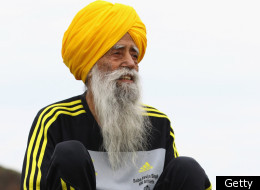
100-Year-Old Marathon Runner Reveals Key To Success

Fauja Singh Reveals The Key To HIs Success

100 Year Old Marathon Runner The world's oldest marathon runner has revealed that drinking cups of tea and eating ginger curry, combined with "being happy", has helped him train for 10 miles every day since he turned 100.

Fauja Singh took up marathon running after his 89th birthday and has now completed seven races.

He holds the world record for the men's over-90 category after completing the 2003 Toronto marathon in five hours and 40 minutes.

The 100-year-old now hopes to take part in the Edinburgh 26.2-mile race as part of a four-man relay team with an average age of 86.

Launching the opening of entries for the Edinburgh Marathon Festival 2012, he said: "I am not a learned person in any shape or form. To me, the secret is being happy, doing charity work, staying healthy and being positive.

"If someone says I must stop running I ignore them - invariably they're younger than me. The secret to a long and healthy life is to be stress-free. If there's something you can't change then why worry about it?

"Be grateful for everything you have, stay away from people who are negative, stay smiling and keep running."
Born in India on April 1 1911, Fauja was a farmer in the Punjab when he first developed a love for running, but he only took
the sport seriously when he moved to the UK 50 years later. He started challenging other pensioners to races and has now run five marathons in London, one in Toronto and one in New York.

The 10th Edinburgh Marathon Festival weekend will be held in May next year with organisers hoping to break all previous records and raise more than £4.5 million in 2012.

Race director Neil Kilgour said: "Edinburgh Marathon Festival has it all - a great city that acts as a stunning backdrop to the event's proceedings and a programme of races that means that everyone is catered for, from children to marathon veterans."

What We Lost To India's Biggest Scams

By Deepak Shenoy

http://mit.zenfs.com/50/2011/09/yahoo_final.jpg

As India immerses itself into removing corruption, it's important to understand what the past scams cost us. But talking in mere amounts isn't fruitful. After all, does 55,000 crore rupees sound bad? How much worse is it than a mere 50,000 crores? (Answer: 1,000 kilometers of highway worse, or the stretch from Bangalore to Mumbai)

The biggest scam that unfortunately doesn't get classified as one is that food enough to feed 100 million people rots in government warehouses.  For the rest, we have for you an infographic that puts the amounts in context, how much we could have done. For past scams we have adjusted the amount for inflation to reflect an equivalent in 2011 — the Rs. 5,000 crore Harshad Mehta Scam for instance is worth Rs. 15,000 cr. today.

Here's all that we could have done with the money lost to some of the biggest scams in India.

Enough food to feed 100 million people rots away

Chandigarh: The wheat lies in the sun. Lakhs of bags of it. The stamp on the jute bags says "2010-2011." This batch of wheat is produced from a crop that's just three months old.  It's rotting away.
"This is the first time wheat has been stored here in the open. Earlier they stored it in a pucca plinth. Now there are more than 1.5 lakh bags out here," says the watchman, at Thol Storage in Haryana.
The wheat should be stored at warehouses owned by the government. But year after year, the warehouses in Punjab and Haryana run out of room. There is no silver lining to this problem of excess, mainly because the government has persistently ignored it. This year, heavy rain and water logging mean that the grain is rotting faster than usual.  The plastic sheets thrown carelessly around the bags of wheat are totemic of the sort of systematic carelessness that a desperately poor and hungry nation is cursed with.
In March, NDTV travelled to warehouses scattered in Sirhind, Anandpur Sahib, Ludhiana, Sangrur. The stench rose sharp and thick from the grain rotting outside. There were rats and snakes crawling among the grain. Embarrassed by the profuse evidence of its lack of concern and initiative, the government has now floated tenders, looking for new warehouses both in Punjab and Haryana that can house an additional 70 lakh metric tons of wheat.

For now, the facts are damning. Currently, in Punjab and Haryana, by official accounts, 100 lakh metric tons of grain has been stored in the open. According to an estimate, 10 per cent of this is rotting. That's enough to feed 100 million people for three months.
On Wednesday, the Supreme Court made its stand clear to Agriculture Minister Sharad Pawar, stating that earlier this month, when it asked him to ensure excess grain is given to poor people, it wasn't offering a suggestion. Find a way to implement the order, the judges said.
Mr Pawar told an angry Parliament hours later that he welcomed suggestions from them on how to distribute grain to poor families.
A solution to distribute the grain - perhaps through ration shops - cannot come soon enough. In Madhya Pradesh, six out of every ten children suffer from diseases caused by hunger or malnutrition.

Vakkom B Purusothaman New Governor of Mizoram

Vakkom_Purushothaman mizoramAizawl, Sep 3 : Veteran Congress leader Vakkom B Purushothaman was sworn in as the Governor of Mizoram today. Gauhati High Court Chief Justice M B Lokur administered the oath of office to Mr Purushothaman, 83, at a ceremony held at the Raj Bhavan s Circular Lawn here at around 1700 hrs.

Chief Minister Lal Thanhawla, ministers, leaders of various political parties and senior officials attended the function. Later, speaking to reporters, Mr Purushothaman said he was happy to be the Governor of Mizoram and extended his greetings to the people.

He felt that the Lal Thanhawla-led Congress government has been doing good work for the people and said he would extend all possible help in implementing the flagship programme of NLUP. Earlier in the day, Ms Purushothaman, accompanied by his wife Lal Riliani, arrived at the Lengpui airport.

Mr Lal Thanhawla and his wife who accompanied the new governor from Kolkata, gave a bouquet to Mr Purushothaman as he landed on Mizoram soil.

The chief minister s cabinet colleagues were also there at the airport to receive him. Mr Thanhawla and Mr Purushothaman had a brief interaction at the airport lounge when the former introduced his ministerial colleagues and senior officials to him.

Mr Purushothaman, veteran Congress leader and an advocate, was born at Vakkom on April 12, 1928 as the son of Bhanu Panicker and Bhavani.

Beginning his political career as an active worker of students Congress in 1946, he became a member of Vakkom Panchayat in 1953.

Later, he served as president, DCC, Thiruvananthapuram, General Secretary, KPCC and vice-president, KPCC. He has been a member of AICC for over 25 years.

Elected to Kerala state assembly for a number of times, he had served as minister and speaker in the state. Ms Purushothaman has had a remarkable stint also as the Lt Governor of Andaman and Nicobar Islands for three years from March 1993.

From New York State to Nagaland, Art, Film and Hospitality Are Common Bonds

By Molly Finnegan
0902_laytonbailey.jpg

Professors Heather Layton and Brian Bailey visit Kohima, Nagaland, 2010. Photo courtesy Heather Layton.

Spurred by curiosity, Heather Layton and Brian Bailey set off from Rochester, NY., last December to visit a place around the world about which they knew almost nothing.

Nagaland is a state located in North Eastern India, bordering Myanmar (Burma). It's a tribal region which resisted British rule and then fought for independence from India. It became a recognized state of India in the 1960s, but for many decades factions of the Naga people continued to fight, sometimes violently, over issues of sovereignty. Government advisories still warn against travel there.

But when Layton and Bailey, who are married, arrived in Nagaland, they found instead a welcoming culture of artists and musicians, eager for dialogue, attention and exchange.

During their stay, Layton, an artist and lecturer at the University of Rochester (where she teaches drawing, painting and performance art), and Bailey, a professor of adolescent education at Nazareth College who specializes in youth media, arranged a contemporary painting show, attended the region's major cultural festival and mounted a screening of films by both emerging New York and Naga filmmakers.

When they got home, they decided they wanted to return the favor of hospitality. Earlier this summer, as a collaborative effort between Nazareth College, the University of Rochester, the Government of Nagaland, and the Rattle and Hum Music Society, five Naga filmmakers -- the first generation of film artists in their country -- journeyed across the globe to share their work.

Art Beat talked to Heather Layton about cultural diplomacy and how her experience in Nagaland has informed her own work.

How did you hear about Nagaland?

I heard about Nagaland when I had the great opportunity to meet a Naga musician. His name is Theja Meru and he was traveling through the United States with a government program that brings groups of people from all over the world to the US. Theja was one of them. They were all interested in different types of sociopolitical issues. They came to the MK Gandhi Institute for Non-Violence at the University of Rochester. Because of what they were interested in, I was asked to present my work and, of course, I'd never heard of Nagaland. I'm reading the countries: Tajikistan and Nepal and I'm reading those and then all of the sudden there is Nagaland. So I got right online and just googled it over and over again, trying to read as much and see as many images as I could. Theja and I met for maybe a half hour, 45 minutes, as I was presenting my work. We stayed in contact through email and decided to see what would happen. If he was here in the United States and saw my art, what if I came to Nagaland to show what I do to his friends and musicians and wood carvers there, the community there. Six months later, Brian and I were on a plane and headed into Nagaland.

What did you glean from your internet searching?

It looks beautiful and it sounds terrifying. We looked into what the traveling warnings say, because you look at the government sites and it's talking about terrorism and insurgencies and headhunting -- it's on every website you look at, that it's a headhunting area. All the photos of these warriors in these beautiful headdresses and spears. Every time we googled it, the third image that comes up is of this man crawling over this pile of skulls. So it sounded terrifying. You know, even when we got on the plane to go to Nagaland, we were still a bit nervous about what it would look like when the plane landed, but it turned out to be an incredibly different experience. The government warnings may be true -- that's very possible -- but they tell a very small sliver of the whole story. And it's difficult to get the rest of the story.

Unless you go, I guess.

Unless you go! And unless you meet Naga people. When we were in Nagaland it was such a learning experience about how you treat other people. It completely raised my bar for what hospitality is, and how to be so kind to other people, and from our perspective, from my experience, seeing a much more collaborative community based society rather than like an individualistic competitive society.

Photo by Heather Layton, 2010
Photo courtesy Heather Layton

While you were there, what kinds of connections or collaborations did you make with other creative people, musicians, artists?

It would take a year to describe everything we did. We started, with Theja, the Glocal Film Festival and the idea was to bring films from young filmmakers in Rochester, N.Y. to Nagaland and screen those films with films by young Naga filmmakers. And then the idea was to bring the films by Naga filmmakers back to the United States to show with Rochester youth. And at that point we decided let's just bring film makers. Why do we need to bring just the film, let's bring the filmmakers.

Tell me about the filmmakers who visited from Nagaland.

There are five filmmakers that came. Liyo Kikon, Kele Yhoshu, Sophy Lasuh, Sesino Yhoshu and Myingthungo Lotha. It was the perfect team. Kele and Liyo are making fictional films and are very interested in animation. One of their films that they screened for example is "Naga Jedi," a takeoff of our "Star Wars," except, you know, they are Naga. Obviously Naga's in a village in Nagaland and the batteries kept running out on the light sword, all these kind of contemporary problems. They did a music video in 3D, a stereoscopic music video. Sophy and Sesino are documentary filmmakers, so Sesino showed one of her films and it was a portrait of her grandfather. Sesino is very interested in video portraiture. Rather than just painting a painting that resembles the person, she is doing these video sketches that really give you a sense of who these people are. And they screened another one, Sophy and Sesino, called "The Story of a House," where the house is the main character in the film and it's a house that sits right on the border. It's true, this is a documentary. Half of the house is in Nagaland and half of the house is Burma/ Myanmar, and it's the house of the village chief.

Watch one of the films by Sesino Yhoshu:

Apfütsa (2009) from Sesino Yhoshu on Vimeo.

Did you get a sense from them whether they feel isolated working in Nagaland?

There aren't any filmmaking programs in Nagaland. If you are going to learn filmmaking in Nagaland, you are learning it off of YouTube and you are learning off the internet. So Kele and Liyo, for example, said everything that they've learned, they've learned on their own through the internet.

That's incredible.

Yeah, it's unbelievable. When you think, they are showing films that are incredibly, incredibly sophisticated and beautiful and so well done and everything they've taught themselves. Sophy, for example, has studied in Edinburgh. She got her Master's degree in Edinburgh, so they have this international experience and this, you know, local experience. And do they feel isolated? I think the internet has played may be a major role in not feeling isolated. They've seen a hundred times more American films than I have. They knew American pop culture so much better than I did. In terms of the film making industry in Nagaland, they are the industry, they are the are the groundbreakers, the first generation filmmakers. At this time, there are no movie theaters in Nagaland, so that's something that they are working on. At this moment, you watch the films on the computers, and you have home screenings, but there aren't public venues yet to screen a film. I wonder to what extent that is isolating when you are a filmmaker.

Visiting Naga filmmakers tour an animation studio in Rochester, N.Y

Visiting Naga filmmakers tour an animation studio in Rochester, N.Y. L to R: Myingthungo Lotha, Kele Yhoshu, Sophy Lasuh, Sesino Yhoshu, Liyo Kikon, Amanda Poppe, and Fred Armstrong (President of Animatus). Photo courtesy Heather Layton

How does your connection to Nagaland continue? What are some of your future projects involving cultural diplomacy?

The first really exciting thing specifically about this Nagaland-U.S. exchange, or professional program exchange of artists and creative people [is that] the government of Nagaland were very happy with the results of this last stage of the exchange, so they've invited five U.S. creative people to come back to Nagaland for the Hornbill festival, and for all different types of cultural events, in December. So Brian and I are now working on creating a team to represent the United States. We're looking for filmmakers and artists, writers, dancers.

I have several projects that will be directly and indirectly affected [by our connection to Nagaland]. The first one I've started working on is a series of drawings that relate to a documentary that Sophy and Sesino are making about one of the clashes that happened in Nagaland between the Indian government and one of the Naga insurgency factions. The drawing series, though is going to be-- there are fictional characters. You start out, you think you know who you are siding with, who your allegiances [are with], but then as the drawing series goes on, you start to question your beliefs. My goal in these drawings is can I trick you into falling in love with the person you thought you hated and it's all going to be done through these little fictional characters. Brian and I are going to be working on a collaborative installation called "Government Warning," and that is going to compare those warnings that I talked about before, the information that we were able to get before we went, with the experience of actually being there. It's actually going to be a physical space that you walk into and you'll have a tourist guide book that only partially gets you through the space. And we'll use film footage that we took while we were there and all different types of sounds and media.

Source: pbs.org