03 September 2011

Vakkom B Purusothaman New Governor of Mizoram

Vakkom_Purushothaman mizoramAizawl, Sep 3 : Veteran Congress leader Vakkom B Purushothaman was sworn in as the Governor of Mizoram today. Gauhati High Court Chief Justice M B Lokur administered the oath of office to Mr Purushothaman, 83, at a ceremony held at the Raj Bhavan s Circular Lawn here at around 1700 hrs.

Chief Minister Lal Thanhawla, ministers, leaders of various political parties and senior officials attended the function. Later, speaking to reporters, Mr Purushothaman said he was happy to be the Governor of Mizoram and extended his greetings to the people.

He felt that the Lal Thanhawla-led Congress government has been doing good work for the people and said he would extend all possible help in implementing the flagship programme of NLUP. Earlier in the day, Ms Purushothaman, accompanied by his wife Lal Riliani, arrived at the Lengpui airport.

Mr Lal Thanhawla and his wife who accompanied the new governor from Kolkata, gave a bouquet to Mr Purushothaman as he landed on Mizoram soil.

The chief minister s cabinet colleagues were also there at the airport to receive him. Mr Thanhawla and Mr Purushothaman had a brief interaction at the airport lounge when the former introduced his ministerial colleagues and senior officials to him.

Mr Purushothaman, veteran Congress leader and an advocate, was born at Vakkom on April 12, 1928 as the son of Bhanu Panicker and Bhavani.

Beginning his political career as an active worker of students Congress in 1946, he became a member of Vakkom Panchayat in 1953.

Later, he served as president, DCC, Thiruvananthapuram, General Secretary, KPCC and vice-president, KPCC. He has been a member of AICC for over 25 years.

Elected to Kerala state assembly for a number of times, he had served as minister and speaker in the state. Ms Purushothaman has had a remarkable stint also as the Lt Governor of Andaman and Nicobar Islands for three years from March 1993.

From New York State to Nagaland, Art, Film and Hospitality Are Common Bonds

By Molly Finnegan
0902_laytonbailey.jpg

Professors Heather Layton and Brian Bailey visit Kohima, Nagaland, 2010. Photo courtesy Heather Layton.

Spurred by curiosity, Heather Layton and Brian Bailey set off from Rochester, NY., last December to visit a place around the world about which they knew almost nothing.

Nagaland is a state located in North Eastern India, bordering Myanmar (Burma). It's a tribal region which resisted British rule and then fought for independence from India. It became a recognized state of India in the 1960s, but for many decades factions of the Naga people continued to fight, sometimes violently, over issues of sovereignty. Government advisories still warn against travel there.

But when Layton and Bailey, who are married, arrived in Nagaland, they found instead a welcoming culture of artists and musicians, eager for dialogue, attention and exchange.

During their stay, Layton, an artist and lecturer at the University of Rochester (where she teaches drawing, painting and performance art), and Bailey, a professor of adolescent education at Nazareth College who specializes in youth media, arranged a contemporary painting show, attended the region's major cultural festival and mounted a screening of films by both emerging New York and Naga filmmakers.

When they got home, they decided they wanted to return the favor of hospitality. Earlier this summer, as a collaborative effort between Nazareth College, the University of Rochester, the Government of Nagaland, and the Rattle and Hum Music Society, five Naga filmmakers -- the first generation of film artists in their country -- journeyed across the globe to share their work.

Art Beat talked to Heather Layton about cultural diplomacy and how her experience in Nagaland has informed her own work.

How did you hear about Nagaland?

I heard about Nagaland when I had the great opportunity to meet a Naga musician. His name is Theja Meru and he was traveling through the United States with a government program that brings groups of people from all over the world to the US. Theja was one of them. They were all interested in different types of sociopolitical issues. They came to the MK Gandhi Institute for Non-Violence at the University of Rochester. Because of what they were interested in, I was asked to present my work and, of course, I'd never heard of Nagaland. I'm reading the countries: Tajikistan and Nepal and I'm reading those and then all of the sudden there is Nagaland. So I got right online and just googled it over and over again, trying to read as much and see as many images as I could. Theja and I met for maybe a half hour, 45 minutes, as I was presenting my work. We stayed in contact through email and decided to see what would happen. If he was here in the United States and saw my art, what if I came to Nagaland to show what I do to his friends and musicians and wood carvers there, the community there. Six months later, Brian and I were on a plane and headed into Nagaland.

What did you glean from your internet searching?

It looks beautiful and it sounds terrifying. We looked into what the traveling warnings say, because you look at the government sites and it's talking about terrorism and insurgencies and headhunting -- it's on every website you look at, that it's a headhunting area. All the photos of these warriors in these beautiful headdresses and spears. Every time we googled it, the third image that comes up is of this man crawling over this pile of skulls. So it sounded terrifying. You know, even when we got on the plane to go to Nagaland, we were still a bit nervous about what it would look like when the plane landed, but it turned out to be an incredibly different experience. The government warnings may be true -- that's very possible -- but they tell a very small sliver of the whole story. And it's difficult to get the rest of the story.

Unless you go, I guess.

Unless you go! And unless you meet Naga people. When we were in Nagaland it was such a learning experience about how you treat other people. It completely raised my bar for what hospitality is, and how to be so kind to other people, and from our perspective, from my experience, seeing a much more collaborative community based society rather than like an individualistic competitive society.

Photo by Heather Layton, 2010
Photo courtesy Heather Layton

While you were there, what kinds of connections or collaborations did you make with other creative people, musicians, artists?

It would take a year to describe everything we did. We started, with Theja, the Glocal Film Festival and the idea was to bring films from young filmmakers in Rochester, N.Y. to Nagaland and screen those films with films by young Naga filmmakers. And then the idea was to bring the films by Naga filmmakers back to the United States to show with Rochester youth. And at that point we decided let's just bring film makers. Why do we need to bring just the film, let's bring the filmmakers.

Tell me about the filmmakers who visited from Nagaland.

There are five filmmakers that came. Liyo Kikon, Kele Yhoshu, Sophy Lasuh, Sesino Yhoshu and Myingthungo Lotha. It was the perfect team. Kele and Liyo are making fictional films and are very interested in animation. One of their films that they screened for example is "Naga Jedi," a takeoff of our "Star Wars," except, you know, they are Naga. Obviously Naga's in a village in Nagaland and the batteries kept running out on the light sword, all these kind of contemporary problems. They did a music video in 3D, a stereoscopic music video. Sophy and Sesino are documentary filmmakers, so Sesino showed one of her films and it was a portrait of her grandfather. Sesino is very interested in video portraiture. Rather than just painting a painting that resembles the person, she is doing these video sketches that really give you a sense of who these people are. And they screened another one, Sophy and Sesino, called "The Story of a House," where the house is the main character in the film and it's a house that sits right on the border. It's true, this is a documentary. Half of the house is in Nagaland and half of the house is Burma/ Myanmar, and it's the house of the village chief.

Watch one of the films by Sesino Yhoshu:

Apfütsa (2009) from Sesino Yhoshu on Vimeo.

Did you get a sense from them whether they feel isolated working in Nagaland?

There aren't any filmmaking programs in Nagaland. If you are going to learn filmmaking in Nagaland, you are learning it off of YouTube and you are learning off the internet. So Kele and Liyo, for example, said everything that they've learned, they've learned on their own through the internet.

That's incredible.

Yeah, it's unbelievable. When you think, they are showing films that are incredibly, incredibly sophisticated and beautiful and so well done and everything they've taught themselves. Sophy, for example, has studied in Edinburgh. She got her Master's degree in Edinburgh, so they have this international experience and this, you know, local experience. And do they feel isolated? I think the internet has played may be a major role in not feeling isolated. They've seen a hundred times more American films than I have. They knew American pop culture so much better than I did. In terms of the film making industry in Nagaland, they are the industry, they are the are the groundbreakers, the first generation filmmakers. At this time, there are no movie theaters in Nagaland, so that's something that they are working on. At this moment, you watch the films on the computers, and you have home screenings, but there aren't public venues yet to screen a film. I wonder to what extent that is isolating when you are a filmmaker.

Visiting Naga filmmakers tour an animation studio in Rochester, N.Y

Visiting Naga filmmakers tour an animation studio in Rochester, N.Y. L to R: Myingthungo Lotha, Kele Yhoshu, Sophy Lasuh, Sesino Yhoshu, Liyo Kikon, Amanda Poppe, and Fred Armstrong (President of Animatus). Photo courtesy Heather Layton

How does your connection to Nagaland continue? What are some of your future projects involving cultural diplomacy?

The first really exciting thing specifically about this Nagaland-U.S. exchange, or professional program exchange of artists and creative people [is that] the government of Nagaland were very happy with the results of this last stage of the exchange, so they've invited five U.S. creative people to come back to Nagaland for the Hornbill festival, and for all different types of cultural events, in December. So Brian and I are now working on creating a team to represent the United States. We're looking for filmmakers and artists, writers, dancers.

I have several projects that will be directly and indirectly affected [by our connection to Nagaland]. The first one I've started working on is a series of drawings that relate to a documentary that Sophy and Sesino are making about one of the clashes that happened in Nagaland between the Indian government and one of the Naga insurgency factions. The drawing series, though is going to be-- there are fictional characters. You start out, you think you know who you are siding with, who your allegiances [are with], but then as the drawing series goes on, you start to question your beliefs. My goal in these drawings is can I trick you into falling in love with the person you thought you hated and it's all going to be done through these little fictional characters. Brian and I are going to be working on a collaborative installation called "Government Warning," and that is going to compare those warnings that I talked about before, the information that we were able to get before we went, with the experience of actually being there. It's actually going to be a physical space that you walk into and you'll have a tourist guide book that only partially gets you through the space. And we'll use film footage that we took while we were there and all different types of sounds and media.

Source: pbs.org

Why PM's Visit To Bangladesh Will Be Historic

Why PM's visit to Bangladesh promises to be groundbreaking

By Sheela Bhatt
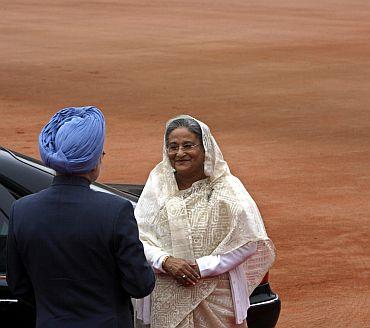
Dr Manmohan Singh with his Bangladeshi counterpart Sheikh Hasina in New Delhi

Dr Manmohan Singh with his Bangladeshi counterpart Sheikh Hasina in New Delhi

New Delhi, Sep 3 : Prime Minister Manmohan Singh's visit to Bangladesh on September 6 and 7, his first to the eastern neighbour and the first by an Indian prime minister in 12 years, promises to take bilateral ties to the next level, reports Sheela Bhatt.

It will be massive! Historic! I think Prime Minister Manmohan Singh's visit to Dhaka is going to be on a massive scale and substantial," says Veena Sikri, former high commissioner to Bangladesh.

Dr Singh's visit to Dhaka on September 6 and 7 is touted as ambitious and historic, and aimed solving bilateral issues pending since 1974. Some issues are the leftovers of history that were not settled even in 1947, when the territory was known as East Pakistan. The PM's visit will be a part of India's diplomatic endeavour to create a 'peaceful periphery'.

After Bangladeshi Prime Minister Sheikh Hasina came to power in 2008, she has taken several steps to rein in Indian insurgents and operatives of Pakistani intelligence agency the Inter Services Intelligence working out of Bangladeshi territory.

The Indian assessment is that "the presence of ISI is less today in Bangladesh than before." In dealing with the insurgent groups of the northeastern states, Hasina's government has certainly delivered.

Both countries determined to end issues blocking economic potential
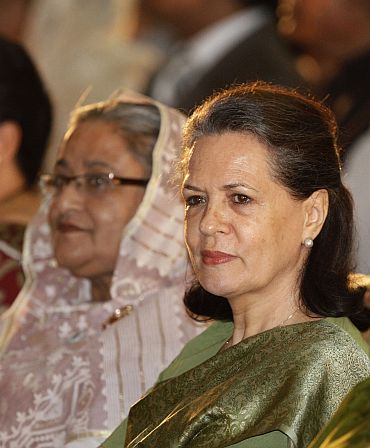
Congress president Sonia Gandhi with Sheikh Hasina in Dhaka during the former's recent visit there

This 'incredible' change in ground realities, after taking action against anti-India forces, gave India the space to work on other issues and grant an important neighbour some concessions in trade and water that it had been looking forward to since 1973.

Currently, Bangladesh has a valid reason to complain as well, because the trade balance is still in India's favour.

The flurry of activities between the two countries suggests that both are determined to put an end to issues that are blocking economic potential. When the global economy is not showing much hope, the Asian countries are expected to fix it.

Plenty of credit goes to Prime Minister Hasina's far-sighted and bold leadership in picking up the offer from Dr Singh to arrive at a series of agreements that would boost the region's economy, help stabilise bilateral security concerns, and take India, Bangladesh, Bhutan and Nepal to a 'win-win situation' by broadening their trade basket.

After both countries did joint surveys of their borders and territorial enclaves, bilateral interactions have moved fast.

Since many decades there have been Bangladeshi enclaves surrounded by Indian villages, as well as some Indian enclaves surrounded by Bangladeshi ones.

Image: Congress president Sonia Gandhi with Sheikh Hasina in Dhaka during the former's recent visit there
Photographs: Andrew Biraj/Reuters

The issue over enclaves is set to be solved
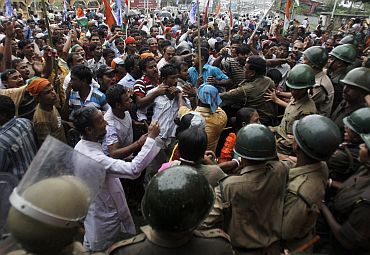
Demonstrators affected by the construction of barbed-wire fencing along Indo-Bangla border clash with policemen in Agartala in May 2011

And, then, there was the issue of giving transit route to the northeastern states through Bangladesh. This issue is likely to be settled, giving a huge advantage to India to develop its northeast. The user's rate for it will be decided by market forces.

India and Bangladesh share 4,096 kilometres of borders but the un-demarcated 6.5 km border issue was never settled. It is also likely to be settled now.

It's not a small event, that for the first time since 1947 both the countries will settle their disputes over 162 territorial enclaves that were stumbling blocks in the final settlement of the border.

Now these enclaves will be swapped and absorbed in the respective countries, and in effect will be wiped off the map. These 'enclaves' are called 'chit mahals' in local parlance.

Bangladesh has some 3,000 acres of land inside India while India has around 3,500 acres of land in that country. India will probably have to give up a little more land in the final settlement, that will require approval from Parliament.

Sikri says, "Much before independence the local kings used to gamble. Whoever lost sent the chit to the winner in which villages were given away. These exchanges of chits while gambling created estates on both sides. They became exclusive islands even after partition."

Two rulers of minor kingdoms, namely the raja of Cooch Behar and the nawab of Rangpur, had their kingdoms on the Teesta river. Cooch Behar remained in India while Rangpur went to Bangladesh, but their stakes in gambling created these islands.

The Union home ministry said that during surveys it was found that some 162 enclaves are inhabited by almost 51,000 people who have been a part of the continuous and sometimes tragic border tensions. These people, it is reported, don't much care for their citizenship as much as for their land and culture.

Image: Demonstrators affected by the construction of barbed-wire fencing along Indo-Bangla border clash with policemen in Agartala in May 2011
Photographs: Jayanta Dey/Reuters

India hopes it doesn't become an issue in Dhaka politics

Former Bangladesh PM Begum Khalida Zia

National Security Advisor Shivshankar Menon, who went to Dhaka to finalise arrangements for the PM's visit, has held talks with Hasina and other officials. India and Bangladesh will ink security, trade, border, water, culture and power-related agreements during the visit at the highest level.

Sikri further says, "We have seen a difficult relationship after the assassination of Sheikh Mujibur Rehman in 1974, but times have changed. To remain globally competitive, you have to first be regionally competitive. When globalisation started, oil was cheaper than it is now. Then one could ignore the next door neighbour and get cotton from Egypt or sugar from Brazil, but that's difficult now due to the prohibitive cost of transport. The settlement of border and water issues makes sense for both the countries."

India-Bangladesh relations have seen many ups and downs due to the intense competitive domestic politics on both sides, more so in Bangladesh where the two major political parties have been taking a tough stand against India when out of power.

If Hasina manages to explain her moves with Dr Singh to her domestic political constituency, only then will India-Bangladesh relations achieve a breakthrough.

Surely, India has ensured that it remained engaged with all the political parties, including main opposition Bangladesh Nationalist Party of Begum Khaleda Zia. In this round, Indian diplomats have taken care to see that 'India' doesn't become an issue in domestic politics.

Image: Former Bangladesh PM Begum Khalida Zia
Photographs: Reuters

The buzz over the trip is on
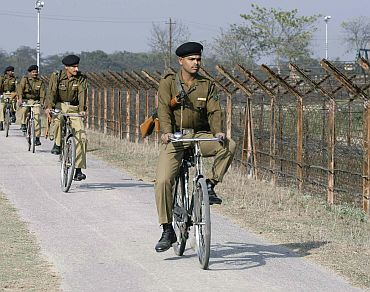
BSF personnel along the fenced border with Bangladesh in Fasidaya village on the outskirts of Siliguri

Mani Tripathi, former high commissioner to Dhaka, says, "We must leave domestic politics to be tackled by the respective countries. We should deal with the government of the day. I don't see any reason why the agreement to be reached by both countries during the PM's forthcoming visit won't be sustainable."

Hasina's foreign affairs advisor Gawher Rizvi has already said, "We have sorted out everything related to the visit."

West Bengal Chief Minister Mamata Banerjee, and the chief ministers of Assam, Tripura, Mizoram, and Meghalaya, states that share a border with Bangladesh, will also join Dr Singh's visit, making it truly historic.

According to a report in the Anand Bazar Patrika, Banerjee had some reservations about the agreement over sharing of the Teesta river waters. Both the countries currently share 54 rivers and have many unresolved issues over it.

The draft of the new understanding over sharing of the Teesta waters has been shown to Banerjee by NSA Menon during a special visit to Kolkata, says the report.

ABP's report claims that India will take 52 percent and Bangladesh 48 percent of Teesta water after preserving 460 cusecs (cubic feet per second). Teesta originates from Sikkim and flows into Bangladesh through Jalpaiguri (in West Bengal) and meets Brahmaputra eventually.

During his visit to Dhaka, Menon met a few editors also. Since the last few years, India has seen that civil society in Bangladesh has been very keen to take the bilateral relationship to the next level. More and more young Bangladeshis are seeking Indian visas and there is a new-found support in society for better ties with India.

Even the world is watching the positive moves between India and Bangladesh.

The Economist has published a controversial piece regarding Sheikh Hasina's increasing ties with India.

While talking about the transit point that would give India faster access to northeastern states, it says, 'Yet the new transit project may be about more than just development. Some in Dhaka, including military types, suspect it is intended to create an Indian security corridor. It could open a way for army supplies to cross low-lying Bangladesh rather than going via dreadful mountain roads vulnerable to guerrilla attack. As a result, India could more easily put down insurgents in Nagaland and Manipur. The military types fear it might provoke reprisals by such groups in Bangladesh.'

The Western publication then drags China into it.

It comments, 'More striking, India's army might try supplying its expanding divisions parked high on the border with China, in Arunachal Pradesh. China disputes India's right to Arunachal territory, calling it South Tibet. Some Bangladeshis fret that if India tries to overcome its own logistical problems by, in effect, using Bangladesh as a huge military marshalling yard, reprisals from China would follow.'

As such, the buzz over the PM's forthcoming visit to Dhaka is already on.

Image: BSF personnel along the fenced border with Bangladesh in Fasidaya village on the outskirts of Siliguri
Photographs: Rupak De Chowdhuri/Reuters

Bhaichung … And Some Speculation About A Hero Born Too Early

By Avalok Langer

Man in motion Bhutia about to pull the trigger in a match against JCT

Man in motion Bhutia about to pull the trigger in a match against JCT

Photo: Pintu Pradhan

THE STADIUM was a blur of painted faces, shirtless men wildly dancing around open fires with the occasional flare shooting into the sky. Draped in green and maroon, the large man slowly stood up. He paused to look around. Raising his hands, he shouted “Mohun Bagan” as he beat his drum “tut-ta-tut-tut”, “Mohun Bagan tut-ta-tut-tut”. The call had been made and 80,000 of the Bagan faithful replied in unison: “Mohun Bagan tut-tatut- tut, Mohun Bagan tut-ta-tut-tut, Mohun Bagan tut-ta-tut-tut”. If you think football is dead in India, you have to watch a match in West Bengal. Seated on the third tier of the Salt Lake Stadium in Kolkata, the Mecca of Indian football, I prepared for what would be a day I would never forget — the 2008 Federation Cup final between Dempo and Mohun Bagan. The day I saw Bhaichung Bhutia play.

Bhaichung Bhutia

Bhaichung Bhutia

To be honest, I wasn’t a Bhutia fan. Not because I disliked his game, but because having grown up in New Delhi, I found myself completely disconnected from the world of Indian football. I knew Bhaichung Bhutia, the name, but having never seen him play, I couldn’t honestly call myself a fan. But as I watched the Fed Cup final, I found myself mesmerised by the ‘Sikkimese Sniper’ and I still remember the moment I started to consider myself a fan. He was tackled in the opponent’s 18-yard box. Falling to the ground, he lost the ball. He jumped up in a flash, chased down the Dempo defender, positioned himself in front of him, cutting off his passing channels and stole the ball back. In that moment, I had been converted.For me, Bhutia went from being the smiling ‘poster boy’ of Indian football to a mercurial striker carrying a sport on his shoulders.

BY NOW, we all know of the star power of Bhaichung Bhutia and having carried Indian football on and off the field for the better part of two decades, his retirement marks the end of an era. But what makes Bhutia special?

While experts and players alike agree that Bhutia is not the most talented striker to have played for India, his ability to think on his feet, innovate and his never-say-die attitude make him the legend that he is. “He is a thinking player,” says Mayanti Langer, a sports presenter, “What made him special was that he was the opportunistic striker, waiting to jump on the ball and score, but you could also place him behind two strikers as a playmaker. He was a visionary and would always lift his head and see who else can score. In this way, he has nurtured Sunil Chhetri. That’s what makes him special, his selflessness.”

Every time Bhutia got the ball, there was an expectation of greatness. You sat on the edge of your seat thinking, “This will be a Bhaichung moment.” I remember watching the India-Syria league match in the 2009 Nehru Cup. Dwarfed by the Syrian defence, Bhutia had been out-muscled in the entire game. A gentleman sitting next to me turned from a fan to an expert and explained how Bhutia was past his prime and should retire. Mid-sentence, Bhutia got the ball in the box, turned, beat the 6’4’’ defender marking him and tapped the ball into the goal from an impossible angle. As the stadium erupted, the man shouted, “See I told you Bhaichung would do it.” Perhaps that’s what made him special, his ability to create magic out of nothing.

After Bury FC, Bhutia learnt the value of the media. He appeared on sports shows and even won a dance reality contest

Indian football legend and Bhutia’s former strike partner IM Vijayan couldn’t agree more. “I remember it was the 1993 Durand Cup semi-final, East Bengal versus the Border Security Force. The match was forced into extra time and a 16-year-old Bhutia walked on to the pitch. A lofty cross came into the box, out of nowhere; Bhutia leapt up, did a bicycle kick and smashed the ball into the goal. As the player celebrated, the stadium went silent for what seemed like a lifetime and then the crowd erupted. It was absolutely brilliant to see this young boy win the match for his team.”

Bhutia’s stint in England was a defining moment in his career, but many question his choice of club and league. Bury FC was a second-division club in North England. They played a very physical brand of football on wet and cold conditions, not the perfect setting for Bhutia. “It was a difficult experience,” he admits, “adjusting to the freezing cold and the football style was tough. It was very frustrating, but I learnt a lot. I became very professional as a player, learnt the importance of hard work and returned with a new mindset.”

Though luck did not favour Bhutia in England, he came back a changed player. He learnt the importance of working out and perseverance. He instilled a sense of professionalism into his teammates that had been lacking in Indian football till then. Former teammate Alvito D’Cunha vouches for his unquestionable work ethic. “Bhaichung motivates himself, he never had to be pushed because he never slacked. Renedy (Singh) and I would often train with him. We would take breaks to go home between the session. But Bhutia would stay on and train, his drive and dedication was enviable.”

His experience in Bury changed Bhutia’s approach off the field as well. Having played in England, he grew in stature and brought a sense of glamour to a sport in desperate need of it. He learnt the importance of the media and capitalised on endorsement, dabbled in punditry on ESPN and Ten Sports and even won a dance reality show. He is the only footballer to create a larger-than-life image and garner a national fan base. Mayanti attributes this quality to the fact that “Bhaichung knows how to interact with the media, how to be a star and yet remain connected to his roots. He has glamourised Indian football and the lifestyle that goes along with it. But all the while, he maintains a perfect balance between Bhaichung the superstar and Bhaichung the guy who just wants to go to his Manipur house with his wife to eat momos. This is why the football fraternity loves him.”

In The Footsteps Of The Sniper

Bhaichung Bhutia transformed the way India plays football. Today’s players are reaping the benefits


Sunil Chhetri
Age
27
Position Striker
Dubbed the ‘next Bhaichung’. Having played upfront with Bhutia for seven years, the team will now look to him to take over the mantle


Jeje Lalpekhlua

Age 20
Position Striker
Though comparisons between him and Bhutia are cropping up, Jeje keeps it simple, “Bhaichung is in a different league. I wish I had been able to play alongside him.”


Gouramangi Singh
Age 24
Position
Stopper
A Bhutia fan at heart, Singh tries to follow his philosophy on the pitch: “Keep it simple and stick to your strengths”


Subrata Pal
Age 24
Position Goalkeeper
The best goalkeeper India has seen in the past two decades recalls, “Everyone’s body language changed when Bhutia entered the dressing room. It’s not the same anymore.”

Photos: AFP, Reuters

As fans, we know Bhutia the player and Bhutia the star, but only a special few have been privy to Bhutia the captain. His skill on the field and his magnetic personality off it made him the ideal leader. A team man, he would go door to door before every game and tell his team that they could win, they could do it. “From the time he entered the dressing room, he would pump us up. Most of the time, we would win the match in the dressing room itself,” says D’Cunha.

Being India’s football icon, Bhutia has played a special role in motivating and nurturing the next generation of Indian players. Twenty-four-year-old Indian defender Gouramangi Singh has had the privilege of sharing a dressing room with Bhutia and admits that he is still a Bhutia fan first and a teammate second. “Like many youngsters in India, he has inspired me. What I admire about him was that no matter the score, he would never give up or relax, he would just keep pushing himself and the team.”

IN THE past 10 years, Indian football has come a long way, maybe not in the way of rankings but in terms of training infrastructure, international exposure and coaching systems for the national side. An ageing Bhutia was able to lead India to the 2011 AFC Asian Cup. Had he been 10 years younger, at his peak and playing in the present scenario, who knows where he would have reached? “I think if I was young today, I would have had more opportunities to play internationally. Those days nobody had played abroad and no one knew how the system there worked. But now we have more exposure and we understand the system,” says Bhutia.

‘If I was young today, I’d have more chances to play abroad. Back then, nobody knew the system,’ says Bhutia

Today’s generation of footballers have inherited a modernised system that Bhutia helped create. The players are exposed to opportunities and techniques that have en-abled the likes of Chhetri to play in America’s Major League Soccer, Gouramangi to be nurtured into a solid defender by a progressive club set-up at Churchill Brothers and the 20-year-old Jeje Lalpekhlua to travel to the West Indies to play international friendlies. “Had Bhutia been 10 years younger in today’s football environment, he could have played in a different European league like the Dutch Eredivisie that would have suited his style of football. That would have changed the course of his career,” believes Novy Kapadia, an Indian football expert.

After over a 100 international caps, playing with the likes of Didier Drogba, Zinedine Zidane, Gennaro Gattuso, and having etched his name in the history of Indian sport, what is next for the star striker? For Bhutia, home beckons. A staunch advocate for improving grassroots-level football in India, he has set up Sikkim United FC in his home state and has established a youth football academy in New Delhi. Larsing Ming, the general secretary of Shillong Lajong FC feels that “Bhutia has inspired the youth in the Northeast to take up football professionally. He has shown that it is possible to break through at the national level and make a mark. He bridged the gap between the Northeast and the mainland, and that has been his greatest contribution to Northeastern football.

WHILE THE converted wait with bated breath for the next messiah, the truth is that there will probably never be another Bhaichung Bhutia. Mayanti believes that “maybe that’s not such a bad thing. We should not see it as a failure of Indian football but as a compliment to the man and the player that he was”. While some worry about the void his exit will create, Nigeria-born football legend Chima Okorie turns to the youth, “His retire ment means a young player will now have a chance to don the national colours.” As young players like Chhetri, Jeje, Gouramangi and Subrata Pal begin to etch a name for themselves, the burden to carry Indian football has shifted onto them.

For the ever-positive Bhutia, there is no question of a void, “As long as there is football in India, players will come and go. We have to look to the future.” These young boys in blue are the future stars of Indian football.

With inputs from Shonali Ghosal

Avalok Langer is a Correspondent with Tehelka. avalok@tehelka.com

NESO Demands Scrapping Of AFSPA

NESO AFSPA

Guwahati, Sep 3
: Demanding that the controversial Armed Forces Special Powers Act be scrapped immediately, the North East Students’ Union (NESO) today rejected Home Minister P Chidambaram’s statement that the Centre was looking for a consensus on the possibility of amending the Act.

The NESO said that no amendment would be sufficient and that “the draconian Act had to be scrapped altogether for preventing its gross misuse to violate fundamental human rights of citizens”.

The NESO also criticized what it said was the partisan attitude of national news channels in highlighting the issues of the North-east. “The unprecedented fast resorted to by Sharmila has elicited little attention from the national media, which is unfortunate to say the least,” it said.

Hunger Strike in India That Needs World’s Attention

By Nehginpao Kipgen

volunteers-who-were-on-fast-unto-death for Sadar Hills District in ManipurIt is uncommon here in the United States to see a peaceful demonstration, in the form of hunger strike that is spearheaded by women activists for a genuine cause they firmly believe in.

The news may sound somewhat unconvincing, but it is happening in the state of Manipur in Northeast India. It may be difficult to find someone who does not know India, even if he or she is unsure of its precise geographical location in the world map. India boasts for its diversity and being the world’s largest democracy, with a population of over 1.21 billion people.

India is a nation originally formed by princely states and territories. It is also a country which fought several decades to gain independence from the British in 1947. Mohandas Karamchand Gandhi (popularly known as Mahatma Gandhi) was a pioneering leader who stood up against the British forces with an effective political weapon called ahimsa (meaning non-violence).

It was Gandhi’s use of non-violent strategy that has left indelible imprints in the hearts and minds of many Indians. If so, why has similar non-violent agitation seemingly become unimportant, if not irrelevant, in the state of Manipur.

In a genuine demand for the upgradation of Sadar Hills Autonomous District Council into a full-fledged district, more than 40 women belonging to the Kuki community began their fast unto death on August 16. To further protest the government’s inaction, the people of Sadar Hills observed India’s Independence Day (August 15) in mourning by wearing black dresses.

On August 28, three hunger strikers were arrested by the state police on charges of attempting to commit suicide, after they refused medical aid. Earlier on August 20, seven hunger strikers were hospitalized because of deteriorating health condition.

As part of their agitation, elected representatives of Sadar Hills have met both the state and central governments. While the central government has advised the state government to look into the agitators’ demand, the state government fails to implement it thus far.

The agitation was initially planned for a seven-day strike starting July 31, but it escalated to an indefinite strike with the death of three women on August 2. They were mowed down by a tanker, whose driver lost control.

Unfortunately, this extreme form of peaceful agitation (i.e. hunger strike) has thus far failed to capture headlines in the Indian mainstream media, not to mention the international media. It has also failed to draw the attention of leading international human rights organizations, such as Human Rights Watch and Amnesty International.

Given the seriousness of the situation, the dearth of publicity is surprising. Whether the Indian general public approves or disapproves of the demand is up to the readers concerned. However, leading newspapers and magazines should cover agitations such as this which involve life and death of ordinary citizens.

Sadar Hills' demand is not something new. It has been mandated by the Indian Parliament Act in 1971. Of the six autonomous hill districts constituted in 1972, only Sadar Hills remains to be officially accorded a full-fledged district status.

Among others, the Indian president, prime minister, home minister and the opposition leader have been officially apprised of the renewed demand, which successive Manipur governments had given verbal assurances but failed to implement them. However, giving a mere advice to the state government without any concrete action is inadequate.

An indifference to such burning issue can generate criticisms and apprehensions from around the world. More importantly, Manmohan Singh-led Indian National Congress government should pay close attention to the non-violent agitation, which Gandhi and other Indian freedom fighters used against the British. The government has responsibility to protect the lives of all its citizens, regardless of ethnicity, race, religion, and location.

Since the ongoing Sadar Hills agitation primarily falls under the state's domain, Manipur Chief Minister Okram Ibobi Singh should explore all possible means to end over a month-long political crisis at the earliest possible.

Meanwhile, the people of ethnically-sensitive Manipur should abstain from dragging the issue of ethnicity in this political game. Administrative convenience being the reason for Sadar Hills demand, it must not be viewed otherwise.

Moreover, the people of Manipur needs to learn the beauty of diversity, while respecting the rights of every citizen. To achieve this goal, the gap (in terms of per capita income) between the hills and the valley people should be bridged. Unless there is equality of distribution, people will be hesitant to share equal responsibility.

Human rights organizations such as National Human Rights Commission of India and National Commission for Minorities should assess the condition of the hunger strikers and extend any possible help. Human rights campaigners around the world should speak up for these voiceless peaceful hunger strikers.

The international community must ensure that the lives of peaceful hunger strikers in India are not jeopardized for a legitimate political demand, and their fundamental rights should be protected. In this regard, pressure must be put on both the Indian and Manipur governments to take necessary steps.


ngp_kipgen_1.jpgNehginpao Kipgen

Asian Tribune -

02 September 2011

Mizoram MLAs Fortunes Grow By 790.48 pc in 5 Years

mizoram_against_corruption

Aizawl, Sep 2
: The fortunes of Mizoram MLAs have grown by 790.48 per cent, compared to 289 per cent growth of members of Parliament s wealth since 2008 state Assembly elections.

According to a paper presented by Dr. Lalthakima, assistant professor of Pachhunga University College, at a seminar on corruption here today, the assets of re-contesting MLAs in the 2008 state Assembly elections grew by 790 per cent over the intervening five years.

Quoting an analysis of affidavits done by the Association for Democratic Reforms and National Election Watch, the paper highlighted that the the percentage rise in assets of members of Parliament (MPs) who re-contested the 2009 elections was 289 per cent while that of re-contesting MLAs in all the states in average was less than 200 per cent.

According to the seminar paper, a Mizoram MLA who topped the rich list got richer by 13022.08 per cent during the five years, from 2003 to 2009. According to his declaration of assets before 2003 elections, this particular MLA had Rs 50,000 which skyrocketed to Rs 65,61,038 when he re-contested the 2008 elections.

A legislator, who experienced the lowest economic growth among the Mizoram legislators, had his wealth grown by 5.84 per cent during the five years.

The assistant professor, who disclosed this analysis on his paper Hlemhletna leh Mizoram politicians (Corruption and Mizoram politicians), said his analysis was based on a booklet on MLA contestants of the 2008 elections, prepared by anti-corruption organization PRISM (People’s Right to Information Development Implementing Society of Mizoram).

The seminar on Corruption and Mizo Christians , organised by Academy of Integrated Christian Studies (AICS) of Baptist Church of Mizoram, discussed papers presented by assistant professors of colleges, senior civil judges, retired bureaucrats and social activists on different topics in corruption.

Lalhmingliana Saiawi, a retired IAS officer, who presented the paper, accused the Mizoram government of having double standards when it comes to corruption cases investigated by the CBI.

This attitude, he said, in the paper, was very clear from the fact that the Mizoram government s challenging Gauhati High Court s order for a CBI probe into alleged misappropriation of PMGSY fund in Mizoram.

While the state government has no objection to the CBI probe into compensation scam in Tuirial hydel project, it has challenged the High Court s order for a CBI probe in the Supreme Court for God-knows-why.

Civic organisation SOSA (society for social action) had filed PILs in Gauhati High Court against the alleged misuse of public money in the two projects, he informed the seminar. Unlike other states where he had served as bureaucrats, Mr Lalhmingliana also felt that the Mizoram government has no real intention to dig out missing public money.

Dr J V Nunchunga, assistant professor of J Thankima College, who presented a paper on corruption and Mizoram economy , underlined that while corruption affects the entire society, the poorer section are the worst-hit.

One of the commonest corruptions in Mizoram, according to J V Nunchunga is government doctors running private clinics despite enjoying non-practice allowance, which is 25 per cent of their monthly salaries.

Moreover, the NPA which is meant for only medical doctors is also being extended to veterinary doctors in Mizoram. Mr Nunchunga also expressed concern over too many government holidays, including Saturdays, in Mizoram, highlighting that the state government losses about Rs 539.92 lakh in each holiday.

He also stated that ruined or delayed projects in Mizoram have also badly affected the state s economy.

MZP Strongly Objects To OBC For Gorkhas in Mizoram

mizoram Gorkhas during a Youth MeetingAizawl, Sep 2 : Even as the state government decided to grant OBC status to the Gorkhas in Mizoram, the Mizo Zirlai Pawl, the state's apex students body, has reiterated its strong objection.

MZP has strongly condemned the Permanent Body's decision to give OBC status to the Gorkhas.

MZP will fight to the end to ensure that this decision does not materialize, the students body said in statement.

The MZP's statement came after the Permanent Body, set up in accordance with the directions of the Supreme Court, has taken a decision to this effect.

The decision is yet to be sent to the higher authority in the Centre for finalization.

Saying that the decision to give OBC status to Gorkhas could be detrimental to the social security of the Mizos, the MZP appealed to all NGOs and political parties to be up in arms against it.

The MZP planned to convene a meeting of all parties and NGOs soon to discuss the issue. The Young Mizo Association is also very likely to oppose the same.

The Permanent Body's decision was high on the agenda of central committee of the state's most powerful organisation's meeting today.

The two organisations, who had earlier voiced their objections to grant OBC status to Mizoram's Gorkhas, feared that it would cause demographic invasion to the Mizos.