02 August 2011

Sadar Hills Village Chiefs Back Manipur Blockade

sardar Hills Bandh manipur

Imphal, Aug 2
: Manipur is yet to forget the price that it had to pay for last year's blockades on National Highways 39 and 53 - Rs 170 for a litre of petrol or Rs 1,700 for an LPG cylinder. Surgeries at hospitals had to be cancelled as medicine shelves ran out of stock and oxygen cylinders remained empty during the nearly-three month agitation called by various Naga groups which continued till May.

A year down the line, the people of the troubled state are once again fearing return of the man-made inflation with a pressure group imposing week-long economic blockades on National Highways 39 and 53 - the lifeline of Manipur - seeking revenue district status for Sadar Hills from Sunday midnight.

While NH-39 ( Imphal-Dimapur route) passes through Sadar Hills in Senapati district, repair work is going on along NH-53 that connects the state capital with Silchar in Assam.

Hordes of village chiefs and civil body leaders from Sadar Hills in Senapati district have extended their support to the weeklong economic blockade. They have also formed committees to chalk out measures to enforce the blockade on the highways effectively.

A joint meeting of about 40 village chiefs and representatives of civil bodies was held at New Keithelmanbi along NH 53 (Imphal-Silchar route) as part of the mobilization process to support the blockade imposed by the self-explanatory Sadar Hills District Demand Committee (SHDDC).

During the meeting, a sub-committee of 12 members was constituted to ensure success of the blockade along the route, which is also known as the second lifeline of Manipur. Similar meetings were also held at various points along NH 39.

SHDDC president Ngamkhohao Haokip has said the economic blockade might be extended further if the state government failed to take any positive step towards fulfilling their demand during the week.

Besides Sadar Hills, similar pressures have already been mounted by the people of Jiribam sub-division in Imphal East and Phungyar in Ukhrul district to the government to upgrade their respective areas to separate districts.

Haokip said, "Despite repeated assurances from successive governments and several agreements signed between the SHDDC and the state, Sadar hills has not become a revenue district." "The Manipur (Hill Areas) Autonomous District Council Act, 1971, gives power to the state government for modification of district boundaries," he said at a media conference at Motbung.

The statute was enacted before Manipur had attained statehood. The aim was to protect the people of the hills in accordance with the provisions of the Constitution. Besides Sadar Hills, the people of the Jiribam sub-division in Imphal East and Phungyar in Ukhrul have been raising similar demands.

Last year, the blockade was called for three reasons. The All Naga Students' Association, Manipur (Ansam), started its agitation from April 12 in protest against the holding of Autonomous District Council (ADC) polls in the hill districts as it feels the ADC Act "suppresses tribal rights". The Manipur government, meanwhile, declared Ansam president David Choro and United Naga Council (UNC) president Samson Remei as "wanted" and announced a cash reward of Rs 1 lakh on them.

The UNC also backed the blockade. The crisis was compounded with NSCN (IM) supporters joining the blockade after the Ibobi Singh-led Congress government prevented Muivah from visiting Somdal over fears it might re-ignite the greater Nagaland and separatist movements.

01 August 2011

It's a start! Delhi's Walk of No Shame

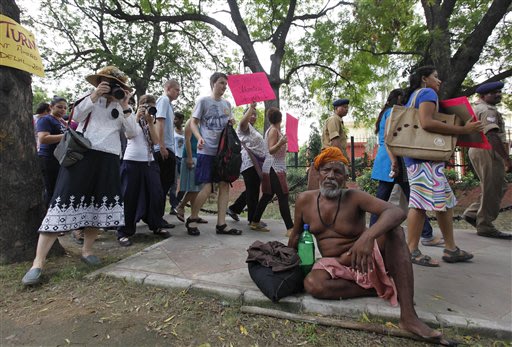
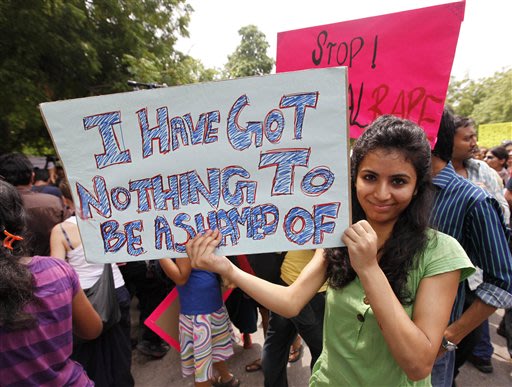
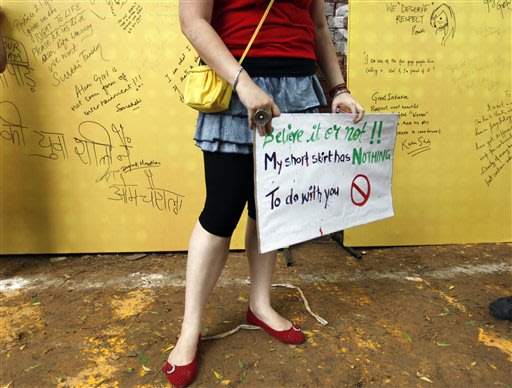
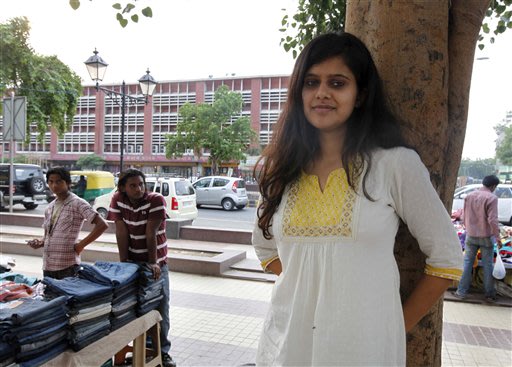
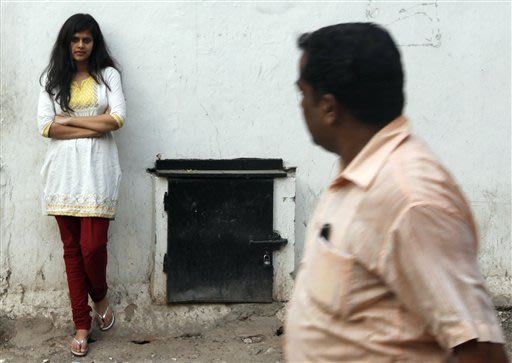
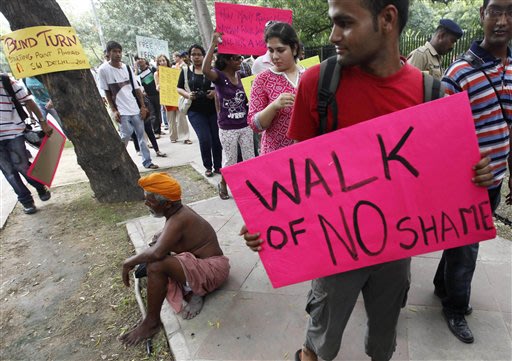
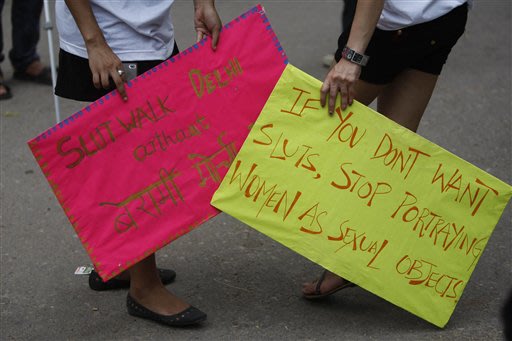
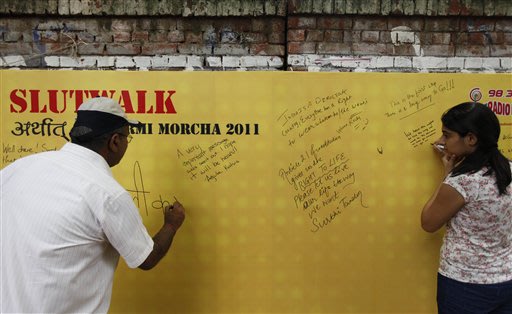
The much-awaited and controversial Delhi SlutWalk — titled SlutWalk Arthaat Besharmi Morcha — got going on Sunday, with a loud call for society to change its attitude rather than force women to hide indoors. While it lacked the lingerie, fishnet stockings and skimpy clothing of its western versions, the march still managed to bring more than 250 supporters to Jantar Mantar with bright signs and loud chants.

AP11073106622

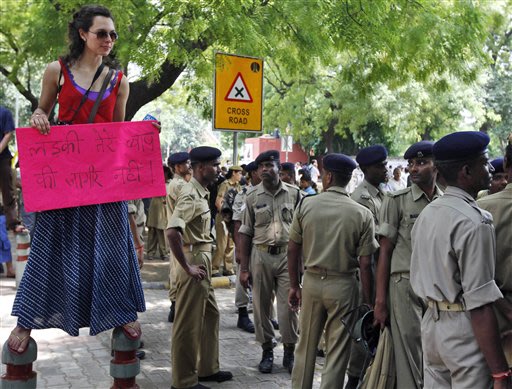
AP11073106631

The volunteers and interested passers-by began gathering at the venue from 10.30 am, and were soon joined by a substantial media contingent as well as 80 policepersons — both male and female — to maintain order. Although the crowd ended up consisting of more men than women, the support for the cause was loud and insistent and slogans such as Bharat apna mahaan hai, ladkiyon ke bina shamshaan hai, and Besharam kaun? Tere aage teri soch could soon be heard above the din of the traffic.

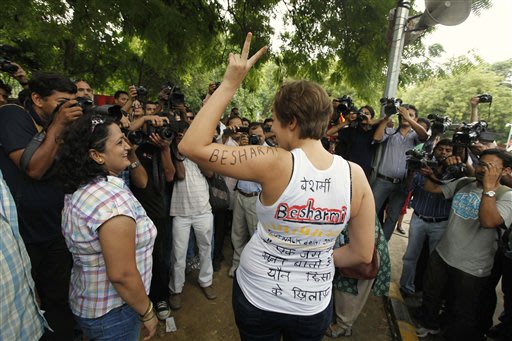
AP11073106711

The movement — initiated after a policeman in Toronto, Canada, said skimpy clothing invited sexual abuse — had gathered momentum in India last month when the Delhi Police chief lectured the city’s women against being out alone late at night. The protesters are now hoping their march would go some distance in changing the attitudes in Delhi, which is often referred to as India’s “ rape capital”. Rashmi, a Delhi University psychology student, said: “ Women can’t step out without being harassed. You know when somebody brushes against you in a bus that it’s not accidental. I want to be able to go out without feeling apologetic about my attire.” On Sunday, the crowd had gathered around Umang Sabharwal, a 19-year-old journalism student who organised the protest.

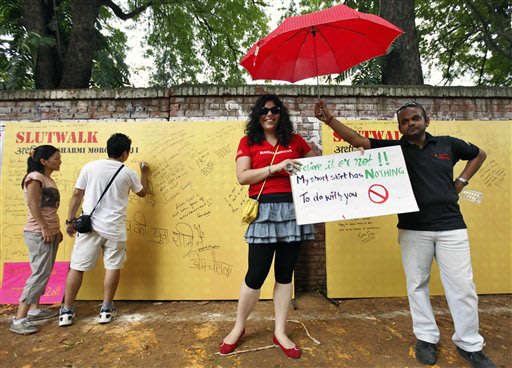
AP11073106757

Calling on the people at the start of the march to remain peaceful and sensible, she said: “ We are walking for a cause and we’re dressed in the same clothes that we wear every day.” The throng then set off on the walk route which was cut short after the police enforced IPC Section 144 ( banning unlawful assembly).

AP11073106864

The run- up to the protest had promised celebs, including Nafisa Ali and Gul Panag, but the only one who turned up was Nafisa. The actress- activist, who stressed the importance of gender equality education at home, said the movement was strengthening by the minute and that it was time the practice of blaming women for rapes and molestations was discouraged.

AP11073106873 

As the crowd made its way past the YWCA guest house, the placards made it clear that, while the rally might have lacked the flesh- baring sizzle of other SlutWalks, it was equally vocal about the message. "You stare at me not because of my clothes but because I’m a woman” one poster read.

AP110622025929

Student Ankur Bindal, who was carrying a sign asking boys to stop rape, was, however, of the view that the march won’t solve problems so fast. He said: “ It’s Delhi that has to change its mindset. My sisters and pals can’t go out without facing harassment.” There were also a few persons among the crowd who had turned up to express their displeasure.

AP110622026091

KPS Baba, who described himself as a citizen for a common cause, said he had come specially to tell off women wearing skimpy clothes. "They think they can wear what they want and nothing will happen?” he asked, adding “ petrol and fire can’t be kept together”. “ If women want to prevent sexual violence, they should dress decently,” Baba said, repeating the Toronto policeman’s words.

AP110731014400

The SlutWalk was followed by a play by Asmita, a drama club, that highlighted the problems women face in Delhi. There was a performance by the Delhi Drums Club and the event ended with supporters signing canvases with messages.

AP110731014418

POLICEWOMEN WERE CLUELESS! The woman contingent of the Delhi Police was asked to be on duty at Jantar Mantar during the SlutWalk, but they had no idea why people had gathered there. “ I don’t know what is happening. I am just doing my duty,” one officer said. Another added that “ you should talk to our seniors. We are just maintaining law and order”. AP110731014822

OLDIES TAKE STAND AGAINST THE CAUSE SEPTUAGENARIAN Indravati was all against the cause women, as well as men, had come together for on Sunday. “ Women have to remain within decent limits. We can’t walk around naked. It not only attracts attention but also displeases God,” she said, protesting against the rally at Jantar Mantar. “ I cannot support filthy imported culture,” she added.

Mizoram Crime Rate Moves Downward

Mizoram Crime Rate Moves DownwardAizawl, Aug 1 : The crime rate continue to go downhill in Mizoram, which police officials attributed to the round-the-clock surveillance, coupled with active cooperation from NGOs.

The months of April, May and June this year have seen a 12.05 per cent decline in crime rate, compared to the corresponding period last year, DIG (Northern Range) L Hrangnawna said at a crime review meeting at the police headquarters here today.

Mizoram police have registered 686 cases (442 IPC cases and 244 non-IPC cases) during April-June this year, as against 780 (544 IPC cases and 236 non-IPC cases) during the corresponding months last year.

Addressing the review meeting, Hrangnawna said, the decline in crime rate is attributed to hard work and dedication of the police and good co-operation from the general public.

Except Saiha district in southern Mizoram and Mamit district in western Mizoram, which have witnessed a 11.76 per cent increase and 12.00 per cent increase respectively, all other districts have seen decline in crime rate with Lawngtlai district in southern Mizoram being the lowest at 63.16 per cent decline.

Aizawl district has witnessed a 4.55 per cent decrease in crime rate.

The crime rate in January this year saw a 23.48 per cent decrease, compared to last year’s January. February and March this year have seen a 18.90 per cent decline in crime rate, compared to the corresponding period last year.

Cultural Close-Up

First-generation filmmakers from India take in Rochester's rich cinematic landscape

By Stuart Low

Liyo Kikon, a filmmaker from Nagaland, India, checks out a Red camera during a tour of Rochester’s Young Lion Studios.

Liyo Kikon, a filmmaker from Nagaland, India, checks out a Red camera during a tour of Rochester’s Young Lion Studios. / CARLOS ORTIZ/staff photographer

Five filmmakers from Nagaland, India, visited Rochester this month:

Liyo Kikon. He got an early start at age 13 by designing a website with thousands of cheat codes for games. Interested in animation and film directing, he often works with Kele Yhoshu. Their most popular film is Liquidators, a portrait of an assassin for hire.

Sophy Lasuh. A graduate of the Edinburgh (Scotland) College of Art, she owns a film production studio with Sesino Yhoshu.

Myingthungo Lotha. He runs the Portrait Studio in Kohima, Nagaland's capital. He has produced documentaries for the Nagaland government and run programs to teach photography and filmmaking to local youth.

Kele Yhoshu. An expert in 3-D modeling and animation, he created several music videos.

Sesino Yhoshu. She is Kele's cousin and Lasuh's partner at the Nagaland production studio Cue Hue. Her latest film, The Imaginary Line, portrays a 17-year-old Naga boy from Burma who crosses the border to India "to have a better life."

Culture shock can be surprisingly agreeable.

Early this month, five young filmmakers were packing suitcases in their native Nagaland — a remote, mountainous region of India known for its turbulent politics.

A few days later, they were exploring the Eastview Mall, Dinosaur Bar-B-Que and Rochester's film industry. They kept comparing the local sights to their private visions of America, drawn largely from Friends, Scrubs and American Idol.

Their verdict?

"Best place I've been in my life," says Kele Yhoshu, 25. "The cars and houses are so clean, the people really friendly and nice."

"Don't forget the air-conditioning!" adds Sesino Yhoshu, Kele's 25-year-old cousin. "We don't have it back home."

The five visitors made Nazareth College their home base during the 12-day tour that ended Tuesday. They took part in workshops, screenings and studio tours during a unique cultural exchange.

"This is a tremendous opportunity to connect two sides of the world," said co-organizer Heather Layton, senior lecturer in art at the University of Rochester. "Not only will this be a once-in-a-lifetime experience for the filmmakers ... but a rare opportunity for Rochester community members to learn about a culturally vibrant region of South Asia scarcely known to the outside world."

Cultural exchanges like this also add up to bring visibilility to both Rochester and its film industry.

'Art diplomacy'

The exchange started in April 2010, when seven South Asian artists visited UR. Layton showed them her multimedia art and began chatting with Nagaland musician Theja Meru. "We talked about the need for art diplomacy in a world of fragile international relations," she says. "Two months later, professor K. Kannan, vice chancellor of Nagaland University, invited me to visit Nagaland as a guest of the Indian government."

Last December, Layton and her husband — Brian Bailey, professor of adolescent education at Nazareth College — flew to Nagaland for a week's tour. In that brief time they managed to launch its first contemporary painting exhibit, an international photo show and a youth film festival.

Both were impressed by their Naga hosts' warm hospitality.

"In Nagaland, it does not take long before you are addressed as a sister or brother," says Layton, a 36-year-old Brighton resident. "Kids called us aunt and uncle from the start."

Eager to sustain these new friendships, she and Bailey offered to host two Naga filmmakers in Rochester. To their surprise, the Nagaland government offered to pay plane fares for five. About $15,000 in other expenses were funded by sponsors including Nazareth, UR and the Rochester Area Community Foundation.

Lights, action

The five visitors, all fluent in English, represent Nagaland's first generation of filmmakers.

"There are hardly any courses in film study, even in India," says Sophy Lasuh, 32. "Everyone said to me, 'How can you earn your bread and butter, there's no film industry here!' But that just made me want to do it more."

Newly arrived in Rochester, she and her four friends are eager to watch its movie makers at work. The Nagaland group spends hours touring the vast production facilities at Young Lion Studios and Animatus Studio, western New York's major animation company.

At Animatus, Liyo Kikon and Kele Yhoshu raptly watch high-tech wizardry on a battery of computer screens. The two men have made animated films together, but with far simpler equipment.

Creative director Dave Puls shows them a new music video starring a Viking with a red beard and stinky feet.

They also get an advance peek at a Wegmans cat food ad starring animated versions of CEO Danny Wegman's own cats, Buju and Ziggie. These pixilated kitties dance, play rock guitar and water-ski.

"This is like a dream studio," says Kikon, 26. "We should open one in Nagaland, maybe in 10 years."

He and Kele Yhoshu show off one of their own animated videos at a July 20 screening at Nazareth. Set to a Nagaland rock hit, it features naked space aliens tumbling through Mayan-style ruins. The effect is comically surreal, as if Salvador Dali is enjoying an acid trip atop Machu Picchu.

"It's really about people trying to break free from the system," says Kikon. "We used a home computer to make it."

A more traditional film wins an enthusiastic response from the town-and-gown audience at the screening. Sesino Yhoshu's Apfutsa is a serene tribute to her grandfather, who is glimpsed amid village scenes — green roofs atop a lush hillside, a strutting rooster, a shadow sliding across gray steps.

Before long, however, the grandfather shares a tragic story: His father and daughter died in the jungle after fleeing Indian government soldiers. He tells us, "I am never at peace because there is no unity among our people."

Indeed, Nagaland's political struggles often surface in these filmmakers' conversation and movies.

Located in northeastern India on the border of Myanmar (the former Burma), it is home to 16 major tribes that have relied for centuries on farming, crafts and forestry. Its history often has been stormy, marked by deep-rooted tribal disputes and repressive Burmese and British rule.

Naga tribes began campaigning for a self-governing state during World War I. After India gained independence in 1947, Naga nationalists rebelled against their Indian rulers and won statehood in 1963.

For the five filmmakers, the memories of conflict are still fresh.

"We grew up in a gun culture and can't help being affected by it," says Lasuh. "In the middle of the night, you'd hear a knock on the door and Indian soldiers would search the house."

Today, the gun culture remains, but the threat of violence has eased.

"I saw men with machine guns, shopping and carrying their kids," says Layton, recalling the first days of her Nagaland trip. "At first it was frightening, but it quickly became the norm."

Naga influence

Inevitably, Nagaland's troubled history will find its way into the filmmakers' productions. Lasuh already is working on a film about Indian paramilitary raids against Naga villagers in 1987.

She worries how Nagaland viewers will react to this sensitive material. But she has a professional partner at her side — Sesino Yhoshu.

"We met on the set of a shoot in 2004 and got along really well," says Yhoshu. "We talked about our dreams and decided to work together."

That same year, they founded the Cue Hue production studio. At first, they made films for government agencies — hardly glamorous work, but a reliable source of income. Recently they've received more private commissions, but seldom for the human interest stories that interest them.

"We take from our own pockets to make those kinds of films," says Yhoshu. "I want to shoot a documentary about Nagaland children living with HIV and AIDS."

All five filmmakers take a messianic view of their profession.

"I want to change people's lives," says Kikon. "There is a lot of miscommunication in Nagaland, and I believe that films can make a difference."

"It's a very powerful medium for telling stories," echoes Sesino Yhoshu.

By now the Nagaland visitors are back in their scenic homeland, entertaining their families with snapshots of Rochester's streets and enviably air-conditioned interiors.

"We are taking a lot back from this trip," says Sesino Yhoshu. "Rochester is right on the path to heaven. But you know: Nagaland is heaven."

source: democratandchronicle.com

First Past The Post

By Sandip G

Lalrina Renthlei from Mizoram

Chennai, Aug 1
: Even as cue sp­o­rts is getting increasingly professional, when quirks and theatrics are met with scorn than snort, their visages grumpier by the day, junior national champion Lalrina Renthlei is a throwback to the more relaxed epoch when cue sports had more recreational than co­mpetitive value.

He can be jargoned a “banger”, but he cares less.

His tussle with Himanshu Jain best exemplifies this contrast. Jain, privileged with his Bangalore upbringing, is a cloud of meditation.

He broods over every move, probes angles and preda­t­es his shots. Conversely, Renthlei would sniff, twitch and fidget at the table, while careering around it with a near manic zeal and speed.

Yet, when he set himself to pot balls and builds a break, no other junior player can have shown a greater natural aptitude, nor can any have taken more delight in the moment of victory. Not that he is casual about the sport, but there is a degree of laid backness, which ought not be mistaken for slackness.

It’s just his disposition; it is the way he is.

He revels in taking the attack to the opposition; he reviles safety play, without condemning it.

“Different players approach the game differently, and I play the game that suites me most. It’s my instinct to be aggressive and curbing it won’t work,” affirmed Renthlei, who has also represented Mizoram in national basketball championship (was the youngest in the Pondicherry nationals). Lalrina Renthlei champ

As is often the case with most cueists, a series of ankle and shoulder injuries prompted his tryst with snooker.

“I was always interested in pool. It was a fad in the last decade. But many pool parlours acquired an unsavory reputation as a haven for drug peddlers, and the government banned them in 2004. So I played basketball and football in the while,” he said.

However, Rina, as his frie­n­ds call him, secretly kept his passion for snooker burning. Much of what Rina learnt was self taught, although he admits he got help from a Steve Davis, multiple pool world champion, coachi­ng DVD provided by then Mizoram Sports Minister Zodintluanga.

“He presented me a video cassette when I won a junior championship, and I converted that to DVD. It contained the basic coaching techniques and I watched it over and over again,” he said.

The scenario is rosier in Mizoram, with its endearingly blue skies and transcendently picturesque locale. “The snooker and billiards association has kicked back to life and they have a few tables there. So I was able to practice since 2009,” he said. The five-year hiatus, though, hardly affected his game.

“Surprisingly, I picked off from where I had left. Initially I struggled a bit with sponsorships, and even though I got a few job offers, I declined because I can’t move out of my State. My family needs me. That’s my priority. Even if I don’t get sponsorship I’ll continue to play. Whether its life or sport, I’m just focusing on the present,” he said.

The 20-year-old has only one grouse — he has to be content practicing with himself. Of course, he has Steve Davis for company, and the hill and the skies.

31 July 2011

Lokayukta is A ‘Toothless Tiger’ in Assam

By Manoj Anand

Lokayukta assam indiaGuwahati, Jul 31 : Assam chief minister Tarun Gogoi may claim to have Lokayukta to check corruption but it is nothing more than a toothless tiger as Lokayukta has neither been authorised to register a case suo moto nor have government servants been allowed to lodge complaints. Advocating amendments in the Assam Lokayukta and

Upalokayukta Act 1985, the Upalokayukta of Assam Justice D. Biswas (Retd) told this newspaper that there are states where the Lokayukta has been given power to register the cases suo moto, which gives strength to the institution.

“The Assam Lokayukta does not have these powers. The Assam Lokayukta and Upalokayuktas Act, 1985, needs to be amended,” he felt.

Admitting that institution has not been able to deliver to its expectations, Justice Biswas said, “There was communication gap as for many years the post of Upa-Lokyukta remained vacant.”

Justice Biswas, who requested the state government to set up office of the Lokayukta at every subdivision and district level to enable the people to lodge complaints, said, “May be the general people are not aware of the Lokayukta and the purpose it serves or perhaps there is some communication gap.

Whatever be the reason, we have not seen many people coming forward and approaching the Lokayukta in Assam.

No big case of corruption has been lodged as yet.” He said if cases are registered against ministers and senior officials, the Lokayukta has been authorised to acquire the services of any investigation agency, including the CBI, for investigation.

He said, “We have been trying to communicate the people that they just have to approach us. All they have to do is to lodge a complaint. If they have no evidence and we think that the complaint is in public interest, we’ll ask for relevant documents from the government department concerned.”

Since 1991, 1,001 cases have been lodged at the Assam Lokayukta — but not against any higher officials, MLA or minister — and only 28 cases are pending.

Justice Biswas, who took over the office in April 2010, said that his office has also taken up a few cases to Assam governor, as the state government could not implement the recommendations.

29 July 2011

Mizoram Amends Liquor Law For More Wine

Hnahlan grapes in mizoram for wineAizawl, Jul 29 : Cheers to thousands of farmers across Mizoram, who grow apple, ginger, passion fruit, peach and pear, as the State Assembly today amended the liquor prohibition law to enable to process these crops into wine.

The Mizoram Assembly unanimously passed the Mizoram Liquor Total Prohibition (Amendment) Bill, 2011, introduced by Law Minister Lalsawta. Earlier in 2007, the prohibition law had been amended to allow wine processing from grapes and guavas.

The Law Minister, while introducing the amendment bill, said grape growers in Hnahlan and Champhai in eastern Mizoram have hugely benefited from the amendment of Liquor Act as grape, when processed into wine, is much more sellable than as fruits or juice.

As apple, ginger, passion fruit, peach and pear can be processed into wine just like grapes.

The amendment bill aims at large-scale commercialisation of the said crops. In such way, the farmers could get more profits from their fruits of labour, Lalsawta said.

Horticulture experts said Mizoram has an ideal climatic and soil condition to grow grapes and other horticultural crops like mentioned above.

The income of grape growers in Hnahlan and Champhai areas in eastern Mizoram bordering Myanmar has skyrocketed since wine produced from their grapes, said Zawlaidi, hit the market since October last year.

Before the amendment in 2007, the Mizoram Liquor Prohibition Act had prevented them from large-scale commercialisation of their products and wine-making from grapes.

The liquor prohibition law was introduced in this Christian-dominated state in Northeast India from February 20, 1997, after much pressure from the powerful church organisations, spearheaded by the Mizoram Presbyterian Church, the states largest Christian denomination.

Brus Returning To Mizoram

By Nava Thakuria

bru returning home to mizoramMore than a decade ago, about 35,000 Bru Janajati people (also known as Reang) fled their villages in Mizoram of Northeast India, following an outbreak of violence, and took shelter in northern Tripura, another province of the region adjacent to Bangladesh. Now, these tribal families-mostly Hindus-are being repatriated to Christian-dominated Mizoram, thanks to the joint efforts of the Union Government of India and the rights groups.

By the end of June 2011, over 3000 Brus had returned home, informed Suhas Chakma, a proactive human rights activist and Director of the Asian Centre for Human Rights (ACHR), who has been acting as an interlocutor between the Brus and the governments. He further informed that these returnee families were resettled in five villages of the Mamit district of northern Mizoram.

The repatriation of Brus, who sought shelter in Tripura in 1997, was suspended in November 2010, following protests by some Bru forums. The ACHR Director Chakma facilitated a dialogue between the pro- and anti-repatriation factions of the displaced Brus at Kanchanpur in December 2010. Both the parties agreed to support the process of repatriation once the central government decided to offer financial aid, under a special project for the sustainable development of the returnee Brus.

Thus emerged the Kanchanpur Agreement. And, along with the central government, the Governments of Tripura and Mizoram, as well as the Union Home Ministry were also involved in the process. The central government has already allocated Rs.9.97 crore for the repatriation process. R R Jha, Joint Secretary (North East) of the Union Home Ministry, in a letter dated 5 January 2011, informed the ACHR Director that along with Rs.80,000 cash assistance, one year's free ration will also be provided to each Bru family.

There are about 30,000 remaining Bru (comprising over 5000 families) internally displaced people in the camps. They have already agreed to return to their homes in Mizoram, owing to the assurance given by the central government.

The Brus have been living in miserable conditions in the relief camps in Tripura since October 1997. Over 40,000 Bru Janajati people left their homes due to the violence perpetrated by the majority Mizos.
Since then, they are taking shelter in six camps in northern Tripura.

The Brus (total population is about 435,000, as per the 2001 census) are spread in Tripura, Mizoram, Assam, as well as in some parts of Bangladesh, and are recognized as Scheduled Tribes. The exodus of Brus was prompted by a demand for an autonomous district council for the socioeconomic and political benefits of Brus in Mizoram. Some politically conscious Brus organized a meeting in September 1997 and raised the demand for an autonomous council in the Bru-inhabited areas of Mizoram, in the hope of getting specific administrative, judicial, and legislative powers.

Mizoram, with nearly one million population, already has three autonomous district councils, under the Sixth Schedule of the Indian Constitution, namely Lai Autonomous District Council, Mara Autonomous District Council, and Chakma Autonomous District Council. On this basis, the demand for a Bru Autonomous District Council was rejected by both the Mizoram government as well as the Mizo civil society groups. While the majority of the Mizo civil society groups, including Young Mizo Association (YMA) and Mizo Zirlai Pawl, expressed their anger against the Bru community, the Brus maintained their demand.

This widened the rift between the two communities.

Meanwhile, the emergence of the Bru National Liberation Front (BNLF) added more complications to the situation. The armed group started disruptive activities, and was held responsible for murdering a Mizo forest guard in Mamit in October 1997. In retaliation, a section of the Mizo people carried out massive violence against the Brus, which forced thousands of Brus to leave Mizoram. Another 5000 Brus had to flee Mizoram in November 2009, following the alleged murder of a Mizo youth by Bru militants in the same district, and join the makeshift camps in Tripura.

Since then, a series of discussions among various parties, including the BNLF, various forums of displaced Bru people, the Governments of Mizoram and Tripura, central government, and human rights groups, took place from time to time. Following the invitation of the Mizoram government, a fact-finding team of the ACHR visited the affected areas and met political leaders, including Chief Minister Lalthanhawla, high profile officials, and civil society groups.

The team-chaired by Milon Kothari, former UN Special Rapporteur on the Right to Adequate Housing, and comprising of Suhas Chakma, ACHR Director; Nava Thakuria, writer of the article; and Bamang Tago, Chief of Arunachal Citizens Rights, as members-completed the mission after visiting Mizoram and Tripura during December 8 to 14, 2009. In February 2010, the Union Home Ministry requested the ACHR to use its good offices to convince the displaced Bru people to return to Mizoram. Finally, the process of repatriation started gaining momentum and success to some extent.

The move has also been welcomed by the most influential Mizo organization, YMA. Speaking to this writer from Aizawl, General Secretary of Central YMA Lalbiakzuala said that YMA leaders have already expressed their willingness to cooperate with the government in the ongoing repatriation of Bru refugees. Lalbiakzuala, however, maintained that only indigenous Bru people (from Mizoram) would be accepted for repatriation and "the repatriated Brus should not live in a single village or group. Rather, they should resettle in different villages".

Meanwhile, a delegation of Brus met the Mizoram Governor, Lt Gen. M M Lakhera at Raj Bhavan in Aizawl and apprised him about the various grievances of the repatriated Bru families. Led by Elvis Chorkhy, General Secretary of the Bru Coordination Committee, the delegation also requested the Governor to take up some special development projects in the affected western Mizoram localities and open a Central School in the Mamit district.

"The resumption of repatriation of Brus is really a welcome move. I believe that the Mizoram government as well as the Union Home Ministry must ensure that these families are immediately resettled in their specified villages," asserted Suhas Chakma, appealing to the Mizo civil society groups to go for continuous interactions with the Bru people.

The rights activist also expressed optimism that if all the stakeholders-the Brus, the Mizoram government, and the Union Government-remain committed, there should not be any further obstacles in the process and, as Chakma says, "if repatriation of all the displaced Brus is completed, this would constitute the largest repatriation of displaced persons of our time, facilitated by a rights group".

Nava Thakuria is the editor of News Network Television, a local news channel of Assam in Northeast India. He also contributes articles to The Statesman (Kolkata), Eastern Panorama (Shillong) and The Independent (Dhaka).