18 July 2011

ULFA Peace Talks in August

By Prabin Kalita

P C HaldarGuwahati, Jul 18 :
After two failed attempts in the past, the much-awaited dialogue between the government and Ulfa is likely to begin next month in New Delhi, Centre's interlocutor for peace talks in Assam P C Haldar said on Friday.

"The peace process entered a new stage after Ulfa announced a unilateral ceasefire (on Tuesday). This is a positive development and we are inching closer to the final stage. We expect the peace talks to start in August," Haldar said.

The former IB chief has been holding peace parleys with the Ulfa's pro-talks faction, led by chairman Arabinda Rajkhowa, for a year. New Delhi had appointed him the interlocutor for peace talks with Ulfa in June last year. He is also in talks with the NDFB's pro-talks faction, the Dima Halom Daogah (DHD) and the United People's Democratic Solidarity (UPDS) in a bid to take them to the negotiating table.

On Friday, Haldar held a meeting with Union home minister P Chidambaram and Assam chief minister Tarun Gogoi in New Delhi. "The Centre is committed to holding talks with Ulfa. It will be a joint effort by the government and Ulfa to find a solution that satisfies both the sides. The government and the outfit will present their points of views. We will then have to find out ways that will satisfy both the government and Ulfa and ensure peace in the state," the interlocutor told TOI over phone.

"The entire process to find a solution may take some time. Anything done at a breakneck speed may not yield a permanent solution," Haldar said.

On the ground rules and modalities that have to be decided before the talks begin, he said, "The government and Ulfa have to decide how to go about it and ensure that there's no ambiguity in the entire process."

Some of the key areas related to the ground rules which are yet to be finalized are deposition of arms by Ulfa and staying within the confines of designated camps during the peace process. According to the Centre's policy, the talks can be held with any group that has abjured violence. Besides, once the peace process is initiated, the outfit concerned has to deposit its arms and all its members have to stay in designated camps set up by the government in consultation with the group.

However, the Ulfa leadership is firm on not depositing its weapons with police and wants rehabilitation camps with training facilities for its cadres. The Ulfa leadership now has to submit its charter of demands before the peace talks finally begin.

The first Ulfa peace attempt dates back to 1990 when a delegation of the outfit met then Prime Minister Narasimha Rao. Led by Ulfa general secretary Anup Chetia, the Ulfa delegation had then agreed to sit for talks with the government within the purview of the Constitution. By doing this, the outfit virtually gave up its demand for a "soeverign Assam", the objective for which Ulfa had been waging an armed struggled since its formation in the later Seventies. However, the militant group out of the process after the first meeting following instruction from its military boss, Paresh Baruah, who did not want to budge an inch from the sovereignty demand.

The second peace bid was initiated by Jnanpith awardee writer Mamoni Goswami in 2005 following the request from Baruah, who later formed a People's Consultative Group (PCG) comprising representatives from the civil society to lay the ground for talks. The PCG, however, pulled out of the process after three rounds of meeting when the Centre refused to call off operations against Ulfa.

In the last one year, since Haldar was appointed by the Centre as the interlocutor, there have been several rounds of talks between him and Rajkhowa, first inside the Guwahati jail and then outside after the Ulfa leaders were released on bail. The discussions initially hovered around the release of the Ulfa leaders to facilitate the peace talks. Earlier this year, the Ulfa pro-talks leaders also met Prime Minister Manmohan Singh and Union home minister P Chidambaram in New Delhi and expressed their keenness to take forward the peace process.

The government, on its part, took it in writing from the Ulfa leadership that it would agree to unconditional talks before facilitating their release on bail. The discussions also got the government to informally stop operations against Ulfa militants in favour of talks. It was after several rounds of discussion with Haldar that the Ulfa general council finally decided to declare unilateral ceasefire.

17 July 2011

More illegal Immigrants From India Crossing US-Mexico Border

Napolitano: At some point this year, border-jumpers from subcontinent will account for about 1 in 3 non-Mexicans caught in Texas

Image: U.S. Customs and Border Patrol agents patrol along the Rio Grande

Eric Gay  /  AP

U.S. Customs and Border Patrol agents patrol along the Rio Grande near Wednesday, on June 8, 2011 in Penitas, Texas. Between October 2009 and March 2011, U.S. Border Patrol detained at least 2,600 illegal immigrants from India, a dramatic spike.

By CHRISTOPHER SHERMAN, WILL WEISSERT

LOS FRESNOS, Texas, Jul 17 :  Police wearing berets and bulletproof vests broke down the door of a Guatemala City apartment in February hunting for illegal drugs. Instead, they found a different kind of illicit shipment: 27 immigrants from India packed into two locked rooms.

The Indians, whose hiding space was furnished only with soiled mattresses, claimed to be on vacation. But authorities quickly concluded they were waiting to be smuggled into the United States via an 11,000-mile pipeline of human cargo — the same network that has transported thousands of illegal immigrants from India, through Central America and Mexico and over the sandy banks of the Rio Grande during the past two years.

Indians have arrived in droves even as the overall number of illegal immigrants entering the U.S. has dropped dramatically, in large part because of the sluggish American economy. And with fewer Mexicans and Central Americans crossing the border, smugglers are eager for more "high-value cargo" like Indians, some of whom are willing to pay more than $20,000 for the journey.

"Being the businessmen they are, they need to start looking for ways to supplement that work," said Rosendo Hinojosa, chief of the U.S. Border Patrol's Rio Grande Valley Sector, at the southernmost tip of Texas, which is the most active nationwide for apprehending Indian nationals.

Between October 2009 and March 2011, the Border Patrol detained at least 2,600 illegal immigrants from India, a dramatic rise over the typical 150 to 300 arrests per year.

The influx has been so pronounced that in May, Homeland Security Secretary Janet Napolitano told a Senate committee that at some point this year, Indians will account for about 1 in 3 non-Mexican illegal immigrants caught in Texas.

Most seek jobs
Most of the border-jumpers are seeking jobs, even though India's economy is growing at about 9 percent per year. Once safely inside the U.S., they fan out across the country, often relying on relatives who are already here to arrange jobs and housing.

Indians have flooded into Texas in part because U.S. authorities have cracked down on the traditional ways they used to come here, such as entering through airports with student or work visas. The tougher enforcement has made it harder for immigrants to use visas listing non-existent universities or phantom companies.

Also contributing to the spike was a quiet change in travel requirements in Guatemala, El Salvador, Nicaragua and Honduras. Beginning in 2009, those nations sought to attract investors by allowing visitors from India to enter without visas.

Mexican authorities have been unable to stop smugglers from moving illegal Indian immigrants over their country's southern border, then north to Texas. Instead, Mexico asked neighboring Guatemala to restore the visa requirement for Indians, which it did June 6.

Still, the lack of a visa requirement allowed at least 8,300 Indians to enter Guatemala and fewer than 28 percent of them exited legally, according to Enrique Degenhart, director of Guatemalan immigration. The others disappeared to continue heading north.

Indeed, the group of Indians police discovered in Guatemala City eventually went free because, at the time, they were in Guatemala legally.

Meanwhile, El Salvador, Nicaragua and Honduras still don't require visas for Indians, meaning smugglers can shift routes and use those countries as alternate jumping-off points for the journey north.

El Salvador's director of immigration, Ruben Alvarado, said officials have begun quizzing arriving Indians about what Salvadoran tourist sites they intend to visit in an attempt to spot those entering the country simply to head north.

Claim persecution
Indians caught by U.S. authorities often claim they fled their homeland because of religious persecution. Then they wait for months in federal detention centers like Port Isabel, in the town of Los Fresnos, about an hour's drive from the Texas-Mexico border.

On a recent morning at Port Isabel, young Indian men wearing navy blue detention uniforms filled the benches in Immigration Judge Keith Hunsucker's courtroom. Sixteen of the 32 cases on the docket were Indian immigrants, including Salimbhai Mansiya, from the state of Gujarat, who had been detained more than a month earlier.

Through an interpreter, Mansiya told the judge that he needed more time to find an English speaker who could help him fill out an application for asylum. The judge ordered his case delayed.

The Justice Department's Executive Office for Immigration Review received 951 requests for asylum from Indian nationals between October and March — a six-month tally nearly equal to 1,002 asylum requests received from Indians in all of fiscal 2010.

Some seeking asylum can arrange to have their bond paid and are set free. Then they melt into American society and skip subsequent court dates. Immigration courts eventually order them deported, but only in absentia.

Many of those detained in Texas hail from Indian states such as Punjab and Gujarat, places that are relatively prosperous and where it's common for people to seek greater fortunes abroad even if they are financially secure at home.

Bid for status?
Pramod Kumar, a political scientist at the Institute for Development and Communication in the Punjab capital of Chandigarh, said immigrating to other countries is an important regional tradition that's even reflected in folk songs.

If people face dire economic straits, "you try and sell your land and go abroad," Kumar said. "If you're prosperous, still you go abroad because, culturally, it gives you a higher status."

Many immigrants take jobs driving trucks or taxis or working on farms. Initially, the pay is not substantially greater than they would make back home, but simply living in the West elevates their social standing in India. And over time, their earnings increase, Kumar said.

Smugglers often move their cargo from India to Mexico via intermediate stops such as Hong Kong and Macao and other parts of China, as well as Singapore, Amsterdam, Ecuador, Brazil, Belize and Panama.

The pipeline shuffles Indians north using the same "plazas," or corridors, preferred by cartels moving drugs into the U.S., Hinojosa said.

Source: AP

India in Waterworld As Monsoon Revives [Photos]

Many places in north India became large waterworlds as the southwest monsoon was back with a bang. But a few places are still praying for rain.

A waterworld as monsoon revives

A man holds on to his tractor as he waits for help in flooded Tawi River in Jammu on Saturday.

A waterworld as monsoon revives

People enjoy the high tide in Mumbai on Saturday afternoon as normal life is back in the city just three days after the blasts.

A waterworld as monsoon revives

A boy enjoys the high tide in Mumbai on Saturday afternoon as normal life is back in the city just three days after the blasts.

A waterworld as monsoon revives

People standing near a collapsed school building at Baligaon after River Ronganadi inundated the locality following breaches in its embankment, in Telahi block in Lakhimpur on Saturday.

A waterworld as monsoon revives

An inundated locality at Baligaon after breaches in the embankment of River Ronganadi in Telahi block in Lakhimpur on Saturday.

A waterworld as monsoon revives

Police and local people near the debris after an under construction apartment collapsed in Shalimar Garden in Ghaziabad on Saturday following heavy rain . Many people are feared to be trapped under the debris.

A waterworld as monsoon revives

A farmer works at a paddy field in Azamgarh district on Saturday.

A waterworld as monsoon revives

While many places were flooded in north, in Jodhpur Muslim women take part in a special mass prayer for rain on Saturday.

Google+ Personalities To Add To Your G+ Circles

Google+, the latest Google-developed service to break into the social networking scene, seems to be a hit.

Though initial reviews of Google+ were mixed, its user base is growing at a staggering rate. According to Google CEO Larry Page (himself a Google+ user), the service has already passed the 10-million member mark, and those users share over a billion pieces of content per day.

Already, there are a number of Google+ users who are taking advantage of all the robust platform has to offer. To help new Google Plusers get started, we've compiled a list of 35 active users you should be following as the service gets off the ground. By adding these social personalities to your Google Plus Circles, you'll be able to enjoy a constant stream of quality content.

TECH: Marissa Mayer

Marissa Mayer is a senior executive at Google. She has been very active on Google+, sharing photos of her new Chihuly glass art installation.
Follow +Marissa Mayer

COMEDY: Ben Huh

Ben Huh is the CEO and founder of Cheezburger, the company behind I Can Has Cheezburger and FAIL Blog. He's a "watchman who watches the Internets", searching for funny clips.
Follow +Ben Huh

TECH: Kevin Rose

Kevin Rose is the founder of social content aggregator Digg. He is an active angel investor in the tech community.
Follow +Kevin Rose

CELEBRITY: Ashton Kutcher

Ashton Kutcher might be best known as an actor, but he's also a significant investor in over a dozen tech startups.
Follow +Ashton Kutcher

TECH: Tom Anderson

Tom Anderson is known as the guy who founded Myspace. Now happily "retired", he has reappeared in the tech scene as a respected voice on Google+.
Follow +Tom Anderson

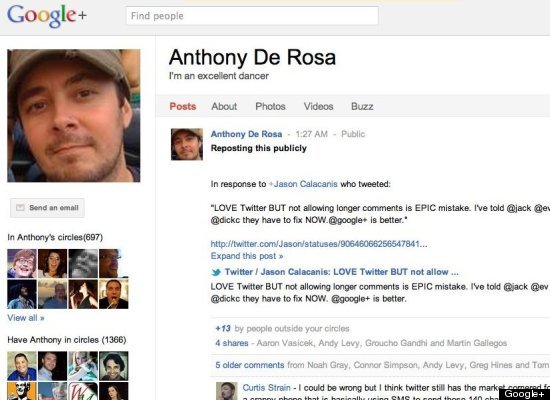
MEDIA: Anthony De Rosa

Anthony De Rosa is the social media editor at Reuters. He discusses breaking news, media and technology.
Follow +Anthony De Rosa

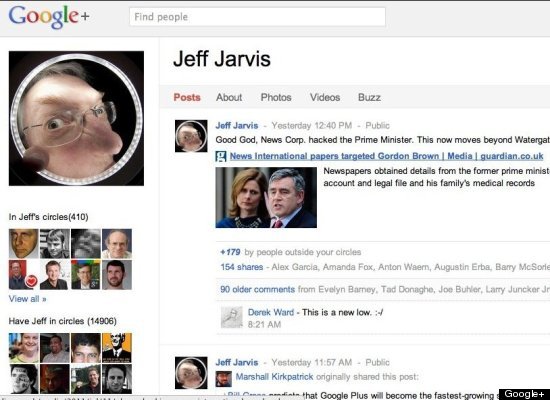
TECH: Jeff Jarvis

Jeff Jarvis is an editor and publisher of the NY Daily News, journalism professor and tech blogger.
Follow +Jeff Jarvis

ARTS: Juergen Hoebarth

Juergen Hoebarth is the world's first self-proclaimed "G+ pop artist". He finds inspiration from social network design schemes and logos.
Follow +Juergen Hoebarth

SPORTS/TECH: Mark Cuban

Mark Cuban is a successful Internet entrepreneur. He is also the "keeper of the Larry O'Brien Trophy" -- since his pro basketball team, the Dallas Mavericks, won the NBA Championship in 2011.
Follow +Mark Cuban

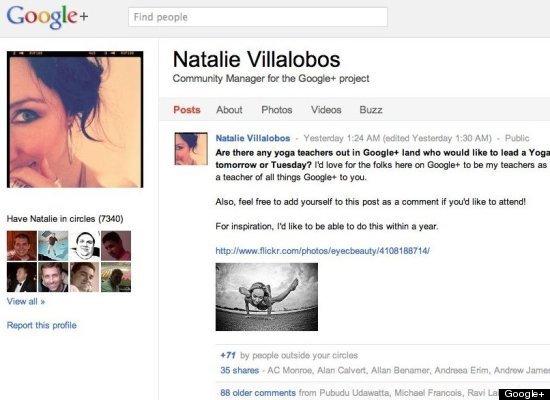
TECH: Natalie Villalobos

Natalie Villalobos is a community manager for the Google+ project. She is a good person to follow if you want all the latest news about Google+, as well as helpful tips for getting started on the social network.
Follow +Natalie Villalobos

CELEBRITY: Alyssa Milano

Alyssa Milano is one of the first hollywood celebrities to become active on Google+. According to one of her posts, she's also teaching her mom how to use the service.
Follow +Alyssa Milano

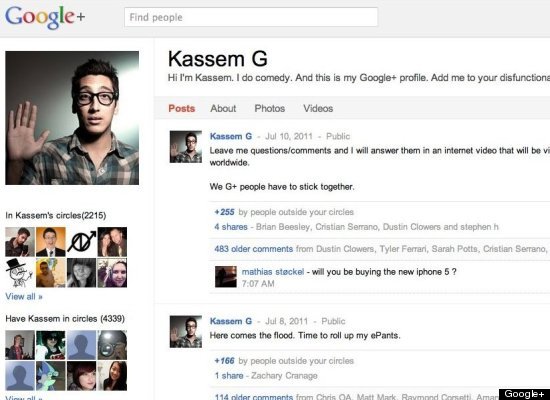
COMEDY: Kassem G.

Best know for his YouTube channel, Kassem G. is a comedian who started out doing stand-up in the local L.A. comedy scene. He uses Google+ to share links and talk with his fans.
Follow +Kassem G.

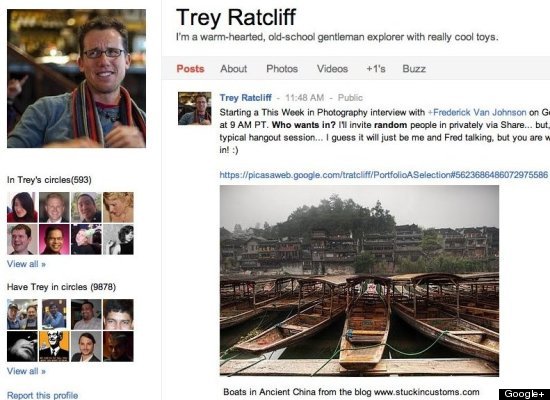
ARTS: Trey Ratcliff

Trey Ratcliff is a photographer and avid traveler. The awe-inspiring photos he shares on Google+ are reason enough to follow him.
Follow +Trey Ratcliff

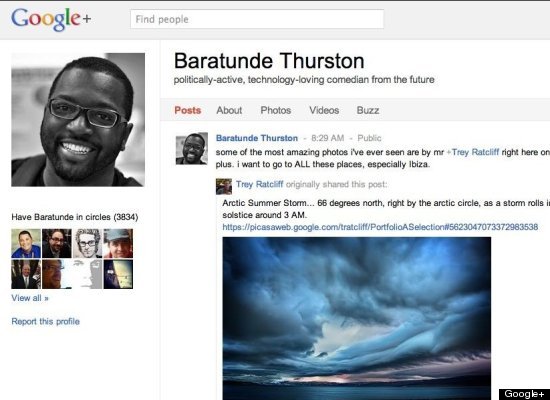
POLITICS/COMEDY: Baratunde Thurston

Baratunde Thurston is co-founder of the black political blog, Jack and Jill Politics, and serves as Director of Digital for The Onion. According to Thurston's Google+ profile, President Barack Obama once called Thurston "someone I need to know".
Follow +Baratunde Thurston

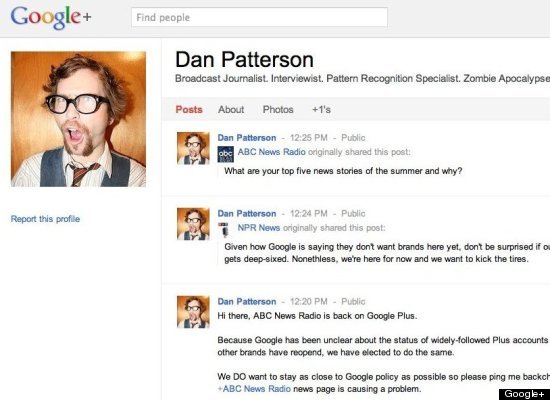
MEDIA: Dan Patterson

Dan Patterson is the digital platform manager for ABC News Radio. He posts interesting news bits, photos and charts on Google+ throughout the day.
Follow +Dan Patterson

ECH: Bill Gross

Bill Gross is founder and CEO of technology incubator, Idealab. He uses Google+ to share insightful commentary on technology-driven innovation.
Follow +Bill Gross

TECH: Denise Howell

Denise Howell is host of This Week in Law and writes a column for The American Lawyer. She discusses Internet privacy and law on her Google+ profile.
Follow +Denise Howell

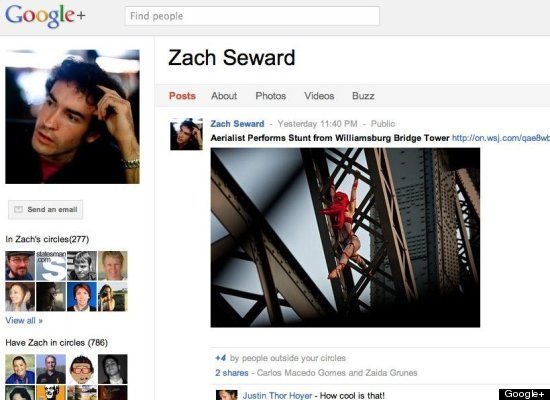
MEDIA: Zach Seward

Zach Seward is a social media editor for The Wall Street Journal. He posts an eclectic mix of content that any media buff will find interesting.
Follow +Zach Seward

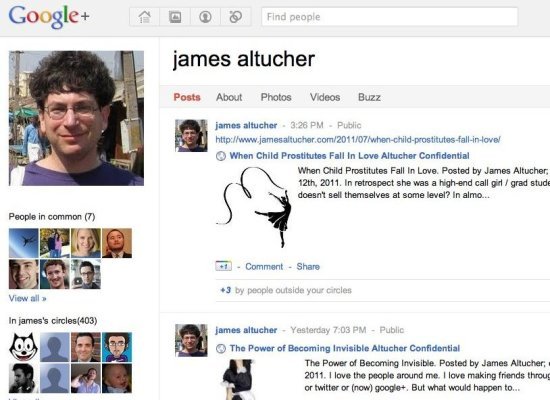
BUSINESS: James Altucher

James Altucher is a hedge fund manager and avid writer. His posts are intelligent, witty, and contain a unique perspective on the world of investing.
Follow +James Altucher

TECH: Guy Kawasaki

Guy Kawasaki is known as an early adopter of social media, and his use of Google+ appears no different. You will find plenty of interesting tech snippets posted to his profile throughout the day.
Follow +Guy Kawasaki

CULTURE/TECH: Scott Beale

Scott Beale is the founder of Laughing Squid, a domain for art, culture and technology. You'll find an array of strangely interesting resources on his Google+ profile.
Follow +Scott Beale

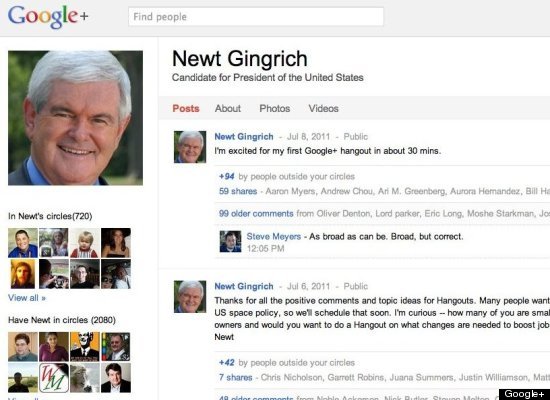
POLITICS: Newt Gingrich

Newt Gingrich is the first presidential candidate to join Google+.
Follow +Newt Gingrich

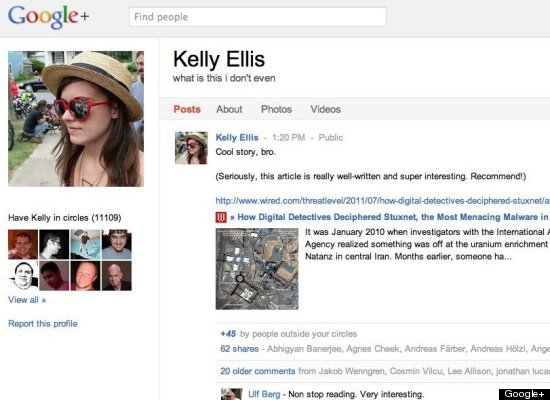
TECH: Kelly Ellis

Kelly Ellis is a software engineer at Google. As one of the engineers responsible for Google+, Ellis frequently posts product updates.
Follow +Kelly Ellis

BUSINESS: Richard Branson

Richard Branson, one of the world's best-known entrepreneurs, seems to have taken a liking to the new social network.
Follow +Richard Branson

ECH: Robert Scoble

Robert Scoble, who blogs at Scobleizer.com is followed by many in the tech industry because of his close ties with Silicon Valley glitterati.
Follow +Robert Scoble

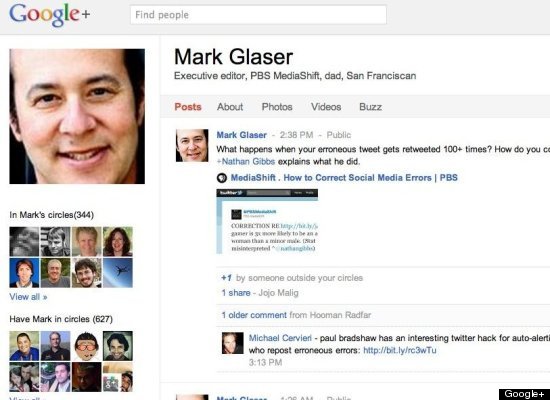
MEDIA: Mark Glaser

Mark Glaser is the executive editor of PBS MediaShift. He often discusses new media journalism on his Google+ profile.
Follow +Mark Glaser

BUSINESS: Chris Brogan

Chris Brogan is a small business consultant, professional speaker and New York Times bestselling author.
Follow +Chris Brogan

MEDIA: Nicholas Kristof

Nicholas Kristof is a two-time Pulitzer Prize winner, and Columnist for The New York Times. He calls himself "a print dinosaur, trying to evolve into a new media maven".
Follow +Nicholas Kristof

COMEDY: Daniel Tosh

Daniel Tosh is an American stand-up comedian and host of the Comedy Central television show, Tosh.0.
Follow +Daniel Tosh

CULTURE: Jillian York

Jillian York is the director or International Freedom of Expression at the Electronic Frontier Foundation. She is also a columnist for Al Jazeera English.
Follow +Jillian York

MEDIA: Andy Carvin

Andy Carvin is a senior strategist at NPR and online community organizer. He is a high-quality poster, sharing an abundance of fascinating content.
Follow +Andy Carvin

ARTS: Thomas Hawk

Thomas Hawk is a photographer and blogger from Oakland, California. He posts breathtaking images on his profile, with the goal of "making your G+ experience more beautiful one photograph at a time".
Follow +Thomas Hawk

CULTURE: Kim Sherrell

Kim Sherrell is a producer at Intertheory and founder at ArtwalkTV. She's a great resource if you enjoy film and culture.
Follow +Kim Sherrel

Assam NGO Plans Blockade of Mizoram

assam-mizoram-hailakandiSinlung Says: Not happy with their KMSS leader Akhil Gogoi being arrested for inciting riot. Now KMSS has turned to yet another issue. Assam-Mizoram border, it is to be noted that Assam has border issues with nearly all states of Northeast India.

State Border issues of Northeast:
1. Assam-Arunachal Pradesh
2. Assam-Nagaland
3. Assam-Meghalaya
4. Assam-Mizoram

These border conflicts has certainly been flash points of people living in the bordering areas. But KMSS trying to put the people into hunger is not acceptable by any human standard.


Hailakandi KMSS for sealing Assam-Mizoram border

Hailakandi, Jul 17 : The Hailakandi district committee of the Krishak Mukti Sangram Samiti (KMSS) has threatened to launch a vigorous movement throughout the district if the Assam-Mizoram border is not sealed within next three months. In a memorandum submitted to the Border Areas Development Minister, Siddeque Ahmed, the president of the committee, Choudhury Charan Goud alleged that the people of Mizoram have encroached on 11,000 hectares of the State land and the State Government has not taken any initiative to counter this.

Attacking PHE Minister Gautam Roy for not taking any action against the alleged Mizo aggression when he held the portfolio of Border Areas Development, Goud, in the memorandum, sought immediate intervention of the new minister.

The KMSS unit further alleged that the entire Assam-Mizoram border area falls under the Katlicherra constituency of Hailakandi and despite representing the constituency, minister Gautam Roy did not take any step to solve the border problem.

The memorandum alleged that the Mizo aggression along the border started in the early part of the 1990s and at present the situation has worsened. The people living in Assam land are facing extreme uncertainty and fear psychosis has gripped the entire area due to the repeated attacks on them by the Mizos. The Mizo people are targeting the agricultural land and taking away fruits, vegetables and other produce of peasants of the State.

Firing and torture by the Mizo people with the help of police still continue in the inaccessible hilly terrain in southern Hailakandi, the memorandum alleged.

The memorandum said that 1,000 hectares of land have been encroached on by the Mizos in the Kachurthal area while other 10,000 hectares of land have been encroached on in Choto Jamira, Khajurai, Riflemarra, Dhalcherra and other villages.

The KMSS unit elaborately mentioned the series of incidents on the border and urged the minister to take action in this regard immediately and seal the border.

Move Over MBAs, Assamese Actors Are Here

By Preethi Nagaraj

Mysore, Jul 17 : While students in Karnataka are busy choosing medical, dental and engineering seats hoping for lucrative careers, some youngsters from Assam landed in Mysore to get a peek into theatre.

Reason: The Assamese theatre, despite all the unrest in the state, pays a whopping sum to its top actors.

A lead actor like Jatin Bora commands as much as Rs 45 lakh for a season stretching up to 10 months with popular theatre companies such as Kohinoor—with Abhahaan and Hengul being in the same league in terms of popularity. This trend has made several youngsters jump on the bandwagon.

Recently, a group of youngsters were in Mysore for a training and exchange programme to boost their career in theatre. Mobile theatre in Karnataka and most parts of the country is on the ventilator. But  the mobile theatre in violence-hit Assam, known as “Bhraymamon” theatre, has mesmerised the National School of Drama (NSD).

The premier theatre institution has taken it up as a case study.  This has resulted in theatre turning not only into a lucrative career option for north-eastern students but also a way to express themselves.
Bhagirati Bai Kadam, who has been running the Seagull Theatre, says acting is a serious career option in Assam. An NSD graduate and from Gavadagere in the Hunsur taluk of Mysore district, Bhagirati along with her husband (also an NSD graduate) Baharul Islam runs a small theatre school which trains actors and actresses besides staging various productions since 1993.

She visited Mysore with 25 aspiring actors and actresses—a majority of whom plan to take up theatre full-time—and had them trained in different forms of Kannada folklore like “veeragaase kunita” and “yakshagana”.

Speaking to Deccan Herald during her visit to Mysore, as part of the exchange programme Seagull organised with various theatre troupes in Karnataka, including Rangayana, Bhagirati says: “There is more to north-east than just scenes of violence, as interpreted usually.”

According to her, an average actor in Assam can look forward to a fulfilling career spanning over two decades since the mobile theatre culture has beaten the television at its game. Along with entertainment, Assamese theatre troupes have also been playing a crucial role in educating people.

Troupes like the Kohinoor experiment with their format and theme have usually been successful. Equipment used are of high quality.  Pandals are erected in each village or town, and the company sets up its own stage. “On an average, tickets sell for anywhere between Rs 500 and Rs 700 per show and a company can stage even four shows a day.

Every time, it is full house with 3,000 people watching the show. So far, no company has wound up for want of funds,” she adds.  Is the theatre untouched by acts of extremism? “In a way, they are for theatre and anything that’s Assamese in soul and identity. They don’t hit out at theatres, mostly,” she says.


Source: Deccan Herald

India Allows Duty-Free Import Of Veg, Fruits From Dhaka

Import Of Veg Fruits dhaka bangladesh

New Delhi, Jul 17
: Ahead of Prime Minister Manmohan Singh's visit to Bangladesh, India, in a goodwill gesture, has allowed zero duty import of vegetables, spices and garments from the neighbouring country, with immediate effect.

However, Bangladesh exporters would enjoy the duty concession only if they dispatch the goods through the land route from Balat-Kalaichar region in Meghalaya for sale in Border Haats.
Besides, their is a ceiling on quantity of the imports under the scheme.

"(Duty concession will not) apply to goods having an estimated total value of $50, brought into India from such border haat by a person during a day," the revenue department said.

India has also removed customs duty on import of minor local forest produce, cottage industry items and small agriculture equipments like plough, axe, spade and chisel.

Some other items like processed food items, fruit juice and melamine products have been exempted from import duty.

Leadership of the two countries have been taking steps to to promote trade and economic cooperation.

External Affairs Minister S M Krishna recently visited Bangladesh.

The Prime Minister is also scheduled to visit Bangladesh in September with an aim to improve bilateral ties. It would be first visit by an Indian Prime Minister to Bangladesh in 12 years.

Apart from the latest customs duty concessions, India has also offered a tariff-free import of 10 million pieces of apparel from its eastern neighbour.

16 July 2011

Tense Atmosphere in Mizoram As Bru Militants Arrested

bairabi police station gheraoAizawl, Jul 16 : A tense situation prevailed in Mizoram's Bairabi town near the Assam border this evening as angry locals gheraoed the police station where two suspected Bru militants had been kept.

The militants were captured by locals, armed with country-made rifles, who were hot on their heels after they (the militants) terrorised a local woman earlier on the day.

" Divided into six groups, the local volunteers pursued the Bru militants and one group captured them from the jungle late in the afternoon and handed them over to the police," a source from Bairabi said.

A woman of Bairabi town in Mizoram near the Assam border was allegedly terrorised by the two armed men, suspected to be Bru militants, around 1200 hrs in a jungle near Bairabi today.

Sources said the woman Lalthianghlimi and her husband went to their jhum and took rest on their way home. The woman then went to collect bamboo shoots inside the jungle. These two armed men suddenly appeared and started threatening her at gun point.

Even though they stuffed her mouth with a piece of cloth, the woman still maanaged to scream.

On hearing his wife’s cry, the man, with some non-Mizo labourers rushed to the jungle. The two armed men managed to flee the scene.

The incident took place inside Assam territory under Hailakandi district.

After the militants were handed over to the police, the angry locals gathered in front of the police station demanding to 'see' the militants. A police official, who talked over phone from Bairabi, hoped to keep the situation under control.