13 June 2010

Economic Blockade Hits Poultry Business in Manipur

poultry_big Imphal, Jun 13 : Poultry business in Manipur has been severely affected due to continued economic blockade.

The ongoing blockade along the national highways, which is on for more than 60 days, has affected the supply of poultry feeds, which is normally brought from outside. One bag of poultry feeds weighing around 70 kilogram used to cost Rs 1,060 earlier.

But now the same is being sold for Rs 2,000.

The farmers have started to feed the chicken with local feed, which has resulted in weight loss of the chicken and the spread of white diarrhoea.

"We somehow manage to provide them with the local feed products made by us. But the feed is not of controlled quality and so the chickens are getting ill and their growth is retarded," said Pradeep Singh, a feed wholesaler.

Before the blockade, about 11,000 to 12,000 chicken were brought into the State by road at least two to three times a week.

But now, only 2,000 chicken are being brought in to the state per week by air.

Manipur Vehicles Not to Ply Through Nagaland

India_truck Imphal, Jun 13 : Buses and trucks of Manipur will not ply through Nagaland until the Centre and the Nagaland government pay compensation for vehicles damaged during the ongoing indefinite economic blockade on national highways, the transporters and drivers council (TDC) said today.

"Several non-government organizations and militant outfits have been extorting money and harassing drivers, vehicle owners and passengers from Manipur in Nagaland for many years but we (TDC) have been tolerating it," TDC spokesman and general secretary N G Haridas told reporters here.

Several vehicles were destroyed during the ongoing economic blockade on NH 39 (Imphal-Kohima-Dimapur) passing through a major portion of Nagaland and NH-53 (Imphal-Jiribam-Silchar) by All Naga Students Association Manipur (ANSAM), Haridas alleged.

The decision not to ply trucks and buses was taken during an emergency meeting of the council last evening.

12 June 2010

In Cricket-Crazy India, Baseball Finds a Foothold

By Shefali Anand

In Manipur, one of India’s most conflict-ridden states, some locals this summer have picked up different types of armaments: bats, balls and gloves to play baseball.

In cricket-crazy India, Manipur has many fans of America’s favorite pastime. Recognizing an opportunity, America’s Major League Baseball International this week sent two coaches to train local coaches with the hope that they can further promote the game locally.

This is the third training camp of its kind to be held in Manipur’s capital of Imphal. The initiative was put together by New York-based First Pitch: The U.S. Manipur Baseball Project, a non-profit organization founded by 54-year-old film curator L. Somi Roy.

Heavy rains in Manipur forced baseball training sessions off the diamond and indoors.

Mr. Roy is a Manipuri who emigrated to the U.S. more than two decades ago. Some years ago, he learned of Manipur’s fascination with baseball. His cousin, a local politician, had asked him to bring some baseball gloves and bats when he visited Imphal next. She informed him that several people were playing baseball in Imphal but with limited and over-used equipment.

Manipur, with a population of just 2.4 million, is a hilly state located at the north eastern edge of India. It shares a border with Myanmar (the former Burma). The state is often in the news for its long-running insurgency, which is demanding secession from India. The fighting has hurt the local economy and has kept the state very poor. Foreign nationals can’t travel to Manipur without a special government permit.

Most recently, Manipur has been in the news because members of tribes from the neighboring state of Nagaland have blocked a main highway to Manipur to protest the Manipuri government’s refusal to let a Naga separatist leader enter the state. (Some Nagas also want to secede from India.) The blockade has created huge shortages of fuel, food and even medical supplies in Manipur, according to news reports.

Amid all this chaos, Major League Baseball and Mr. Roy have been plugging away with their baseball camp this past week. Thanks to heavy rains over the last few days, nearly three-fourths of the training has had to take place indoors, says Mr. Roy.

Major League Baseball International coach Robert Buskett, who was in India for the first time, said he’s “impressed” with the local coaches and, in less than a week, he has “seen progress already.” He said that MLB has similar coaching camps in other parts of Asia as part of its efforts to increase awareness of the game.

Within India, Manipur is a good base because its people have long had a strong sports culture. Many of India’s national-level sportspeople come from Manipur, including weight-lifting champion Nameirakpam Kunjarani Devi, boxing medalist Dingko Singh, and several players in India’s soccer team. Also, contrary to the rest of India, Manipuris are not crazy for cricket. Football is their first love.

There is little recorded history of how baseball first came to Manipur. Geet Singh, 36 years old, a Manipuri sportsman and project coordinator with First Pitch, says that there are local reports that baseball was played in Imphal during World War II by American soldiers who were based there.

Local sportswoman Bhanu Devi, 45, (now an MLB-certified baseball coach) says the game was formally introduced in the early 1980s, by E. Bijoy Singh, the then-chief of the All Manipur Sports Association. A team was created which participated in baseball tournaments held in New Delhi and other parts of India, says L. Ranjit Roy, secretary of the All Manipur Football Association. But the momentum waned, especially after Mr. Singh retired a decade later.

However, when Mr. Roy of First Pitch came to set up the first MLB coaching camp in 2006, hundreds of locals showed up to learn the sport. They returned in 2007, and MLB has now certified 31 Manipuri coaches.

“We are not bringing baseball to Manipur; it was already there,” says Mr. Roy. “We admire the fact that they’ve kept it alive” despite the poverty and lack of resources, he adds. Mr. Roy, who is not a baseball enthusiast, says he reached out to MLB and organized these coaching camps in Manipur as a way to promote an exchange between the two cultures that he belongs to.

Mr. Roy’s next project is to try to create a baseball season to give locals an incentive to play for a longer part of the year. He hopes to bring the Major League Baseball coaches back with him to Manipur in middle of January. Without the rains, they might even get to practice outside.

[ via wsj ]

Heavy Rains Endanger Rare Animals in Northeast India

kaziranga On Thursday, heavy rains swamped most parts of India's Kaziranga National Park in the Indian state of Assam, endangering the lives of many animals.

The park is home to more than half of the world's population of the endangered one-horned rhinoceros.

Forest officials are worried about the safety of the animals, especially when crossing the road.
The animals were moving towards the southern part of the park, in search of food and shelter.

The heavy downpour in the state has caused a major river to overflow, submerging many parts of the national park.

Kaziranga National Park is recognized as the UNESCO World Heritage Site for its largest habitation of one-horned Indian black Rhinos and various species of birds and animals.

Indian Officials Hope to Lift Blockade in 'Jeweled Land'

By Harmeet Shah Singh

STORY HIGHLIGHTS

  • Two-month blockade threatens lives of 2.5 million people
  • Manipur, home to numerous tribes, is known as India's 'jeweled land'
  • Indian authorities say they are willing to sit down for talks

New Delhi, Jun 12 A two-month blockade by ethnic tribes that stripped the luster from a "jeweled land" in a remote northeastern corner of India may be ending soon, a top Indian official said Friday.

More than 2 million people were fast running out of food, fuel and life-saving drugs in Manipur state amid a blockade of vital roadways in place since mid-April.

Protesters from the Naga Students Federation have promised to end the stalemate shortly, Home Secretary G.K. Pillai said.

But "it may take a few days. We hope it will be lifted early next week," he said.
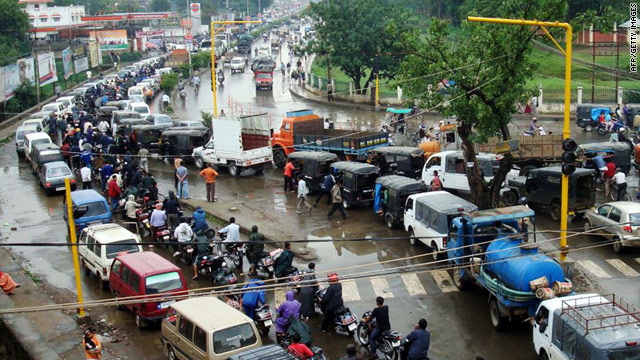
Vehicles in India's Manipur state line up for gas as a blockade caused supply shortages on Wednesday.

For years, tribal groups in Manipur have resisted the authority of New Delhi, claiming that they have suffered neglect from the central government. Dissatisfaction, in turn, has given rise to an insurgency that has inflicted violence on the state.

The Manipuri Nagas tribe wants greater autonomy for its districts and was unhappy with the state's decision to proceed with overdue local elections.

Naga leaders boycotted the vote, claiming that their demands have not been met. Passions were also fueled last month when state authorities prevented Naga rebel leader Thuingaleng Muivah from entering his native village.

The economic stranglehold of the highways, seen as the lifeline to the state, was also affecting emergency services in hospitals, officials said.

"The situation is very serious. There's an acute shortage of foodgrains and medicines," said Manipur government spokesman N. Biren Singh.

In Imphal, the state capital, residents are facing crippling shortages.

Anju, a homemaker, said she had been using a kerosene stove for a month because cooking gas was not available. Luckily, she said, she had stockpiled kerosene but feared that the market had no more to offer.

She also felt lucky that her family owns a rice field and isn't dependent on local stores, where shelves were emptying fast.

Though blessed with the beauty of blue mountains and oval valleys, Manipur is landlocked.

Authorities were flying in essential commodities, but Singh said air transportation of supplies was not enough to feed 2.5 million people. He said the state government was willing to hold talks with the protesters and put an end to the blockade.

But some residents blasted the state government for rushing elections without addressing the core concerns of the local Nagas.

"They should have talked with [the Nagas] and listened to their demands, right or wrong, before announcing elections," said Newmai Huniboi, a school principal in Manipur's Tamenglong district.

[ via CNN ]

Mizoram Ministers Visit Disaster Management Training Camp

mizo minister Aizawl, Jun 12 : Mr S.Hiato, Minister, PHED and Mr N.K. Chakma visited the ongoing Disaster Management & Rehabilitation training  at Central Training Institute,Sesawng, 41km from Aizawl city, yesterday.

The training for State Disaster Response Force(SDMF) was supervised by instructors from 1st battalion National Disaster Management Force, Guwahati. Emergency responses replicating the real life situations were demonstrated by the participants  during this functions attended by the visiting Ministers.

Minister, Disaster Management & Rehabilitation(DM&R) had voiced the significance of the training in Mizoram where common natural disasters such as fire, landslide, bad storms are frequently felt every year.

He was particularly pleased with the voluntary participations a large number of young people and their concern for the safety of others.

The trainees were pleaded to give full hearted effort to their  training in order to have a great impact on the efficiency of disaster management in time of emergency and to render a successful life saving operations when needed.

The training would surely reduced the number of casualties and avoidable injuries even if the state had to face unwanted emergency due to natural calamities and disasters in the future, the Minister said.

Mr S.Hiato, Minister, PHED was also pleased with the way training was conducted and believed that it would surely increase the state's preparedness in dealing with natural calamities and emergency. He was hopeful of the trainees using their theirs skills and efforts swiftly and efficiently when the emergency situation rises in the future.

It was admirable to risk one's own life to save the lives of others despite dangers and difficulties, he said.He also suggested that  skills imparted in the training should also be taught to various NGO's in the state so as to render an efficient and timely services in a concerted effort  wherever and whenever required.

Mizoram has the distinction of being the first state in India to set up Disaster Management Force and the first to conduct training for SDMF. Disaster management force in Mizoram comprises of 4 Companies manned by personnel of 1st battalion MAP, 2nd Battalion MAP, 1st & 2nd Battalion IR.

The ministers, accompanied by director, DM&R, director,AH&Vety and other officials  had  also visited search and rescue operations under water at LAD picnic spot, Lawibual within the city of Aizawl.

Green India Mission to Protect Northeast From Fall-out of Climate Change

Green India Mission Guwahati, Jun 12 : Green India Mission (GIM) will protect the north eastern region from the fall-out of the climate change, Union minister of state for environment and forest, Jairam Ramesh today said.

"The prevailing climatic change is a matter of concern for the vulnerable north eastern region and the Green India Mission (GIM) will take all measures to protect it", Ramesh told reporters at the sidelines of the first regional consultation programme to finalize the GIM document.

The union minister said while the north east's land share of the country is only 7%, its forest share 25%.

The GIM target is to include afforestation of six million hectares of degraded forest lands and increase the forest cover of the country from the present 23% to 33%.

About Assam, Ramesh expressed satisfaction that 38% of its land area was forest and tea garden land but regretted that 20% of that area was degraded.

"Efforts are to be made to protect the existing forest cover and help increase it", he said.

The union minister said a composite committee would be formed soon to involve the common people and evolve a strategy to protect and increase the country's forest cover.

Stating that human encroachment on forest land was a serious problem, he said villagers living in the fringe areas of forest should be provided alternative avenues for livelihood so that they did not destroy vegetation.

The minister said that a climate change monitoring centre will be soon set up in the North Eastern Hill University (NEHU) in Shillong.

16-year-Old Sailor Abby Sunderland Feared Lost at Sea

Abby Sunderland Lost

Los Angeles, Jun 12 : A 16-year-old Southern California girl attempting a solo sail around the world was feared in trouble Thursday thousands of miles from land in the frigid, heaving southern Indian Ocean after her emergency beacons began signaling and satellite phone communication was lost.

An international effort to rescue young Abby Sunderland began, but the vast distances meant long hours of waiting for her family and support team, which expressed confidence that she was alive because the beacons were deliberately turned on rather than set off automatically.

"She's got all the skills she needs to take care of what she has to take care of, she has all the equipment as well," said brother Zac, himself a veteran of a solo sail around the world at age 17.

Australian Maritime Safety Authority spokeswoman Carly Lusk said three vessels were sent from the French territory of Reunion Island and an aircraft was dispatched from Perth on a four-hour flight to Abby's location more than 2,000 miles from both Africa and Australia.

Qantas airlines said in a statement that an Airbus A330 tasked by the safety authority took off at 7:53 a.m. Friday Perth time (23:53 GMT) and its crew would try to spot the sailboat.

It was not clear when the surface vessels left, but it would take a day for the nearest ship to reach the area. Reunion Island is off Madagascar, the very large island along the east coast of Africa.

Support team member Jeff Casher said the two emergency beacons were continuing to broadcast and GPS location data showed they were together and drifting at 1 mph. He believed the beacons were on Abby's boat but said they could be with her on a raft.

Casher offered several scenarios: The boat may have flipped over and Abby could still be inside; the boat's mast may have been damaged; or she was injured and could not pilot the boat. He said that if the boat flipped, the hull would prevent her from calling from her satellite phone.

Conditions can quickly become perilous for any sailor exposed to the elements in that part of the world.

"We've got to get a plane out there quick," said family spokesman Christian Pinkston, adding that the teen's family in Thousand Oaks was asking for prayers for her safety.

Her brother said Abby was prepared and mentally tough. "I really wish I could see her and hope she gets through this one," he told reporters outside the family home.

Abby last communicated with her family at 4 a.m. PDT Thursday and reported 30-foot swells but was not in distress, Pinkston said.

Casher said Abby had to make repeated calls with her Iridium satellite phone because of sketchy connections. He said she had been in rough weather and had a problem with her engine, which she eventually managed to start. The team then asked her to check other things on the boat.

"She hung up to go check some things and she never did call back," he said.

An hour later the family was notified that her emergency beacons had been activated, and there was no further communication.

Her brother said the boat was most likely not completely submerged because another beacon would be triggered at a depth of 15 feet.

Derrick Fries, a U.S. sailing instruction and safety expert, said Abby's circumstances were very unclear.

"It's hard to determine if she's rolled over, swamped, or washed overboard. She has to have a dry suit on to have any chance," he said. "To be capsized in the middle of the ocean with waves crashing relentlessly down, not just for hours, but days, I can't tell you how difficult those conditions are."

A lifelong sailor whose father is a shipwright and has a yacht management company, Abby set sail from Los Angeles County's Marina del Rey in her 40-foot boat, Wild Eyes, on Jan. 23 in an attempt to become the youngest person to sail around the world alone without stopping. Her brother briefly held the record in 2009.

Before Abby's voyage began, her brother described her as having more skill and experience than most sailors in their 20s and 30s. Her father said she had more solo sailing experience than Zac did before he started out.

"He totally thinks that I'm ready to do it, so that does help," she said at the time.

Abby soon ran into equipment problems and had to stop for repairs. She gave up the goal of setting the record in April, but continued on.

On May 15, Australian 16-year-old Jessica Watson claimed the record after completing a 23,000-mile circumnavigation in 210 days. Jessica and her family sent a private message of hope to Abby's family, spokesman Andrew Fraser said. "We are hoping she's OK and are trying to stay positive," he said.

Abby left Cape Town, South Africa, on May 21 and on Monday reached the halfway point of her voyage.

On Wednesday, she wrote in her log that it had been a rough few days with huge seas that had her boat "rolling around like crazy."

"I've been in some rough weather for awhile with winds steady at 40-45 knots with higher gusts," she wrote. "With that front passing, the conditions were lighter today. It was a nice day today with some lighter winds which gave me a chance to patch everything up. Wild Eyes was great through everything but after a day with over 50 knots at times, I had quite a bit of work to do."

Information on her website said that as of June 8 she had completed a 2,100-mile leg from South Africa to north of the Kerguelen Islands, taking a route to avoid an ice hazard area. Ahead of her lay more than 2,100 miles of ocean on a 10- to 16-day leg to a point south of Cape Leeuwin on the southwest tip of Australia.

Charlie Nobles, executive director of the American Sailing Association, said the best-case scenario would be that she had had a severe knockdown or roll by a strong wave that caused her communication equipment to go out, or the boat sustained structural damage that was preventing her from sailing.

The worst case would be if she was in the water or in her life raft.

"It's an extreme set of conditions with the winds, the force of the waves," he said.

A person lost at sea can typically survive 12 days on average without fresh water and a month without food, according to survival experts.

If the boat capsized, survival will depend on factors including water temperature, sea conditions, safety gear and whether there was something to hold on to.

Last year a Netherlands court concerned about safety blocked a 13-year-old girl's plan to sail around the world, sparking debate on the role of authorities and parents when children want to undertake risky adventures.

Such attempts have resulted in success and tragedy.

Last month, 13-year-old Jordan Romero of Big Bear, Calif., became the youngest person to scale 29,035-foot Mount Everest. But in 1996, 7-year-old Jessica Dubroff, her father and a flight instructor were killed in a crash in Cheyenne, Wyo., during her attempt to become the youngest person to fly across the country.