19 May 2010

Inside Imphal: Discontent And Dialogue

By Rajiv Bhatia

aerial_imphal city As our flight from Delhi landed at the airport in Imphal, the capital of Manipur, the relief was palpable. The temperature at 28 degrees Celsius was welcome. But my happiness was short-lived.

As I looked around, it was impossible to miss the evidence of under-development. The two vehicles we used had passed their prime a long time back. In the city one saw many places where garbage had not been collected. Soon I was to hear a lot about galloping unemployment, failure to attract industry and a flawed education system.

The most tragic sight in the city was an exceedingly long queue of motorists who have been waiting for hours to buy a few litres of petrol or diesel. At another outlet one saw an even longer queue of two-wheelers for the same purpose. What a waste of time and productivity, I thought.

In the next three days, I had several conversations with academics, members of civil society, editors and journalists. They spoke about the immediate cause of the fuel crisis, the blockade of national highways number 39 and 53 that normally brought supplies through Nagaland into Manipur. The supply line had been disrupted by serious political developments. But they talked much more about the malaise that has gripped Manipur for long.

Serious discontent prevailed, I was told, among people against the government, both at the central and state levels. A young but thoughtful interlocutor said that a “disconnect” existed between the government and the people, essentially because fruits of development had not reached the latter adequately. “Why was it so,” I asked. “Corruption,” was the cryptic response.

Unhappiness with New Delhi was even more complex. When I pointed out that many positive developments had taken place such as a steep increase in the development budget, the positive contribution of the North Eastern Council and the setting up of a new ministry, namely, the Ministry of Development of North East Region, the point was conceded for a while.

Then the litany against New Delhi or ‘against India’ began: ‘the independent kingdom of Manipur’ was merged with India through a dubious process in 1947-48; the Armed Forces (Special Powers) Act and the restricted areas permit regime were unacceptable restrictions on the province’s democracy; the extent of insurgency was exaggerated; attacks by insurgents were sometimes found to be the acts by agents provocateurs, etc.

A major grievance was that, in the context of a feud over the proposed visit of NSCN leader Thuingaleng Muivah to his ancestral village in Manipur, Delhi was favouring him and was being unfair to the people of Manipur. By refraining from taking effective action to end the blockade of national highways, the central government was not doing what it should, they argued.

Some feared that the size of Manipur might shrink “once again”. The reference was to the Nehruvian time when India settled its boundary with U Nu’s Burma. This had entailed ignoring Manipur’s claim to the Kabaw Valley.

Independent India had to factor in the decisions of the Raj as well as the larger ramifications involving other neighbours. Whereas for India and Myanmar the matter had been settled a long time back, the noteworthy point was that the perception in Manipur was one of a historic wrong.

Insurgency in Manipur might be under control, but it has not disappeared. The presence of security personnel is quite visible. Nevertheless, a plethora of underground outfits continue to flourish through extortion of large sums of money from business and even government officials.

Topography of the area is helpful to their hit-and-run operations. They are reportedly a divided lot, but they manage to create a sense of abnormalcy and uncertainty in the state. Until this is remedied, new business groups can hardly be expected to invest without which economic problems cannot be resolved.

Addressing an elite audience of strategic community in Delhi recently, Home Minister P. Chidambaram asserted that insurgency in the North-East could be contained, controlled and resolved. Most would agree with him. For this very purpose, the Ministry of Home Affairs should consider undertaking a fresh evaluation of ground realities in Manipur. This should be followed by an in-depth dialogue involving all stakeholders, including the government and a representative section of society.

Alternatively, a more flexible Track II approach could be adopted. The objective of dialogue in either format should be to identify key obstacles to development and to craft an acceptable and actionable blueprint for future.

No one can wean away the people of Manipur from the Republic of India, but it is the Republic’s duty to reduce their discontent. Only then will Manipur, known as “the flower on the lofty heights”, become a shining jewel on the forehead of Mother India.

**The author is a retired ambassador. He can be contacted at rajivbhatia@airtelmail.in

Manipur Govt Needs to Win Back Hearts of the Hill People to Save Manipur, Says Tribal Leader

HK-JOUTE In a free and frank talk with Mizoram Express’ Churachandpur team member TIMOTHY Z. ZOTE, Manipur Tribal Council president H K JOUTE says that the answers to Manipur’s integration lies in non-discriminated all round development of the hill areas.
What is Manipur Tribal Council’s stand on the District Council elections in Manipur?
Willy-nilly decision and delaying tactics played by the Government of Manipur spoils the process and the flow of the District Council elections. Had the election been held a bit earlier by at least two to three months earlier nothing of the problem we are facing now may crop up. Now that the government is firm on conducting elections by all means as no objection has come. Had objection been raised a bit earlier by ANSAM and ATSUM, the crisis could have been avoided.
On ANSAM and ATSUM demand for 6th Scheduled status in the hills?
By holding election and having MDC elected I though the members elected would try and fight for Act. But the way the District Council election is pulled shows seeds of fissiparous tendencies even at the start. I find now that my expectations are going to be a cry for the moon. Now, ANSAM and ATSUM demand for 6th Scheduled Status is more relevant, more so as to protect and uplift the Hill Tribal people against continuous deprivation.
Some organisations say that if there are 6th Scheduled District Councils it will mark the beginning of disintegration of Manipur. What’s your take on this?
We all know very well, even people with whom we never dwell together and in far off places and regions as far as or even farther than two to 3000 km away have understood that we the tribal people in North East India are need attention and special care. The sad part is people with whom we’re living do not want to understand our needs.
Knowing the conditions of tribals living in Assam at the start of the functioning of Indian Constitution Sixth scheduled District council provisions was created to protect them. However, the tribals in all north eastern states are still not happy as the state governments do not want to share powers. For instance at one point of time Manipur was at least 20 to 30 years ahead of Mizoram in terms of development but now it’s the reverse. Why this? It’s because successive Manipur governments have paid no heed to the development of the hills. Jiri-Tipaimukh Road has not been even half done and Barak Bridge at Tipaimukh to be constructed 10 years ago is still not built. These are only just few examples.
In such position can we say that we can nicely maintain Manipur integrity? Manipur’s territorial integrity does not depend on the existence or absence of the Sixth Scheduled District Councils. Manipur as a state will remain intact only if the happiness and the satisfaction of the people are assured by the State government.

[for the Full Interview visit mizoramexpress ]

India Decides to Resume Construction Work of Tipaimukh Dam

New Delhi, May 19 : The Government of India has decided to resume works for construction of much protested Tipaimukh dam, according to a message received here in Dhaka.

The construction work was suspended amid massive protest from people of Manipur district and also from Bangladesh who fear that the dam will bring disaster for them.

On April 28 the Sutlej Jal Vidyut Nigam Ltd (SJVN), NHPC Ltd and the Manipur government signed a memorandum of understanding to construct the 1,500MW Tipaimukh hydroelectric project in Manipur.

The project is to be built on Manipur's Barak river that branches into the Surma and the Kushiara rivers after entering Sylhet district of Bangladesh.
The dam could affect water flow into Bangladesh. It will also impact the livelihood of around 60,000 people.

In a joint communique issued after the three-day visit of Bangladesh Prime Minister Sheikh Hasina to India in January, Manmohan Singh had reiterated that "India would not take steps on the Tipaimukh project that would adversely impact Bangladesh".

Environment minister Jairam Ramesh had also said the central government would take a fresh look at the project following protests in Manipur and Bangladesh.

By regulating excess water, the Tipaimukh project is expected to help control floods in Sylhet, western Manipur and southern Assam.
It will also open a new waterway from Haldia port in Bengal to the Northeast via Bangladesh.
anti Tipaimukh-Dam-Activists
The project is estimated to cost Rs 8,138 crore. NHPC will pick up a 69 per cent stake in the joint venture, while 26 per cent will be held by SJVN and the remaining 5 per cent by the Manipur government.

The Sinlung Indigenous Peoples Human Rights Organisation on May 10 protested signing of the MoU. In a release it said theMoU signed by the Government of Manipur with the National Hydro Power Corporation (NHPC) and Shimla-based Satluj Jal Vidyut Nigam Limited (SJVN) on April 28, 2010 at Faridabad, for building the controversial 1500 MW Tipaimukh Hydroelectric (Multipurpose) Project is without the prior, informed consent and approval of the Sinlung-originated Hmar indigenous peoples who has been peacefully co-existing with river Tuiruong and Tuivai since time immemorial.
The MoU is without the understanding of the Hmar people who are living in the proposed dam site in Tipaimukh and Vangai Hills (Manipur), Sinlung Hills (Mizoram) which will be part of the upper-stream as well as downstream and Barak Valley (Assam) in the downstream.

"When the new agreement, which will be a joint venture between NHPC (69 per cent), SJVN (26 per cent) and Manipur Government (5 per cent), was made, the threatened Hmar indigenous people's citizenship and democratic rights , land, rivers, forest, natural resources and entitlement were not assessed, identified or mentioned. The MoU is unconstitutional, discriminating, unjust, and undemocratic."

NHPC's track record with hydro-power is alarmingly poor in all the important aspects. If one looks at NHPC's performance, in case of Indira Sagar and Omkareshwar in Madhya Pradesh, Chamera I and II projects in Himachal Pradesh, Loktak project in Manipur, Koel Karo project in Jharkhand, Lower Subansiri project in Arunachal Pradesh, Teesta Low Dam stage III project in North Bengal, Salal and Uri projects in Jammu and Kashmir, Dul Hasti project in Jammu and Kashmir, Baira Saul project in Himachal Pradesh and Tanakpur and Dhauliganga projects in Uttaranchal, Rangit project in Sikkim, it is evident that NHPC severely failed in good practices, creating irresponsible disaster to land, people and resources, displacing people without proper relief, rehabilitation and resettlement measures, violating human rights, huge cost and time overruns, causing construction related disaster, poor social and environmental standards. In many cases NHPC did not even have an Environmental Impact Assessment (EIA) and Social Impact Assessment of its projects.

Worst, NHPC have also, in many cases, failed to avail free, prior information for the affected people. Many a times, NHPC doggedly pursue its projects without informing the targeted people about public hearings.

In short, NHPC has been involved in severe violations of current Indian environment norms and manipulating environmental impact assessments. NHPC should rather be responsible for the gross unpardonable destruction that it has caused to lives, rights and environment and focus on good practices instead of toying with bigger project that will create bigger destruction and tragedy.

Similarly, with a poor and failed record of implementing policies on dams and any development projects, breakdown of law and order and governance, the Government of Manipur does not qualify to be one of the implementing agencies by playing with the lives of its citizens, forests, rivers, and rights in the name of development.

Bru Refugees to Return To Mizoram Next Week

bru refugees tripura Aizawl, May 19 : With the Mizoram Government having agreed to provide vehicles to 462 Bru refugees in Tripura relief camps to return home, one of their leaders today said they would do so next week.

President of the Mizoram Bru Displaced People’s Forum Elvis Chorkhy said over phone that the sub-divisional magistrate of Kanchanpur sub-division in North Tripura received a fax message from the Mizoram Government that the refugees would be taken home to Mamit district by vehicles arranged by it from May 25.

He said that the refugees would be ready to return as soon as vehicles were provided by the Mizoram Government.

State Home department sources said that two officials were sent to Kanchanpur sub-division to arrange vehicles for repatriation of the refugees.

The State Government, following instructions from the Union Home Ministry, had earlier decided to begin the repatriation process from May 11 and complete it by May 15, but this could not be done as the refugees demanded Rs 1,500 for each family for hiring vehicles to return home.

Only nine of the Bru families returned home on Saturday, the last day of the proposed repatriation.

The Brus had fled to Tripura following the gunning down of a youth by Bru militants near the Mizoram-Tripura border on November 13 last year.

The proposed repatriation of thousands of Bru refugees lodged since October 1997 in the six relief camps in Kanchanpur sub-division from November 16 last year had not only failed to take off, but triggered another exodus after after the killing of the youth.

The Bru refugees fled Mizoram in 1997 following the murder of Lalzawmliana, a forest guard inside the Dampa Tiger Reserve by the Bru National Liberation Front (BNLF) militants.

If Manipur is Divided, State Will break Away From India, Warns UCM

Sinlung says: Isn't this good news or what? At least for the Hills of Manipur, which have been neglected since Adam and Eve. United Committee Manipur warning India that it will break away from Indian Union. It will be a joyous for citizens in Churachandpur district, which can join Mizoram being ethnic blood brothers and sisters…thereby greater Mizoram.

All Naga inhabited Hills to Nagaland, leaving Thoubal and Imphal Valley to Manipur…WOW…
:)

Now for the news news below:

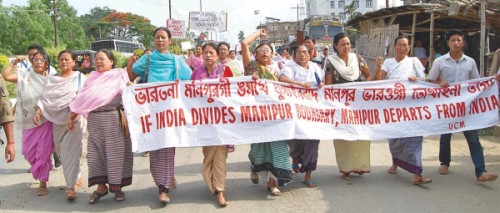
Imphal, May 19 : The United Committee Manipur today warned that if the Government of India tries to disintegrate the territory of Manipur, the state will break away from the Indian Union even as rallies and sit-in demonstrations against the proposed visit of Th Muivah, now deferred, are continuing in various places of the state today also.
Speaking at a public meeting held at THAU Ground, Thangmeiband today, president of the UCM, Yumnamcha Dilip strongly charged the government of India of spewing venoms to the people of the state who are living together in harmony since time immemorial to disunite them.
Hundreds of people from all works of life including people from Kabui community converged from different directions with rallies shouting slogans against Muivah and GoI responsible for the unrestness situation of the state took part in the meeting.

A large number of women took out a protest rally against the insidious plan of GOI to divide Manipur's territorial integrity on Tuesday in Imphal

If the GoI tries to break the territorial integrity of the state, UCM with people of the state will rise up voice to disintegrate from the Indian Union, Dilip warned speaking on the occasion.
People of the state are no more fool.
That was why no misunderstanding was created among the people of the state when Muivah planned to enter into the state in the name of visiting his birthplace.
This should be acknowledged by GoI and NSCN (IM) general secretary Th Muivah, he added.
If today's generation could not protect the territory of the state drawn by the blood of "our forefather" who fought even with the mighty British Emperor, it will be meaningless for the Manipuris to live in this world.
When they could not convinced rebel leader Muivah to install as Chief Minister of Nagaland to end his arm struggle, leaders of the GoI, on thinking that if he be installed as Chief Minister by creating South Nagaland, is sending Muivah to the state, he went on to allege.
Leaders of GoI think that there is no harm in creating South Nagaland by breaking Manipur having its own history of more than two thousand year as it would be within the Indian Union, he observed.
Advisor of the UCM, RK Ranendrajit who also spoke at length at the meeting criticized the effort of state government of airlifting of essential commodities as like that of distribution of some exercise books by the Army as part of its Civic Action Programme to draw people's attention toward them.
Giving permission to Muivah to visit the state while the state is preparing for District Council election is also a nice hidden policy of the GoI which people of the people need to find out and understand.
At the concluding part of the meeting, the gathering people marched a rally which police attempted to block which resulted to a heated argument between the rallyists and police.
Rallyists, however, force to march the rally upto DM College.
Muivah, if you want peace, choose the path of peace, said a banner displayed at a sit-in demonstration at Top Khewa Bazar by the womenfolk of the area under the banner of the Moirangkampu in Imphal east district written.
In the evening, a torch rally was also marched on the streets in the surrounding area of Top Khwa Bazar and burnt down effigy of Th Muivah by shouting slogans against his proposed visit in the state.
Another rally participated by people of different communities was also marched at Uripok with the slogans like "Let live in harmony, we want peace not war, women want peace not war," etc in the placards carried by the rallyists.

[ via Hueiyen News Service ]

Buy a TV, Get Free Petrol in Manipur

By K Sarojkumar Sharma

manipur TV Shop Imphal, May 19 : “Buy a television set and get 10 litres of petrol free.” Sounds bizarre? Not exactly, if you are in Manipur where an electronic dealer has published such an advertisement in local dailies to cash in on the scarcity of petrol triggered by the economic blockades on national highways by Nagas in protest against the state’s decision to prevent NSCN (IM) general secretary Thuingaleng Muivah from visiting his ancestral village, Somdal, in Ukhrul district.

Petrol has run out of stock in strife-torn Manipur after the arterial supply routes were blocked by Naga agitators for over a month.

It’s on a rare instance that a lucky person gets a litre of petrol, and that too after paying Rs 200 in the grey market.

Amid this acute fuel scarcity, an Imphal-based electronic outlet dealer, L Sharat Singh, came up with the smart idea to jack up the sale of television sets, washing machines and refrigerators by luring customers with “free” petrol.

The best medium, he felt, was newspaper ads. And the response was overwhelming —hundreds of customers were seen queueing up at his store. However, there’s a catch.

The customers have to wait for the “free” petrol till the highway blockades are lifted and the fuel becomes available in filling stations. Incidentally, this is not the first time that Sharat has come up with such an innovative marketing strategy.

During the 52-day economic blockade on NH-39 and NH-53 he had used the same strategy to rev up his sales. The aim behind such strategies, said Sharat, “is not only to attract customers, but also to send a message to the government”.

Meghalaya Police Bust SIM Card Racket

SIM card Shillong, May 19 : Police in Meghalaya Tuesday busted a massive mobile phone SIM card racket spread across Manipur and Nagaland as well, based on a disclosure of a top arrested militant leader.

The racket was unearthed at Tura, the district headquarters of West Garo Hills, following the disclosure to the police by Novembirth Ch Marak, a top Garo National Liberation Army (GNLA) militant leader.

Novembirth, founder and general secretary of GNLA, was arrested from Siliguri railway station in West Bengal Saturday, dealing a blow to the group’s network.

“We have detained three agents of different mobile companies for questioning based on Novembirth’s confession,” Deputy Superintendent of Police Bobby Momin told IANS.

Momin said that according to Novembirth, the mobile phone agents operating in Tura arranged for pre-paid SIM cards from Dimapur in Nagaland and Manipur.

“They bring registered pre-paid SIM cards from Dimapur and Manipur and sell them to people, violating all telecom norms,” Momin said.

The GNLA, which is fighting for a ’sovereign Garoland’ in the western areas of Meghalaya, is headed by Champion R. Sangma, a policeman-turned-rogue. It had demanded extortion money from various people through mobile text messages ranging from Rs.5 lakh to Rs.1 crore.

The GNLA had made these extortion demands on politicians, petrol pump owners, coal dealers and businessmen in the coal-rich districts of Garo Hills.

A former minister in the previous D.D. Lapang ministry and a retired inspector general of police were among those who received extortion demands.

The GNLA, a nascent militant outfit operating in three Garo Hills districts in the western part of Meghalaya, maintains links with the National Socialist Council of Nagaland-Isak-Muivah (NSCN-IM), United Liberation Front of Asom (ULFA) and National Democratic Front of Bodoland (NDFB).

18 May 2010

Mizo Students arrested Over Row With Mizo Varsity

mizoram_university Aizawl, May 18 : About 90 activists of Mizo Students Union were arrested by police after they gheraoed the residence of Mizoram University vice chancellor Prof A N Rai at Luangmual locality here today. The Mizo Students Union has served a 'quit Mizoram' diktat to Prof Rai in protest against the 'unlawful' exclusion of local candidates in an interview for teaching posts under the central university.

The MSU activists had burned the effigy of Prof Rai at Treasury Square yesterday and demanded that the vice-chancellor should step down from his office and leave Mizoram. The Mizoram University-Mizo Students Union row erupted with the ongoing recruitment for teaching posts under the university in which the administration allegedly blocked local candidates by means of a criteria set by the university.

The university has set its own criteria in which applicants with first division marks in class ten, class twelve, graduation and post-graduation are given preferences, MSU president C Lalrosanga said.

However, this four-first-division criteria is mentioned neither in the university ordinance nor advertisement for the posts, he added.

The MSU also claimed that it had signed an agreement with the university authorities in 2005 which 'gives preferences to local candidates' over their counterparts from outside with equal qualification. Out of the six candidates called for the interview for the newly introduced mass communication department which began from today, only one was local. Even as the students organization has pressed the university authorities to revoke its earlier decision in favour of the said agreement, the varsitys officials made it very clear that they have done all they can under their capacity.

''We are going by the national norms set by the UGC and there cant be any deviation,'' deputy registrar Lalthanzami Sailo told UNI over phone.

However, the vice-chancellor is empowered to give some relaxation. For instance, the vice-chancellor can call eight candidates to an interview for one post against the prescribed six candidates in certain cases, he added.

The university officials also maintained that there was no such agreement actually signed as claimed by the MSU.

It was more of an informal agreement endorsed by a meeting of MSU leaders and university authorities. Anyway, the agreement states that a minimum of six local candidates would be called for one post it they are eligible for the post. It also states that qualified local candidates would be given preferences.

Regarding the four-first-division criteria strongly argued by the MSU, the university officials stated that this is the highest rankings and not a cutoff.