30 March 2010

NH 40 4-Laning to Begin This Year

National Highway 40 Kolkata/ Guwahati Mar 31 : Four-laning of National Highway 40, which connects Shillong, capital of Meghalaya, with Guwahati, is expected to commence in 2010. Work on Shillong bye-pass would also start by the end of this year, said Mukul Sangma, finance minister of Meghalaya, while presenting the state budget for 2010-2011.

"Both projects are now at an advanced stage of consideration for award of work by the National Highways Authority of India (NHAI)," Sangma said.

In the current year, he said, the state government provided Rs 180 crore from the state plan for construction of roads and bridges, by which 368 schemes will be completed by this year. This will result in 46 km of new construction; 227 km blacktop roads; 42 km improved and widened roads and 895 metres of bridges.

Of this, 8 are ongoing projects with a target of 44 kms of upgraded roads and 6 are under-construction bridges under North-Eastern Council (NEC) sponsored schemes.

Sangma said that Rs 30.24 crore has been provided for additional land acquisition for upgrading Umroi Airport, near Shillong. The land will be acquired shortly, he added. He further said that steps had been initiated for setting up a permanent helipad in Shillong.

On power sector front, Sangma said that to meet the shortfall, some hydro projects have been identified for completion in the 11th Plan. Capacity of 193.5 MW is expected to be added to state's own generation during these five years. He added that the state government was in the process of allotting hydro and thermal power projects to NEEPCO and other parties.

The state's generation capacity is 186 MW, which is exclusively hydel-based. Meghalaya's share of power from central utilities in North-East is around 130 MW. However, due to transmission constraints, only 60 MW of power can be drawn during peak hours and 80-100 MW during off-peak hours.

As a consequence, power availability is only around 40 per cent to 50 per cent of total requirement. The present unrestricted power demand of the State is 610 MW, of which 480 MW is industrial demand and 130 MW is domestic demand.

Air India Did Not Take Permission Before Using Ao Naga Shawl: Rio

By Deepti Kashyap

AI did not take permission before using Ao Naga shawl: Rio

Kohima, Mar 30 : Nagaland Chief Minister Neiphiu Rio has informed the state Legislative Assembly that the Air India has imprinted the picture of Ao Naga shawl on the aircraft without the permission of the Nagaland government.

Replying to a question of Congress legislator I Imkong on whether the Air India has taken permission to use Ao Naga shawl on planes, Mr Rio said they had not sought permission from the Government, but it is the pride of the Nagas that the picture of Ao Naga shawl has been used on the body of the aircraft.

''We are glad that they are popularizing our culture,'' Mr Rio said in his concluding remark on the Motion of Thanks to the Governor's Address on Saturday and assured that the Government will look into the matter if any misuse was reported. He also stated that the Government would patent the Naga textiles.

Media Dialogue Invite on Northeast India: Fallen off the Media Map?

Or, why does the media give so little space to this vast region?

The Foundation for Media Professionals (FMP), in association with the Nehru Memorial Museum & Library (NMML), invites interested individuals to a panel discussion on whether the mainstream media is neglecting the Northeast at the nation’s peril.

Date: March 31, 2010 (Wednesday)
Time: 10.30 am to 1.00 pm

Venue: Auditorium, Nehru Memorial Museum and Library, Teen Murti House, New Delhi

Topic: Northeast – Fallen off the Media Map?

The panelists have been specially chosen to bring out the diversity of the Northeast India:

  • Subir Bhaumik, BBC Eastern India Correspondent and Author of “Troubled Periphery”
  • Geoffrey Yaden: Owner-Editor, Nagaland Post
  • Pradip Phanjoubam: Owner-Editor, Imphal Free Press
  • R S Pandey, Former Chief Secretary, Nagaland
  • Syed Zarir Hussain, Managing Editor, News Live, Assam
  • Dibang, former Managing Editor, NDTV India
  • Moderator: Sevanti Ninan, Editor, thehoot.org, a media watch website

The issue at focus would revolve around questions such as does the media contribute to the isolation of the states lumped together as the Northeast, and to their exclusion from the mainstream discourse?

Would reporters in Delhi or Bombay be able to even name  the capitals of all these states if asked? How much news space do all the Northeast states together average in newspapers across the country, compared to the coverage given to Kashmir?

via delhigreens

Moscow Subway Explosions: Dozens Killed By Two Female Suicide Bombers

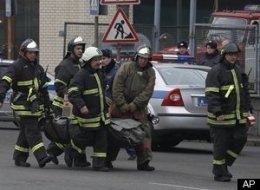
Photos taken around the scene of the Moscow subway attack.

Moscow, Mar 30 : Terror returned to the heart of Russia, with two deadly suicide bombings on the Moscow subway at rush hour, including an attack at the station beneath the headquarters of the secret police.

At least 38 people were killed and more than 60 wounded in Monday morning's blasts, the first such attacks in Moscow in six years.

Russian police have killed several Islamic militant leaders in the North Caucasus recently, including one last week in the Kabardino-Balkariya region, which raised fears of retaliatory strikes and escalating bloodshed by the militants.

As smoke billowed through the subway tunnels not far from the Kremlin and dazed survivors streamed out of the vast transportation system, al-Qaida-affiliated Web sites were abuzz with celebration of the attacks by the two female suicide bombers.

The bombings showed that the beleaguered rebels are still strong enough to inflict harm on an increasingly assertive Russia, and they followed a warning last month from Chechen rebel leader Doku Umarov that "the war is coming to their cities."

Prime Minister Vladimir Putin, who built much of his political capital by directing a fierce war against Chechen separatists a decade ago, promised to track down and kill the organizers of what he called a "disgusting" crime.

"The terrorists will be destroyed," he said on national television.

In a televised meeting with President Dmitry Medvedev, Federal Security Service head Alexander Bortnikov said the remains of the two bombers pointed to a Caucasus connection. "We will continue the fight against terrorism unswervingly and to the end," Medvedev said.

Umarov, the Chechen rebel leader, has relied on al-Qaida's financial support and has several al-Qaida emissaries in his entourage, said Alexander Ignatenko, the head of the independent Moscow-based Institute for Religion and Politics, who has closely followed the Islamic insurgency in the Caucasus.

"Al-Qaida has established a presence in the North Caucasus, like they did in Afghanistan, Pakistan, Iraq, Somalia and Europe," Ignatenko told The Associated Press. The militants' links with al-Qaida also are recognized by other experts on terrorism.

Militants in the Caucasus have declared the creation of an Islamic state as their top goal. Radical Islamic sects have spread throughout the Caucasus region and parts of Russia as well, with religious schools set up. In Chechnya, Kremlin-backed strongman Ramzan Kadyrov has conducted a campaign to impose Islamic values in an effort to blunt the appeal of hard-line Islamic separatists.

Monday's first explosion took place just before 8 a.m. at the Lubyanka station in central Moscow, beneath the notorious headquarters of the Federal Security Service or FSB, the KGB's main successor agency. The FSB is a symbol of power under Putin, a former KGB officer who headed the agency before his election as president in 2000.

About 45 minutes later, a second blast hit the Park Kultury station on the same subway line, which is near renowned Gorky Park. In both cases, the bombs were detonated as the trains pulled into the stations and the doors were opening.

"I was getting off the train when I heard the sound of an explosion and saw clouds of smoke," said Yegor Barbatunov, 29. "The (Park Kultury) station was jammed with people trying to get out, but there was no panic. I saw a young man walking past, blood pouring off his head and neck and trickling to the floor."

Added Alevtina Rogatova, a 23-year-old student who was on the same train: "I smelled burning plastic and heard cries of 'let the wounded through.'"

Amateur video on Russian TV showed wounded and possibly dead commuters on the floor of the smoke-filled Lubyanka station. One video showed gruesome images of dead passengers sprawled inside a mangled subway car and a bloody leg lying on a station platform.

Passengers streamed out of the stations, many crying and making frantic calls on cell phones. The wounded were put on ambulances and helicopters, some with their heads wrapped in bloody bandages, as sirens wailed.

Traffic was paralyzed as large sections of downtown were closed off. Some gypsy cab drivers jacked up their rates for panicky passengers trying to get to work, drawing a harsh rebuke from Orthodox Patriarch Kirill later in the day.

"Any desire to profit on the grief of others brings nothing but grief in return," Patriarch Kirill said after a liturgy.

At 4 p.m., the two subway stations reopened and dozens boarded waiting trains.

"It's really terrifying," said Vasily Vlastinin, 16. "It's become dangerous to ride the metro, but I'll keep taking the metro. You have to get to school, to college, to work somehow."

Both stations had been scrubbed clean. Holes left by shrapnel in the granite were the only reminder of the day's tragic bombings.

The ornate Moscow subway system is the world's second-busiest after Tokyo's, carrying around 7 million passengers on an average workday, and is a key element in running the sprawling and traffic-choked city.

The last confirmed terrorist attack in Moscow was in August 2004, when a suicide bomber blew herself up outside a subway station, killing 10 people. Chechen rebels claimed responsibility.

In February 2004, a suicide bomber from the North Caucasus attacked a subway train during the morning rush hour, killing more than 40 people and wounding more than 100.

Dozens of contributors to three Web sites affiliated with al-Qaida wrote comments in praise of Monday's attacks. One site opened a special page to "receive congratulations" for the Chechen rebels who "started the dark tunnel attacks in the apostate countries," and all wished for God to accept the two women as martyrs.

"Don't forget Russia's crimes of genocide in the Caucasus and Chechnya," said one writer. "The battle has been shifted to the heart of Moscow," another wrote.

Ignatenko said Islamic militants in the Caucasus often recruit women whose relatives were killed by Russian security services.

"They tell them that if they become martyrs, they will join their husbands, brothers and fathers," he said. "And they also persuade them that the Russians as a nation share a collective guilt."

While the Russian army battered Chechen rebels a decade ago, the separatists continue to move through the region's mountains and forests with comparative ease despite security sweeps by federal forces and police under the control of local leaders loyal to the Kremlin.

Rights groups say that abductions, torture and killings of young men suspected of militant links by Russian security forces have helped swell the rebels' ranks.

World leaders, including President Barack Obama, condemned the subway attacks. Obama telephoned Medvedev to convey the condolences of the United States.

New York increased security in its transportation network with officers assigned to subways overnight held in place so they overlapped with the day tour. Special units also were assigned to transit facilities. Washington, D.C., Metro police conducted random inspections of stations and rail yards. Atlanta's public transit system said its police department was increasing the number of officers and patrols in the system.

In London and Madrid, two cities hit by terrorist attacks, officials said there were no immediate plans to tighten security.

Indian Govt, Indian Army Disagree on Changing Harsh Law

Frog jumping on road in Manipur- Thats AFSPA Sinlung Says: Not sure what Indian government is thinking. Can the Bureaucrats, Army Officers, Union Ministers work and have sane thinking if their heads were forcefully pinned down with the cold barrel of the INSAS rifle stuck to their heads. If they can, they are not human beings. Everyone (we mean every citizen) in the states where the draconian law is in place has a story to tell. Their uncles beaten up, sisters molested, raped, parents humiliated; brothers made to do frog-jump on roads because they went to school. When children get to know what sound what gun makes instead of what kind of music the guitar makes.

When the male family members of villages are herded together at 4 in morning into small village playgrounds, leaving women in the houses for the Indian forces to molest, rape them, touch them unnecessarily. Yes, you can hear the women cry from afar. what can the the men do? What is their fault? AFPSA.

Many a families are broken because of these Indian Security monsters. Why do Armed Men with Guns need protection? They already have all the protection they need, their guns, their uniform, their terrorizing ways.

Has it solved the people problems since India’s independence. It aggravates a youth to die for a cause he/she knowing that someone from his/her village was shot dead in a Fake encounter. How many hits have the Indian Security forces really made on the so called militants. We believe it might be close to 1 or 2 per cent. the rest are Fake Encounters, for sake of promotions, kidnap, money, and everything else that comes with power.

Yes Absolute power does corrupt…and this is a fact with Indian Security Forces, they don’t need any protection if they are supposed to do what they are supposed to do. Provide Security, protect.

That’s a Far cry any way in India.


By Varghese K George & Aloke Tikku

does this India Security know this student is on his way to the library New Delhi, Mar 30 : Changes in the controversial Armed Forces Special Powers Act (AFSPA) — in force in Jammu and Kashmir and some northeastern states — will have to wait “until the army comes on board”.

Prime Minister Manmohan Singh had promised to consider amendments to AFSPA to make it more “humane”, but the army has found a draft proposal prepared by the home ministry “too drastic”, according to government sources.

“The army needs to be persuaded first before the government moves Parliament,” a source told HT.

The Centre or a state government can notify an area as disturbed under AFSPA and invoke the Act, giving security forces — the army, a central paramilitary force or even the police — wide-ranging powers, often criticized as draconian.

It is in force in parts of Assam, Manipur, Nagaland and J&K now. Manipur protester Irom Sharmila has achieved iconic status with her long-running hunger strike against the Act.

Two government panels — the Administrative Reforms Commission and the Justice Jeevan Reddy Committee — recommended scrapping the Act and amending others laws to give the army the powers it needs to fight insurgents.

Following resistance from the army, the ministry decided to tweak the law rather than push for a complete overhaul, which again has been found unacceptable by the army. “It will mean asking us to fight with our hands tied,” said a senior army functionary, refusing to be identified.

The key change proposed is to remove any explicit reference to the power of a non-commissioned officer, such as a Havaldar, to “cause death” if in his opinion it is necessary for maintenance of public order.

The ministry also sought to provide for a grievance redressal mechanism.

The Reddy panel was set up in 2004 to study the law in keeping with the PM’s promise to consider replacing AFSPA “with a more humane law that addresses both the concerns of national security and rights of citizens”.

Lt-Gen (retd) V.R. Raghavan was a member to ensure the army perspective was reflected. A government functionary said there was disappointment  at the army’s reluctance  “but the final view was it wouldn’t be advisable to ram it down the army’s throat”.

India's Remote River of Tea

By Roderick Eime

India's remote river of tea

CARRY ON: Hindu men pray to the Hindu Sun God during the religious festival Chhat Puja in Guwahati, Assam.

The engines pushed and pushed, churning great clouds of silt in the water, but we were stuck.

The Brahmaputra River, a wide voluminous waterway, carries enormous amounts of water and silt all the way from Tibet on its journey to the Bay of Bengal, where it joins forces with the mighty Ganges just north of Calcutta.

The current flows strongly around the port town of Guwahati (Guwahati) and spreads out to create immense sand bars - and the MV Charaidew is stuck on one.

The local newspaper trumpets our misfortune with headlines like Ship stuck in sand, foreigners taste the Orient while two heroic river tugs work noisily throughout the night to free us. By breakfast, however, we are under way, embarrassed, but otherwise undamaged.

The 24-berth MV Charaidew is one half of Assam Bengal Navigations (ABN) fleet of classic river steamers plying both the Brahmaputra and Ganges on cultural and nature-based itineraries throughout the region.

In 2003, the ABN found her languishing sadly in the mud and duly rescued her from despair. The subject of a complete refit, her life of toil was over and new adventures on the river awaited.

Our snail-paced journey upstream allows us plenty of leisure time on the broad rooftop, sundeck. We mingle with the fellow passengers and generally take it easy, enjoying the delicious local tea by the gallon.

"May I?" inquired a dapper old chap with a Sandhurst accent.

I indicate the chair is free and as he sits, careful not to spill his steaming cup of chai, I notice a nasty scar across his shoulder.

"Ah, yes, that. A Jap sniper got me just as I was about to toss him a grenade."

As the discussion unfolds, I learn I am taking tea with Colonel James "Jimmy" Evans (retired) who served as a young officer with the Gurkha Rifles when the Japanese made their last ditch effort to invade India in 1944.

I find his tales enthralling as he relates to me the story of a largely forgotten campaign during which he was awarded the Military Cross.

Jimmy and his charming wife, Jenifer, are accompanied by more retired Gurkha Rifles officers and our entourage soon takes on a jolly "Carry On Up the River" feel.

The tone is lifted further with the arrival of the British High Commissioner, his wife and son.

Apart from tea and toffs along the river, the itinerary expands into numerous shore excursions that include village visits, wildlife safaris and temple tramps.

At the farthest extent of our travel, we overnight 32km past Tezpur at Diphlu River Lodge, ABN's newest jungle lodge, strategically placed to allow access to nearby Orang and Kaziranga National Parks.

Both are inscribed in the Unesco World Heritage catalogue and home to species of endangered Asian Rhinoceros, Barking Deer, tiger, birds and elephants.

Take an elephant-back safari and be sure to see the elephant feeding as the infant pachyderms scramble around the grounds playing tag with visitors while their mothers, munching contentedly, look on unperturbed.

Among the surrounding villages are acres of tea plantations. The produce, described as red, black and white is often marketed under the breakfast tag and can be purchased directly from the factory door.

Assamese tea, as distinct from highland varieties, has a strong brisk taste, bright colour with a characteristic maltiness due to the hot, humid weather.

Ladies in bright saris move slowly among the bushes, their arms delicately caressing the branches as they pick and stow their tiny harvest. On a good day, a woman will pick 20 kilograms and earn about three dollars.

While travel in India is a test of patience and endurance for many, Assam is devoid of much of the intense, fatiguing tourist experience common in the major centres. While poverty is ubiquitous throughout rural India, Assam seems less affected by obvious hardship. Even the usually nail-biting road travel is a little more docile here.

My pack crammed and wafting fragrant aromas, from now on every simple cup of tea will transport me back to Assam and my many riverside adventures.

IF YOU GO

Travel in India is subject to Australian DFAT warnings. Check the latest updates at smarttraveller.gov.au.

Assam Bengal Navigation conducts four, seven and 10-night cruises along the Brahmaputra combined between October and April with lodge stays and wildlife safaris. Prices are calculated at $US350 (NZ$495) per person per day plus taxes. Single supplement applies. Discounts are sometimes offered.

The RV Charaidew accommodates 24 passengers in 12 air-conditioned, twin cabins, each with private facilities. Included buffet meals are served in the dining room and there is a separate lounge/bar/library in the bow plus a large rooftop sundeck.

Nasim Akhtor Leads The First Ever Team From Northeast India to Climb Mt Everest

By Teresa Rehman

mountaineer It's a bold decision to take at the age of 53. But Nasim Akhtor, the first woman mountaineer from Northeast India, is as strong as the lofty Himalaya. At an age when most retire from sports, she has taken the ultimate vow - to lead the first ever team from Northeast India to climb Mt Everest. There is no tinge of misgiving to her resolve. "I have everybody's love and prayers," she says.

She had always nurtured a dream to conquer the Everest. "I may not be that strong physically now but I have mental conviction. I have never wanted to go it alone. Instead, I wanted to lead a team from the region. Today, many years have gone by and I am old, but at least the dreams of many other young mountaineers will be fulfilled," she smiles. She narrates the story of a mountaineer who tried to climb the Everest twice but could not complete either attempt. He was then asked "Why the Everest?" To which he replied, "I wish I knew. Then I would not have gone."

The young mountaineers who will be part of the expedition throng her residence for advice in Guwahati, the capital of the state of Assam in Northeast India. On July 20, 2009, she led a pre-Everest trek to Kolai peak in Kashmir. In March 2011, she expects to lead the team to Mt Everest. "We are hoping for sponsors since the cost of the expedition will be around Rs 3 crore," she says. She rues the cricket obsession in the country and observes, "Big companies only want to sponsor cricket, not other sports. There are occasions in the past when I had wanted to do something but failed because of the lack of money." In fact, as the Secretary of the Northeast Adventure Foundation, Nasim has long been planning to set up an adventure institute in the region because its pristine nature lends itself to adventure sports, but things have not worked out yet.

A school teacher by profession, Nasim prefers to call herself a 'mountaineer'. And why not? Mountaineering has given a new meaning to her life. Born into a middle-class Muslim family in Guwahati, it was only because of the constant encouragement of her liberal mother, Mazida Begum, that she could indulge her tomboyish obsession. Her father, a contractor in the army, died when she was only two years old.

Nasim always stood out within her circle of friends. She still remembers the day when she got her first pair of trousers stitched for a mountaineering expedition. It caused many taunts from people who did not understand what mountaineering was about. Her mother then told her, "You will have to be appropriately dressed on all occasions. If you do mountaineering, you will have to be dressed like a mountaineer." She also remembers her mother reassuring her by explaining that whenever a person does something pioneering, it is inevitable that he or she will face impediments. Those words helped her become even more determined to pursue a passion many considered as 'manly'. And she did face challenges - both physical and social - so much so that even marriage proved to be an elusive proposition!

But Nasim always managed to juggle her government job with mountaineering. "Sometimes I went without pay, sometimes on special leave and sometimes without increment," she laughs. She was fortunate that Guwahati's Nehru Stadium was close by and she could easily access its sporting facilities and meet people associated with adventure sports. The doyen of mountaineering in Assam, the late Rohini Bhuyan, was her mentor. Nasim also had the opportunity to meet world-famous mountaineers and work with them at the New Delhi-based Indian Mountaineering Foundation (IMF). She was a Governing Council member of the IMF for nine years from 1989 to 2009.

Nasim was only 16 when she met the ace mountaineer, Tenzing Norgay, at the Himalayan Mountaineering Institute, Darjeeling, where she had gone trekking as part of a 25-member team from Assam. Recalls Nasim, "I had heard about him since I was a child, read about him in books. I was excited to see him." She met up with him several times after that and Norgay once told her, "You will fall in love with Baba Himalaya." After she came back from the Himalaya, he asked her, "How did it feel?" She could only say, "I want to go back." Since then she has always looked upon the Himalaya as a father, constantly giving her strength. "He seems to reassure me. He seems to tell me, look, I am standing tall in spite of all odds, you should learn from me," smiles Nasim. Whenever she is alone or in trouble, she asks Baba Himalaya to give her the fortitude to move ahead. "When I lost my dear ones, Baba Himalaya always gave me the courage to pick up the pieces of my life once again," she remarks.

She also met Edmund Hillary several times while she was in Delhi and he had even expressed an interest to come to Guwahati. That visit did not work out, but Nasim was able to bring Japanese mountaineer Junko Tabei, the first woman to climb Mt Everest, to her city and get her to interact with local mountaineers.

Nasim has several feats to her credit. She was part of the All-Assam Ladies Expedition in 1986 to Kangyisay in the Ladakh Himalaya, scaling a height of 21,132 feet. The expedition holds a record for being the first Indian women's team on the Ladakh Himalaya and the world's first all-women team to reach the Kangyisay peak. The highest she had managed to climb was to the White Needle peak at the Zanskar range in Jammu and Kashmir in 1987. "I have seen the Himalaya from every location - from Kumaon, Darjeeling, Kashmir, Ladakh, Arunachal Pradesh. It looks magnificent from all angles," she says.

Like all serious mountaineers, Nasim views climbing as a vocation and not as some kind of glamorous activity. Every time she confronts the Himalaya, she feels like dedicating her whole life to it. Whenever she sits in a tent pitched up on a snow-covered mountainside with the moon shining on the snow, she feels as if she is in some kind of communion with God.

When her mother, who had stood like a rock behind her, breathed her last, Nasim was busy organizing a national rock climbing training programme in Guwahati. After three days of her demise, she was back at the camp. "I felt like I had lost everything yet I went back to the camp. My mother used to tell me that even if she dies, I should not give up my mountaineering," says Nasim.

Nasim, incidentally, is a firm believer and she always appeals to the Almighty to come to her aid before she commences on a climbing expedition. Ever the pilgrim, she now plans to surrender herself to the tallest peak in the world and create history for herself and her region.

Womens Feature Service covers developmental, political, social and economic issues in India and around the globe. To get these articles for your publication, contact WFS at the wfsnews.org website.

The Learning Curve

‘Having thrown away our tribal values, what we are clinging to today are simply remnants of a lost culture’

By Patricia Mukhim

Last week in these columns, I looked at the neighboring state of Mizoram in an effort to understand its society better. After all, a state without a people is a vacuum. The article elicited a phenomenal number of responses from the Mizo Diaspora spread across the universe and from Mizos residing in Bangalore, Delhi, Pune, you name it. There were, of course, responses also from Mizoram and from Shillong where I live. Mizos living outside this region were positive and felt that internal churning is healthy for every society.

Reactions from Mizos closer home, including some research scholars from NEHU, bordered on the hostile. They said Mizos should be left to themselves because they are the only pristine group today, since all other tribes have been assaulted by cross-cultural fusion that was not exactly healthy. They were supportive of the Inner Line Permit, which they felt was a gate-keeping mechanism to keep out non-tribes from proliferating in Mizoram. They pointed to the non-tribal traders in Shillong, Dimapur, Itanagar and the like and said Mizos would not like to follow that beaten track. Well, to each his own.

Self-introspection, leave alone self-criticism, is not a virtue of any of the tribes. There is an inherent need to showcase the best to the world even if inside we are crumbling to pieces. Understandably, this is a tribal trait that emerges from two things. One is the deep sense of insecurity that if the world knows what is not so good about us, we would lose our social pride.

Secondly, our tribal worldview is juxtaposed to that of mainstream Indian worldview. This is a very problematic position. Every tribal inwardly acknowledges that the non-tribals are way ahead of us intellectually, having been recipients of wisdom from a 5,000-year-old civilization. I have my doubts about this rationale. What causes insecurity is that if others know too much about our weaknesses, they might capitalize on those weaknesses.

Tribal values

Social inbreeding such as that practiced by Parsis has its own constraints. Nature has other ways of maintaining a healthy equilibrium. But for now most tribes still believe they have a right to privacy and “others” have no right to pry into that private domain.

Interestingly, we look upon our social pride as something quite exclusive and distinct from other forms of behavior. Tribes are quite sharp in their criticism of politicians.

States like Mizoram and Nagaland are usually referred to as Christian states. On the political front, however, politicians from these states and also from other tribal states portray a homogenous culture of venality and we are ruthless in countering these misdemeanours and criticising acts of corruption.

But in using two separate yardsticks to judge social and political behaviour, we forget that the same human beings, who are in politics, are also part and parcel of society. And that if political behaviour is getting more and more venal, then society itself must have produced that venality. After all, politicians don’t drop down from outer space.

What every tribal group forgets perhaps is that prior to the arrival of Christianity to these hills, there were deeply embedded tribal values that were our moral compasses. These indigenous gems of wisdom tell us with no ambiguity that it is wrong to steal; that we should always return what does not belong to us; that we have to conserve nature and use resources judiciously and sustainably. We were told then as we are now that it is wrong to kill or harm another and that sharing resources will take us much further than hoarding everything for ourselves.

Winds of change

Our wise ancestors told us to take only what we need and that need was so well defined that it never transgressed into greed. Above all, our ancestors told us categorically that we should not pine for what we have not earned. They exhorted us to earn our bread by the sweat of our brow.

The valuable codes of conduct were transmitted from one generation to the next by parents and grandparents as they sat round the hearth in the evenings, lulling their children and grandchildren to sleep. Things have certainly changed a lot since then. We have graduated from the hearth to the dining table. With that we have also lost the best nuggets of our cultural values. Today, conversations are reduced to monosyllables. Even younger children are multi-tasking and how! They watch television while eating and therefore have no time to talk.

Our younger generation, no matter which tribe it belongs to, no longer values its heritage. The young know so little of their social and cultural moorings. They have just one behavioural code — what you see is what you have. An all-pervasive culture of instant gratification is what is starkly visible. Parents can afford to give their children everything except time. Time has a different connotation to a tribal, which is not linked to the clock or to her watch.

Time is life itself because life is counted by the time we have on this earth. But could it be because of our inner contradictions that we are afraid to give time to our children? And if we do give time, it is only to take them to the shopping mall or for very material pursuits. It appears that life itself has lost its quality and meaning.

Reality check

There is nothing to distinguish a tribal child from “others” if one assesses them on the basic indicators of “needs and wants”. This is where the claim to being tribal and unique rings hollow. Having thrown away our tribal values, what we are clinging to today are simply remnants of a lost culture.

The word “tribal” is purely a political instrument. Ironically, the all-pervasive role of the church both in Mizoram and Nagaland has failed to correct our deviant behaviour.

The other day, a non-Naga working in that state wondered why every government function is prefaced by a prayer. Yet there is such a wide, almost unbridgeable chasm between the prayers and the actions of those who lead the state and its bureaucracy. Often it is a mockery of Christianity, which to all intents and purposes preaches one basic tenet — love for fellow human beings. Those who live by the teachings of Christ would know it is wrong to divert money from the health department into their private coffers even while so many women and children die from lack of health facilities.

But isn’t this happening in all the Christian states?

These discordant notes need reflection and corrective action. If we claim a pristine tribal culture but fail to practise those tribal values because we believe they have lost currency after we embraced Christianity, then we need to do a serious reality check.

It is also time to grapple with the eternal truth that no society is pure and that we all evolve and imbibe new cultures.

Change, as someone said is the only permanent thing. And sociologists tell us that if we do not manage change, then change will manage us. Our problem as tribes is that we refuse to accept that we have changed, sometimes volitionally and at other times because we have been pushed to change.

The learning curve is the average rate of knowledge gained over time. Every society has its learning curve. While some graphs depict steeper curves, others are more flat. I often wonder what sort of learning curve we have as tribes and whether that actually affects our worldview and therefore our interface with the world.

(The writer can be contacted at patricia17@rediffmail.com)