14 March 2010

Strike in Manipur Fizzling Out

By Iboyaima Laithangbam

  manipurImphal, Mar 14 : The strike launched by some government employees in Manipur since January 16, demanding revised pay scale as recommended by the Sixth Pay Commission has started fizzling out.

The non-gazetted employees of J.N. Hospital formally withdrew from the affiliation to the Joint Administrative Council (JAC) on Friday, giving a crippling blow to the All Manipur Trade Unions Council and the All Manipur Government Employees Organisation, which were behind the strike.

The government had announced that the 80,000 employees could not hold the people to ransom and the employees in the essential services would be booked if they resorted to strike.

However, some employees of J.N. Hospital went on strike. Police arrested 12 employees on Thursday under the Essential Services Maintenance Act, 1984.

Some other employees who courted arrest were, however, released later in the night.

On Friday, the non-gazetted employees held a meeting to take stock of the situation and decided to resume duty immediately on the condition that the 12 employees be released.

Following an agreement, the government set free the employees late on Friday night. The hospital authorities said normal work had commenced in the hospital.

Chief Minister Okram Ibobi said the government would pay the revised pay scale and pension from April.

The demand for payment of the arrears with retrospective effect from January 2006 could not be considered since it would involve Rs. 1,000 crore and the State exchequer did not have that much money.

The JAC had tried to justify the strike, saying enough money was paid by the Union government for the additional payment.

Arms haul

Amid these developments, police commandos of Thoubal district recovered a huge cache of arms and ammunition belonging to the banned People's Liberation Army, military wing of the Revolutionary People's Front after the arrest of a member identified as Thokchom Biren (43) of Ushangkhong.

Talking to journalists, Clay Khongshai, Superintendent of Police of the district, said that following the arrest one AK 56 rifle, four 9 mm pistols, 20 Chinese made hand grenades and assorted ammunition were recovered.

The arrested person was being interrogated.

Meanwhile, women vigilantes staged a sit-in. They were protesting against the lobbing of a hand grenade in the house of T. Sumanta, a pradhan, on Thursday night in connection with extortion bids.

Alleged rape of girl

A four-year-old girl was allegedly raped by a 55-year-old man, her neighbor, on Thursday, a delayed police report said.

The accused, who is absconding, was identified as Chongtham Opendra of Iroishemba Maning Leikai. He allegedly raped the girl when she came to watch television in his house.

There was no other family member at that time.

Local residents stormed the house of the accused. Property were vandalized and there were attempts to torch the house.

However the mob was controlled by the IRB troopers from the nearby post.

Police have registered a case and have launched a manhunt for Opendra.

13 March 2010

Mizoram Church to Take Steps Against Homosexual Members

Aizawl, Mar 13 : The Baptist Church of Mizoram (BCM) today decided to take strong punitive action, including ex-communication, against homosexual members.

The assembly of the BCM, the highest decision-making body of the powerful church in the state next only to the Presbyterian Church, resolved that homosexuality should be outlawed, church sources said.

The BCM also dubbed birth control and abortion as wrong and said medical termination of pregnancy should be allowed only when life of a woman was in danger.

Naga Women's Commission Cheer Women's Reservation Bill

By: Amber Ruata

Naga women Kohima, Mar 13 :
The Nagaland State Women Commission (NSWC) today welcomed the passing of Women Reservation Bill in the Rajya Sabha and described it as a ''historic moment''.

In a release issued here, NSWC Chairperson Sano Vamuzo called upon the Naga women to be more responsible as the time is changing, adding the Naga women were thankful to the leaders for recognizing that the overall development of a society and a nation cannot make headway, without women's participation as they constitute 50 per cent of the society.

The NSWC also congratulated all those who had put immense effort to get this Bill see the light of day paving the way for more responsibility for women in policy making at the state and national levels.

''This Bill empowers us with more responsibility,'' she said, while urging Naga women to show sincerity and responsible attitude in making the Bill a reality.

Football United: Beautiful Game Battling Ugly Reality In Northeast India

By Rahul Bali

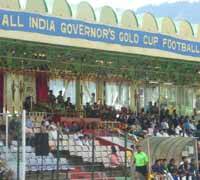
All India Governor's Gold Cup, SikkimAll India Governor's Gold Cup, Sikkim

The northeastern region of India used to be comprised of seven states – Meghalaya, Tripura, Assam, Manipur, Nagaland, Arunachal Pradhesh and Mizoram -  and were often collectively known as the ‘Seven Sisters’.

Sikkim and certain areas of North Bengal were later included in this region and are under the North East Council (NEC), which was formed to develop these areas economically. This region is ethnically different from the rest of India.
India has been fighting terrorism in north east for the last five decades or so. It originated with local people being told, often by foreign forces and Christian missionaries, that they were different to the rest of the country or even that they didn’t belong to India.

At the center of it were the Nagas, who had this philosophy introduced to them way back in the pre-Independence era. The Naga National Council (NNC) declared its war against the Government of India and demanded a separate nation, stating that they had no affinity or relations of any sort with the rest of the country. The primary forces behind this were Rev. Michael Scott, a British missionary and Angami Zapu Phizo, a local.

Some intellectuals in this region continue to support the outdated theories of Naga Nationalism. The law and order situation is absolutely bizarre and even a certain section of people’s salaries goes to the banned fighters for independence.

The Indian army’s success in the 1971 war against Pakistan saw their foes fan the anti-Indian feeling in the north eastern region, which has always been ripe for such thoughts. The north eastern states have a 4500 km long international border with five countries - Bangladesh, Bhutan, Burma (Myanmar), China and Nepal.

Insurgency and an influx of people from across the border has been a major issue to contend with, which saw the setting up of various militant groups. Unemployment, economic backwardness, lack of infrastructure are some of the other problems prevalent in this region.

But in spite of the issues, there’s one thing which brings everyone together – football.

“Football in the north east is what cricket is to the entire Indian subcontinent. When we play our local league games, we easily get crowds of 12,000 or so,” says L. Ming, who owns Shillong Lajong FC, which is the first from the region to make it into the I-League.

Maharaja Pradyot Bikram Kishore Manikya Deb Barman is the King of Tripura, the second oldest dynasty in the world, opines that football provides an opportunity for the people in the north east to escape from their problems. He adds that watching the likes of Bhaichung Bhutia and Renedy Singh play for India increases their pride and makes them forget the feeling of ‘alienation’ which has been injected for long. 

“When we see our players represented in the Indian team, it helps alleviate the nonsense of north east not being part of India which has been propagated by many. The captain of the Indian Olympics team, T.Ao in 1948 was from our region,” said His Highness.

Indian internationals Renedy Singh and Gouramangi Singh state that in Manipur, football is the only source of entertainment, as Bollywood movies are unofficially banned from the local theatres.

“Football is the only way to relax. You have veteran’s football as well and so, it’s not just the youngsters but senior members of the society do take active participation in the sport," says Renedy Singh.

“There’s no electricity for large periods of the day. Every evening, for two hours people come together play and after the game interact for some time, which is the only source of happiness here,” he added.

“Football acts a drug which helps people forget their problems for some time and come together to enjoy. Forget the fear and just enjoy the game. After the day's work, in every part of Manipur you can see people actively participating in football. There’s a strong football culture here,” adds Gouramangi of the state where after fie pm, there are security checks on the road at a distance of 15 minutes’ walk.

Back to Nagaland, the Government of India reached a pact with the NNC for peace in 1975 but some members were dissatisfied with the same and formed the Nationalist Socialist Council of India (NSCI), which again broke into two factions – NSCI (IM) and NSCI (K). The two groups have been involved in a bloody conflict to gain control over the region, which has claimed the lives of thousands.

Last year, the two warring factions came together to play a football match as part of their reconciliation programme to end the fratricidal killings.
It is a fact that people in the northeast have much to grumble about. The militants and insurgent groups are running parallel governments in certain states at the expense of people’s freedom. People in this region don’t associate themselves with mainstream India and are often the subject of racial abuse throughout the nation.

There have been various dialogues between the Central and State governments with the terrorists but nothing has come of it with the banner of “All dialogue-no peace” being apt.

“If the north eastern states are given proper facilities for football, I am sure a lot of problems can be solved. Everyone would then, just play football,” says Tempo Bhutia from Sikkim, who is also the member of the All India Football Federation’s (AIFF) executive committee.   


via Goal.com

MeSEB Incurs Heavy Loss Due to Power theft

electgricty theft Tura, Mar 13 : The Meghalaya State Electricity Board (MeSEB) is running under heavy loss as consumers are indulging in large-scale malpractices, both in rural and urban areas. Without the knowledge of the Board, there has been a mass tapping and increase in power load. This has led to transformers bursting as the intake load capacity increases.

In Garo Hills alone, the situation has become so worse that a huge revenue loss is being incurred by the board. Many cases of overloading and improper service connections are being observed. The board officials are conducting raids and are now giving notice to those defaulters.

In a raid at Dalu, Gasuapara and Chokpot, the department came across many illegal connections. Two coal export industries, namely HNZ Company and JC Company have engaged in heavy power theft. HNZ Company declared connected load of 2.92 KW. However, the actual connected load is 14 KW. JC Company had declared that connected load as 4.53 KW and the actual connected load is 20.26 KW.

The Excise Office located at Barenggapara has been using electricity for years without any connection. The building is owned by Tourism Pvt Ltd and the electricity line is extended from nearby coal export firm JC Company.

Many commercial coal export companies have sprout up in areas like lower Gasuapara and most of them are resorting to illegal use of electricity.

“Most of the consumer don’t inform about increasing the capacity load when they construct a new house or the as the case maybe, which is leading to failure of transformers,” UN Madan, CEO, MeSEB, Garo Hills, said.

Newmai News Network

Mizoram Dances in to The Guinness

10736 dancers set up ‘longest & largest’ record

mizo dancers Mizo dancers perform cheraw at the Assam Rifles ground in Aizawl on Friday.

Aizawl, Mar 13 : Mizoram danced its way into the Guinness World Records this afternoon with a 10-minute performance of its famous bamboo dance, cheraw, featuring 10,736 participants in 671 groups at the Assam Rifles ground and the adjoining 2.5-km-long road in Aizawl.

A dam of ecstasy burst forth as Lucia Sinigaliesi, the adjudicator of Guinness World Records, announced that Mizo dancers had wrested the laurels for orchestrating the “largest and longest dance” event in the world.

The ground was packed with about 12,000 people when she made the announcement and handed over the certificate acknowledging this unprecedented feat to Mizoram art and culture minister, P.C. Zoramsangliana, at 4pm.

Subsequently, people took out a large procession in the state capital, kindling memories of the spontaneous euphoria witnessed on the evening of July 28, 1986, when the historic peace accord was signed between New Delhi and Mizo National front (MNF) supremo Laldenga.

The run-up to the final 10 minutes was equally frenzied. Hundreds of spectators made a beeline for the route from Treasury Square to Chandmari via Zarkawt locality to witness Mizoram’s tryst with destiny.

The large number of bamboo dancers, who had converged from all over the state, danced all along this 2.5km stretch and the Assam Rifles ground, to set up the world record for the “longest” (apart from the “largest”) dance.

By 2pm, when the final dance lasting 10 minutes was over, the state capital’s footpaths and roads turned into an impromptu dance stage.

Chief minister Lalthanhawla thanked the people of Mizoram for toiling hard to set up the record. The government and the state’s population of nine lakh had been praying for a place in the Guinness records. The government had even declared a holiday to enable the people to witness this historic moment.

Adjudicator Sinigaliesi also watched the two rounds of rehearsals from 12 noon and then the finals at 2pm.

Yesterday, the state celebrated the Chapchar Kut festival, which is a curtain raiser to the bamboo dances. It is one the three kuts (festivals) of Mizoram related to agricultural activities and is observed every year to mark the sowing of seeds after the customary burning down of jhum fields.

Lathanhawla was named the Father of the Kut while Zoramsangliana, credited with organising this mass dance, was named the Host of the Kut.

The women participants wore colourful traditional puans (skirts) of the Mizos — crimson and green being the prominent colours — and headgear festooned with colourful beads.

The men wore white puans (a rounded lungi type of apparel) and white and purple shirts.

The women spectators also came dressed in puans. Some youths brought gongs, cymbals and drums that lent a raucous note to the dance.

A few Asian and western tourists also savoured the frenzy surrounding the bamboo dance.

Wenchy Ong, a delegate from the team of the Taipei Economic and Cultural Centre, New Delhi, said he was mesmerised by this robust dance performed on such a wide scale. He said he had not seen anything like this before.

Lalthalmuani, a 19-year-old college student from Aizawl said, “Such devotion of the Mizos to their art and culture, as evidenced in their zeal for the bamboo dance, is remarkable. It helps to bring about oneness among the variegated Mizo tribals.”

The genesis of cheraw can be traced to the reign of Kawlni chiefs in the land of the Mizos in the mid-15th century. This dance celebrates bonhomie and camaraderie among Mizos and symbolises the spirit of excellence, skill, strength and aspiration.

The cheraw dance uses bamboo staves, which are kept on the ground in cross and horizontal formations. Men move these bamboo stilts against each other in rhythmic beats and the women dance in harmony, stepping in and out of the bamboo blocks.

Before Mizoram entered the pages of Guinness, the previous record for the largest dance gathering was held by the Phillippines' Cebu province where about 7,000 people had joined hands to dance together last year.

12 March 2010

'Comic Activists' Take on Climate Disasters

A young 'comic artist' in northeast India works on a cartoon about disaster risk reduction as part of an innovative effort to raise awareness of climate change-related disaster risks.

A young 'comic artist' in northeast India works on a cartoon about disaster risk reduction as part of an innovative effort to raise awareness of climate change-related disaster risks.

By Teresa Rehman

Guwahati, Mar 12 :  Looking for ways to effectively spread awareness about disaster prevention and risk reduction, youthful activists in northeast India have hit on a hot idea - comics.

"Nowadays people do not have the patience to read long narratives. On the other hand, a cartoon with an element of humor can easily attract the attention of the public," said 13-year-old Nilotpal Lakhar, one of group of students in India's Assam province being trained to draw disaster awareness comics.

The young "comic activists" are the brainchild of 'Nayi Dishayein' or 'New Ways' a project of mass communications students at Guahati University that aims to tackle problems in the region, particularly a lack of awareness about disaster management and preparedness, through the medium of comics.

'New Ways' was created as part of World Comics India (WCI) - a collective of artists, media personalities, social activists and grassroots journalists who see comics as a powerful tool to bring about social change.

DRAWING FROM FIRST-HAND EXPERIENCE

The young comic artists have plenty of first-hand material for their work. As climate change takes hold in the region, Lahkar, from Barbhag in lower Assam, has seen the once annual floods in his village turn into unpredictable disasters, with waters sometimes rising six or seven times a year.

His school books were washed away in one severe flood, he remembers. In another, he and his family had to take shelter at a makeshift camp on an embankment. The district is vulnerable to cyclones, hailstorms and floodwaters rushing in from the neighboring mountain nation of Bhutan.

Now, he and other students are drawing comics based on their experiences, their understanding of the changing weather and climatic conditions and their ideas of how communities could gear up to meet these crises.

Hemanga Kaushik Sharma, 13, for instance, recalls his uncle telling of an incident at Bangalmur village where it was decided that anybody who saw a breach in the community river embankment would alert villagers by beating the drums at the community prayer hall or 'naamghar'.

When a breach happened, a villager rushed to the drums, alerting villagers in time to evacuate to higher ground. That night, the embankment gave way and the entire village went underwater.

The new comic artists, trained at a recent workshop, have turned out comics on a wide range of disaster-related issues, from the problems of sanitation and hygiene during floods to the inconveniences women face during disasters.

Studies show women are particularly vulnerable in disaster situations because they often care for young children and the elderly, and tend to be more housebound.

Pradip Mahanta, the programme manager of Gramya Vikash Mancha (GVM), a local NGO working on disaster management and climate change, said his organization had conducted a survey in 40 local schools and asked students what means of communication they found most compelling.

STUDENTS FIND CARTOONS MOST COMPELLING

"Most of the students admitted that they enjoyed cartoon shows on television and comic books the most. We thought it would be ideal to work on the issue of preparedness of climate change adaptability through the refreshing medium of cartoons," he said.

Learning to draw cartoons took a little time. At a workshop, the students introduced themselves by drawing caricatures of each other.

"The participants, very apprehensive in the beginning, enjoyed the exercise once they started doing it. They wonderfully captured each other's prominent features in the drawings they had made," said Usha Dewani, who conducted the workshop.

Gradually, the students were initiated into the different types of disasters - their causes and impacts, how precautions and early warning systems work, and how to reduce risks.

"The participants came up with their personal feelings on how a situation like flooding affects their lives when they have to forego their studies for indefinite time periods. They spoke out on how they get disconnected with their friends or relatives in situations like this," Dewani said.

Then they were asked to weave a story, convert the story script into visuals and create a final artwork. The comics later were taken for field testing in two schools, and were well received, she said.

Locally produced comics, she believes, may prove a particularly apt grassroots means of getting out the message on reducing disaster risks.

"Here, people from the community make comics themselves on their own issues, using local context and flavour. Therefore, the issue is not seen as 'black' or 'white' but rather in its own different shades. So it is a democratic medium which brings out grassroots issues," she said.

**Teresa Rehman is a journalist based in Northeast India. She can be reached at www.teresarehman.net

Villagers in Assam Take Care of an Injured Elephant

elephant injured assam Guwahati, Mar 12 : Villagers of Shattergaon are taking care of a female elephant, which got hurt by a train near Deepor Beel (a freshwater lake) in Guwahati.

A goods train had hit the elephant on February 28, when it was trying to cross a railway track.

The injured elephant, pregnant at that time, then gave birth to a male calf in a nearby forest. But, she abandoned her calf and vanished in the Garbahanga Reserve forest in Kamrup district.

Forest officials then found the newborn calf and took him to the Assam State Zoo.

The mother elephant then reached Shattergaon village, near the Garbhanga Reserve forest and is now being taken care by the villagers.

To save the animal, the villagers are fetching water and banana trees to feed the ailing animal.

"The elephant was hit by a train and reached our village. All the villagers are looking after it, and we are feeding the elephant, so that the elephant gets well," said Diganta Ravam, a villager.

Nanda Narzary, a village schoolteacher, said that despite knowing the elephant's condition, the forest officials are not doing much to save the poor animal.

"The officials come to see the elephant and then go back. They are not bothered with what the elephant needs. This is such a sad situation. The elephant needs a quintal of food in a day but they bring only a kilogram of food for her. Moreover, the animal needs tons of water. How can a litre or two of water help the poor elephant?" asked Narzary.

Despite facing a lot of problems from elephants, which often raid their fields, the villagers of Shattergaon are putting all their efforts to save the animal.

The train had hit another female elephant on February 28, which had died on the spot.